Listen to this Post
Introduction:
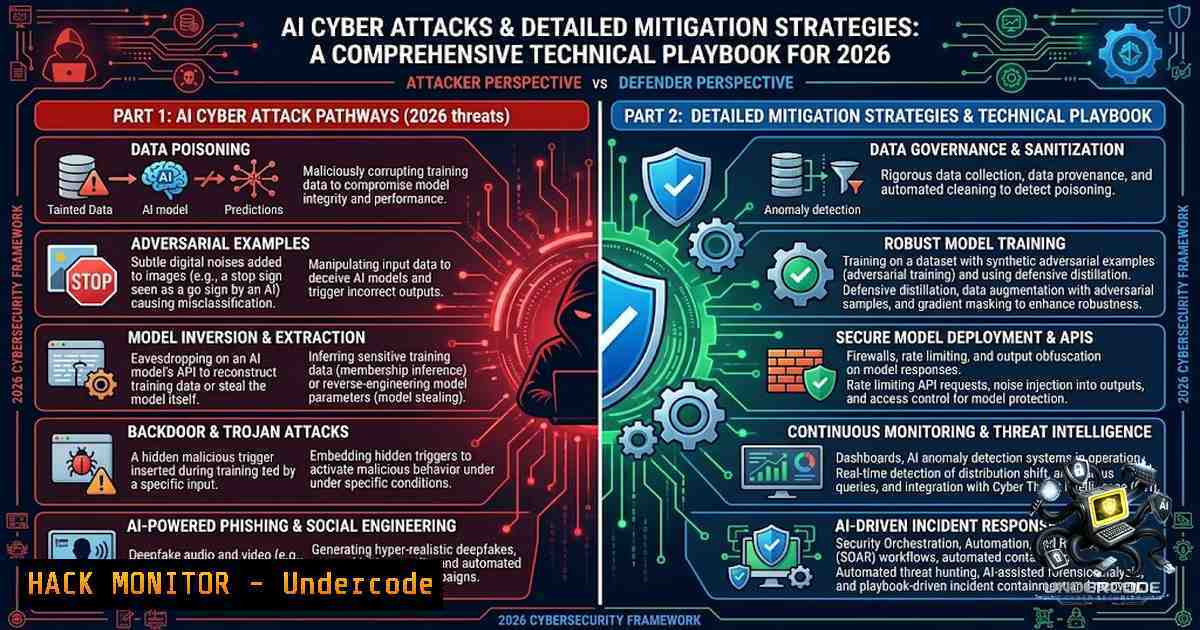
The cybersecurity landscape has undergone a paradigm shift. As artificial intelligence (AI) accelerates the digital transformation of enterprises, it simultaneously equips adversaries with unprecedented capabilities. AI-powered attacks are no longer theoretical—they are actively compromising organizations through hyper-personalized phishing, adaptive malware that evolves to evade detection, and sophisticated prompt injections targeting large language models (LLMs). This article provides a detailed, technical playbook for security professionals, covering the full spectrum of AI-driven threats and delivering actionable mitigation strategies, verified commands, and configuration guides to fortify your defenses.
Learning Objectives:
- Understand the taxonomy of AI-powered cyberattacks, including adversarial ML, prompt injection, and AI-generated malware.
- Master the implementation of defense-in-depth strategies, from zero-trust architecture to AI-specific guardrails.
- Acquire hands-on skills using Linux/Windows commands, open-source tools, and cloud-hardening techniques to detect, contain, and remediate AI-driven threats.
- Understanding the AI Attack Surface: A Technical Taxonomy
AI systems introduce a new attack surface that extends far beyond traditional IT vulnerabilities. Adversaries exploit the entire machine learning lifecycle—from data collection and model training to deployment and inference.
Key Attack Vectors:
- Adversarial Machine Learning (AML): Attacks such as evasion (subtle input manipulations that cause misclassification), poisoning (corrupting training data to compromise model integrity), and extraction (stealing model parameters through repeated queries).
- Prompt Injection: Direct injections (malicious commands in user prompts) and indirect prompt injections (hidden instructions within external data like emails or documents that instruct the AI to exfiltrate data).
- AI-Generated Malware: Threat actors use generative AI to create polymorphic malware that continuously alters its structure to bypass signature-based detection.
- Supply Chain Attacks: Poisoned pre-trained models, malicious third-party libraries, and compromised datasets distributed via repositories like Hugging Face.
Mitigation Strategy: Adopt a zero-trust architecture with continuous verification and least-privilege access. Implement robust input validation and sanitization for all data ingested by AI systems.
2. Defending Against Prompt Injection and LLM Manipulation
Prompt injection is one of the most critical risks facing LLM-powered applications, ranked highly in the OWASP Top 10 for LLM Applications. Attackers can manipulate LLMs to disclose sensitive information, execute unauthorized actions, or spread misinformation.
Step-by-Step Guide to Mitigate Prompt Injection:
1. Deploy Layered Input Validation:
- Implement semantic filters and context-aware sanitization to detect and neutralize malicious instructions before they reach the model.
- Use dedicated ML-based content classifiers to filter harmful data from user queries and external sources.
2. Enforce Strict Output Encoding and Confirmation:
- Sanitize all model outputs, particularly markdown and URLs, to prevent cross-site scripting and other injection attacks.
- Implement a user confirmation framework for high-risk actions (e.g., financial transactions, system changes) to provide a human-in-the-loop check.
3. Conduct AI Red Teaming:
- Regularly test your models against adversarial inputs using techniques like “security thought reinforcement” and adversarial training.
- Utilize tools like the OWASP GenAI Security Project’s Threat Defense COMPASS to evaluate your AI threat resilience.
Commands & Tools:
- Linux (Log Analysis for Suspicious Prompts):
Monitor API logs for anomalous prompt patterns (e.g., unusually long inputs) tail -f /var/log/nginx/access.log | grep -E "POST /api/chat" | awk '{print $NF}' | sort | uniq -c | sort -1r - Windows (PowerShell – Monitor for Unauthorized AI Tool Usage):
Check for unauthorized AI tool installations or executions
Get-WinEvent -LogName Security | Where-Object { $<em>.Message -match "AI" -or $</em>.Message -match "LLM" } | Select-Object TimeCreated, Message
- Hardening the AI Supply Chain: Detecting and Preventing Model Poisoning
The AI supply chain is a prime target for attackers. Poisoned models and datasets can introduce backdoors, cause systematic misclassifications, or leak sensitive data.
Step-by-Step Guide to Supply Chain Security:
1. Implement Provenance and Verification:
- Generate and verify tamper-proof provenance (e.g., using SLSA framework adapted for AI) to confirm the identity and authenticity of model producers.
- Generate an AI Software Bill of Materials (AI-BOM) to track all dependencies, datasets, and models.
2. Sanitize Training Data and Inputs:
- Sanitize all publicly available datasets before use to reduce poisoning risk.
- Implement strict Role-Based Access Control (RBAC) for data ingestion pipelines and isolate inference layers.
3. Secure Model Repositories:
- Disable `trust_remote_code` by default in Hugging Face and similar repositories. Only enable it for a pinned allowlist of verified publishers.
- Run all model loads (especially pickle files) inside a strict sandbox with no network or filesystem access.
Commands & Tools:
- Linux (Verify Model Checksum):
Verify the integrity of a downloaded model file
sha256sum /path/to/model.bin
Compare against the official checksum from the vendor
- Windows (Check for Suspicious Files in Model Directory):
Find recently added or modified files in the model directory
Get-ChildItem -Path "C:\Models\" -Recurse | Where-Object { $_.LastWriteTime -gt (Get-Date).AddDays(-1) }
4. Combating AI-Enhanced Social Engineering and Phishing
Generative AI has transformed social engineering. Attackers now craft hyper-personalized phishing emails, create deepfake audio and video, and automate spear-phishing campaigns with unprecedented scale and accuracy.
Step-by-Step Guide to Mitigation:
1. Implement Non-Phishable Credentials:
- Move aggressively to passwordless, phishing-resistant authentication methods (e.g., FIDO2 security keys).
2. Deploy Behavioral Analytics:
- Use AI-driven tools to establish behavioral baselines for users and detect anomalies in communication patterns and access requests.
- Require out-of-band verification for all high-risk requests (e.g., vendor bank changes, CEO “urgent” approvals).
3. Conduct Regular Security Awareness Training:
- Educate employees on the risks of AI-powered social engineering, including deepfakes and vishing.
Commands & Tools:
- Linux (Analyze Email Headers for Phishing Indicators):
Extract and analyze email headers for spoofing
cat suspicious_email.eml | grep -E "^From:|^Reply-To:|^Return-Path:"
- Windows (PowerShell – Check for Suspicious Login Attempts):
Review Azure AD sign-in logs for anomalous activity
Get-AzureADAuditSignInLogs -All $true | Where-Object { $_.RiskLevel -eq "high" }
- Deploying AI-Powered Defenses: Using AI to Fight AI
Organizations must leverage AI to counter AI-driven threats. AI-enhanced security tools provide real-time threat detection, automated incident response, and predictive analytics.
Step-by-Step Guide to Deploying AI Defenses:
1. Adopt AI-Enhanced EDR and XDR:
- Deploy endpoint detection and response (EDR) and extended detection and response (XDR) solutions that utilize behavioral analytics and machine learning to detect zero-day and polymorphic malware.
2. Implement Automated SOAR Playbooks:
- Use Security Orchestration, Automation, and Response (SOAR) platforms to automate incident response workflows, reducing mean time to detect (MTTD) and respond (MTTR).
3. Utilize Predictive Analytics:
- Apply AI-based techniques for predictive threat forecasting and risk scoring to proactively identify and patch vulnerabilities before they are exploited.
Commands & Tools:
- Linux (Using `s0-cli` for Security Scanning):
Install s0-cli (Security-Zero) for automated vulnerability scanning
curl -fsSL https://raw.githubusercontent.com/antonellof/s0-cli/main/install.sh | bash
s0-cli scan --target 192.168.1.0/24
- Windows (Using SecuSploitX – AI-Powered Toolkit):
Clone and run SecuSploitX for penetration testing (authorized use only)
git clone https://github.com/Largo-m/SecuSploitX.git
cd SecuSploitX
python3 -m venv venv && source venv/bin/activate  Linux/macOS
.\venv\Scripts\activate  Windows
pip install -r requirements.txt
python3 secusploitx.py --cli
Note: SecuSploitX is an open-source, AI-powered toolkit for authorized security testing.
6. Securing Cloud Infrastructure for AI Workloads
AI workloads often run in the cloud, introducing unique security challenges including misconfigured storage, exposed APIs, and insecure model endpoints.
Step-by-Step Guide to Cloud Hardening:
1. Harden API Endpoints:
- Implement strong authentication (OAuth 2.0, API keys) and rate limiting for all AI model APIs.
- Regularly audit and route all SaaS integrations through a central identity provider (IdP).
2. Encrypt Data at Rest and in Transit:
- Ensure all training data, models, and inference results are encrypted using strong cryptographic standards.
3. Monitor and Reduce Exposure:
- Continuously monitor cloud environments for misconfigurations and exposed storage buckets.
- Implement extended log retention policies (beyond 90 days) for comprehensive forensic analysis.
Commands & Tools:
- Linux (Check for Open S3 Buckets using AWS CLI):
aws s3api list-buckets --query "Buckets[].Name" --output table
aws s3api get-bucket-acl --bucket <bucket-1ame> --query "Grants[?Grantee.URI=='http://acs.amazonaws.com/groups/global/AllUsers']"
- Windows (Azure CLI – Check for Publicly Accessible Blob Containers):
az storage container list --account-1ame <storage-account> --query "[?properties.publicAccess!='None']"
What Undercode Say:
- Key Takeaway 1: The battle against AI-powered threats is asymmetric. Defenders must adopt a proactive, defense-in-depth strategy that combines AI-driven defense tools, zero-trust architecture, and continuous security validation.
- Key Takeaway 2: Human oversight remains critical. While AI automates threat detection and response, security teams must maintain control through regular red teaming, staff training, and robust incident response plans.
Analysis: The integration of AI into both offensive and defensive cybersecurity is inevitable. Organizations that fail to adapt will be overwhelmed by the speed and sophistication of AI-driven attacks. However, by embracing AI-enhanced security tools, hardening the AI supply chain, and implementing rigorous access controls, enterprises can turn the tide. The key lies in continuous education, proactive threat hunting, and a commitment to security fundamentals. The threat landscape is evolving rapidly, but a well-prepared security team armed with the right tools and knowledge can effectively mitigate these emerging risks.
Prediction:
- +1: The widespread adoption of AI-driven defense mechanisms will lead to a significant reduction in MTTD and MTTR, potentially lowering the average cost of a data breach by 20-30% by 2028.
- +1: Standardization of AI security frameworks (e.g., OWASP, NIST, MITRE ATLAS) will improve cross-organizational collaboration and threat intelligence sharing, creating a more resilient global cybersecurity ecosystem.
- -1: The commoditization of AI-powered hacking tools on the dark web will lower the barrier to entry for cybercriminals, leading to a surge in attacks from less-skilled threat actors.
- -1: As AI models become more autonomous and interconnected (Agentic AI), the potential for cascading failures and unintended consequences will increase, requiring new governance models and real-time intent controls.
- -1: The opacity of AI models and their supply chains will remain a significant challenge, making it difficult for organizations to fully vet the security and integrity of the AI systems they deploy.
▶️ Related Video (82% Match):
🎯Let’s Practice For Free:
🎓 Live Courses & Certifications:
Join Undercode Academy for Verified Certifications
🚀 Request a Custom Project:
Secure, high-velocity infrastructure and disruptive technological engineering. Contact our engineering team for high-tier development and proprietary systems:
[email protected]
💎 Smart Architecture | 🛡️ Secure by Design | ⭐ Trusted by Thousands
IT/Security Reporter URL:
Reported By: Https: – Hackers Feeds
Extra Hub: Undercode MoN
Basic Verification: Pass ✅


