Listen to this Post
Introduction:
In an era where cyberattacks are not a matter of “if” but “when,” the traditional perimeter-based defense paradigm has become obsolete. Cyber resilience transcends mere prevention; it embodies an organization’s capacity to Detect, Respond, Recover, and Continuously Improve before a security incident metastasizes into a business-disrupting catastrophe. As Mahmoud Hamwi aptly articulates, “If you don’t truly understand it, you can’t manage it, secure it, or extract its full business value.” This principle forms the cornerstone of modern cybersecurity strategy, where understanding the attack surface, correlating disparate signals, and orchestrating a unified response are paramount. The CyberMeshX (CMX) platform by LinkShadow exemplifies this paradigm shift, moving from fragmented security tools to a synchronized, AI-driven defense fabric that unifies network, identity, and data security into a single adaptive framework.
Learning Objectives:
- Understand the five critical pillars of cyber resilience: Identify, Close Gaps, Detect, Respond, and Validate.
- Learn how AI-driven correlation and Zero Trust enforcement can unify visibility across hybrid and multi-cloud environments.
- Acquire practical knowledge on implementing orchestrated response actions and continuous threat validation.
You Should Know:
- The Five Pillars of Cyber Resilience: A Technical Deep Dive
The journey from vulnerability to resilience is structured around five critical areas that form a continuous lifecycle. These pillars are not merely theoretical constructs but are deeply technical and operationally rigorous.
Identify & Prioritize: This foundational step involves mapping and understanding your critical assets, identities, data, applications, and business services. Without a comprehensive asset inventory, prioritization is impossible.
Close Security Gaps: This entails identifying and remediating vulnerabilities, misconfigurations, exposed identities, and visibility gaps. It’s about proactively shrinking the attack surface before adversaries can exploit it.
Detect Faster: This involves centralizing security telemetry and leveraging AI-driven threat detection and hunting to reduce the time between compromise and discovery (dwell time).
Respond & Contain: Orchestrating and automating response actions across endpoints, networks, identities, and cloud environments to contain threats before they escalate.
Validate & Continuously Improve: Testing resilience through continuous assessments, threat simulations, and lessons learned, turning every incident into an opportunity for strengthening defenses.
Step-by-Step Guide: Implementing a Continuous Validation Loop
To operationalize the “Validate & Continuously Improve” pillar, security teams can implement a continuous validation loop using open-source tools:
- Conduct Automated Vulnerability Scans: Use tools like `Nmap` and `OpenVAS` to regularly scan your network.
Linux: Perform a fast scan on a subnet
nmap -sn 192.168.1.0/24
Linux: Launch a vulnerability scan with OpenVAS
sudo openvas-cli --target 192.168.1.10 --scan
-
Simulate Attacks with Breach and Attack Simulation (BAS): Use frameworks like `Caldera` or `Metasploit` to simulate adversary techniques.
Linux: Start Metasploit console
msfconsole
Within msfconsole: Use an exploit module
use exploit/windows/smb/ms17_010_eternalblue
-
Harden Configurations Using CIS Benchmarks: Apply CIS (Center for Internet Security) benchmarks to your systems. For a Windows Server, this can be automated using PowerShell:
Windows PowerShell: Install and run a CIS benchmark script (example)
Install-Module -1ame PowerStig -Force
Invoke-Stig -OsVersion 2019 -StigVersion 2.1
-
Analyze and Improve: After each simulation, conduct a post-incident review (PIR). Document lessons learned and update your playbooks and detection rules accordingly.
-
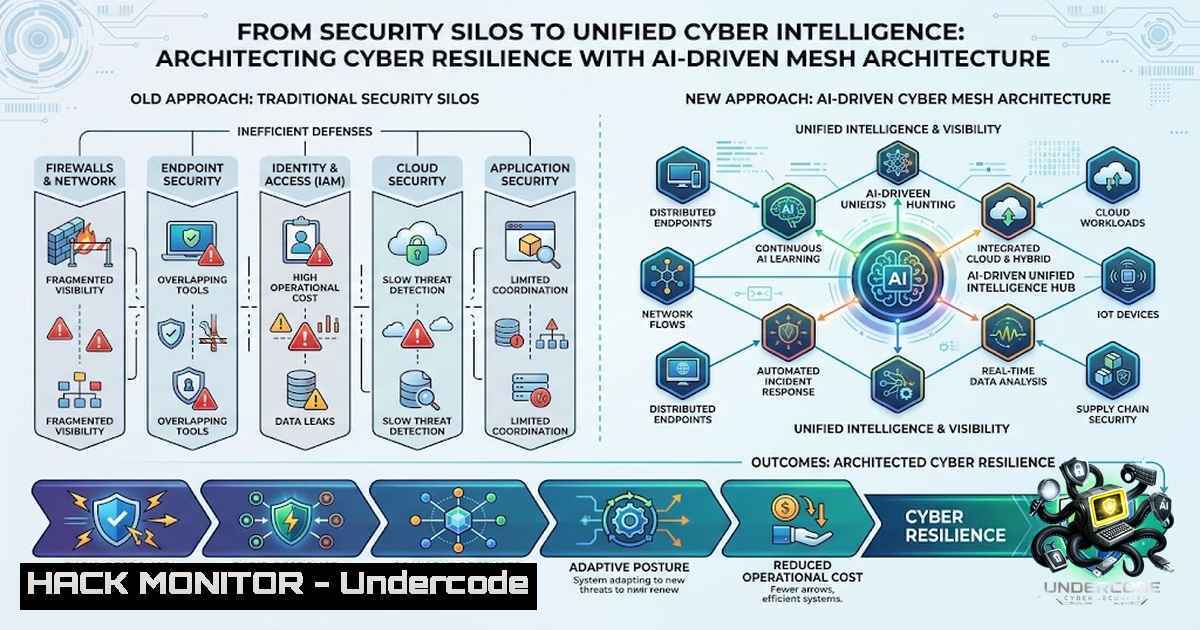
Unified Visibility: Breaking Down Silos with a Cyber Mesh Architecture
Traditional security architectures are plagued by silos—SIEM, SOAR, NDR, and EDR tools that operate in isolation, generating overwhelming alert fatigue and obscuring the true attack narrative. The CyberMeshX platform addresses this by providing a unified, single-pane dashboard that delivers deep insights across data, identity, and network layers. This is achieved through an AI-driven correlation engine that transforms fragmented signals into a cohesive, actionable threat narrative.
Step-by-Step Guide: Correlating Logs from Disparate Sources
While a platform like CMX automates this, understanding the underlying principles is crucial. Here’s a basic approach to correlating logs using the Elastic Stack (ELK) on Linux:
1. Install and Configure Elasticsearch, Logstash, and Kibana:
 Linux: Install Elasticsearch
wget -qO - https://artifacts.elastic.co/GPG-KEY-elasticsearch | sudo apt-key add -
sudo apt-get install apt-transport-https
echo "deb https://artifacts.elastic.co/packages/7.x/apt stable main" | sudo tee /etc/apt/sources.list.d/elastic-7.x.list
sudo apt-get update && sudo apt-get install elasticsearch
- Configure Logstash to Ingest and Parse Logs: Create a configuration file (
/etc/logstash/conf.d/network-logs.conf) to parse firewall and IDS logs.input { beats { port => 5044 } tcp { port => 5000 } } filter { grok { match => { "message" => "%{COMBINEDAPACHELOG}" } } date { match => [ "timestamp", "dd/MMM/yyyy:HH:mm:ss Z" ] } } output { elasticsearch { hosts => ["localhost:9200"] } stdout { codec => rubydebug } } -
Create Correlation Rules in Kibana: Use Kibana’s Canvas or Timelion to create visualizations that detect anomalies, such as a single source IP accessing multiple sensitive databases in a short timeframe.
3. AI-Driven Threat Detection and Automated Response
The volume and velocity of modern cyber threats render manual analysis obsolete. AI and machine learning are now essential for reducing alert fatigue, prioritizing risks, and accelerating investigations. Platforms like CMX leverage behavioral analytics, predictive AI/ML intelligence, and Large Language Models (LLMs) to move beyond rule-based correlation to proactive defense. This allows for the automated triage of low-level alerts (L1 investigations) and the intelligent enrichment of cases, enabling human analysts to focus on sophisticated, high-priority threats.
Step-by-Step Guide: Implementing Basic Automated Response with SOAR
For organizations without a full-fledged SOAR, basic automation can be achieved using scripting and APIs. This example demonstrates a script that fetches alerts from a SIEM (using its API) and triggers an automated response on an endpoint.
1. Python Script for Alert Triage and Response:
import requests
import json

Configuration
SIEM_URL = "https://your-siem-api.com/alerts"
EDR_URL = "https://your-edr-api.com/endpoints/isolate"
API_KEY = "your_api_key_here"

Fetch high-severity alerts
headers = {"Authorization": f"Bearer {API_KEY}"}
response = requests.get(SIEM_URL, params={"severity": "high"}, headers=headers)
alerts = response.json()

for alert in alerts:
if alert['type'] == 'Malware_Detection':
endpoint_id = alert['endpoint_id']
 Automate isolation of the infected endpoint
payload = json.dumps({"endpoint_id": endpoint_id, "action": "isolate"})
edr_response = requests.post(EDR_URL, headers=headers, data=payload)
print(f"Isolated endpoint {endpoint_id}. Response: {edr_response.status_code}")
- Schedule the Script: Use `cron` (Linux) or Task Scheduler (Windows) to run this script at regular intervals, providing a primitive but effective automation layer.
4. Zero Trust Enforcement Across Hybrid Environments
The Zero Trust model, encapsulated by the principle “never trust, always verify,” is a critical component of modern cyber resilience. It requires strict identity verification for every user and device attempting to access resources, regardless of their location. This involves micro-segmentation, least-privilege access, and continuous monitoring. The NIST Special Publication 800-207 provides a comprehensive framework for implementing Zero Trust Architecture (ZTA).
Step-by-Step Guide: Implementing Micro-Segmentation with Linux iptables
Micro-segmentation limits lateral movement by restricting traffic between workloads. Here’s how to implement basic micro-segmentation on a Linux server using iptables:
- Define Trusted Subnets: Identify which subnets or IP addresses should have access to the server.
2. Apply Default Deny Policies:
 Linux: Set default policies to DROP
sudo iptables -P INPUT DROP
sudo iptables -P FORWARD DROP
sudo iptables -P OUTPUT ACCEPT
3. Allow Established Connections:
 Linux: Allow established connections
sudo iptables -A INPUT -m state --state ESTABLISHED,RELATED -j ACCEPT
4. Allow Specific Services from Trusted Subnets:
 Linux: Allow SSH only from the management subnet (e.g., 10.0.0.0/24)
sudo iptables -A INPUT -p tcp -s 10.0.0.0/24 --dport 22 -m state --state NEW -j ACCEPT
 Linux: Allow HTTPS from the web subnet (e.g., 192.168.1.0/24)
sudo iptables -A INPUT -p tcp -s 192.168.1.0/24 --dport 443 -m state --state NEW -j ACCEPT
5. Save the Rules: Ensure the rules persist across reboots.
 Linux: Save iptables rules (Debian/Ubuntu)
sudo apt-get install iptables-persistent
sudo netfilter-persistent save
5. Securing the Cloud: DSPM and ITDR
As organizations migrate to the cloud, securing data and identities becomes paramount. Data Security Posture Management (DSPM) focuses on discovering, classifying, and protecting sensitive data across hybrid and multi-cloud environments. Identity Threat Detection and Response (ITDR) is crucial for mitigating identity compromise, privilege abuse, and insider threats.
Step-by-Step Guide: Auditing Cloud Identity Permissions
Over-privileged identities are a primary attack vector. Here’s how to audit IAM roles in AWS using the AWS CLI:
1. List All IAM Users:
 Linux/Windows: List all IAM users
aws iam list-users
2. Check for Unused Credentials: Identify and deactivate unused access keys.
 Linux/Windows: List access keys for a specific user
aws iam list-access-keys --user-1ame <username>
3. Review Attached Policies: List the policies attached to each user or role to ensure least privilege.
 Linux/Windows: List attached policies for a user
aws iam list-attached-user-policies --user-1ame <username>
4. Use IAM Access Analyzer: Generate findings for any policies that grant public or cross-account access.
 Linux/Windows: Validate a policy
aws iam validate-policy --policy-document file://policy.json
What Undercode Say:
- Key Takeaway 1: Cyber resilience is not a technology project; it is a fundamental business capability. The goal is not to stop every fire but to know where the fire is, contain it before it spreads, and keep the business running.
- Key Takeaway 2: The shift from fragmented security silos to a unified, AI-driven mesh architecture is not just an upgrade—it’s a necessity. Platforms like CyberMeshX (CMX) exemplify this by integrating NDR, DSPM, and ITDR into a single, adaptive framework.
Analysis: The insights from Mahmoud Hamwi and the technical capabilities of the CyberMeshX platform highlight a crucial evolution in cybersecurity thinking. The move from a prevention-centric to a resilience-centric model acknowledges the inevitability of breaches. The emphasis on “systemized auditing” through AI and Zero Trust technology is particularly significant. It shifts the burden from human-centric, error-prone processes to automated, continuous validation. The five pillars—Identify, Close Gaps, Detect, Respond, and Validate—provide a structured, actionable framework that aligns perfectly with the NIST Cybersecurity Framework (CSF) 2.0. This is not merely about acquiring new tools but about transforming security operations into a proactive, intelligence-led function.
Prediction:
- +1 The integration of AI and machine learning into security operations will continue to accelerate, with platforms like CMX leading the charge. This will lead to a significant reduction in mean time to detect (MTTD) and mean time to respond (MTTR), making security teams exponentially more effective.
- +1 The adoption of Cybersecurity Mesh Architecture (CSMA) will become a standard best practice, enabling organizations to compose a flexible and resilient security fabric from a diverse set of best-of-breed solutions.
- -1 As AI-driven defenses become more sophisticated, adversaries will increasingly leverage AI to craft more evasive and targeted attacks, leading to an AI arms race in the cybersecurity domain.
- +1 The focus on unifying identity, data, and network security will drive greater collaboration between IT and security teams, breaking down organizational silos and fostering a more holistic approach to risk management.
- -1 Organizations that fail to adopt a resilience-focused, AI-augmented strategy will find themselves increasingly vulnerable to sophisticated, multi-stage attacks that can cause irreversible business disruption and reputational damage. The gap between resilient and fragile organizations will widen significantly.
▶️ Related Video (80% Match):
🎯Let’s Practice For Free:
🎓 Live Courses & Certifications:
Join Undercode Academy for Verified Certifications
🚀 Request a Custom Project:
Secure, high-velocity infrastructure and disruptive technological engineering. Contact our engineering team for high-tier development and proprietary systems:
[email protected]
💎 Smart Architecture | 🛡️ Secure by Design | ⭐ Trusted by Thousands
IT/Security Reporter URL:
Reported By: Mahmoud Hamwi – Hackers Feeds
Extra Hub: Undercode MoN
Basic Verification: Pass ✅


