
Listen to this Post
Introduction:
Graph databases have emerged as a critical component in modern data architectures, powering applications from social networks to fraud detection systems. However, selecting the right graph database for a given workload remains a formidable challenge, as vendor benchmarks often lack transparency and reproducibility. A recent hands-on benchmarking project using the SNAP Epinions social-1etwork dataset—comprising 50,256 nodes and 200,000 relationships—provides a practical framework for evaluating graph database performance across traversal, lookup, aggregation, and ingestion workloads. This article dissects the methodology, findings, and actionable insights from this reproducible benchmark, offering a roadmap for engineers and architects navigating the graph database landscape.
Learning Objectives & Secrets:
- Objective 1: Design a Reproducible Benchmarking Pipeline – Learn to structure a benchmark that enforces same data, same logical workloads, fair resource allocation, repeated measurements, and p50/p95 latency analysis to yield meaningful, comparable results.
- Objective 2 Secret Tip: Prioritize p95 Over Averages – While mean latency provides a baseline, p95 latency reveals tail latency behavior critical for production systems. In this benchmark, Memgraph’s p95 for 3-hop traversals was 291.565 ms versus Neo4j’s 416.608 ms—a difference that can dramatically impact user experience under load.
- Objective 3 Secret Tip: Document Failed Runs Transparently – The benchmark’s most valuable lesson was not which database won, but the integrity of documenting incomplete runs. CognoDB’s loading experiment reported 251.203 seconds but could not be verified, and FalkorDB’s relationship ingestion timed out. Publishing these failures builds trust and prevents misleading conclusions.
You Should Know:
1. Benchmark Architecture and Workload Definition
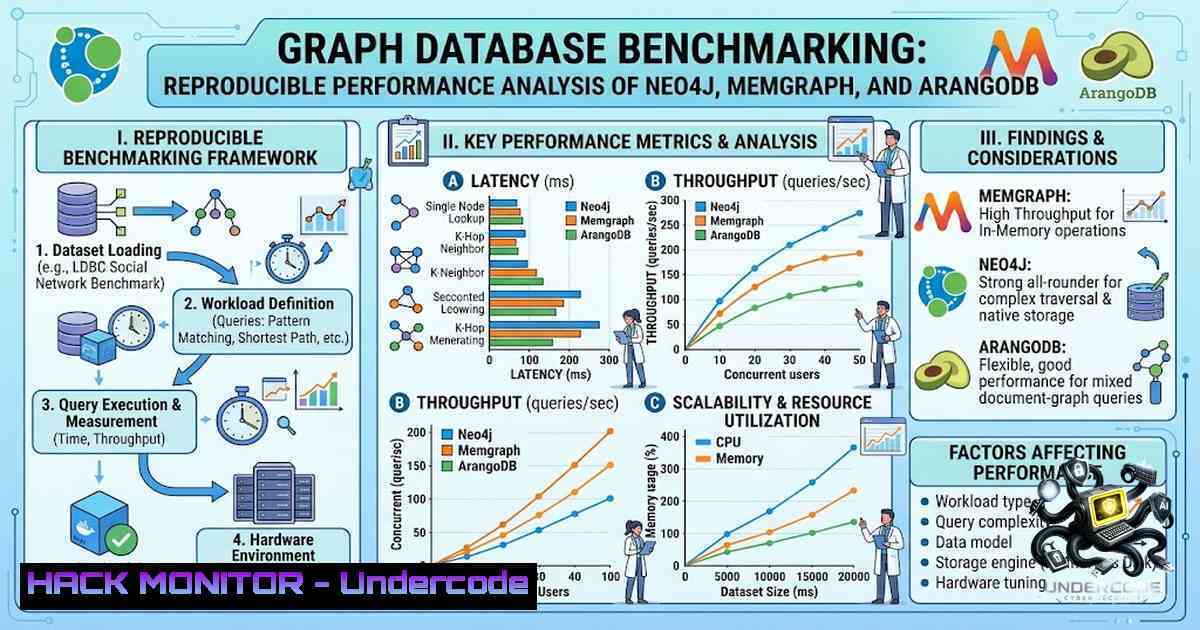
The benchmark pipeline follows a rigorous seven-step workflow: dataset preparation → database loading → data verification → graph query benchmarks → latency measurement → JSON results → comparison tables and charts. Each database receives the same prepared dataset—the SNAP Epinions social network, modeled as (:Person)-[:FOLLOWS]->(:Person)—and executes five logical workloads:
- 1-Hop Traversal: Find immediate outgoing neighbors of a person.
- 2-Hop Traversal: Traverse two relationships.
- 3-Hop Traversal: Traverse three relationships.
- Point Lookup: Find a person by identifier.
- Aggregation: Calculate relationship counts and identify high-degree nodes.
For each query workload, the benchmark executes 10 warm-up runs followed by 100 measured runs, using `time.perf_counter()` at the Python client for precision.
Step‑by‑Step Guide to Replicating the Benchmark:
 1. Clone the repository
git clone https://github.com/udayasri-pagilla/wexa-cognodb-benchmark.git
cd wexa-cognodb-benchmark

<ol>
<li>Install dependencies
pip install -r requirements.txt</p></li>
<li><p>Prepare the dataset (generates benchmark_edges.csv in data/)
python src/prepare_dataset.py</p></li>
<li><p>For each database, run: test → load → verify → benchmark
Neo4j example:
python src/test_neo4j.py
python src/load_neo4j.py
python src/verify_neo4j.py
python src/benchmark1.py

Memgraph example:
python src/test_memgraph.py
python src/load_memgraph.py
python src/verify_memgraph.py
python src/benchmark_memgraph.py

ArangoDB example:
python src/test_arangodb.py
python src/load_arangodb.py
python src/verify_arangodb.py
python src/benchmark_arangodb.py
2. Data Ingestion Performance and Optimization
Ingestion throughput is a critical operational metric, particularly for migration, ETL pipelines, and real-time data ingestion. Among the databases that successfully loaded the complete 50,256-1ode, 200,000-relationship dataset, Memgraph achieved the highest observed relationship-ingestion throughput at 19,969 relationships per second, completing the load in 10.015 seconds. ArangoDB followed at 17,053.87 relationships/sec (11.728 seconds), and Neo4j at 15,266.22 relationships/sec (13.101 seconds).
For optimizing ingestion in production environments, consider these techniques:
Linux Performance Tuning for Database Ingestion:
 Increase file descriptor limits
ulimit -1 65535

Monitor disk I/O during ingestion
iostat -x 1

Check memory pressure
vmstat 1
Docker Resource Allocation (when running databases in containers):
docker run --memory=8g --cpus=4 --1ame memgraph -p 7687:7687 memgraph/memgraph
Connection Pooling Configuration (Python client example):
from neo4j import GraphDatabase
driver = GraphDatabase.driver(
"bolt://localhost:7687",
auth=("neo4j", "password"),
max_connection_pool_size=50,
connection_acquisition_timeout=60
)
3. Query Performance Analysis: p50 and p95 Latency
The benchmark’s query performance results reveal distinct strengths across databases:
| Workload | Neo4j (p50) | ArangoDB (p50) | Memgraph (p50) |
|||||
| 1-Hop Traversal | 17.882 ms | 46.815 ms | 3.107 ms |
| 2-Hop Traversal | 39.925 ms | 54.125 ms | 20.499 ms |
| 3-Hop Traversal | 211.336 ms | 258.159 ms | 148.441 ms |
| Point Lookup | 4.258 ms | 55.382 ms | 1.264 ms |
| Aggregation | 81.569 ms | 99.555 ms | 90.947 ms |
Memgraph demonstrated the lowest p50 latency for all traversal workloads and point lookups, while Neo4j excelled in aggregation queries. ArangoDB showed competitive traversal performance, with its 2-hop p95 (78.623 ms) outperforming Neo4j’s (105.537 ms) in this benchmark run.
Cypher Query Equivalents for Workload Replication:
Neo4j/Memgraph (Cypher):
// 1-Hop Traversal
MATCH (p:Person {id: $start_id})-[:FOLLOWS]->(neighbor:Person)
RETURN neighbor.id

// 2-Hop Traversal
MATCH (p:Person {id: $start_id})-[:FOLLOWS2]->(neighbor:Person)
RETURN neighbor.id

// Aggregation
MATCH (p:Person)-[:FOLLOWS]->(followed:Person)
RETURN p.id, COUNT(followed) AS follow_count
ORDER BY follow_count DESC LIMIT 10
ArangoDB (AQL):
// 1-Hop Traversal
FOR v IN 1..1 OUTBOUND @start_id FOLLOWS
RETURN v._id

// Aggregation
FOR p IN Person
LET followCount = LENGTH(p.outbound_FOLLOWS)
SORT followCount DESC
LIMIT 10
RETURN {id: p._id, followCount: followCount}
4. Benchmark Methodology and Statistical Rigor
The benchmark emphasizes statistical rigor through repeated measurements and percentile analysis. Each workload executes 100 measured runs across 100 start nodes, capturing p50 (median), p95, mean, minimum, and maximum latencies. The p50 provides a stable central tendency measure, while p95 exposes tail latency—critical for SLA monitoring and capacity planning.
For production-grade benchmarking, extend this methodology with:
Automated Statistical Analysis (Python snippet):
import numpy as np

def compute_percentiles(latencies):
return {
'p50': np.percentile(latencies, 50),
'p95': np.percentile(latencies, 95),
'p99': np.percentile(latencies, 99),
'mean': np.mean(latencies),
'std': np.std(latencies)
}
Grafana/Prometheus Integration for Real-Time Monitoring:
 prometheus.yml - scraping database metrics
scrape_configs:
- job_name: 'neo4j'
static_configs:
- targets: ['localhost:2004']
- job_name: 'memgraph'
static_configs:
- targets: ['localhost:9091']
5. Security Best Practices for Benchmark Environments
Database credentials must never be committed to version control. The benchmark project correctly excludes `.env` files through `.gitignore` and stores sensitive configuration using environment variables.
Secure Credential Management:
 .env file (excluded from Git)
NEO4J_URI="bolt://localhost:7687"
NEO4J_USER="benchmark_user"
NEO4J_PASSWORD="secure_password_here"
MEMGRAPH_URI="bolt://localhost:7687"
MEMGRAPH_PASSWORD="secure_password_here"
Loading Environment Variables in Python:
import os
from dotenv import load_dotenv

load_dotenv()
uri = os.getenv("NEO4J_URI")
user = os.getenv("NEO4J_USER")
password = os.getenv("NEO4J_PASSWORD")
Docker Security Hardening for Database Containers:
 Run with least privilege
docker run --read-only --tmpfs /var/lib/neo4j/data \
-e NEO4J_AUTH=neo4j/secure_password \
neo4j:latest

Network isolation
docker network create --internal benchmark-1et
6. Limitations and Future Work
The benchmark transparently documents several limitations:
- CognoDB’s full dataset could not be reliably verified after loading.
- FalkorDB relationship ingestion timed out with
redis.exceptions.TimeoutError. - Indexed/filtered lookups and concurrent read/write throughput are not yet included.
- Resource-level details (CPU, RAM, Docker limits, database configurations) require more rigorous documentation for stronger comparisons.
Expanding the Benchmark:
 For concurrent workload testing (using Locust)
locust -f concurrency_test.py --host=http://localhost:7474

For resource monitoring during benchmarks
docker stats --1o-stream $(docker ps -q)
What Undercode Say:
- Key Takeaway 1: Reproducibility Trumps Rankings – The benchmark’s greatest contribution is not declaring a winner but establishing a transparent, reproducible framework. Publishing both successes and failures (CognoDB’s unverified load, FalkorDB’s timeout) builds credibility and helps the community avoid hidden pitfalls.
- Key Takeaway 2: Workload Matters More Than the Database – Memgraph excelled at traversals and point lookups, while Neo4j dominated aggregations. No single database is universally superior; the optimal choice depends on your specific query patterns and access patterns.
- Key Takeaway 3: Tail Latency Is the True Production Metric – p50 latency tells a story, but p95 reveals the reality of production performance under load. The 3-hop traversal p95 gap between Memgraph (291.565 ms) and Neo4j (416.608 ms) represents a 30% difference that could translate to real-world timeouts or degraded user experiences.
Prediction:
- +1 The trend toward reproducible, open-source benchmarking will accelerate as organizations demand vendor-1eutral performance data for infrastructure decisions. Projects like this benchmark provide a template for evaluating emerging graph databases (e.g., Kuzu, TigerGraph) and will likely be extended to include distributed and cloud-1ative deployments.
- +1 The integration of AI workloads with graph databases will drive demand for benchmarks that include vector similarity search, GraphRAG (Retrieval-Augmented Generation), and hybrid query patterns. Expect future iterations of this benchmark to incorporate these workloads.
- -1 Without standardization of benchmarking methodologies, organizations risk making misinformed decisions based on vendor-provided benchmarks that may not reflect their specific workloads. The industry needs a community-driven standard, similar to TPC for relational databases, to ensure fair comparisons.
- +1 The documentation of failed experiments (CognoDB, FalkorDB) signals a maturing culture in database engineering—one that values transparency over marketing. This shift will pressure vendors to improve both their products and their benchmarking practices.
- -1 The benchmark’s limitations—single dataset, single execution environment, no concurrency testing—mean that results should not be generalized without validation against your own data and workload patterns. Organizations must invest in their own benchmarking efforts rather than relying solely on third-party results.
▶️ Related Video (80% Match):
🎯Let’s Practice For Free:
🎓 Live Courses & Certifications:
Join Undercode Academy for Verified Certifications
🚀 Request a Custom Project:
Secure, high-velocity infrastructure and disruptive technological engineering. Contact our engineering team for high-tier development and proprietary systems:
[email protected]
💎 Smart Architecture | 🛡️ Secure by Design | ⭐ Trusted by Thousands
IT/Security Reporter URL:
Reported By: https://lnkd.in/p/eNd89pw9 – Hackers Feeds
Extra Hub: Undercode MoN
Basic Verification: Pass ✅


