Listen to this Post
Introduction:
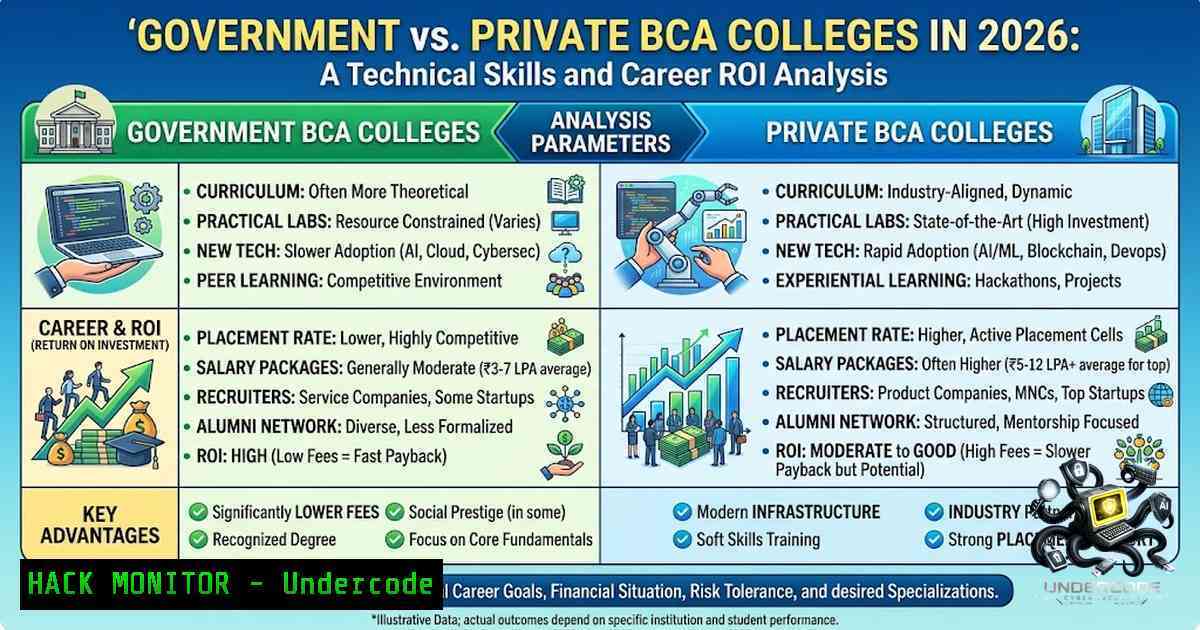
The Bachelor of Computer Applications (BCA) has evolved from a foundational programming degree into a specialized pathway for emerging technologies. As India’s IT sector shifts its demand from pure coding headcount to graduates who can work alongside AI tools, handle cloud infrastructure, and turn data into decisions from day one, the choice between government and private institutions in 2026 requires a technical, ROI-driven evaluation. This article dissects the curriculum, infrastructure, placement outcomes, and skill-building ecosystems of both sectors, providing a data-backed framework for prospective students.
Learning Objectives:
- Analyze the technical curriculum differences between government and private BCA programs, including AI/ML, cybersecurity, and cloud computing integrations.
- Evaluate the cost-to-placement ratio and return on investment (ROI) for both college types using 2026 fee and salary data.
- Identify the specific Linux, Windows, and cloud-1ative commands and tools that BCA graduates must master for industry readiness.
- Develop a decision-making framework based on career goals, learning style, and budget constraints.
You Should Know:
- Curriculum Deep Dive: AI, Cybersecurity, and Cloud Computing Integration
The BCA curriculum in 2026 is no longer a generic programming course. Top institutions have restructured their syllabi to focus on three major core areas: Artificial Intelligence & Machine Learning, Cyber Security, and Data Science/Analytics. Government colleges, while more affordable, often maintain older curricula with less frequent updates. Private colleges, conversely, charge more but typically offer modern infrastructure, industry-oriented specializations, and dedicated placement support.
A typical industry-aligned BCA program now includes modules covering full-stack development using modern stacks like Java, Python, and MERN (MongoDB, Express.js, React, Node.js), alongside cloud computing fundamentals on AWS, Azure, and Google Cloud. Cybersecurity training now encompasses ethical hacking, network defense, and data encryption, with hands-on tools such as Kali Linux and Wireshark.
Step-by-Step Guide: Setting Up a Basic Cybersecurity Lab on Linux
For BCA students specializing in cybersecurity, setting up a local penetration testing environment is essential.
- Install VirtualBox or VMware on your Windows/Linux host to create isolated virtual machines.
- Download and install Kali Linux (the industry-standard penetration testing distribution) from the official website.
- Set up a target machine – install a deliberately vulnerable OS like Metasploitable 2 or a Windows 10 VM with known vulnerabilities.
- Configure network adapters to “Host-Only” or “NAT Network” to ensure the VMs can communicate without exposing your host.
- Run initial reconnaissance from Kali using `nmap -sn 192.168.1.0/24` to discover live hosts on your virtual network.
- Perform a service scan: `nmap -sV -p- 192.168.1.X` (replace X with the target IP) to identify open ports and running services.
- Attempt basic exploitation using Metasploit: `msfconsole` then `search` for a relevant exploit based on the service version discovered.
-
The Financial Equation: Fees, Infrastructure, and Hidden Costs
The cost disparity between government and private BCA colleges is substantial. In 2026, BCA course fees in India range from ₹5,000–₹30,000 per year in government colleges, compared to ₹50,000–₹2,50,000+ per year in private institutions. For the full three-year program, students typically pay between ₹30,000 and ₹1.8 lakh at government institutions and between ₹1.5 lakh and ₹6 lakh at reputed private colleges.
However, fees alone don’t tell the full story. A cheaper college with outdated labs and no placement support can end up costing more in the long run — in missed opportunities, lower starting salaries, or the need for expensive add-on certifications later. Private colleges justify higher fees through modern computing labs, industry-aligned electives, internships, and dedicated placement cells. Government colleges, subsidized by the state, offer exceptional value but often have highly competitive admission processes through entrance exams such as CUET, IPU CET, or state-level tests.
Step-by-Step Guide: Calculating Your BCA ROI
To make an informed decision, calculate the Return on Investment (ROI) for each college type.
- Estimate Total Cost: Add tuition fees, hostel/accommodation, books, and any mandatory certification costs for the entire 3-year program.
- Research Average Placement Package: Look for college-specific placement reports. For example, RCM Bhubaneswar reports an 8.5 LPA average package, while other private colleges may range from 3-6 LPA. Government college placements can vary widely, with some top institutions offering 3.2-5.5 LPA.
- Calculate Net ROI: Subtract the total cost from the expected first-year salary (or average package multiplied by a career horizon, e.g., 5 years).
- Factor in Intangibles: Consider the value of industry exposure, internship opportunities, and the college’s alumni network, which can significantly impact long-term career growth.
3. Placement Ecosystems and Industry Connect
Placements are the critical filter when shortlisting a BCA college. A strong curriculum on paper means little if it is not backed by a placement cell that runs structured training, brings in real recruiters, and tracks outcomes transparently. Industry expectations have moved fast: recruiters now screen BCA candidates for practical exposure to AI tools, cloud platforms, and live projects, not just theoretical programming knowledge.
Private colleges often invest heavily in placement infrastructure. For instance, RCM Bhubaneswar leverages a network of 830+ recruiters, with published BCA-specific figures of an 8.5 LPA average and a 12 LPA highest package. Christ University, another prominent private institution, has a diverse recruiter network across consulting, IT, and finance, though it does not consistently publish BCA-specific statistics. Government colleges, while more affordable, may have less structured placement cells, though top institutions like the University of Delhi (DU) and Banaras Hindu University (BHU) offer very high ROI due to their low cost structure and strong alumni networks.
Step-by-Step Guide: Building a Placement-Ready Portfolio
Regardless of the college type, students must proactively build a portfolio to stand out.
- Contribute to Open Source: Start with small bug fixes on GitHub projects. Use
git clone,git branch, and `git pull request` workflows. - Build a Personal Website/Portfolio: Use HTML, CSS, and JavaScript (or a framework like React) to showcase your projects. Deploy it using GitHub Pages or a cloud platform.
– Windows (using Git Bash): git init, git add ., git commit -m "Initial commit", git remote add origin <your-repo-url>, git push -u origin main.
– Linux: Similar commands, using the terminal.
3. Complete Industry Certifications: Pursue certifications like AWS Certified Cloud Practitioner, Google IT Support Professional, or EC-Council’s Certified Ethical Hacker (CEH) to validate your skills.
4. Document Live Projects: Create a detailed case study for each project, explaining the problem, your solution, the technologies used, and the outcome. Include this in your portfolio and LinkedIn profile.
4. Technical Skill Requirements for 2026 IT Jobs
The modern BCA graduate must be proficient in a wide array of technologies. The curriculum now emphasizes hands-on experience with industry-standard tools. Key technical areas include:
- Full-Stack Development: Mastery of both front-end (HTML5, CSS3, JavaScript, React) and back-end (Node.js, PHP, Django) technologies.
- Cloud Computing: Deployment and management of applications on AWS, Azure, and Google Cloud, moving away from local hosting to distributed systems.
- Cybersecurity: Ethical hacking, network defense, and data encryption.
- Data Science: Using Python-based libraries (Pandas, TensorFlow) and machine learning algorithms to extract actionable insights from datasets.
- Database Management: Proficiency in both SQL (relational) and NoSQL (MongoDB) databases.
Step-by-Step Guide: Setting Up a Full-Stack Development Environment
To begin building full-stack applications, set up your development environment.
- Install a Code Editor: Download and install Visual Studio Code (VS Code) on Windows, macOS, or Linux.
- Install Node.js and npm: This is essential for JavaScript-based back-end development.
– Windows: Download the installer from the official Node.js website.
– Linux (Ubuntu/Debian): `sudo apt update && sudo apt install nodejs npm`
3. Install Python: Required for data science and Django/Flask development.
– Windows: Download from python.org.
– Linux: `sudo apt install python3 python3-pip`
4. Set Up Version Control: Install Git.
- Windows: Download from git-scm.com.
- Linux: `sudo apt install git`
5. Create a Project Folder: `mkdir my-first-app && cd my-first-app`
6. Initialize a Node.js Project: `npm init -y`
7. Install Express.js: `npm install express`
- Create a Basic Server: Create an `index.js` file and write a simple “Hello World” server.
- Run the Server: `node index.js` and open `http://localhost:3000` in your browser.
5. The AI Integration Factor: A Game Changer in 2026
The 2026 curriculum is designed with AI and ML as a spine running through every year — not as optional electives. BCA students now encounter AI-integrated labs from the second semester onwards, applying AI tools in software engineering, code generation, and intelligent system design as a core skill, not an add-on. Specializations in AI & Machine Learning, Data Science, and Generative AI are becoming increasingly common.
This integration is driven by industry demand. Companies are seeking graduates who can work alongside AI tools, handle cloud infrastructure, and turn data into decisions from day one. Programs like RCM’s AI-integrated BCA PLUS combine core computer applications with specializations in AI & Machine Learning, Data Science, Cyber Security, and Cloud Computing. Private colleges are leading this charge, often collaborating with industry partners like Microsoft, Intel, and EC-Council to deliver cutting-edge curricula.
Step-by-Step Guide: Running a Simple Machine Learning Model in Python
To get hands-on with AI/ML, follow these steps to build a basic linear regression model.
1. Install Python and pip: Ensure Python 3.x is installed.
2. Install required libraries: `pip install numpy pandas scikit-learn matplotlib<h2 style="color: yellow;">3. Create a Python script (e.g.,ml_model.py`).4. Import libraries:
import numpy as np
import pandas as pd
from sklearn.model_selection import train_test_split
from sklearn.linear_model import LinearRegression
from sklearn.metrics import mean_squared_error
import matplotlib.pyplot as plt
- Load or create a dataset: For simplicity, create a small dataset.
Sample data: hours studied vs test scores data = {'Hours': [1, 2, 3, 4, 5, 6, 7, 8, 9, 10], 'Scores': [10, 20, 30, 40, 50, 60, 70, 80, 90, 100]} df = pd.DataFrame(data) X = df[['Hours']] y = df['Scores'] - Split the data: `X_train, X_test, y_train, y_test = train_test_split(X, y, test_size=0.2, random_state=42)`
7. Train the model: `model = LinearRegression(); model.fit(X_train, y_train)`8. Make predictions:
predictions = model.predict(X_test)9. Evaluate the model:
print(mean_squared_error(y_test, predictions)) - Visualize the results: `plt.scatter(X, y); plt.plot(X, model.predict(X), color=’red’); plt.show()`
What Undercode Say:
- Key Takeaway 1: The choice between government and private BCA colleges is not merely about fees; it is a strategic decision about career trajectory and skill acquisition. Private colleges, with their higher fees, often provide superior industry exposure, modern infrastructure, and structured placement support, which can lead to higher starting salaries and faster career progression. However, government colleges offer unparalleled affordability and a strong academic foundation, making them an excellent choice for students with budget constraints who are willing to proactively seek external certifications and internships.
- Key Takeaway 2: The BCA curriculum in 2026 is heavily skewed towards emerging technologies like AI, ML, cybersecurity, and cloud computing. Regardless of the college type, students must take ownership of their learning, building a robust portfolio of projects, contributing to open source, and obtaining industry-recognized certifications to remain competitive. The days of relying solely on a degree for employment are over; practical, demonstrable skills are the new currency in the IT job market.
Prediction:
- +1 The increasing integration of AI and specialized technologies into the BCA curriculum will create a new generation of IT professionals who are not just coders but solution architects, capable of leveraging AI to solve complex business problems. This will drive innovation and productivity across all sectors of the Indian economy.
- +1 Private colleges, with their agility and industry partnerships, will continue to lead in curriculum innovation, offering niche specializations that directly align with market demands. This will further widen the gap between top-tier private institutions and government colleges in terms of placement outcomes and starting salaries.
- -1 The high cost of private BCA education may exacerbate socioeconomic disparities, limiting access to quality tech education for students from lower-income backgrounds. This could lead to a talent gap, where the most innovative roles are filled by a privileged few, while others are left with outdated skills and limited opportunities.
- -1 Government colleges, if they fail to update their curricula and invest in modern infrastructure and placement cells, risk becoming irrelevant in the rapidly evolving tech landscape. This could result in a generation of graduates who are academically qualified but professionally unemployable, leading to a skills mismatch and increased competition for low-skill IT roles.
▶️ Related Video (80% Match):
🎯Let’s Practice For Free:
🎓 Live Courses & Certifications:
Join Undercode Academy for Verified Certifications
🚀 Request a Custom Project:
Secure, high-velocity infrastructure and disruptive technological engineering. Contact our engineering team for high-tier development and proprietary systems:
[email protected]
💎 Smart Architecture | 🛡️ Secure by Design | ⭐ Trusted by Thousands
IT/Security Reporter URL:
Reported By: Priya Jena – Hackers Feeds
Extra Hub: Undercode MoN
Basic Verification: Pass ✅


