Listen to this Post
Introduction
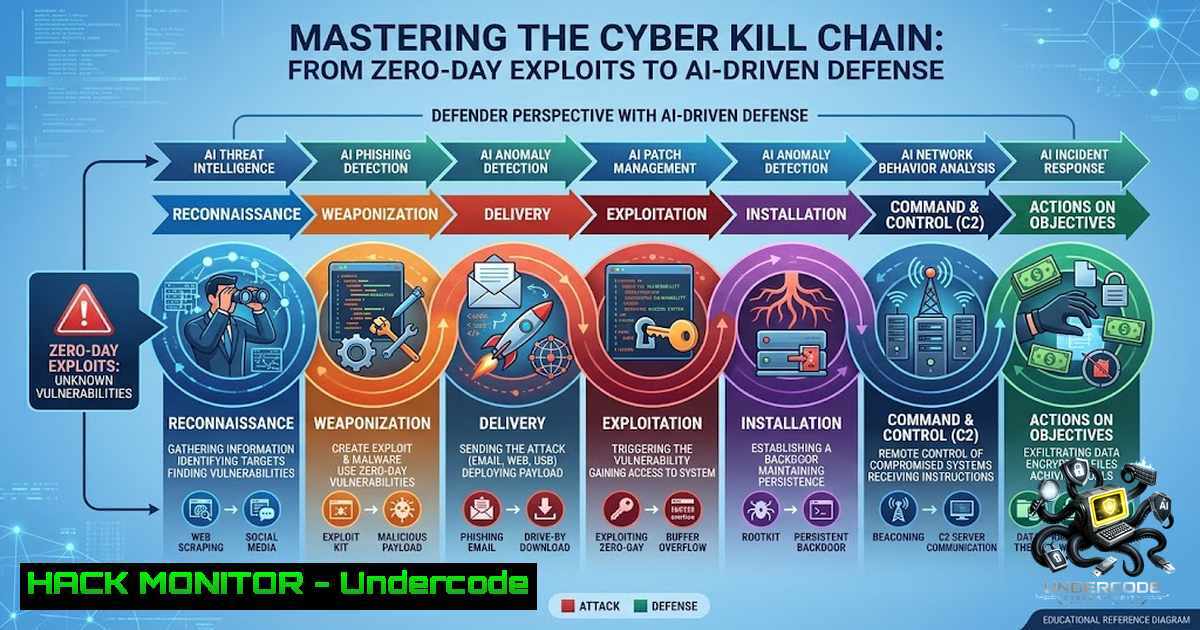
The modern cyber battlefield is no longer defined by simple perimeter defenses; it is a complex ecosystem where attackers leverage Living Off the Land (LOTL) techniques and AI-powered automation to compromise systems in minutes. As organizations grapple with an expanding attack surface spanning cloud-1ative APIs and legacy infrastructure, the role of the cybersecurity professional has evolved from a reactive gatekeeper to a proactive threat hunter. This article provides a comprehensive technical roadmap—bridging foundational concepts, offensive security tactics, and defensive AI implementations—to equip practitioners with the actionable skills needed to protect modern digital assets.
Learning Objectives
- Objective 1: Understand the anatomy of modern cyberattacks, including zero-day exploitation and identity-based lateral movement, and how to mitigate them using a Defense-in-Depth (DiD) strategy.
- Objective 2: Master the practical application of AI and machine learning in cybersecurity for anomaly detection and threat intelligence.
- Objective 3: Learn to harden cloud-1ative environments and APIs by implementing Zero Trust architecture principles and runtime protection controls.
You Should Know
- The Offensive Mindset: Understanding Vulnerabilities and Attack Vectors
To build an effective defense, one must first understand the offense. The 2025 cybersecurity landscape has demonstrated that attackers are faster than ever. For instance, the React2Shell flaw (CVE-2025-55182) became the most targeted vulnerability within weeks of its disclosure, proving that the window for patching has shrunk dramatically. Simultaneously, attackers are increasingly relying on “Living Off the Land” (LOTL) techniques, using legitimate system tools to evade detection.
Step-by-Step Guide: Initial Vulnerability Assessment
This process helps you identify potential entry points in your environment.
- Network Enumeration (Linux): Use `nmap` to discover live hosts and open ports. A SYN scan (
-sS) is stealthy and effective.nmap -sS -p- -T4 192.168.1.0/24
What it does: This scans the entire subnet for open ports without completing the TCP handshake, making it less likely to be logged by the target.
-
Network Enumeration (Windows): Use built-in tools to understand the network configuration.
ipconfig /all
netstat -rn
What it does: `ipconfig /all` displays detailed IP configuration for all network adapters. `netstat -rn` shows the routing table, revealing how the system reaches other networks.
-
Vulnerability Scanning: Deploy a vulnerability scanner like OpenVAS or Nessus to identify known CVEs in your systems. Focus on critical and high-severity vulnerabilities that are actively being exploited in the wild.
2. Building the Defense: AI-Enhanced Intrusion Detection
Traditional signature-based detection is failing against zero-day and polymorphic threats. Machine Learning (ML) and Deep Learning (DL) models offer a paradigm shift by identifying anomalies based on behavior rather than known signatures. Convolutional Neural Networks (CNNs), for example, excel at analyzing network traffic patterns to detect unusual behaviors indicative of DDoS attacks, port scanning, and intrusions.
Step-by-Step Guide: Implementing a Basic Anomaly Detection Pipeline
This conceptual guide outlines how to set up an ML-based detection system.
- Data Collection: Aggregate network flow logs (e.g., from Zeek or Cisco NetFlow) and system logs into a centralized data lake.
- Feature Engineering: Extract key features from the data, such as packet size, protocol type, connection duration, and the number of bytes transferred.
- Model Training: Train an unsupervised learning model (e.g., Isolation Forest or Autoencoder) on a baseline of “normal” network traffic. This allows the model to learn what constitutes typical behavior.
- Deployment & Alerting: Deploy the trained model to analyze live traffic. Configure it to generate alerts when it detects a significant deviation from the learned baseline, flagging potential zero-day attacks.
-
Securing the Cloud-1ative Perimeter: API and Cloud Hardening
As organizations migrate to the cloud, APIs have become the new primary attack surface. NIST Special Publication 800-228 provides comprehensive guidelines for API protection, emphasizing a Zero Trust approach where no entity is trusted by default. Security must be built into the API lifecycle from design to runtime.
Step-by-Step Guide: Hardening a Public-Facing API (AWS Example)
This guide demonstrates how to apply key NIST recommendations.
- Implement Rate Limiting: Place your API behind an API Gateway (e.g., AWS API Gateway) and configure rate limiting rules. This mitigates DDoS and brute-force attacks by restricting the number of requests from a single IP.
{
"rateLimit": {
"burstLimit": 100,
"rateLimit": 50
}
}
What it does: This configuration allows a burst of 100 requests but limits the sustained rate to 50 requests per second.
-
Enforce Least Privilege: Use Identity and Access Management (IAM) to grant each component (e.g., Lambda functions) the minimum permissions necessary to perform its function. Never use root or overly permissive roles.
- Encrypt Everything: Ensure all data in transit is encrypted using TLS 1.2 or higher. Encrypt all data at rest using a Key Management Service (KMS).
- Continuous Monitoring: Centralize logs using a SIEM solution (e.g., AWS Security Hub or GuardDuty) to detect and respond to anomalies across all layers of your cloud environment.
4. Identity: The New Battlefield
In 2025, identity-based attacks became central to major cyber operations, including lateral movement, privilege escalation, and persistence. Attackers are no longer just breaking in; they are logging in.
Step-by-Step Guide: Hardening Active Directory (Windows)
- Audit Privileged Groups: Regularly audit membership in high-privilege groups like
Domain Admins,Enterprise Admins, andSchema Admins.Get-ADGroupMember -Identity "Domain Admins"
What it does: This PowerShell command lists all members of the Domain Admins group, helping you identify and remove unnecessary accounts.
-
Implement Privileged Access Workstations (PAWs): Ensure that administrative tasks are performed from dedicated, hardened workstations that are not used for daily activities like email or web browsing.
- Enable Advanced Auditing: Configure your domain controllers to log detailed authentication events.
auditpol /set /subcategory:"Logon" /success:enable /failure:enable
What it does: This command enables detailed logging of both successful and failed logon attempts, which is crucial for detecting brute-force attacks and unauthorized access.
5. The Human Element: From Curiosity to Career
The journey into cybersecurity is often fueled by a deep curiosity about how systems work and how they can be broken—and subsequently protected. As Anshula Sridhar’s path to UNSW Bengaluru illustrates, a strong foundation in AI, data, and software development provides an invaluable multidisciplinary perspective. The UNSW Master of Cyber Security program, for example, bridges the gap between theory and practice with courses in cyber offence, information assurance, and software security lifecycle. The field demands continuous learning, ethical hacking skills, and the ability to think like an adversary to build robust defenses.
What Undercode Say
- Key Takeaway 1: The integration of AI into cybersecurity is not a luxury but a necessity. The speed and sophistication of modern attacks, particularly zero-day exploits and LOTL techniques, render manual and signature-based defenses obsolete. Organizations must invest in ML-driven anomaly detection and automated response systems.
- Key Takeaway 2: The principle of “trust but verify” is dead. Zero Trust architecture, encompassing strict identity verification, least-privilege access, and continuous monitoring, is the only viable defense model for today’s cloud-1ative and hybrid environments. This must be applied consistently across APIs, networks, and identities.
The evolving landscape demands that cybersecurity professionals not only master technical tools but also cultivate an adversarial mindset. The most effective defenders are those who understand the attacker’s playbook—from initial reconnaissance to final data exfiltration—and can proactively build controls that disrupt each stage of the cyber kill chain. As the React2Shell incident shows, the gap between vulnerability disclosure and exploitation is now measured in days, not months. This reality underscores the need for continuous, automated vulnerability management and a culture of rapid patching. Furthermore, the shift towards identity-based attacks highlights a critical weakness in many organizations’ security postures: the over-reliance on perimeter defenses while neglecting internal access controls. The future of cybersecurity lies in resilience—the ability to assume breach and design systems that can withstand and quickly recover from an attack.
Prediction
- +1: The demand for cybersecurity professionals with AI and ML expertise will continue to outstrip supply, driving significant salary premiums and making these skills among the most valuable in the tech industry.
- +1: The adoption of NIST SP 800-228 and similar frameworks will become a compliance baseline, forcing organizations to mature their API security posture and leading to a new wave of DevSecOps tooling that integrates security directly into the CI/CD pipeline.
- -1: The increasing reliance on AI for defense will be paralleled by a rise in AI-powered attacks, including automated vulnerability discovery and sophisticated social engineering, creating an ongoing “AI arms race” between attackers and defenders.
▶️ Related Video (86% Match):
🎯Let’s Practice For Free:
🎓 Live Courses & Certifications:
Join Undercode Academy for Verified Certifications
🚀 Request a Custom Project:
Secure, high-velocity infrastructure and disruptive technological engineering. Contact our engineering team for high-tier development and proprietary systems:
[email protected]
💎 Smart Architecture | 🛡️ Secure by Design | ⭐ Trusted by Thousands
IT/Security Reporter URL:
Reported By: Anshula Sridhar – Hackers Feeds
Extra Hub: Undercode MoN
Basic Verification: Pass ✅


