Listen to this Post
Introduction:
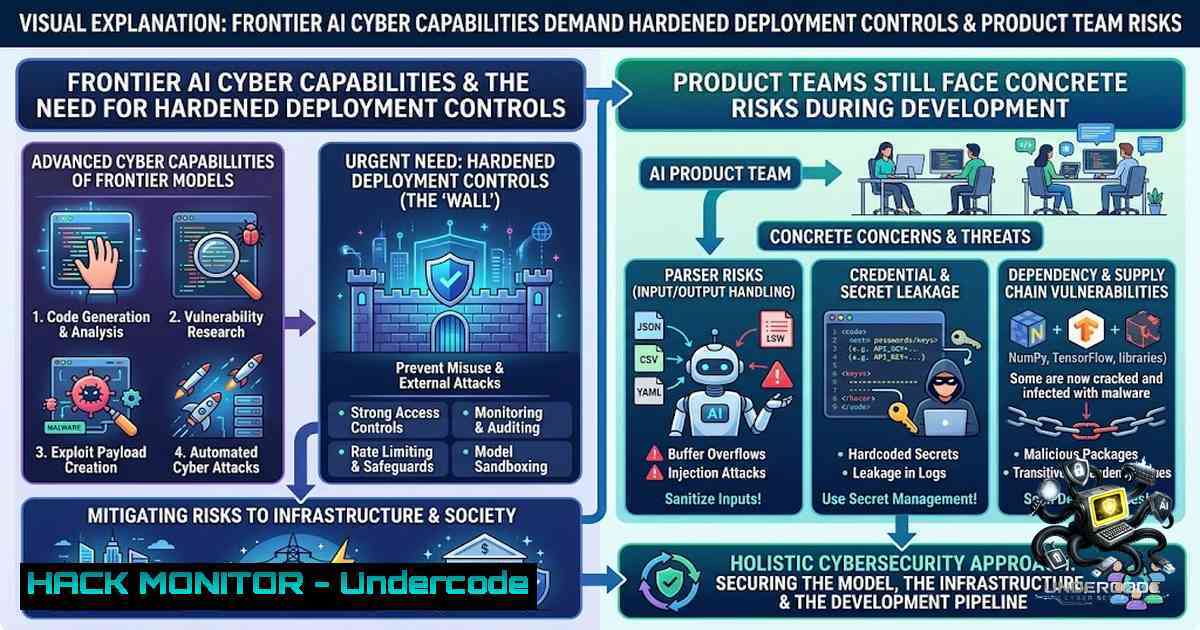
OpenAI’s preliminary evaluations of its upcoming Astra model have concluded that the company “cannot rule out” Critical cyber capability under its Preparedness Framework—a threshold at which a model can identify and develop functional zero-day exploits of all severity levels in hardened real-world critical systems without human intervention. This represents a material escalation from the High threshold assigned to previous models including GPT-5.6-Sol. Simultaneously, NIST has opened public comment on SSDF Version 1.2 through January 30, 2026, expanding secure development practices across the full SDLC while attackers continue to exploit credential sprawl, dependency confusion, and misconfigured pipelines. Product security teams must now operate at two speeds simultaneously: deploying frontier AI with militarized security controls while shoring up fundamental SSDLC hygiene.
Learning Objectives:
- Understand OpenAI’s Critical cyber threshold and the specific deployment controls required for frontier AI agents
- Master NIST SSDF v1.2 updates and the expanded secure development practices across the full software development lifecycle
- Implement dependency management controls including lockfiles, provenance verification, and reachability-based prioritization
- Deploy credential hardening strategies for non-human identities, service accounts, and CI/CD pipeline secrets
- Apply practical Linux and Windows commands for sandboxing, monitoring, and supply chain verification
You Should Know:
- Frontier AI Deployment Controls: Isolated Testing, Restricted Network Access, and Model-Weight Protection
OpenAI’s response to Astra’s preliminary Critical rating establishes a template for any organization deploying frontier AI agents. The company implemented “stricter security controls for higher-capability models and associated activities,” including isolated testing environments, restricted network and tool access, enhanced model-weight protections and encryption, additional monitoring and detection capabilities, and sandboxed execution. Internal activities involving Astra that do not meet these strengthened controls have been paused, and universal monitoring now evaluates the model’s Chain of Thought, triggering security responses to review and interrupt high-risk activity.
For teams testing frontier agents, the minimum viable control set includes:
- Network segmentation: Gate all agent outbound traffic through a controlled egress proxy with allowlists
- Tool access restriction: Implement capability-based access control where each tool invocation requires explicit authorization
- Sandboxed execution: Run agentic code in isolated containers with no persistent storage or lateral movement paths
- Model-weight protection: Encrypt weights at rest and in transit; restrict access via hardware security modules where feasible
Linux Commands for Sandboxed Agent Execution:
 Create isolated network namespace for agent testing
ip netns add agent-sandbox
ip netns exec agent-sandbox ip link set lo up

Run container with strict seccomp and no network egress
docker run --rm \
--security-opt seccomp=seccomp-agent.json \
--1etwork none \
--read-only \
--tmpfs /tmp:rw,noexec,nosuid,size=64m \
agent-image:latest

Monitor all file system writes from agent process
strace -f -e trace=file -o agent-file-access.log -p $(pgrep -f agent)
Windows Commands for Process Isolation:
 Create AppContainer sandbox for agent process
New-AppContainerProfile -1ame "AgentSandbox" -Capabilities "internetClient"
Start-Process -FilePath "agent.exe" -ArgumentList "--sandbox" -AppContainerName "AgentSandbox"

Monitor network connections from agent
Get-1etTCPConnection | Where-Object {$_.OwningProcess -eq (Get-Process agent).Id}
- NIST SSDF v1.2: Expanded Secure Development Across the Full SDLC
NIST released the initial public draft of SP 800-218r1 (SSDF Version 1.2) on December 17, 2025, with the public comment period open through January 30, 2026. The update broadens the framework beyond development-phase practices to address the full software development lifecycle, recognizing that “few software development life cycle (SDLC) models explicitly address software security in detail”. This shift reflects the reality that modern product security requires continuous security monitoring, automated build deployments, pre-production testing, and automated rollbacks.
The four practice groups remain foundational:
- Prepare the Organization (PO): Ensure people, processes, and technology are ready
- Protect the Software (PS): Protect all software components from tampering
- Produce Well-Secured Software (PW): Produce secure software with minimal vulnerabilities
- Respond to Vulnerabilities (RV): Identify residual vulnerabilities and remediate
Practical Implementation Steps:
- Map your existing SDLC to SSDF practice groups—identify coverage gaps
- Generate SBOMs as a build step for every artifact (see dependency management section below)
- Implement automated vulnerability scanning in CI/CD with reachability analysis
- Establish vendor attestation requirements per SSDF compliance (FedRAMP, EO 14028 lineage)
CI/CD Pipeline Security Commands:
 Generate SBOM using Syft
syft dir:. -o spdx-json > sbom.spdx.json

Validate SBOM against known vulnerabilities with Grype
grype sbom:sbom.spdx.json --fail-on high

Enforce signed commits in CI
git verify-commit $(git rev-parse HEAD) || exit 1
3. Dependency Management: Lockfiles, Provenance, and Reachability Analysis
Modern applications are “80-plus percent third-party code by volume,” with transitive dependencies often exceeding direct dependencies by an order of magnitude. The 2025 compromise of chalk/debug npm accounts—which pushed wallet-stealing code across packages with billions of weekly downloads—demonstrates that even well-maintained packages can turn hostile. The 2026 best practices for dependency management center on three pillars: enumeration, integrity, and prioritization.
Enumeration: Generate and Maintain SBOMs
“You cannot secure what you cannot enumerate, and ‘look at package.json’ doesn’t cut it—that shows direct dependencies, not the transitive graph where most risk hides”. Generate SBOMs as a build step, store them versioned, and keep them current.
 Generate SBOM with multiple formats for different consumers
syft dir:. -o cyclonedx-json > sbom.cyclonedx.json
syft dir:. -o spdx-tag-value > sbom.spdx.txt

Query SBOM for specific package presence
jq '.components[] | select(.name=="openssl")' sbom.cyclonedx.json
Integrity: Pin Everything and Verify Provenance
“A build that resolves ‘latest compatible’ at install time is a build an attacker can influence after you’ve reviewed the code”. Commit lockfiles and enforce reproducible installs.
 npm: enforce lockfile consistency
npm ci  fails if lockfile is out of sync with package.json

Python: require hash verification
pip install --require-hashes -r requirements.txt

Go: enforce read-only module mode
GOFLAGS=-mod=readonly go build ./...

Maven: ban dynamic version ranges
mvn enforcer:enforce -Drules=requireReleaseDeps
Prioritization: Reachability Over Raw CVE Count
“Version-based scanning flags a vulnerability if a package version contains it, regardless of whether your code ever calls the affected function”. Reachability analysis traces whether the vulnerable symbol is actually invoked—prioritize fixes by reachable vulnerabilities, not raw CVE counts.
 npm: audit with reachability (where supported)
npm audit --production --include=prod

OSS-Fuzz integration for reachability
python3 -m pip install osv-scanner
osv-scanner --reachability --sbom sbom.spdx.json
- Credential Hardening: Non-Human Identities, Service Accounts, and Pipeline Secrets
“Credentials don’t just open doors. They become the knife”. In 2026, the most critical identity risks are non-human: service account tokens, OAuth secrets, API keys, and machine tokens that were “never created in, or governed by, the directory”. Credential sprawl across environments means the same exposed credential may be unique or repeated—and attackers test passwords, tokens, and reset paths at AI-driven speed.
Hardening Controls for Non-Human Identities:
- Centralized identity platform: Maintain a single source of truth for users, roles, and authentication policies
- Kill stale accounts and merge duplicates: Review privileged access monthly for crown jewels; review standard access quarterly
- Deploy honeytokens and canaries: Deception capabilities layered with behavioral monitoring and pre-authorized containment
- Implement phishing-resistant MFA: FIDO2, PKI, and mobile ID technologies
- Secrets rotation: Rotate secrets alongside segmentation, egress filtering, and Zero Trust
Linux Commands for Credential Auditing:
 Find hardcoded secrets in repositories (using truffleHog)
trufflehog git file://. --json | jq '.'

Audit AWS IAM roles for unused credentials
aws iam list-users --query 'Users[].UserName' | while read user; do
aws iam list-access-keys --user-1ame $user --query 'AccessKeyMetadata[].Status'
done

Check for expired service account tokens in Kubernetes
kubectl get secrets --all-1amespaces -o json | jq '.items[] | select(.type=="kubernetes.io/service-account-token") | .metadata.creationTimestamp'
Windows Commands for Service Account Management:
 List all service accounts with their last password change
Get-WmiObject -Class Win32_Service | Where-Object {$_.StartName -like "$"} | Select-Object Name, StartName

Audit scheduled tasks running with elevated privileges
Get-ScheduledTask | ForEach-Object { $_.Principal.UserId }
- SSDLC Integration: Automated Security Gates in CI/CD Pipelines
The transition from SSDLC as a static development process to continuous security monitoring requires automated gates at every stage. NIST’s DevSecOps Practices document, open for public comment through April 24, 2026, demonstrates how to embed security controls into pipeline automation.
CI/CD Security Gate Implementation:
- Pre-commit: SAST scanning, secret detection, and license compliance
- Build: SBOM generation, dependency vulnerability scanning, and artifact signing
3. Test: DAST, container image scanning, and fuzzing
- Deploy: Policy-as-code validation, runtime security monitoring, and automated rollback on anomaly detection
 GitHub Actions security gates example
name: Security Pipeline
on: [push, pull_request]
jobs:
security-scan:
runs-on: ubuntu-latest
steps:
- uses: actions/checkout@v4
- name: SAST Scan
run: |
semgrep --config auto --sarif > semgrep.sarif
- name: Dependency Scan
run: |
npm ci
npm audit --production --json > npm-audit.json
- name: Secret Detection
run: |
trufflehog filesystem . --json | jq '.'
- name: SBOM Generation
run: |
syft dir:. -o cyclonedx-json > sbom.json
- name: Container Scan (if Dockerfile present)
run: |
grype dir:. --fail-on high
What Undercode Say:
- Key Takeaway 1: Frontier AI capability is advancing faster than deployment controls—OpenAI’s precautionary pause on Astra activities that don’t meet strengthened security controls sets a precedent that all organizations testing frontier agents should follow. The Critical threshold is not theoretical; it represents models capable of autonomous zero-day discovery and exploitation against hardened critical systems. Teams must gate network/tool access, enforce sandboxing, implement model-weight encryption, and deploy universal Chain of Thought monitoring before any production deployment.
-
Key Takeaway 2: The SSDLC is no longer a development-phase concern—NIST SSDF v1.2 expands secure practices across the full SDLC, and organizations must treat this as an operational imperative rather than a compliance checkbox. The combination of AI-generated code volume, active adversarial attack surfaces, and the non-deterministic nature of AI outputs means that “AI models cannot reliably self-certify their own probabilistic outputs”. Automated, independent verification layers are now mandatory.
Analysis: The convergence of frontier AI capability escalation and expanded SSDLC requirements creates a unique pressure point for product security teams. On one hand, Astra-level models demand military-grade deployment controls that most organizations are unprepared to implement. On the other, fundamental hygiene issues—dependency confusion, credential sprawl, and missing SBOMs—remain unaddressed in many development pipelines. The 2026 dependency management best practices (lockfiles, provenance verification, reachability-based prioritization) are not optional; they are the baseline for supply chain security. Organizations that treat credential security as an “operating habit” rather than a “tool project” will be better positioned to defend against AI-accelerated attacks that exploit identity rather than vulnerability. The NIST comment periods closing in January and April 2026 represent a critical opportunity for the security community to shape the frameworks that will govern software development for the next decade.
Prediction:
- +1 Organizations that implement the full stack of controls described above—frontier AI deployment gates, SSDF-aligned pipelines, dependency provenance, and credential hardening—will achieve measurable reductions in mean time to remediate supply chain vulnerabilities (projected 40-60% improvement by Q4 2026).
-
-1 Organizations that delay implementing reachability-based prioritization will experience alert fatigue and missed critical vulnerabilities, as raw CVE counts continue to grow exponentially with AI-generated code volumes.
-
+1 NIST SSDF v1.2 will become the de facto standard for federal procurement and enterprise vendor assessments, driving widespread adoption of SBOM generation and automated security gates across the software industry.
-
-1 The credential attack surface will expand as AI agents proliferate—non-human identities will outnumber human identities 10:1 by 2027, and organizations without centralized identity governance will face breaches originating from compromised service accounts and pipeline secrets.
-
+1 The transparency demonstrated by OpenAI in publishing its Preparedness Framework findings will establish a new norm for responsible frontier AI disclosure, enabling the security community to develop countermeasures before malicious actors can operationalize Critical-level capabilities.
▶️ Related Video (72% Match):
https://www.youtube.com/watch?v=1gB8A_mt6zk
🎯Let’s Practice For Free:
🎓 Live Courses & Certifications:
Join Undercode Academy for Verified Certifications
🚀 Request a Custom Project:
Secure, high-velocity infrastructure and disruptive technological engineering. Contact our engineering team for high-tier development and proprietary systems:
[email protected]
💎 Smart Architecture | 🛡️ Secure by Design | ⭐ Trusted by Thousands
IT/Security Reporter URL:
Reported By: Codrut Andrei – Hackers Feeds
Extra Hub: Undercode MoN
Basic Verification: Pass ✅


