Listen to this Post
Introduction:
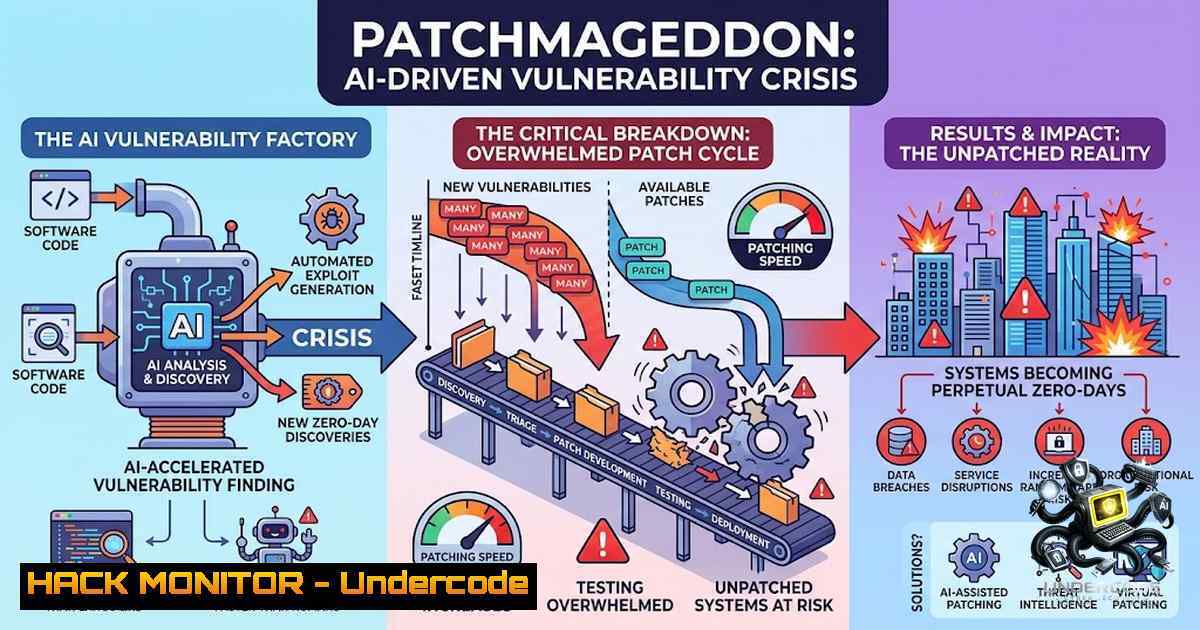
The cybersecurity landscape has entered a new era where the asymmetry between attack and defense has reached a critical tipping point. Frontier AI models such as Anthropic’s Claude Mythos and OpenAI’s GPT-5.5 can now discover thousands of previously unknown vulnerabilities at scale, autonomously generate working exploits, and reverse-engineer patches within minutes—while organizations struggle to patch even known flaws. J.P. Morgan’s Michael Cembalest warns in his latest Eye on the Market report “Patchmageddon” that the average time between vulnerability disclosure and exploitation has collapsed to zero days, with projections suggesting it could fall to one minute by 2027. This article dissects the technical realities of AI-driven vulnerability discovery, provides actionable defense strategies, and delivers hands-on commands for hardening systems against the coming “tsunami of patches”.
Learning Objectives:
- Understand how frontier AI models automate zero-day discovery and exploit generation at machine speed
- Master the technical mechanics of the patch gap and why traditional vulnerability management fails
- Implement Linux, Windows, and cloud-1ative hardening commands to shrink your own patch window
- Deploy AI-augmented defensive tools and CI/CD security pipelines to counter autonomous attacks
- Develop an incident response playbook for the zero-window era based on assume-breach principles
- The AI Vulnerability Discovery Engine: How Mythos Broke the Model
The fundamental shift is quantitative and qualitative. Anthropic’s Mythos Preview, initially restricted to ~50 partners including AWS, Apple, Google, Microsoft, CrowdStrike, and Palo Alto Networks, scanned more than 1,000 open-source projects and uncovered 23,019 vulnerabilities—6,202 of which were high or critical severity. In the first month of testing, advanced AI systems identified over 10,000 new high- and critical-severity zero-day vulnerabilities, many absent from public databases like the NVD or GitHub Security Advisories. Mozilla testing Mythos on Firefox 150 found and patched 271 vulnerabilities—more than ten times the number found with the previous Claude Opus 4.6 model. Cloudflare simultaneously discovered 2,000 bugs, with 400 classified as critical.
What makes this terrifying is not just the volume but the velocity. Mythos Preview autonomously converted known vulnerabilities into working privilege escalation exploits in under one day at a cost below $2,000, with no human intervention. The model can also chain multiple low- and medium-severity bugs into severe attack paths, effectively weaponizing what were once considered isolated weaknesses. Palo Alto Networks’ Unit 42 confirmed that 92% of vulnerabilities uncovered by frontier AI were of different types, with particular effectiveness at identifying semantic and logic flaws that traditional SAST tools miss.
Step-by-Step: Auditing Your Codebase with AI-Powered SAST
To fight fire with fire, integrate LLM-based security scanners into your CI/CD pipeline:
- Deploy `vulnhuntr` (Python 3.10–3.13 required) to analyze GitHub repositories:
pip install vulnhuntr
vulnhuntr --repo https://github.com/your-org/your-repo --output report.json
This tool uses LLMs to find zero-day style vulnerabilities in open-source codebases.
-
Use `ai-security-scan` for npm/Node.js projects with severity thresholds:
npx ai-security-scan --path ./src --severity high --fail-on critical
Exit code 1 blocks the pipeline if findings exceed the threshold.
-
Implement `codejury` to tune prompt effectiveness and measure false positive rates:
codejury eval --golden-set ./golden.json --capability ./capability.yaml
This sharpens local-pattern checks beyond basic data-flow analysis.
- The Patch Gap Exposed: 530 Critical Bugs, Only 75 Patched
The numbers from Anthropic’s Project Glasswing are sobering. As of May 2026, of 530 high- or critical-severity vulnerabilities reported to maintainers, only 75 had been patched. The remaining 455 remain exposed. Even when patches exist, organizations fail to deploy them in time: in approximately 60% of breaches, a patch was already available at the time of compromise. The Zero Day Clock now shows that nearly 80% of attacks occur on or before the day of disclosure, with the median exploitation time dropping from roughly one year in 2021 to just one day in 2026. Google’s M-Trends 2026 report estimates the mean time-to-exploit at negative seven days—exploitation occurs, on average, a full week before patches exist.
The structural problem is asymmetry: AI lowers the cost and skill barrier for finding and exploiting vulnerabilities, while defenders still operate patch cycles, risk models, and detection systems built for human-speed threats. The average time-to-exploit now sits under 20 hours, and your patch Tuesday cadence was never designed for this reality.
Step-by-Step: Shrinking Your Own Patch Window
1. Automate Linux patching with criticality-based prioritization:
 List all pending security updates with severity
sudo apt-get update && sudo apt-get upgrade --dry-run | grep -i security
 For RHEL/CentOS
sudo yum --security check-update
sudo yum --security update-minimal
 For Arch-based
sudo pacman -Syu --1oconfirm $(pacman -Qu | grep -i security | awk '{print $1}')
2. Windows patch automation via PowerShell:
 Install PSWindowsUpdate module
Install-Module PSWindowsUpdate -Force
 List available updates with severity classification
Get-WUList -Category "Security Updates" | Select ,KB,Severity
 Install only critical security updates
Install-WindowsUpdate -Category "Security Updates" -AcceptAll -AutoReboot
3. Implement zero-touch container patching:
 Scan container images for vulnerabilities
trivy image --severity CRITICAL,HIGH your-image:latest
 Automatically rebuild base images weekly with fresh patches
docker pull alpine:latest && docker build --1o-cache -t your-app:latest .
3. Open-Source Supply Chain: The Unseen Attack Surface
The underappreciated breadth of risk from open-source code is a central theme of the Patchmageddon report. AI models have exposed structural limits in traditional SAST tools, uncovering long-hidden vulnerabilities in widely used OSS projects. Recent examples include a backdoor enabling remote code execution discovered in the XZ Utils project and the deliberate addition of Use-After-Free bugs into the Linux kernel. Anthropic found a critical wolfSSL cryptography library flaw (CVE-2026-5194) that would have allowed attackers to forge certificates and host fake bank or email provider websites.
The risk is compounded by dependency hell: the average modern application includes hundreds of transitive dependencies, each a potential entry point. AI models can now scan entire dependency trees and identify logic flaws that human reviewers would never spot.
Step-by-Step: Hardening Your Open-Source Supply Chain
1. Audit dependencies with AI-enhanced SCA tools:
 OWASP Dependency-Check with NVD feed
dependency-check --scan ./ --format JSON --out report.json
 Use Snyk for AI-powered dependency scanning
snyk test --severity-threshold=high --all-projects
 GitHub's Dependabot with security updates enabled
gh api repos/your-org/your-repo/dependabot/alerts --jq '.[] | select(.security_advisory.severity=="critical")'
2. Implement SBOM generation and verification:
 Generate SPDX-compliant SBOM
syft dir:. -o spdx-json > sbom.json
 Compare against vulnerability database
grype sbom.json --fail-on high
3. Lock dependencies and enforce integrity:
 npm
npm shrinkwrap && npm ci --only=production
 Python
pip freeze > requirements.txt && pip install --require-hashes -r requirements.txt
 Go
go mod vendor && go mod verify
- Physical Infrastructure at Risk: When Code Meets Concrete
The Patchmageddon report explicitly warns about risks to physical infrastructure. Frontier AI models are not just finding bugs in software—they are discovering vulnerabilities in operational technology (OT), industrial control systems (ICS), and hardware. The AI revolution is entirely dependent on physical energy and utility infrastructure; a failure in OT security directly threatens the viability of the AI economy. Hardware-based and proxy-centric security models are colliding with the speed and scale of frontier AI attacks.
Attackers can now use AI to find vulnerabilities in SCADA systems, power grids, and transportation networks. The model found thousands of vulnerabilities across every major operating system and browser, permanently collapsing the distinction between digital capability and physical danger. Data centers themselves have become physical targets, with hardware-level GPU exploits and physical/geopolitical attacks surprising the industry in 2026.
Step-by-Step: Securing OT and Physical Infrastructure
1. Network segmentation for ICS/SCADA:
 Linux: Isolate OT networks with iptables
sudo iptables -A FORWARD -i eth0 -o eth1 -m state --state NEW -j DROP
sudo iptables -A INPUT -i eth1 -p tcp --dport 22 -j DROP  Block SSH from OT net
 Windows: Set network profile to Public for OT interfaces
Set-1etConnectionProfile -InterfaceAlias "OT-1IC" -1etworkCategory Public
2. Monitor for anomalous PLC/RTU behavior:
 Use Zeek for OT protocol analysis
zeek -r ot-traffic.pcap modbus_detection.zeek
 Snort rules for known ICS exploits
snort -r pcap.pcap -c /etc/snort/snort.ics.conf -A full
3. Hardware-level integrity checks:
 Verify TPM/secure boot status (Linux)
sudo dmesg | grep -i tpm
sudo bootctl status
 Windows: Check HVCI and Memory Integrity
Get-DeviceGuard -Online
Get-ComputerInfo -Property "DeviceGuard"
5. The Defender’s Counterplay: AI-Augmented Blue Team Operations
While the threat is dire, the report emphasizes that the same tools used to detect and exploit vulnerabilities can also propose code fixes and remediate them. Security-focused AI agents are being developed by Anthropic and OpenAI, and forward-thinking security teams are already deploying LLM-based security reviews into CI/CD pipelines. The Cloud Security Alliance recommends formalizing AI agent use across all security functions as an operational requirement—optional programs have not overcome cultural resistance, and teams operating without agents cannot match the speed of AI-augmented attacks.
Step-by-Step: Building an AI-Augmented Security Operations Center
1. Deploy autonomous red-team AI agents:
 Use Metasploit with AI-driven exploit selection
msfconsole -q -x "use auxiliary/scanner/ai_vuln_scanner; set RHOSTS 192.168.1.0/24; run"
 Integrate with OpenAI API for log analysis
python3 ai_log_analyzer.py --source /var/log/auth.log --model gpt-4 --alert-threshold 0.8
2. Automated patch validation and rollback:
 Pre-patch validation (Linux)
ansible-playbook patch-validation.yml --check --diff
 Canary deployment for patches
kubectl set image deployment/app app=new-patched-image --record
kubectl rollout pause deployment/app
 Monitor for 5 minutes, then resume or rollback
kubectl rollout resume deployment/app || kubectl rollout undo deployment/app
3. Continuous compromise assessment:
 Deploy EDR with AI-driven behavioral detection
sudo osqueryi --json "SELECT  FROM processes WHERE cmdline LIKE '%exploit%' OR cmdline LIKE '%payload%'"
 Windows: Use Sysmon with AI-enhanced event correlation
sysmon -accepteula -i sysmon-config.xml
Get-WinEvent -FilterHashtable @{LogName='Microsoft-Windows-Sysmon/Operational'; ID=1,3,7} | Out-GridView
- The Zero-Window Playbook: Assume Breach, Contain at Scale
With near-zero exploit windows now the norm, “patch faster” or “patch better” are no longer enough. Security teams need new playbooks based on an assume-breach model: breaches will happen, and detecting them as they occur and containing them at scale will be paramount. The report warns that companies must increasingly measure themselves on the speed of remediation rather than accuracy alone. The median time-to-exploit, already at one day in 2026, is projected to reach one minute by 2027.
Step-by-Step: Building Your Zero-Window Incident Response
1. Immutable infrastructure deployment:
 Terraform: Blue/green deployment with automated rollback
terraform plan -var="deploy_version=green" -out=green.tfplan
terraform apply green.tfplan
 If incident detected, rollback in seconds
terraform apply -var="deploy_version=blue" -auto-approve
2. Automated containment playbooks:
 Linux: Isolate compromised host
sudo iptables -I INPUT 1 -s $COMPROMISED_IP -j DROP
sudo systemctl stop $SUSPICIOUS_SERVICE
 Windows: Network isolation via PowerShell
New-1etFirewallRule -DisplayName "Block Compromised" -Direction Inbound -RemoteAddress $COMPROMISED_IP -Action Block
Stop-Service -1ame $SUSPICIOUS_SERVICE -Force
3. Post-breach forensic collection:
 Linux memory capture
sudo dd if=/dev/mem of=/forensics/memory.dump bs=1M
 Windows: Use KAPE for rapid evidence collection
.\kape.exe --target C:\ --module Windows --output .\output\
 Network traffic replay for analysis
tcpdump -i eth0 -w incident.pcap -C 100 -W 10
What Undercode Say:
- The patch gap is no longer a metric—it’s a weapon. When AI can find 10,000 zero-days in a month and attackers exploit vulnerabilities before patches exist, traditional vulnerability management is obsolete. The 530:75 ratio from Anthropic isn’t just a statistic; it’s a death sentence for organizations that rely on monthly patch cycles.
-
Defense must become autonomous to survive. The asymmetry between AI-powered offense and human-speed defense is unsustainable. Security teams must deploy AI agents for detection, patching, and response—not as an option, but as an operational requirement. The organizations that embrace autonomous defense will survive; those that don’t will be breached at machine speed.
Analysis: The Patchmageddon report reveals a fundamental reordering of the cyber risk landscape. The combination of AI-driven vulnerability discovery, automated exploit generation, and collapsing patch windows means that every disclosed vulnerability is effectively a zero-day. The 60% statistic—that patches existed at the time of compromise in most breaches—exposes organizational failure, not technical limitation. The projected one-minute exploitation window by 2027 means that human-in-the-loop security operations will be physically impossible. The only viable path forward is AI-augmented, autonomous defense systems that can detect, patch, and contain threats at machine speed. The report’s call for Federal government action on open-source security and physical infrastructure protection underscores that this is not just a corporate IT problem—it’s a national security imperative.
Prediction:
- -1 The median time-to-exploit will reach one minute by 2027, rendering manual patch management completely obsolete. Organizations that fail to automate patching will experience breach rates exceeding 90% annually.
-
-1 AI-powered vulnerability discovery will uncover millions of previously unknown flaws in critical open-source projects, overwhelming maintainers and creating a “dependency collapse” where key libraries become unmaintainable.
-
+1 The same AI models that find vulnerabilities will evolve into autonomous patching agents, capable of proposing, testing, and deploying fixes in seconds—shifting the battle from discovery to verification.
-
-1 Physical infrastructure attacks will increase dramatically as AI models find OT/ICS vulnerabilities at scale, potentially causing the first major AI-enabled physical catastrophe (power grid, water treatment, or transportation) within 24 months.
-
+1 Regulatory frameworks will mandate AI-augmented security operations for critical infrastructure, creating a new cybersecurity industrial base and driving massive investment in defensive AI.
-
-1 The cybersecurity talent shortage of 4.8 million professionals will worsen as AI outpaces human defenders, creating a “defender desert” where only AI-equipped organizations can survive.
-
+1 Open-source security will become a national security priority, with government-funded “bug bounty” programs at scale and mandatory SBOM requirements for all federal suppliers.
-
-1 Ransomware operators will weaponize frontier AI to automate entire attack chains—reconnaissance, vulnerability discovery, exploit generation, and data exfiltration—making human-operated ransomware obsolete and increasing attack volume by orders of magnitude.
-
+1 The security industry will pivot from “prevention” to “resilience,” with cyber insurance requiring AI-augmented defense and real-time patching as prerequisites for coverage.
-
-1 By 2028, the average enterprise will face over 1,000 critical patches per week—a volume that no human team can manage, forcing a fundamental rethink of software architecture toward memory-safe languages and formal verification.
▶️ Related Video (76% Match):
https://www.youtube.com/watch?v=3GUMoGRRA2U
🎯Let’s Practice For Free:
🎓 Live Courses & Certifications:
Join Undercode Academy for Verified Certifications
🚀 Request a Custom Project:
Secure, high-velocity infrastructure and disruptive technological engineering. Contact our engineering team for high-tier development and proprietary systems:
[email protected]
💎 Smart Architecture | 🛡️ Secure by Design | ⭐ Trusted by Thousands
IT/Security Reporter URL:
Reported By: Scott Marshall – Hackers Feeds
Extra Hub: Undercode MoN
Basic Verification: Pass ✅


