
Listen to this Post
Introduction:
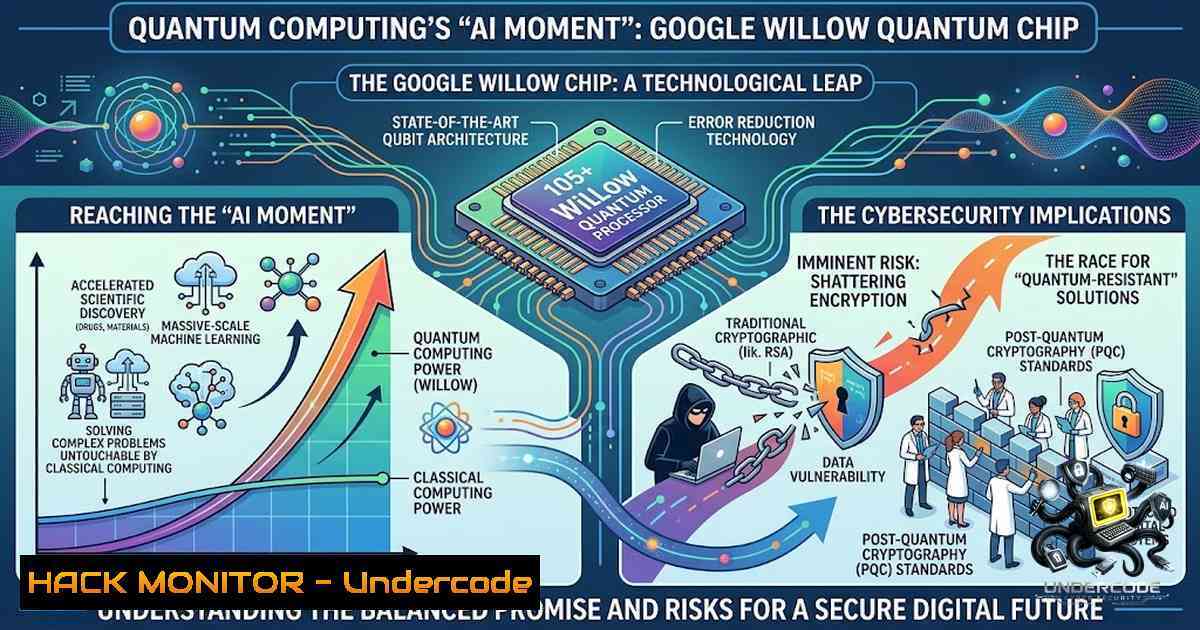
Google’s 105-qubit Willow quantum processor has achieved what many researchers once considered impossible: demonstrating quantum error correction below the surface code threshold while simultaneously completing a Random Circuit Sampling (RCS) benchmark in under five minutes—a task that would take the world’s fastest classical supercomputer an estimated 10 septillion years. This milestone represents quantum computing’s “AI moment,” analogous to the early deep learning breakthroughs of the 2010s: still experimental, still limited, but unmistakably pointing toward a technological revolution that will transform medicine, materials science, energy optimization, and—critically—cybersecurity. For security professionals, the message is clear: the era of cryptographically relevant quantum computers is approaching faster than previously anticipated, and the time to prepare for post-quantum cryptography (PQC) migration is now.
Learning Objectives & Secrets:
- Objective 1: Understand Quantum Error Correction Below Threshold – Learn how Google’s Willow demonstrated that increasing the number of physical qubits can reduce the logical error rate, a paradigm shift that overturns decades of assumptions about quantum noise scaling.
-
Objective 2 Secret Tip: Simulate Quantum Circuits Locally – Master the setup of open-source quantum simulation frameworks (Qiskit, Cirq, Stim) on Linux/Windows to experiment with quantum algorithms and error correction without access to real quantum hardware.
-
Objective 3 Secret Tip: Audit Your Cryptographic Inventory for PQC Readiness – Conduct a comprehensive cryptographic asset inventory and implement hybrid PQC deployments (classical + post-quantum algorithms) to protect against “harvest now, decrypt later” attacks.
You Should Know:
1. Quantum Error Correction: The Surface Code Breakthrough
For decades, the quantum computing community struggled with a fundamental paradox: adding more qubits typically introduced more errors, making large-scale quantum computers seemingly impossible. Google’s Willow chip shattered this barrier by demonstrating that increasing the code distance (the spatial separation of logical qubits) suppresses the logical error rate exponentially by a factor of Λ = 2.14 ± 0.02 per incremental step. The physical qubits on Willow achieved single-qubit gate error rates as low as 0.035% and two-qubit gate errors of 0.33%. When scaled from a 3×3 to a 7×7 qubit array, the error rate dropped by approximately 2.14× compared to Google’s previous Sycamore processor.
This achievement—known as operating “below the surface code threshold”—means that quantum error correction (QEC) is no longer a theoretical abstraction but an engineering reality. The practical implication: fault-tolerant quantum computers capable of running Shor’s algorithm against RSA-2048 encryption may require only ~1 million physical qubits (down from earlier estimates of 20 million), with Google projecting a cryptographically relevant quantum computer (CRQC) by 2029.
Step‑by‑Step Guide: Simulating Surface Code Error Correction with Stim and PyMatching
To understand QEC experimentally without quantum hardware, set up the Stim stabilizer simulator and PyMatching decoder on your Linux system:
 Install Python virtual environment and dependencies
python3 -m venv qec_env
source qec_env/bin/activate
pip install --upgrade pip
pip install stim pymatching numpy matplotlib
Create a surface code memory experiment in Python:
import stim
import pymatching
import numpy as np

Generate a distance-5 rotated surface code circuit with noise
circuit = stim.Circuit.generated(
"surface_code:rotated_memory_z",
distance=5,
rounds=5,
after_clifford_depolarization=0.001
)

Sample detector error model and run Monte Carlo simulation
model = circuit.detector_error_model(decompose_errors=True)
matching = pymatching.Matching.from_detector_error_model(model)
sampler = circuit.compile_sampler()

Simulate 1000 shots and decode
shots = 1000
detector_data, observable_data = sampler.sample(shots, separate=True)
predictions = matching.decode_batch(detector_data)
logical_errors = np.any(predictions != observable_data, axis=1)
error_rate = np.mean(logical_errors)
print(f"Logical error rate: {error_rate:.4f}")
This simulation reproduces the core principle demonstrated by Willow: as you increase code distance (distance=3,5,7), the logical error rate decreases exponentially.
2. Random Circuit Sampling: Benchmarking Quantum Supremacy
The RCS benchmark that Willow completed in under five minutes is a deliberately constructed problem designed to test quantum computational power. Unlike practical applications, RCS involves running random quantum circuits and sampling their output distributions—a task exponentially hard for classical computers due to the inherent complexity of quantum interference. Willow executed this benchmark with 40 cycles across its 105 qubits, achieving a five-minute runtime versus the 10²⁵ years estimated for classical simulation.
However, security professionals should note a critical nuance: RCS has “not yet known real-world applications”. The benchmark is a stress test, not a practical algorithm. The real significance lies in what it proves about Willow’s engineering: stable qubit coherence times improved by a factor of five over Sycamore, readout efficiency enhancements, and optimized decoders that enable error correction in real time.
Step‑by‑Step Guide: Running a Quantum Circuit Simulation with Qiskit
Set up IBM’s Qiskit framework to simulate quantum circuits and understand superposition and entanglement:
 Linux/macOS installation
python3 -m venv quantum_env
source quantum_env/bin/activate
pip install --upgrade pip
pip install qiskit qiskit-aer matplotlib
Create and simulate a Bell state (entanglement):
from qiskit import QuantumCircuit, transpile
from qiskit.providers.aer import AerSimulator
from qiskit.visualization import plot_histogram

Build a Bell state circuit
qc = QuantumCircuit(2, 2)
qc.h(0)  Hadamard gate on qubit 0
qc.cx(0, 1)  CNOT gate
qc.measure([0, 1], [0, 1])

Simulate with noise-free backend
simulator = AerSimulator()
compiled_circuit = transpile(qc, simulator)
result = simulator.run(compiled_circuit, shots=1024).result()
counts = result.get_counts()
print(f"Measurement results: {counts}")
plot_histogram(counts)
For GPU-accelerated simulation on Linux with CUDA:
pip install qiskit-aer-gpu Requires CUDA 11.2+
3. Post-Quantum Cryptography: The Security Imperative
Willow’s breakthrough has direct implications for cybersecurity. Public-key cryptography—the foundation of TLS, SSH, digital signatures, and PKI—relies on the hardness of factoring large integers (RSA) or discrete logarithms (ECC). Shor’s algorithm running on a sufficiently powerful quantum computer can factor these problems exponentially faster than classical machines. Google’s revised threat model now prioritizes PQC migration for authentication services, with a target of 2029 for CRQC arrival.
The “harvest now, decrypt later” attack vector is particularly concerning: adversaries are already exfiltrating encrypted data today with the intention of decrypting it once quantum computers become available. Organizations still relying on RSA, TLS 1.2, or standard PKI to protect sensitive data in transit are exposed today, regardless of when Q-day actually arrives.
NIST has finalized three post-quantum cryptographic standards:
- FIPS 203 (CRYSTALS-Kyber) – Key encapsulation mechanism for general encryption
- FIPS 204 (CRYSTALS-Dilithium) – Digital signatures
- FIPS 205 (SPHINCS+) – Stateless hash-based signatures
Step‑by‑Step Guide: Cryptographic Inventory and PQC Migration Checklist
Conduct a cryptographic asset inventory and begin PQC readiness:
 Linux: Scan TLS configurations across your infrastructure
nmap --script ssl-enum-ciphers -p 443 192.168.1.0/24

Windows: Check active certificates and key lengths
Get-ChildItem -Path Cert:\LocalMachine\My | Select-Object Subject, NotAfter, KeyLength

Audit SSH key algorithms
ssh -Q key | grep -E "ecdsa|rsa|ed25519"
ssh -Q kex | grep -E "ecdh|curve"

Check for weak RSA keys (< 2048 bits)
find /etc/ssl -1ame ".pem" -exec openssl rsa -in {} -text -1oout \; | grep "Public-Key"
Migration roadmap phases:
- Discovery – Inventory all cryptographic assets (certificates, keys, TLS versions, SSH algorithms)
- Risk Assessment – Prioritize systems based on data sensitivity and data retention periods
- Hybrid Deployment – Deploy PQC algorithms alongside classical cryptography (dual-stack approach)
- Testing – Validate PQC implementations in staging environments
- Full Migration – Replace classical algorithms with NIST-approved PQC standards
- Continuous Monitoring – Maintain crypto-agility for future algorithm updates
4. Quantum Simulation Tools for Security Researchers
Security professionals preparing for the quantum era should familiarize themselves with quantum computing concepts through simulation. The following open-source tools provide accessible entry points:
| Tool | Purpose | Installation |
|||–|
| Qiskit | IBM’s quantum SDK with simulators and real hardware access | `pip install qiskit` |
| Cirq | Google’s quantum framework for NISQ circuits | `pip install cirq` |
| Stim | High-performance stabilizer circuit simulator for QEC | `pip install stim` |
| PyMatching | Minimum-weight perfect matching decoder for surface codes | `pip install pymatching` |
Step‑by‑Step Guide: Installing Cirq on Ubuntu Linux
 Ensure Python 3.11+ is installed
python3 --version

Create and activate virtual environment
python3 -m venv cirq_env
source cirq_env/bin/activate

Upgrade pip and install Cirq
python -m pip install --upgrade pip
python -m pip install cirq

Verify installation
python -c "import cirq; print(cirq.<strong>version</strong>)"
Create a simple quantum teleportation circuit:
import cirq

Define qubits
q0, q1, q2 = cirq.LineQubit.range(3)

Create circuit
circuit = cirq.Circuit(
 Prepare Bell pair
cirq.H(q1),
cirq.CNOT(q1, q2),
 Teleport q0 state
cirq.CNOT(q0, q1),
cirq.H(q0),
 Measure
cirq.measure(q0, q1),
 Apply corrections
cirq.CNOT(q1, q2),
cirq.CZ(q0, q2)
)

print("Teleportation circuit:")
print(circuit)

Simulate
simulator = cirq.Simulator()
result = simulator.simulate(circuit)
print(f"Final state: {result.final_state_vector}")
5. Cloud Hardening for the Quantum Era
As quantum computing capabilities expand, cloud infrastructure security must evolve. Key hardening strategies include:
- Crypto-agile architectures – Design systems that can swap cryptographic algorithms without major re-engineering
- Hybrid key exchange – Implement post-quantum KEMs alongside ECDHE in TLS 1.3
- Quantum-safe VPNs – Deploy OpenVPN or WireGuard with post-quantum extensions
- Certificate lifecycle management – Shorten certificate validity periods to reduce exposure to retrospective decryption
Step‑by‑Step Guide: Enabling Post-Quantum TLS in Nginx
 Install OpenSSL with post-quantum support (using liboqs)
git clone https://github.com/open-quantum-safe/openssl.git
cd openssl
./config --prefix=/usr/local/oqs-openssl
make && make install

Configure Nginx with quantum-safe cipher suites
 /etc/nginx/nginx.conf
ssl_protocols TLSv1.3;
ssl_ciphers "ECDHE-ECDSA-AES256-GCM-SHA384:ECDHE-RSA-AES256-GCM-SHA384:KYBER512-AES256-GCM-SHA384";
ssl_ecdh_curve secp384r1;
ssl_prefer_server_ciphers off;
Windows: Audit Quantum-Vulnerable Cryptographic Algorithms
 Check for weak certificate algorithms
Get-ChildItem -Path Cert:\LocalMachine\My | Where-Object { $_.PublicKey.Key.KeySize -lt 2048 }

Audit TLS 1.2 cipher suites (quantum-vulnerable)
Get-TlsCipherSuite | Where-Object { $<em>.Name -match "ECDHE" -or $</em>.Name -match "RSA" }

Enable quantum-safe group policies (Windows 11 22H2+)
Set-ItemProperty -Path "HKLM:\SOFTWARE\Policies\Microsoft\Cryptography\Configuration\SSL\00010002" -1ame "Functions" -Value "KYBER512-AES256-GCM-SHA384"
What Undercode Say:
- Key Takeaway 1: Willow’s “below threshold” error correction is the engineering breakthrough that transforms quantum computing from a scientific curiosity into an engineering trajectory. The ability to scale qubits while reducing errors is the missing piece that makes fault-tolerant quantum computers inevitable.
-
Key Takeaway 2: The cybersecurity community must treat 2029—Google’s projected CRQC timeline—as a hard deadline for PQC migration. Organizations that delay cryptographic modernization risk exposure to “harvest now, decrypt later” attacks that are already underway.
Analysis: Google’s Willow represents a paradigm shift comparable to the 2012 ImageNet moment in AI. Just as deep learning moved from academic curiosity to industrial revolution within a decade, quantum computing is now on a similar trajectory. The difference is that quantum computing poses an existential threat to the cryptographic foundations of the digital economy. Security leaders must recognize that PQC migration is not a future problem—it is a present imperative. The cost of inaction (exfiltrated data, compromised PKI, broken digital signatures) far exceeds the cost of early preparation. Organizations should begin cryptographic inventory today, deploy hybrid PQC implementations by 2026, and complete full migration by 2029. The window for action is closing faster than most realize.
Prediction:
- +1 Willow’s error correction breakthrough will accelerate investment in quantum computing startups and cloud-based quantum services, creating a $50B+ quantum technology market by 2030.
-
-1 The 2029 CRQC timeline will force rushed PQC migrations, leading to implementation vulnerabilities and interoperability issues across global supply chains.
-
-1 Legacy systems (SCADA, industrial IoT, mainframes) that cannot support PQC algorithms will remain vulnerable, creating persistent attack surfaces for nation-state actors.
-
+1 NIST PQC standards will drive innovation in crypto-agile architectures, making enterprise security more adaptable to future cryptographic threats.
-
-1 The gap between quantum computing advancement and PQC adoption will widen, with most organizations still relying on RSA-2048 and ECDSA when CRQC arrives.
-
+1 Quantum-resistant blockchain protocols and zero-knowledge proofs will emerge as early winners, protecting digital asset infrastructure from quantum attacks.
🎯Let’s Practice For Free:
🎓 Live Courses & Certifications:
Join Undercode Academy for Verified Certifications
🚀 Request a Custom Project:
Secure, high-velocity infrastructure and disruptive technological engineering. Contact our engineering team for high-tier development and proprietary systems:
[email protected]
💎 Smart Architecture | 🛡️ Secure by Design | ⭐ Trusted by Thousands
IT/Security Reporter URL:
Reported By: https://lnkd.in/p/e_gcTFek – Hackers Feeds
Extra Hub: Undercode MoN
Basic Verification: Pass ✅


