
Listen to this Post
Introduction:
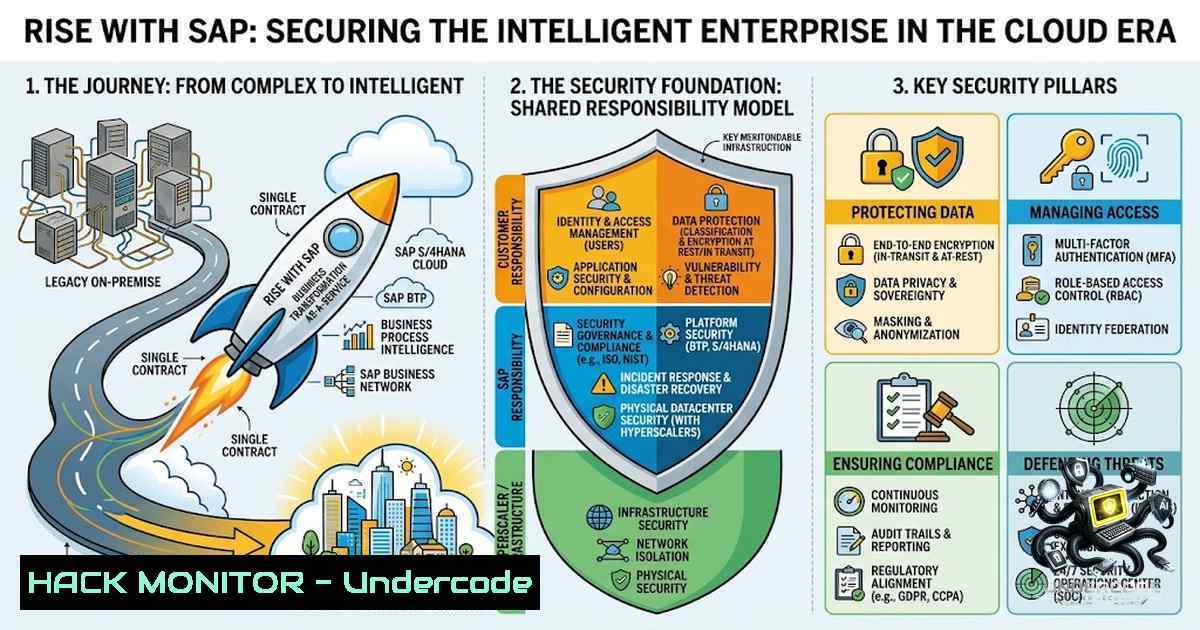
The migration from on-premise SAP ECC to SAP S/4HANA and the “Rise with SAP” model marks a paradigm shift in enterprise resource planning. This transition is not merely a version upgrade but a fundamental re-architecture of business processes into a clean-core, cloud-1ative environment that leverages SAP Business Technology Platform (BTP). However, with this shift toward hyperscaler integration, API-driven extensibility, and real-time data processing, the threat surface expands significantly, making cybersecurity, compliance, and data governance non-1egotiable pillars for a successful transformation.
Learning Objectives & Secrets:
- Objective 1: Master the “Clean Core” Principle to minimize custom code vulnerabilities and ensure seamless, secure upgrades.
- Objective 2 (Secret): Leverage SAP BTP security services (e.g., Identity Authentication and XSUAA) to implement granular access control and protect API endpoints from OWASP Top 10 risks.
- Objective 3 (Secret): Automate Security Compliance and Audit Logging using SAP Cloud ALM and native cloud provider tools (AWS/Azure/GCP) to ensure data sovereignty and regulatory adherence.
You Should Know:
1. The Clean-Core Strategy and Security Hardening
The “Clean Core” principle is central to the Rise with SAP strategy. It mandates that the core S/4HANA system remains free from heavy customizations, moving modifications to the SAP BTP layer. This approach directly impacts security by reducing the complexity of the core database and application layers, thereby limiting potential attack vectors within the primary ERP.
Step‑by‑step guide to analyzing your custom code for “Clean Core” readiness:
– Extract Custom Objects: Execute transaction `SE80` to navigate the repository. Use `SE84` to generate a cross-object analysis list. Export the list of custom development packages (starting with `Z` or Y).
– Identify Modification Types: Use the `SCMON` (ABAP Runtime Analysis) transaction to measure the performance impact of custom code. For standard modifications, use `SPDD` and `SPAU` to check for repository conflicts with the S/4HANA kernel.
– Remediate via BTP: For critical extensions, create an API-driven microservice on SAP BTP using Cloud Foundry. Use the ABAP Cloud development model (strictly utilizing released APIs) to ensure future compatibility.
– Security Check: Use the SAP Code Vulnerability Analyzer (transaction SAT) to run security scans on the remaining ABAP code. Look for critical findings such as missing authority checks (AUTHORITY-CHECK) and SQL injection vulnerabilities.
– Firewall and Whitelisting: On the OS level (Linux/Unix), restrict database access. Use iptables to limit access to the HANA DB port (3[instance number]15) only to the application server tier.
Linux Command to verify database listener security:
netstat -tulpn | grep 3<instance>15
 Check if listening on 0.0.0.0 (potential risk) or specific internal IP
Windows equivalent (PowerShell) to check firewall rules for the SAP instance:
Get-1etFirewallRule -DisplayName "SAP" | Where-Object { $<em>.Direction -eq "Inbound" -and $</em>.Action -eq "Allow" }
2. Securing SAP BTP and API Integrations
Rise with SAP thrives on modern APIs and integrations via SAP Integration Suite. Securing these endpoints is critical to prevent data leakage and unauthorized system access. Weak API security directly compromises the entire hybrid landscape.
Step‑by‑step guide to configuring secure API access using SAP BTP:
– Set Up Identity Authentication: Configure SAP Cloud Identity Services (IAS) as the central Identity Provider (IdP). Enable Multi-Factor Authentication (MFA) for all BTP sub-accounts.
– Configure XSUAA: Create a new service instance of the `xsuaa` application plan. Bind this service to your microservice application.
– Define Security Scopes: In the `xs-security.json` file, define fine-grained scopes (e.g., `$XSAPPNAME.Admin` vs. $XSAPPNAME.Read).
{
"xsappname": "risesec_ext",
"tenant-mode": "dedicated",
"scopes": [
{ "name": "$XSAPPNAME.Admin", "description": "Admin Scope" }
]
}
– API Gateway Security: Use SAP API Management to proxy all external calls. Set up API key validation or OAuth2.0 client credential flows. Implement a spike arrest policy to prevent DDoS attacks.
– Encryption in Transit: Enforce strict TLS 1.3 policies on the API Management gateway. Disable weak ciphers in the `destination` configuration for external endpoints.
3. Data Migration, Governance, and Backup Strategies
Data discipline is a key commitment for Rise success. The migration from ECC to S/4HANA involves massive data transfer, requiring robust backup strategies and real-time replication security to prevent data corruption or loss during cutover.
Step‑by‑step guide for secure data migration:
- Data Masking: Before migrating non-production (sandbox/test) systems, de-identify Personally Identifiable Information (PII). Use SAP Information Lifecycle Management (ILM) to apply anonymization rules.
- Migration Monitoring: Use the SAP Data Migration Monitor (
LTMCorSAP Data Services). Ensure the migration user has only the minimum required privileges (SAP_ALL is strictly forbidden). - Cloud Storage Security: If migrating via cloud storage (AWS S3 or Azure Blob), ensure the storage bucket is private. Enable server-side encryption (SSE-S3 or SSE-KMS). Generate a pre-signed URL with a short expiration time for the transfer.
- Logging: Activate audit logging in the source and target systems. For Linux, enable system auditing using `auditd` to monitor file access to export directories.
Linux command to monitor export file integrity:
auditctl -w /usr/sap/trans/data/ -p rwxa -k sap_migration
4. Compliance, Audit Readiness, and ESG Alignment
Rise with SAP includes native support for ESG reporting, which requires high data integrity. Auditors now demand continuous controls monitoring (CCM) rather than point-in-time checks. You must implement continuous risk assessment to avoid non-compliance penalties.
Step‑by‑step guide to continuous compliance:
- Set up Audit Information System (CAIS): Activate the CAIS in the SAP system to identify critical authorizations and Segregation of Duties (SoD) conflicts.
- Integrate with Governance, Risk, and Compliance (GRC): Connect SAP GRC to the BTP landscape. Use the Rule Set to automatically update SoD violations during user provisioning.
- Azure/AWS Compliance Center: If using a hyperscaler, enable the Security Compliance Center to continuously scan configurations (e.g., ensure S3 buckets or Azure storage accounts are not public). Use Azure Policy to enforce tagging and security headers.
- Cloud ALM: Utilize SAP Cloud ALM for real-time security monitoring. Configure “Health Monitoring” dashboards to track critical security KPIs like failed logins and authorization errors.
5. Change Management and Continuous Improvement (DevSecOps)
Treating Rise as a journey requires a DevSecOps approach. This means integrating security gates into the CI/CD pipeline for SAP transports. “Continuous enablement” means automating security tests for every change.
Step‑by‑step guide for integrating security into the transport pipeline:
– Set up a GitHub Actions or Azure DevOps pipeline: Connect to the SAP BTP Cloud Foundry endpoint.
– Static Code Analysis: Integrate Checkmarx or the SAP Cloud Security Scanner into the pipeline to scan for OAuth misconfigurations and credential leaks.
– Container Security: If deploying via Kyma (Kubernetes), incorporate Trivy or Aqua Security into the pipeline to scan Docker images for known vulnerabilities before deployment.
– Penetration Testing: Schedule automated, scheduled DAST (Dynamic Application Security Testing) scans against the BTP APIs using tools like OWASP ZAP in your non-production environment.
6. Infrastructure Hardening (Linux/HANA)
The underlying OS and database must be hardened. Since Rise uses SAP HANA on Linux, OS-level security is vital.
Step‑by‑step guide:
- Patch Management: Implement an automated patching schedule for the Linux kernel and HANA DB. Use the `SUSE Manager` (for SLES) or
Red Hat Satellite. - Disable Unused Services: Use `systemctl` to disable unnecessary services (e.g.,
cups,sendmail) to reduce the attack surface. - HANA Security: Set up the HANA Audit Policy. Redirect logs to a secure syslog server.
- User Accounts: Remove default users (
sapadm,adm). Enforce password aging usingchage.
Linux command to enforce password policies:
chage -M 90 -m 7 -W 7 <username>
What Undercode Say:
- Key Takeaway 1: The “Clean Core” is your strongest defense. Moving custom logic to BTP is not just an architectural best practice but a security imperative to isolate vulnerabilities from the core business data.
- Key Takeaway 2: Success hinges on treating security as a proactive, continuous practice rather than a one-time checklist. The integration of security controls (IAM, API GW, Continuous Monitoring) into the cloud-1ative fabric is what separates a successful transformation from a security breach waiting to happen.
Analysis: The post highlights a strategic shift, but the technical reality is that the complexity introduced by BTP and hybrid integrations demands high operational maturity. The real “secret” is leveraging native cloud security tools alongside SAP’s administrative tools to bridge the gap between legacy governance and modern threat landscapes. This requires a cultural shift towards DevSecOps, where security teams are embedded in the S/4HANA migration squads from day one.
Prediction:
- +1: The convergence of SAP Rise with hyperscaler native AI security tools (like AWS GuardDuty or Azure Sentinel) will automate threat detection, drastically reducing incident response times and providing a competitive edge for early adopters.
- -1: The initial complexity of mapping SAP roles (PFCG) to cloud IAM policies (Azure AD/AWS IAM) will lead to misconfigurations, potentially resulting in critical data exposure within the first 18 months of mass adoption if rigorous training is not prioritized.
▶️ Related Video (86% Match):
🎯Let’s Practice For Free:
🎓 Live Courses & Certifications:
Join Undercode Academy for Verified Certifications
🚀 Request a Custom Project:
Secure, high-velocity infrastructure and disruptive technological engineering. Contact our engineering team for high-tier development and proprietary systems:
[email protected]
💎 Smart Architecture | 🛡️ Secure by Design | ⭐ Trusted by Thousands
IT/Security Reporter URL:
Reported By: https://lnkd.in/p/e4fT3DaM – Hackers Feeds
Extra Hub: Undercode MoN
Basic Verification: Pass ✅


