
Listen to this Post
Introduction:
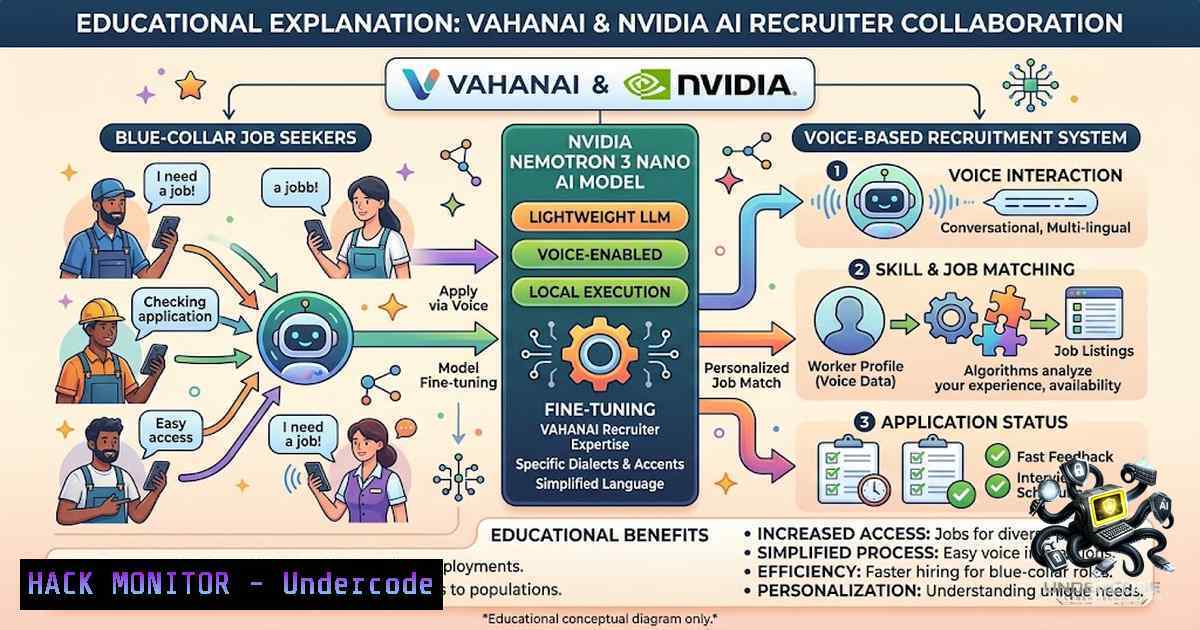
In a significant advancement for HR technology, Indian AI startup Vahan.ai has partnered with NVIDIA to fine-tune its Nemotron 3 Nano model for a voice-based AI recruiter targeting blue-collar hiring. The collaboration, facilitated through NVIDIA’s Inception programme, demonstrates how specialized fine-tuning of large language models can address domain-specific challenges in recruitment, particularly in multilingual, voice-first environments. This development marks a pivotal shift from generic AI assistants to purpose-built models optimized for high-volume, low-latency conversational AI in emerging markets.
Learning Objectives & Secrets:
- Objective 1: Understand the methodology behind fine-tuning a 30-billion-parameter model (Nemotron 3 Nano) using proprietary production data to achieve superior performance over larger models (120-billion parameters) in specialized tasks.
- Objective 2 Secret Tips: Leverage human-corrected recruitment conversations as training data to enhance accuracy in intent recognition and response generation, thereby reducing hallucination in job-matching scenarios.
- Objective 3 Secret Tips: Optimize model inference for telephony environments by focusing on reducing time-to-first response (TTFR) and end-to-end latency, which are critical for maintaining natural conversation flow in voice-based interactions.
You Should Know:
1. Model Fine-Tuning for Domain-Specific NLP Tasks
The core of Vahan.ai’s achievement lies in fine-tuning NVIDIA’s Nemotron 3 Nano, a model optimized for edge and cloud inference. Fine-tuning involves adapting a pre-trained model on a smaller, task-specific dataset. Here, the dataset comprised recruitment conversations, including human-corrected dialogues to correct errors and improve contextual understanding. This process is computationally intensive but can be streamlined using NVIDIA’s NeMo framework, which supports distributed training and mixed precision to reduce time and cost.
For those looking to replicate this approach, consider using the following command to initiate fine-tuning with NVIDIA NeMo on a single GPU:
python /path/to/nemo/examples/nlp/language_modeling/megatron_gpt_finetuning.py \
--config-path=/path/to/config \
--config-1ame=finetune_config.yaml \
trainer.devices=1 \
model.data.data_prefix=/path/to/training_data \
model.tensor_model_parallel_size=1 \
model.pipeline_model_parallel_size=1 \
exp_manager.exp_dir=/path/to/experiment
For distributed multi-GPU training, adjust the tensor and pipeline parallel sizes. This fine-tuning process typically requires a curated dataset in JSONL format where each line contains a prompt-response pair. Windows users can leverage WSL2 with NVIDIA drivers or use Azure/AWS instances with GPU acceleration.
2. Latency Optimization for Voice-Based AI
The reported 6.7x faster time-to-first response (TTFR) and over 3x lower average end-to-end latency are critical for maintaining user engagement in voice calls. Achieving these gains likely involved quantization, pruning, and compiler-level optimizations. NVIDIA TensorRT can be used to optimize the model for inference, significantly reducing latency on NVIDIA GPUs.
To convert a fine-tuned model to TensorRT, use the following:
trtexec --onnx=model.onnx --saveEngine=model_fp16.plan --fp16 --workspace=4096
On Windows, TensorRT can be executed via Docker or native installation with CUDA. For production deployment, consider using NVIDIA Triton Inference Server, which supports dynamic batching and concurrent model execution. Below is a sample configuration for Triton:
name: "nemotron_3_nano"
platform: "tensorrt_plan"
max_batch_size: 8
input: [
{ name: "input_ids", data_type: TYPE_INT32, dims: [ -1, -1 ] }
]
output: [
{ name: "logits", data_type: TYPE_FP16, dims: [ -1, -1, -1 ] }
]
3. Deployment Infrastructure for Telephony Integration
Vahan.ai’s AI recruiter interfaces with telephony systems via SIP or WebRTC. The model must handle real-time audio streaming, speech-to-text (STT), and text-to-speech (TTS) pipelines. For robust deployment, consider using a microservices architecture with Kubernetes for orchestration. Here’s an example of a Kubernetes deployment YAML for the inference service:
apiVersion: apps/v1
kind: Deployment
metadata:
name: ai-recruiter
spec:
replicas: 3
selector:
matchLabels:
app: ai-recruiter
template:
metadata:
labels:
app: ai-recruiter
spec:
containers:
- name: triton-server
image: nvcr.io/nvidia/tritonserver:23.10-py3
args: ["tritonserver", "--model-repository=/models"]
ports:
- containerPort: 8000
volumeMounts:
- mountPath: /models
name: model-volume
- name: stt
image: your/stt-image:latest
ports:
- containerPort: 8080
- name: tts
image: your/tts-image:latest
ports:
- containerPort: 8081
This setup ensures scalability and resilience, critical for handling high call volumes.
4. Benchmarking and Performance Metrics
The fine-tuned model outperformed both the base Nemotron model and Vahan’s earlier 120-billion-parameter model across seven recruitment-specific benchmarks. These benchmarks likely include metrics like intent classification accuracy, response relevance, and conversational coherence. To evaluate your own fine-tuned model, consider implementing a custom evaluation script using Hugging Face’s `evaluate` library:
from evaluate import load
metric = load("accuracy")
predictions = model.predict(test_dataset)
accuracy = metric.compute(predictions=predictions, references=test_labels)
For voice-specific evaluation, use Word Error Rate (WER) for STT components and Mean Opinion Score (MOS) for TTS quality. Additionally, track latency using Python’s `time` module at each pipeline stage.
5. Multilingual Capabilities and Expansion
Vahan.ai currently supports English and Hindi, with plans to add eight more Indian languages. Achieving multilingual support requires extensive linguistic data and fine-tuning across languages. Techniques like cross-lingual transfer learning and multilingual tokenization can be applied. For Hindi, you might use a tokenizer trained on Hindi corpora. Here’s how to implement a multilingual tokenizer using Hugging Face:
from transformers import AutoTokenizer
tokenizer = AutoTokenizer.from_pretrained("bert-base-multilingual-cased")
inputs = tokenizer(["Hello, how are you?", "नमस्ते, आप कैसे हैं?"], padding=True, truncation=True)
For adding new languages, collect or generate synthetic data for those languages and incorporate them into the fine-tuning dataset. The model must be retrained or continue training with the new data, which can be done using NVIDIA NeMo’s continual learning capabilities.
6. Security and API Hardening
Given the sensitivity of recruitment data, API security is paramount. Deploy the AI model behind an API gateway with authentication (OAuth2) and rate limiting. Use HTTPS with TLS 1.3 for encryption. Additionally, implement input validation to prevent prompt injection attacks. Below is a Node.js example for securing a REST API endpoint:
const express = require('express');
const rateLimit = require('express-rate-limit');
const app = express();
const limiter = rateLimit({
windowMs: 15  60  1000, // 15 minutes
max: 100 // limit each IP to 100 requests per windowMs
});
app.use('/api/', limiter);
app.use(express.json());
app.post('/api/recruit', (req, res) => {
// Validate input
if (!req.body.text || typeof req.body.text !== 'string') {
return res.status(400).send('Invalid input');
}
// Process request
});
For cloud deployments on AWS or Azure, use Key Vault or Secrets Manager to store API keys and model credentials securely.
What Undercode Say:
- Key Takeaway 1: Fine-tuning a smaller, specialized model (30B parameters) can outperform larger general-purpose models (120B) on domain-specific tasks, demonstrating that model size isn’t the only determinant of performance; data quality and task alignment matter more.
- Key Takeaway 2: Optimizing for latency and TTFR is essential for voice-based AI applications, especially in telephony environments where user experience hinges on natural conversation flow. Vahan.ai’s achievement of 6.7x faster TTFR underscores the importance of inference optimization techniques.
Analysis: The collaboration between Vahan.ai and NVIDIA highlights a growing trend of enterprise AI fine-tuning. By focusing on blue-collar hiring in India, Vahan.ai addresses a critical market need where voice interfaces are more accessible than text. The model’s multilingual expansion plan indicates a deep understanding of the linguistic diversity in India’s workforce. Moreover, the speed and cost-efficiency of using the 30B model over the 120B model suggest that enterprises should prioritize computational efficiency without sacrificing performance, especially in resource-constrained environments.
Prediction:
+1: As LLM fine-tuning frameworks like NeMo mature, we can expect more domain-specific AI models in HR tech, leading to more accurate and empathetic recruitment processes.
+1: The success of Vahan.ai’s model will encourage other startups to adopt similar fine-tuning strategies, driving innovation in voice-based AI across other sectors like healthcare and education.
-1: Increased reliance on AI for recruitment may raise concerns about algorithmic bias, necessitating rigorous auditing and transparent AI practices to ensure fairness.
-1: The rapid expansion to multiple languages could lead to data scarcity issues, potentially impacting model accuracy for under-resourced languages unless adequate data collection and synthetic generation methods are employed.
+1: Integration with NVIDIA’s hardware ecosystem will likely accelerate, enabling real-time AI processing on edge devices, reducing dependency on cloud infrastructure and improving privacy.
+1: The fine-tuning approach of using human-corrected data sets a benchmark for continuous model improvement, with production workflows providing a feedback loop that enhances system performance over time.
-1: The computational resources required for fine-tuning and maintaining such models could be a barrier for smaller enterprises, potentially widening the technological gap between large and small HR tech companies.
▶️ Related Video (84% Match):
🎯Let’s Practice For Free:
🎓 Live Courses & Certifications:
Join Undercode Academy for Verified Certifications
🚀 Request a Custom Project:
Secure, high-velocity infrastructure and disruptive technological engineering. Contact our engineering team for high-tier development and proprietary systems:
[email protected]
💎 Smart Architecture | 🛡️ Secure by Design | ⭐ Trusted by Thousands
IT/Security Reporter URL:
Reported By: https://lnkd.in/p/ei3NeUsk – Hackers Feeds
Extra Hub: Undercode MoN
Basic Verification: Pass ✅


