
Listen to this Post
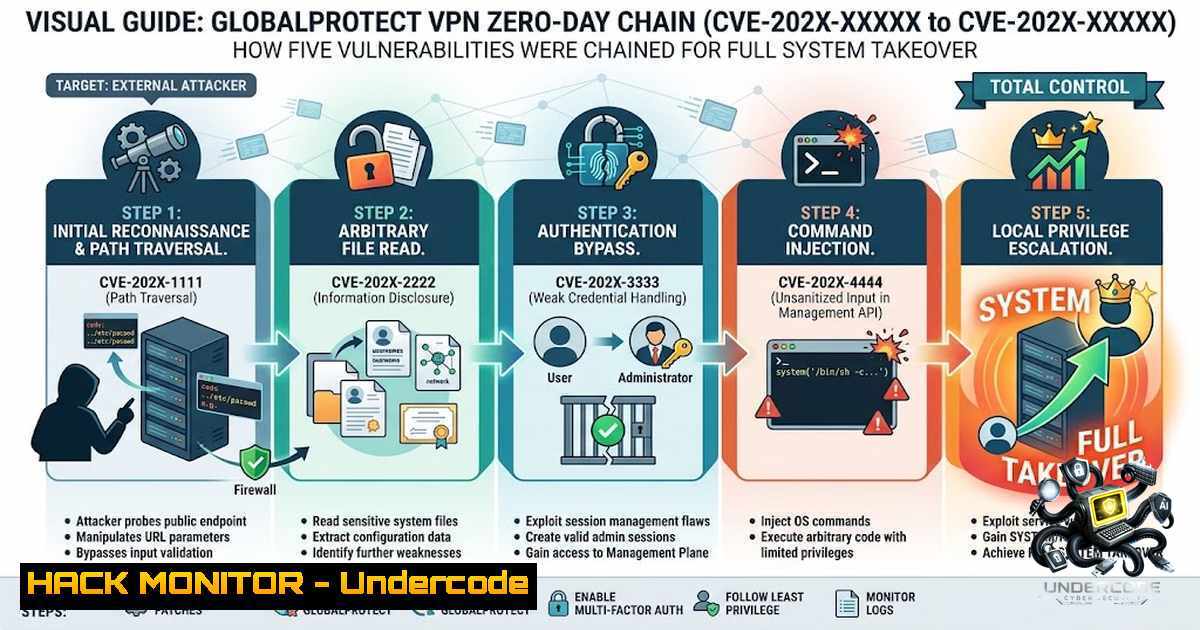
Introduction:
In early April 2026, security researcher Martijn van Ramesdonk uncovered five critical vulnerabilities in Palo Alto Networks’ GlobalProtect VPN endpoint software—ranging from local privilege escalation to full Active Directory password recovery. The findings, now documented at globalunprotect.io, expose a troubling reality: while Palo Alto touts AI-driven threat detection through Project Glasswing and GPT Daybreak, their vulnerability disclosure process remains reactive, opaque, and researcher-unfriendly. This article dissects the technical mechanics of these exploits, provides actionable mitigation steps, and examines the systemic failures in vendor communication that left researchers chasing responses for months.
Learning Objectives & Secrets:
- Objective 1: Understand COM Hijacking for Privileged Code Execution – Learn how GlobalProtect’s trusted `wa_3rd_party_host_64.exe` process instantiates WMI COM objects from HKCU before HKLM, allowing standard users to inject arbitrary DLLs into a signed Palo Alto binary.
- Objective 2: Chain Low-Severity Bugs into SYSTEM-Level Compromise – Master the exploit chain combining reversed IPC encryption (C-03), empty checksum bypass (C-05), and world-writable temp directory abuse (C-06) to achieve NT AUTHORITY\SYSTEM privileges in ~3.5 minutes.
- Objective 3: Weaponize Environment Variable Hijacking – Exploit
WEBVIEW2_BROWSER_EXECUTABLE_FOLDER—a user-writable HKCU environment variable—to force PanGPA.exe to load attacker-controlled DLLs with zero interaction, surviving reboots.
You Should Know:
- COM Hijack via HKCU (C-02): Code Execution in a Trusted Process
GlobalProtect’s `wa_3rd_party_host_64.exe` performs Host Information Profile (HIP) checks by instantiating the `IWbemLocator` COM object (CLSID {4590F811-1D3A-11D0-891F-00AA004B2E24}). Windows resolves COM class lookups from `HKEY_CURRENT_USER\Software\Classes\CLSID` before HKEY_LOCAL_MACHINE—and any standard user can write to their own HKCU hive without admin rights or UAC prompts.
What this does: By placing a malicious DLL path under HKCU\Software\Classes\CLSID\{4590F811-1D3A-11D0-891F-00AA004B2E24}\InprocServer32, the next HIP check (triggered automatically every ~hour, or instantly by killing the process and releasing/renewing DHCP) loads that DLL directly inside wa_3rd_party_host_64.exe—a signed, trusted Palo Alto binary.
Step-by-step guide:
- Create a malicious DLL that executes your payload (e.g., reverse shell, persistence installer).
- Write the registry key as a standard user:
reg add "HKCU\Software\Classes\CLSID{4590F811-1D3A-11D0-891F-00AA004B2E24}\InprocServer32" /ve /t REG_SZ /d "C:\path\to\malicious.dll" /f - Trigger the HIP check instantly by terminating `wa_3rd_party_host_64.exe` and forcing a network change:
taskkill /IM wa_3rd_party_host_64.exe /F
ipconfig /release && ipconfig /renew
- Verify execution—your DLL runs with the process’s privileges (standard user context, but inside a trusted signed binary).
Mitigation: Monitor HKCU\Software\Classes\CLSID for unauthorized subkeys. Apply Palo Alto patches (6.2.8-h10+ or 6.3.3-h11+) which address this vector.
- SYSTEM Privilege Escalation via IPC Encryption Reversal (C-10)
This finding chains four separately minor bugs into a complete standard-user-to-SYSTEM escalation. The core enabler is C-03: the AES-256-CBC key used for IPC communication on TCP port 4767 between `PanGPA.exe` (user context) and `PanGPS.exe` (SYSTEM) was fully reversed.
What this does: A standard user can send arbitrarily crafted, validly encrypted IPC messages to the SYSTEM‑level `PanGPS.exe` process. By injecting a “software-upgrade” message that points to a `.reg` file planted in the world‑writable C:\Windows\Temp, the SYSTEM process imports that registry file—granting the attacker arbitrary writes to HKLM as NT AUTHORITY\SYSTEM.
Step-by-step guide (proof-of-concept logic):
- Plant a malicious `.reg` file in `C:\Windows\Temp` (world-writable) containing your desired SYSTEM-level registry changes (e.g., new user creation, disabling security controls).
- Craft an encrypted “software-upgrade” IPC message using the reversed AES key (available in public PoC at globalunprotect.io).
- Send the message to `PanGPS.exe` on TCP port 4767 (local loopback).
- Observe as `PanGPS.exe` (SYSTEM) executes
reg import C:\Windows\Temp\malicious.reg—your registry changes are applied with full SYSTEM privileges.
Timeline: End-to-end exploit takes ~3.5 minutes, fully automated, single-shot, no reboot required.
Affected versions: GlobalProtect 6.2.8 (prior to -h10) and 6.3.3 (prior to -h11) on all Windows versions.
Mitigation: Upgrade to 6.2.8-h10 (6.2.8-948) or 6.3.3-h11 (6.3.3-c1016) immediately. Restrict write permissions on `C:\Windows\Temp` for non-admin users where possible, and monitor TCP 4767 for anomalous IPC traffic.
3. WebView2 Environment Variable DLL Injection (C-09)
PanGPA.exe uses Microsoft Edge WebView2 to render the GlobalProtect portal/login UI. The WebView2 loader checks the environment variable `WEBVIEW2_BROWSER_EXECUTABLE_FOLDER` before any HKLM registry path. This variable resides in HKCU\Environment—fully writable by the standard user with no admin rights.
What this does: By setting `WEBVIEW2_BROWSER_EXECUTABLE_FOLDER` to an attacker-controlled directory containing a proxy DLL, killing PanGPA.exe causes the SYSTEM‑level `PanGPS.exe` watchdog to respawn it—loading the attacker’s DLL directly into a signed, trusted Palo Alto process.
Step-by-step guide:
- Create a proxy DLL that mimics the WebView2 runtime exports but executes your payload.
- Place the DLL in a directory you control (e.g.,
C:\Users\Public\webview2\). - Set the environment variable as a standard user:
setx WEBVIEW2_BROWSER_EXECUTABLE_FOLDER "C:\Users\Public\webview2\"
(This writes to `HKCU\Environment`.)
4. Kill PanGPA.exe:
taskkill /IM PanGPA.exe /F
5. Wait ~10 seconds—PanGPS.exe respawns PanGPA.exe, which now loads your DLL.
Impact: Persistent code execution inside a trusted signed process, surviving reboots, with zero user interaction.
Mitigation: Monitor `HKCU\Environment` for unauthorized modifications to WEBVIEW2_BROWSER_EXECUTABLE_FOLDER. Apply patches (6.2.8-h10+ / 6.3.3-h11+) which address this vector.
4. SYSTEM Registry Import from World-Writable Path (C-06)
This finding shares the same underlying weakness as C-10: the reversed AES-256-CBC key on the TCP 4767 IPC channel. However, C-06 is simpler: the “software-upgrade” IPC message makes `PanGPS.exe` run `reg import` from `C:\Windows\Temp` as SYSTEM, with no integrity check on the `.reg` file.
What this does: Any standard user can write a `.reg` file to the world-writable `C:\Windows\Temp` directory and send a crafted IPC message to trigger its import by the SYSTEM process—resulting in arbitrary writes to HKLM.
Step-by-step guide:
- Create a `.reg` file in `C:\Windows\Temp` (e.g.,
C:\Windows\Temp\pwn.reg) containing your desired registry changes. - Craft and send the encrypted “software-upgrade” IPC message (using the reversed key from C-03) to `PanGPS.exe` on TCP 4767.
3. Verify—the registry import runs as NT AUTHORITY\SYSTEM.
Affected versions: Same as C-10: 6.2.8 prior to -h10 and 6.3.3 prior to -h11.
Mitigation: Upgrade immediately. As a temporary workaround, restrict write access to `C:\Windows\Temp` for non-admin users and monitor for `reg import` executions originating from PanGPS.exe.
- Active Directory Password Recovery via CredMan Decryption (C-08)
One of the findings (C-08) enables full recovery of a user’s Active Directory password directly off the machine. While the technical writeup is pending full disclosure (Palo Alto has not yet fixed it after five months), the attack vector involves decrypting credentials stored in Windows Credential Manager that GlobalProtect caches.
What this does: By exploiting weaknesses in how GlobalProtect stores and encrypts AD credentials locally, an attacker with local access can recover the user’s plaintext password—bypassing any network-based protections.
Step-by-step guide (conceptual):
- Gain local access to the target machine as the signed-in user (no admin required).
- Extract the encrypted credential blobs from GlobalProtect’s local storage.
- Decrypt using the recovered key material (methodology to be published post-fix).
4. Recover the plaintext Active Directory password.
Mitigation: Until Palo Alto releases a patch, enforce multi-factor authentication (MFA) for all VPN logins and limit local access to corporate devices through strict physical and endpoint security controls.
6. The Disclosure Process Failure: A Researcher’s Nightmare
Van Ramesdonk reported all five vulnerabilities in early April 2026. The outcomes were wildly inconsistent:
– Two vulnerabilities were silently patched under CVE-2026-0251 without notice or credit. The researcher discovered the CVE himself while browsing Palo Alto’s security advisory page and had to request attribution.
– Two more were dismissed as “out of scope”—despite being confirmed, reproducible, and including full proof-of-concept code.
– The last one (C-08) received months of follow-up, a 90-day deadline extended to 120 days, over 40 emails to a PSIRT team that “barely responds”—and Palo Alto still asked to postpone publication further.
What this teaches us: AI can find vulnerabilities—Palo Alto’s Project Glasswing and GPT Daybreak invest heavily in this. But AI won’t fix your disclosure process. That takes accountability.
What Undercode Say:
- Key Takeaway 1: Vendor responsiveness is the weakest link in responsible disclosure. Five confirmed, reproducible vulnerabilities with full PoC should not require months of chasing, silence, and rejections.
- Key Takeaway 2: The exploit chain from C-02 → C-03 → C-05 → C-06 → C-10 demonstrates how multiple “low-severity” bugs compound into a critical SYSTEM compromise. Organizations must patch holistically, not selectively.
Analysis: Palo Alto’s handling of this disclosure reveals a systemic issue: security teams are overwhelmed, PSIRT processes are under-resourced, and researchers are left navigating bureaucratic labyrinths. Meanwhile, the exploits are public—four PoCs are already live at globalunprotect.io, and a fifth drops as soon as Palo Alto fixes it. The irony is palpable: a company that prides itself on AI-driven threat detection struggles to manage human-driven vulnerability reports. Until vendors treat researchers as partners rather than nuisances, the “responsible” in responsible disclosure will remain aspirational.
Prediction:
- -1 Palo Alto’s delayed response and inconsistent handling will erode researcher trust, potentially reducing future voluntary disclosures and pushing more findings to zero-day exploit markets.
- -1 The public availability of four PoCs will trigger a wave of opportunistic attacks against unpatched GlobalProtect instances, particularly in enterprises with slow patch cycles.
- +1 This incident will pressure Palo Alto to overhaul its PSIRT processes, potentially adopting more transparent timelines, automated CVE attribution, and dedicated researcher liaisons.
- +1 The detailed technical documentation at globalunprotect.io will serve as a valuable educational resource for defenders, enabling more effective detection and mitigation of similar COM hijacking and IPC abuse patterns.
- -1 Until C-08 (AD password recovery) is patched, organizations remain exposed to credential theft—a risk compounded by the five-month-and-counting delay.
- +1 The broader security community will increasingly scrutinize VPN endpoint software, leading to more discoveries and ultimately stronger products—if vendors listen.
▶️ Related Video (82% Match):
🎯Let’s Practice For Free:
🎓 Live Courses & Certifications:
Join Undercode Academy for Verified Certifications
🚀 Request a Custom Project:
Secure, high-velocity infrastructure and disruptive technological engineering. Contact our engineering team for high-tier development and proprietary systems:
[email protected]
💎 Smart Architecture | 🛡️ Secure by Design | ⭐ Trusted by Thousands
IT/Security Reporter URL:
Reported By: https://lnkd.in/p/emxMHesz – Hackers Feeds
Extra Hub: Undercode MoN
Basic Verification: Pass ✅


