
Listen to this Post
Introduction:
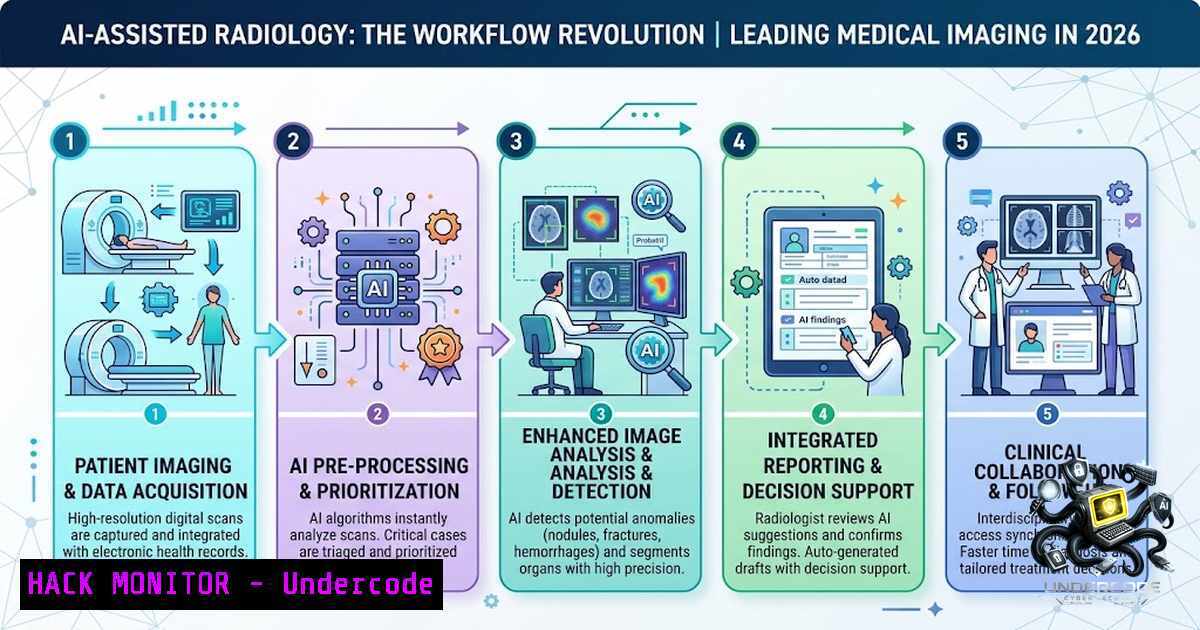
The integration of artificial intelligence into radiology has transitioned from experimental research to live clinical workflow augmentation. In 2026, AI models do not merely flag anomalies but actively generate comprehensive draft reports for chest X-rays and other modalities, moving from a “decision-support” tool to a “productivity-layer” component in the imaging chain. This shift necessitates a new cybersecurity framework focused on data integrity, API security, and the secure management of patient data as it flows between imaging equipment, cloud-based AI endpoints, and PACS (Picture Archiving and Communication Systems).
Learning Objectives & Secrets:
- Objective 1 (Security-Centric): Understand the fundamental shift in data sovereignty and the attack surface introduced by cloud-based AI drafters. Learn to map data flows from modality (scanner) to AI processor and back to the Radiologist Information System (RIS).
- Objective 2 (Secret Tip for Integration): Master the specific API authentication and hardening techniques required for deploying Aidoc or DeepHealth solutions within a HIPAA/FDA-compliant environment, focusing on immutable audit trails.
- Objective 3 (Secret Tip for Mitigation): Discover how to implement local data drift detection to prevent “Adversarial Radiological” attacks where malicious inputs may alter AI-generated measurements without visibly changing the image to the human eye.
You Should Know:
- Securing the “Image In → AI Draft → Radiologist Sign” Pipeline
The operational model described relies on a fragile chain of custody. The image moves from the imaging device (e.g., CT or X-Ray) to a PACS server, then is forwarded to an AI engine—often hosted on a private cloud or edge server—and the draft is returned to the workflow list. This creates an opportunity for data interception or injection.
Step‑by‑step guide to audit the connection:
- Linux (Network/Host): Use `tcpdump` or `ss` to monitor active connections. Ensure the AI endpoint is whitelisted and not responding to unnecessary traffic.
sudo tcpdump -i eth0 host [bash] and port 443 -v
- Windows (PowerShell): Use `Test-1etConnection` to validate secure channel connectivity to the cloud service provider hosting the AI draft engine.
Test-1etConnection [bash] -Port 443
- Mitigation: Implement mutual TLS (mTLS) between the PACS gateway and the AI inference engine. This ensures that the AI engine only accepts requests from validated PACS nodes, preventing spoofed imaging data from entering the reporting queue.
- API Security and Payload Integrity for Clinical AI
AI models like Harrison.Rad 1.5 receive DICOM (Digital Imaging and Communications in Medicine) data via RESTful APIs or FHIR (Fast Healthcare Interoperability Resources). However, a critical gap exists in the validation of the request payload. A crafty attacker could intercept an API call and modify the “Study Description” or “Patient ID” fields, causing the AI to generate a report for the wrong patient or with incorrect metadata.
Step‑by‑step API hardening:
- Verify Signatures: Ensure your API gateway validates JSON Web Signatures (JWS) for incoming imaging metadata.
- Linux/Ubuntu (OpenSSL): If using a local AI server, check the SHA-256 checksum of the DICOM header to ensure the metadata hasn’t been altered in transit.
openssl dgst -sha256 -verify public_key.pem -signature sig.bin data.dcm
- Windows (CertUtil): Validate file integrity of received images before sending to the AI:
CertUtil -hashfile C:\DICOM\Study001.dcm SHA256
- Recommendation: Enforce strict schema validation on the REST API to reject requests containing unexpected tags (e.g., private DICOM fields that could cause parsing errors in the AI’s attention mechanism).
- Data Drift Detection and Bias Monitoring as an Incident Response Strategy
The article highlights “local data drift” as a critical limit. In cybersecurity terms, a shift in AI accuracy isn’t just a performance issue; it can be a red flag for a poisoning attack or hardware malfunction (e.g., a failing X-ray tube that changes image noise characteristics). Radiologists must monitor “Confidence Scores” output by the AI.
How to setup monitoring:
- Logging: On the Windows server hosting the PACS, enable detailed audit logs for AI-pushed reports.
- Automation: Use `auditd` on Linux to track access to the AI model weights directory.
sudo auditctl -w /opt/aidoc/models/ -p wa -k AI_MODEL_INTEGRITY
- Training Scenario: If the AI’s confidence level drops below 85% consistently over a shift (8 hours), initiate a rollback to a stable model version. This is akin to mitigating a zero-day vulnerability; you revert to a known good state until the root cause is identified.
4. Cloud Hardening for the “Super Radiologist” Model
The transition to AI-assisted radiology necessitates a hybrid cloud architecture where private patient data is processed outside of the traditional hospital firewall. To comply with regulations, you must secure the “edge” where the AI lives.
Implementation checklist:
- Network Segmentation: Isolate the AI processing VLAN from the general hospital administrative network.
- Command (Linux Firewall):
iptables -A INPUT -s [bash] -j ACCEPT
iptables -A INPUT -s [bash] -j DROP
- Windows Firewall: Configure advanced rules to block outbound traffic from the AI server except to the specific hostnames required for model updates (preventing data exfiltration).
New-1etFirewallRule -Direction Outbound -Action Block -RemoteAddress Any -Description "Block all unless whitelisted"
- Vulnerability Mitigation: Regularly patch the container runtime (Docker/Kubernetes) where the AI inference engine runs. Use `docker scan` to check for CVEs in the base image.
5. Governance, Audit Trails, and “Who Signed This?”
The article emphasizes that the human “still signs.” This legal requirement translates to a cryptographic requirement: the signature must be non-repudiable. The system must log exactly what the AI suggested versus what the radiologist changed.
Implementation for Legal Compliance:
- Database Integrity: Use `CHECKSUM TABLE` in MySQL (if used for PACS metadata) to verify that report history hasn’t been tampered with.
CHECKSUM TABLE radiology_reports;
- Linux Syslog: Forward all approval events to a central SIEM (Security Information and Event Management).
logger -p local0.info "Report ID: 12345 signed by Dr. X; AI Draft overridden on measurement Y."
- Best Practice: The “Save” function on the workstation should trigger a cryptographic hash of the final signed report, stored on a blockchain-like ledger (or simple immutable storage) to satisfy audit requirements.
What Undercode Say:
- Key Takeaway 1: The “AI” is not a threat actor but a high-privilege API endpoint. Securing it requires the same Zero Trust principles applied to admin accounts—continuous verification of every image request.
- Key Takeaway 2: The biggest vulnerability isn’t the AI’s accuracy; it’s the dependency on the integrity of the underlying infrastructure. If the data pipeline is poisoned, the AI becomes an unwitting accomplice in producing a false report.
Analysis: The integration of AI drafters introduces a complex “insider threat” dynamic. While the AI lacks intent, its accessibility allows for unintended data exposure. The shift to AI requires a security team to become experts not just in firewalls, but in the specific DICOM protocol and medical device interoperability. The attack surface has grown from securing a single PACS server to securing a distributed mesh network of imaging nodes and cognitive services. If the authentication between the PACS and AI is breached, an attacker could effectively dictate the “findings” that the radiologist sees, making the human verification step ineffective. Conversely, well-hardened, on-premise AI models can significantly reduce the risk of data exfiltration compared to sending all imaging data to a public cloud vendor.
Prediction:
- -1: In the next two years, there will be a significant incident where an AI drafting system is exploited via adversarial DICOM images to hide critical findings, leading to a delay in patient care and a $10M+ HIPAA breach settlement.
- +1: Open-source vulnerability testing frameworks specifically designed for medical imaging AI (fuzzing DICOM headers) will emerge by 2027, allowing hospitals to proactively test their AI resilience before deployment.
- -1: The reliance on high-volume drafting will increase the risk of “automation bias,” where radiologists will sign off on AI-generated reports with less scrutiny, potentially missing errors that the AI model is not calibrated to detect, causing a legal liability crisis.
- +1: The security requirements for medical AI will force the adoption of Hardware Security Modules (HSM) for AI model storage, creating a new revenue stream for cybersecurity firms specializing in healthcare IoT.
▶️ Related Video (86% Match):
🎯Let’s Practice For Free:
🎓 Live Courses & Certifications:
Join Undercode Academy for Verified Certifications
🚀 Request a Custom Project:
Secure, high-velocity infrastructure and disruptive technological engineering. Contact our engineering team for high-tier development and proprietary systems:
[email protected]
💎 Smart Architecture | 🛡️ Secure by Design | ⭐ Trusted by Thousands
IT/Security Reporter URL:
Reported By: https://lnkd.in/p/e6RJnE7W – Hackers Feeds
Extra Hub: Undercode MoN
Basic Verification: Pass ✅


