
Listen to this Post
Introduction:
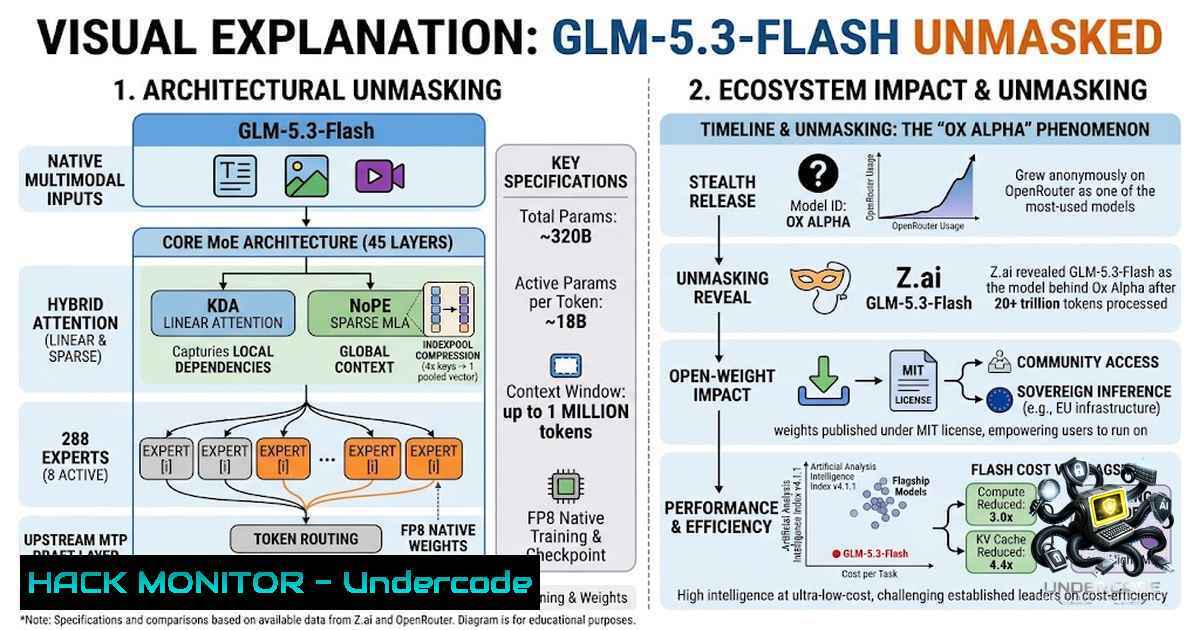
The AI community spent the better part of a week puzzling over “Ox Alpha,” an anonymous model that surged to become the largest launch in OpenRouter’s history. On August 26, 2026, Z.ai (Zhipu AI) revealed the mystery model’s true identity: GLM-5.3-Flash — a 320-billion-parameter Mixture-of-Experts (MoE) model with just 18 billion active parameters per token, released under the MIT license. More significantly, Z.ai confirmed that the model’s anonymous testing period — handling approximately 100 trillion tokens of daily traffic — was powered entirely by a cluster of over 100,000 domestically produced Chinese AI chips, marking a pivotal moment in the geopolitics of AI infrastructure. This article dissects the technical architecture, benchmark performance, deployment pathways, and security implications of GLM-5.3-Flash for cybersecurity and IT professionals.
Learning Objectives & Secrets:
- Objective 1: Understand GLM-5.3-Flash’s hybrid MoE architecture — how 320B total parameters with only 18B activated per token achieves frontier-level performance at one-tenth the cost of its predecessor.
-
Objective 2 Secret Tip: Leverage native multimodality for security workflows — the model natively accepts text, image, and video input without bolt-on vision adapters, enabling direct analysis of screenshots, video feeds, and multimodal logs.
-
Objective 3 Secret Tip: Optimize deployment with the right inference framework — choose vLLM for multi-GPU low-latency serving, SGLang for long-context high-throughput workloads, or KTransformers for consumer-grade GPU with large RAM.
You Should Know:
1. Architecture Deep Dive: Hybrid Attention and IndexPool
GLM-5.3-Flash represents a fundamental architectural departure from its predecessors. The 45-layer language model interleaves KDA linear-attention layers — which capture local dependencies through state modeling — with NoPE sparse MLA layers that retrieve global context via a lightweight indexer. Each token routes through 8 of 288 experts, and the model ships with native FP8 weights plus one MTP (Multi-Token Prediction) draft layer.
The efficiency gains are substantial. At a 1-million-token context window, the indexer itself becomes a latency and memory bottleneck. Z.ai addresses this with IndexPool, which compresses four indexer key vectors into one through weighted pooling. The company reports approximately 3× less attention compute and a 4.4× smaller KV cache compared to GLM-5.3. The model was pre-trained on a 30-trillion-token multimodal corpus, making it the first GLM-5 series model with native multimodality.
- Performance Benchmarks: Where It Wins and Where It Doesn’t
GLM-5.3-Flash’s benchmark scores tell a nuanced story. Against its predecessor GLM-5.2, the improvements are dramatic: DeepSWE v1.1 climbs from 46.2 to 63.4; AutomationBench v1.0.6 nearly doubles from 26.2 to 48.8; Terminal Bench 2.1 moves from 81.0 to 84.3.
Against closed frontier models, the picture is mixed — which is what “approaching” Claude Opus 4.8 means in practice. On Terminal Bench 2.1, GLM-5.3-Flash scores 84.3 versus Opus 4.8’s 85.0 and GPT-5.6 Terra’s 87.4. On DeepSWE v1.1, it clears Opus 4.8 (58.0) but trails GPT-5.6 Terra (69.6) and Gemini 3.7 Flash (65.3). On Z.ai’s internal Code Bench v1.0, it reaches 29.0 against Opus 4.8’s 29.5.
The vision capabilities are new territory for the series. GLM-5.3-Flash reports 62.4 on OfficeQA Pro against Opus 4.8’s 48.9, and 89.4 on CharXiv Reasoning with tools against Opus 4.8’s 89.9. It is weaker on video and perceptual tasks: BabyVision 53.4 against Gemini 3.7 Flash’s 70.9, and MVBench 77.8 against 82.2.
Notably, GLM-5.3-Flash outperforms DeepSeek-V4-Flash on Terminal-Bench 2.1 (84.3 vs. 82.7) and DeepSWE (63.4 vs. 54.4) while undercutting DeepSeek’s pricing significantly.
3. Deployment Guide: From API to Self-Hosting
Step 1: API Quick Start (Recommended for Most Teams)
The fastest path to production is Z.ai’s hosted API. Create an API key and use the OpenAI-compatible client:
from openai import OpenAI

client = OpenAI(
api_key="YOUR_API_KEY",
base_url="https://open.bigmodel.cn/api/paas/v4/"
)

response = client.chat.completions.create(
model="glm-5.3-flash",
messages=[{"role": "user", "content": "Analyze this security log for anomalies."}],
temperature=1,
top_p=0.95,
reasoning_effort="max"
)
print(response.choices[bash].message.content)
The official recommendation is `temperature=1` and top_p=0.95; `reasoning_effort` can be set to `max` for enhanced reasoning capability. On OpenRouter, the model ID is `z-ai/glm-5.3-flash` with a 1,048,576-token context window.
Step 2: Download Open Weights for Self-Hosting
The model weights are available on Hugging Face under the MIT license at zai-org/GLM-5.3-Flash. The default FP8 checkpoint is approximately 306 GiB before runtime and KV-cache overhead.
git lfs install
git clone https://huggingface.co/zai-org/GLM-5.3-Flash /path/to/GLM-5.3-Flash
Verify the weights were downloaded correctly:
ls -lh /path/to/GLM-5.3-Flash
Step 3: vLLM Deployment (NVIDIA Hopper and Newer)
For production multi-GPU serving, vLLM is the recommended path. Use the official Docker image before the integration is merged into the public repository:
docker run --gpus all --privileged --ipc=host -p 8000:8000 \
-v ~/.cache/huggingface:/root/.cache/huggingface \
-e VLLM_ENGINE_READY_TIMEOUT_S=3600 \
vllm/vllm-openai:glm53-flash \
zai-org/GLM-5.3-Flash \
--tensor-parallel-size 8 \
--1o-enable-flashinfer-autotune \
--tool-call-parser glm47 \
--enable-auto-tool-choice \
--reasoning-parser glm45
For a GB200 tray with FP8 and MTP enabled:
vllm serve zai-org/GLM-5.3-Flash \
--tensor-parallel-size 4 \
--kv-cache-dtype fp8 \
--speculative-config '{"method":"mtp","num_speculative_tokens":5}' \
--tool-call-parser glm47 \
--reasoning-parser glm45 \
--enable-auto-tool-choice
Critical Requirements:
- FlashInfer 0.6.18 or newer is required for NoPE sparse MLA initialization
- The model supports NVIDIA Hopper and newer GPUs, and AMD Instinct gfx950 via ROCm
- Self-hosting realistically requires at least an 8-GPU node or a GB200 tray at TP4
4. Security and Compliance Considerations
GLM-5.3-Flash’s open-weight nature under the MIT license presents both opportunities and risks for cybersecurity professionals. Independent fingerprinting groups found a sharply concentrated censorship pattern that blocks or alters outputs on seven China-domestic sensitive topics. However, the MIT license enables organizations to inspect, modify, and deploy the model rather than depending exclusively on an anonymous API endpoint.
The model’s cyber capabilities grew faster than expected during development, prompting Z.ai to hold back GLM-5.3’s weights for a two-week safety review before releasing GLM-5.3-Flash. Z.ai collaborated with Tsinghua University, Nankai University, and leading Chinese security teams including QIANXIN, Tencent Xuanwu, and CyberKunlun for intensive red-team testing and security assessments, collectively identifying 2,436 vulnerabilities (after initial screening and deduplication), of which 1,097 were classified as medium-to-high severity.
For security teams, GLM-5.3-Flash represents a dual-edged tool: it can accelerate vulnerability discovery and security auditing, but its open weights also mean adversaries can strip guardrails. An “uncensored” version has already appeared on Hugging Face. Organizations should implement API security best practices — rate limiting, input sanitization, output filtering, and audit logging — when deploying the model in production environments.
5. The Chinese Chip Factor: Geopolitical Implications
Perhaps the most significant revelation is that GLM-5.3-Flash’s anonymous testing phase — handling approximately 100 trillion tokens daily — was powered entirely by a cluster of over 100,000 domestically produced Chinese AI chips. Z.ai claims the cost efficiency is comparable to NVIDIA GPUs. While Z.ai has not confirmed specific suppliers, reports suggest the chips may come from Huawei, Moore Threads, and Hygon.
This development has drawn analysis from SemiAnalysis, which characterized it as a test of NVIDIA’s moat. Following the announcement, Z.ai’s Hong Kong-listed shares surged over 8%. For cybersecurity and IT professionals, this signals a growing diversification of AI hardware supply chains — and with it, new vectors for supply chain security assessments.
What Undercode Say:
- Key Takeaway 1: GLM-5.3-Flash’s hybrid attention architecture with IndexPool delivers real efficiency gains — 3× less attention compute and 4.4× smaller KV cache than GLM-5.3 — making 1M-token context workloads economically viable for the first time in an open-weight model.
-
Key Takeaway 2: The MIT license and Hugging Face availability democratize access to frontier-level AI, but the rapid appearance of an “uncensored” version underscores the security governance challenges that come with open-weight models.
The broader implication is that GLM-5.3-Flash represents a convergence of three disruptive trends: open-weight licensing that rivals closed models, native multimodality that eliminates vision-adapter overhead, and domestic chip infrastructure that challenges NVIDIA’s dominance. For security teams, this means AI capabilities are becoming more accessible, more affordable, and more difficult to control. The model’s strong performance on coding and agentic benchmarks (63.4 on DeepSWE vs. 46.2 for GLM-5.2) suggests it will accelerate automation of security tasks — from log analysis to vulnerability discovery — while simultaneously lowering the barrier for adversarial use. Organizations should prioritize establishing AI governance frameworks that address model provenance, output validation, and threat monitoring.
Prediction:
- +1 GLM-5.3-Flash will accelerate the commoditization of frontier AI, forcing closed providers to further reduce pricing and expand free tiers — benefiting enterprises with tighter AI budgets.
-
+1 The MIT license will spur a wave of fine-tuned security-specific variants, potentially leading to specialized models for vulnerability detection, malware analysis, and compliance auditing.
-
-1 The open-weight nature and rapid “uncensored” forks will increase the attack surface for adversarial AI use, including automated social engineering, credential theft, and code vulnerability exploitation.
-
-1 Reliance on domestic Chinese chip infrastructure — while impressive — introduces supply chain transparency concerns; organizations deploying the model should conduct thorough hardware and firmware security assessments.
▶️ Related Video (86% Match):
https://www.youtube.com/watch?v=1UPKWHa0FoY
🎯Let’s Practice For Free:
🎓 Live Courses & Certifications:
Join Undercode Academy for Verified Certifications
🚀 Request a Custom Project:
Secure, high-velocity infrastructure and disruptive technological engineering. Contact our engineering team for high-tier development and proprietary systems:
[email protected]
💎 Smart Architecture | 🛡️ Secure by Design | ⭐ Trusted by Thousands
IT/Security Reporter URL:
Reported By: https://lnkd.in/p/e66X6MiB – Hackers Feeds
Extra Hub: Undercode MoN
Basic Verification: Pass ✅


