
Listen to this Post
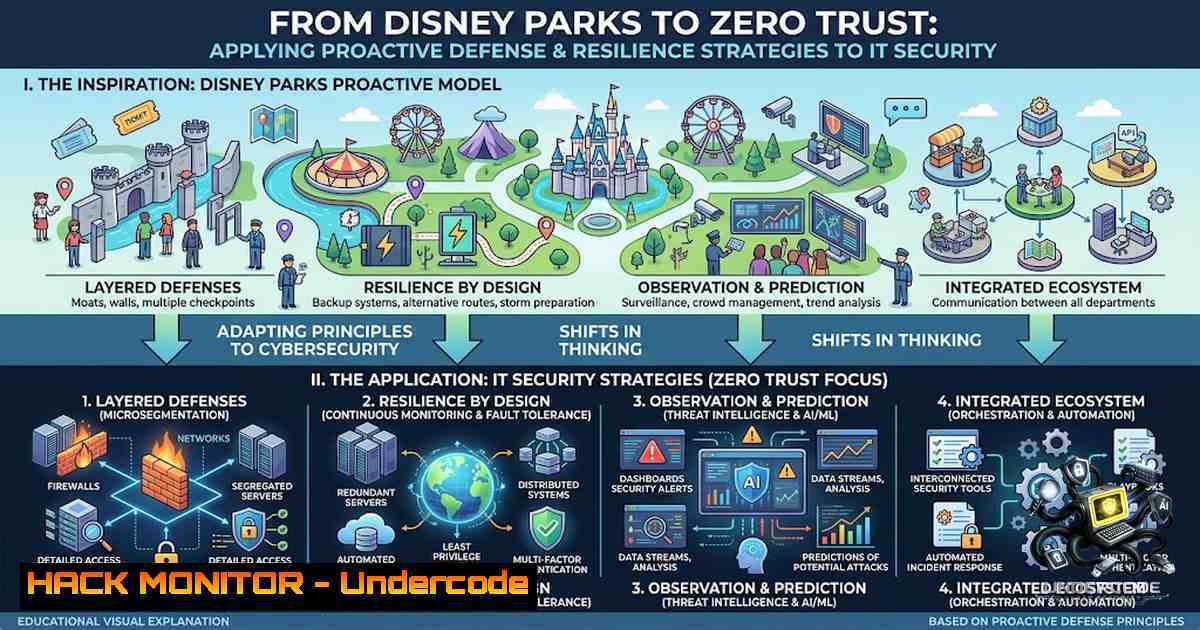
Introduction:
The latest survival guide for a day at Walt Disney World and Universal Studios reads less like vacation advice and more like a cybersecurity playbook. Techniques such as pre-emptively applying blister treatments, using pain-1umbing creams before pain begins, and carrying battery backups for mobile apps are textbook examples of proactive defense, redundancy, and resilience. In the same way visitors deploy these strategies to mitigate the chaos of theme park logistics, cybersecurity professionals must implement “pre-event” configurations, resource redundancy, and pain-free incident response plans to ensure operational continuity and system integrity under peak digital loads.
Learning Objectives & Secrets:
- Objective 1: Proactive Hardening (Anti-Chafe Pre-Application). Understand that system hardening and vulnerability patching must occur before deployment. Waiting until a breach (blister) occurs increases complexity and recovery costs.
- Objective 2: Latency Management with Lidocaine. Use performance tuning and monitoring agents to “numb” latency spikes and resource bottlenecks, allowing applications to maintain pace during high-traffic events.
- Objective 3: Resource Resilience via Liquid I.V. Implement power and connectivity redundancy strategies (UPS, 5G failover) to “rehydrate” system throughput and avoid complete shutdown during peak API request floods.
You Should Know:
1. Pre-emptive System Hardening: Applying the “Anti-Chafe” Layer
The post emphasizes that anti-chafe products are useless if applied after the friction damage is done. In cybersecurity, this translates to the principle of “Secure by Design.” Hardening scripts and baseline configurations must be applied to operating systems and containers before they are connected to production networks.
- Step‑by‑step guide:
- Linux (CIS Benchmarks): Run a pre-configured hardening script using `apt-get install lynis` and execute `lynis audit system` to identify weaknesses before deployment.
- Windows (PowerShell): Use the Security Compliance Toolkit. Execute `Set-MpPreference -DisableRealtimeMonitoring $false` to ensure real-time protection is active prior to application launch.
- Configuration: Enforce AppLocker or SELinux policies. For web servers, remove default pages and disable unused modules before going live to shrink the attack surface.
2. Latency “Lidocaine”: Performance Tuning and Disaster Recovery
Travelers use lidocaine to preemptively numb foot pain, allowing them to walk longer without stopping. For servers, this means implementing Web Application Firewalls (WAF) and rate-limiting to “numb” the impact of Distributed Denial-of-Service (DDoS) attacks or traffic spikes, ensuring the “walker” (application) doesn’t stop.
- Linux Commands:
- Install `htop` for real-time process monitoring:
sudo apt install htop. - Use `tc` (Traffic Control) to simulate network latency for disaster testing:
sudo tc qdisc add dev eth0 root netem delay 100ms. - Windows Commands:
- Use PowerShell to simulate CPU load for stress testing:
Get-WmiObject -Class Win32_Processor. - Best Practice: Set up automatic scaling policies (AWS Auto Scaling or Kubernetes HPA) so that infrastructure expands painlessly before the traffic tsunami hits the ticketing API.
3. Resource “Hydration” and Redundancy: API Security
Just as Liquid I.V. transforms a glass of free water into an effective hydration solution, API gateways must transform raw HTTP requests into secure, validated transactions.
- API Security Config:
- Authentication: Deploy OAuth 2.0 with JWT. Validate tokens on edge routers.
- Rate Limiting: Configure Nginx rate limiting:
limit_req zone=one burst=10 nodelay;. - Backup Routes: Establish failover endpoints. If the primary payment gateway fails, route traffic to a secondary “hydration” provider (backup data center).
- Verification: Use `curl -v https://yourapi.com/health` to check status codes and ensure response times remain under 200ms.
4. Mitigating The “Rain Poncho” Attack: Cloud and Data Hardening
Buying a poncho at Walmart instead of inside the park prevents a high-cost “impulse buy” during a downpour. In IT, this is analogous to leveraging cloud-agnostic backup storage to avoid vendor lock-in and the high “cost” of egress fees during disaster recovery.– Cloud Hardening:
– Encryption: Ensure S3 buckets (or Azure Blobs) are encrypted with Customer-Managed Keys (CMK).
– Snapshots: Schedule automated snapshots of critical EC2 instances using `aws ec2 create-snapshot`. - Spoiler Alert: Test recovery by executing a full system restore in a staging environment before the storm (ransomware) hits.
- Command: Verify object integrity using `Get-FileHash` in PowerShell for downloaded backups.
- Battery Management: Endpoint Security and Mobile Device Management (MDM)
The “Mini Advil and Powerbank” tip highlights the need to handle unexpected disruptions (headaches) and connectivity failure (battery depletion). For enterprises, this means deploying MDM to enforce security policies and ensure devices don’t become “flat” (compromised) during peak usage.
- MDM Best Practices:
- Remote Wipe: Configure Azure AD or JAMF to enable remote wipe if a device is lost in the “theme park.”
- App Whitelisting: Allow only approved apps to run, much like how a visitor prioritizes using the Disney app over random third-party tools.
- Installation: Enforce certificate-based authentication to prevent “man-in-the-middle” attacks on public Wi-Fi networks.
6. Windows and Linux Hardening for “Pedestrian” Servers
Since every “visitor” (request) must be validated, operating system security is crucial.
- Linux Hardening:
- Disable root login:
sudo passwd -l root. - Configure
ufw: `sudo ufw default deny incoming` andsudo ufw allow ssh. - Windows Server Core:
Set-1etFirewallProfile -Profile Domain,Public,Private -Enabled True.- Implement BitLocker to ensure data is encrypted at rest, matching the concept of keeping “cash and cards” secure.
What Undercode Say:
- Key Takeaway 1: The window for effective mitigation is before the incident, not during. Applying “creams” (patches) after the fact leads to system “blisters” (downtime) that are more expensive to treat.
- Key Takeaway 2: Infrastructure must have a “Powerbank” mindset. Latency, bandwidth, and compute power require active monitoring and fallback strategies to sustain high user concurrency without crashing.
Analysis: This comparison highlights a fundamental truth in cybersecurity: resilience is built in advance. Just as a traveler packs band-aids for a 10-mile walk, an enterprise must pack backup networks and zero-trust architecture for potential cyber “rain storms.” The application of local anesthetics (performance boosters) must be calibrated with caution—too much and you ignore critical alarms, too little and you fail under load. The use of external off-the-shelf ponchos (open-source or multi-cloud solutions) offers a financial hedge against the premium prices of proprietary lock-ins. However, this strategy requires rigorous testing (simulated rain) to ensure the shield holds up. Ultimately, both the theme park goer and the security engineer share the same philosophy: expect friction, prepare for exhaustion, and always have a backup power source ready.
Prediction:
- +1: Adoption of “pre-failure” maintenance schedules will increase, driven by AI-predictive analytics that anticipate hardware failure before it occurs, reducing unplanned outages by 30%.
- -1: As systems become more reliant on automation, the “Lidocaine” effect may numb engineers to underlying security threats, leading to a false sense of security and potential zero-day exploitation.
- +1: Multi-cloud redundancy will become the standard “poncho” against ransomware, allowing companies to quickly switch operations to unaffected zones without paying “in-park” ransom fees.
- -1: The reliance on portable power (BYOD and mobile endpoints) increases the risk surface for data exfiltration, as more employees use unmanaged devices to access corporate apps.
- +1: API security will evolve to include dynamic rate-limiting and verification, mirroring the “Liquid I.V.” principle of maximizing efficiency from limited resources to sustain peak performance.
▶️ Related Video (78% Match):
🎯Let’s Practice For Free:
🎓 Live Courses & Certifications:
Join Undercode Academy for Verified Certifications
🚀 Request a Custom Project:
Secure, high-velocity infrastructure and disruptive technological engineering. Contact our engineering team for high-tier development and proprietary systems:
[email protected]
💎 Smart Architecture | 🛡️ Secure by Design | ⭐ Trusted by Thousands
IT/Security Reporter URL:
Reported By: https://lnkd.in/p/eMSHPxDt – Hackers Feeds
Extra Hub: Undercode MoN
Basic Verification: Pass ✅


