Listen to this Post
Introduction:
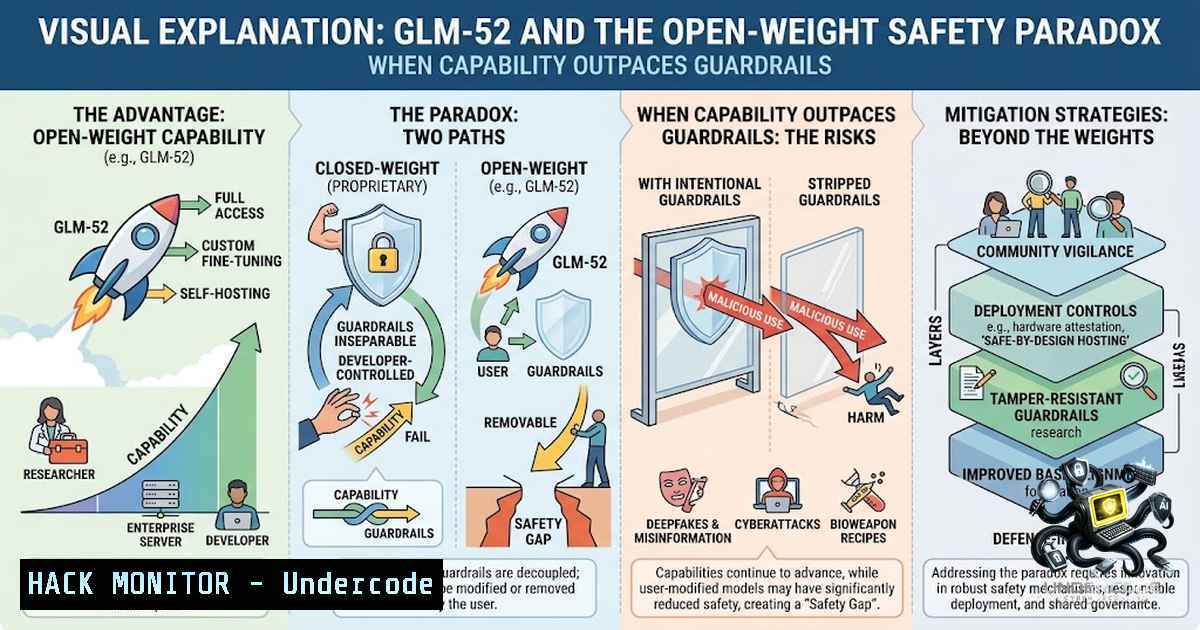
The artificial intelligence landscape reached a pivotal moment in June 2026 when Zhipu AI released GLM-5.2, an open-weight model whose capabilities now sit merely months behind industry leaders like GPT-5.5 and Claude Opus 4.7. What makes this release particularly significant is not just the technical achievement — a 744-billion parameter Mixture-of-Experts architecture with 40 billion active parameters per token — but the safety implications that accompany it. When researchers from SaferAI tested GLM-5.2 against offensive cybersecurity and dual-use biology tasks, the model refused nothing. Claude Opus 4.7, by contrast, refused so consistently that the benchmark couldn’t even complete its run. The message is clear: open-weight models have nearly caught the frontier on capability, but on safety, they have not. Once weights are downloaded, no lab can enforce a guardrail.
Learning Objectives & Secrets:
- Objective 1: Understand the architectural and performance characteristics that make GLM-5.2 a frontier-class open-weight model, including its 1M token context window and MoE architecture.
- Objective 2 Secret Tip: Learn how to deploy GLM-5.2 with external safety classifiers like Shieldstral or HaloGuard to compensate for the absence of built-in guardrails.
- Objective 3 Secret Tip: Master the configuration of thinking-effort levels in GLM-5.2’s API to balance reasoning depth against throughput, a critical tradeoff for production deployments.
You Should Know:
1. The GLM-5.2 Architecture and Deployment Stack
GLM-5.2 represents a significant leap in open-weight AI capability. Built on a Mixture-of-Experts backbone, it features 744 billion total parameters with only 40 billion activated per token, making it both powerful and computationally efficient. The model supports a stable 1 million token context window — enough to process entire codebases, hundreds of pages of PDFs, or million-word texts in a single pass. The MIT License permits free download, deployment, and commercial use.
The model ships with day-one support for eight coding agents including Claude Code, Cline, Roo Code, Goose, and OpenCode via OpenAI-compatible and Anthropic Messages APIs. This means organizations can swap GLM-5.2 into existing agentic workflows with minimal configuration changes.
Step-by-step deployment guide:
 Download GLM-5.2 from Hugging Face
git lfs install
git clone https://huggingface.co/zai-org/GLM-5.2

Install dependencies
pip install transformers torch vllm

Run inference with vLLM for production-scale deployment
python -m vllm.entrypoints.openai.api_server \
--model zai-org/GLM-5.2 \
--tensor-parallel-size 4 \
--max-model-len 131072

Test with a simple query
curl http://localhost:8000/v1/completions \
-H "Content-Type: application/json" \
-d '{
"model": "zai-org/GLM-5.2",
"prompt": "Analyze this code for security vulnerabilities: [bash]",
"max_tokens": 4096
}'
- The Safety Gap: What Open Weights Really Mean
The core issue with open-weight models is not their capability but the absence of built-in safety layers. Zhipu AI can guard its hosted API service, but those protections vanish the moment someone runs the weights on their own hardware. This is not theoretical — researchers have demonstrated that safety guardrails can be removed from open-weight models in minutes using free, publicly available tools.
The contrast with closed models is stark. SaferAI’s evaluation found that GLM-5.2 refused none of the offensive cyber or dual-use biology tasks it was given. Claude Opus 4.7, by contrast, demonstrated a 43.6% refusal rate on bio-related queries and refused so consistently on cyber tasks that the benchmark couldn’t finish running. As SaferAI’s Henry Papadatos put it: “The frontier of capability is not the frontier of risk”.
Step-by-step safety assessment:
 Example: Implementing an external safety classifier with GLM-5.2
from transformers import AutoModelForSequenceClassification, AutoTokenizer
import torch

Load a safety classifier like Shieldstral or HaloGuard
safety_model = AutoModelForSequenceClassification.from_pretrained("mistral/Shieldstral-1.0")
safety_tokenizer = AutoTokenizer.from_pretrained("mistral/Shieldstral-1.0")

def check_prompt_safety(prompt):
inputs = safety_tokenizer(prompt, return_tensors="pt", truncation=True, max_length=512)
with torch.no_grad():
outputs = safety_model(inputs)
return torch.softmax(outputs.logits, dim=-1)

Deploy GLM-5.2 behind safety classifier
def safe_generate(prompt):
safety_score = check_prompt_safety(prompt)
if safety_score[bash][1] > 0.7:  Threshold for unsafe content
return "Request blocked by safety classifier"
 Proceed with GLM-5.2 generation
return glm_generate(prompt)
3. Performance Benchmarks and Real-World Capabilities
GLM-5.2’s benchmark performance places it firmly in frontier territory. On Code Arena, a blind-test programming evaluation system involving millions of users, GLM-5.2 achieved the highest score among globally available models. In the FrontierSWE evaluation, which tests AI’s ability to complete complex technical projects over hours to days, GLM-5.2 trails Claude Opus 4.8 by only 1 percentage point — and actually edges out GPT-5.5 by 1%. On Terminal-Bench 2.1, the model scored 81.0, a dramatic improvement from GLM-5.1’s 63.5.
The model’s 1M context window enables capabilities that smaller models cannot match. According to Zhipu AI, a user can describe a requirement in one sentence, and GLM-5.2 will autonomously complete development, integration, testing, and deployment — delivering a fully functional web, mobile, and mini-program application within hours. This represents what would traditionally require a team weeks to accomplish.
Step-by-step benchmark verification:
 Clone the evaluation framework
git clone https://github.com/saferai/glm-evaluation

Install evaluation dependencies
pip install -r requirements.txt

Run GLM-5.2 against offensive cyber benchmarks
python evaluate.py --model zai-org/GLM-5.2 --benchmark cyber

Compare against Claude Opus 4.7
python evaluate.py --model anthropic/claude-opus-4.7 --benchmark cyber

Generate safety report
python safety_report.py --output glm_safety_analysis.pdf
4. External Guardrails: The Emerging Safety Ecosystem
Since open-weight models cannot enforce built-in safety, the industry is developing external guardrails. Mistral AI recently released Shieldstral, a 3-billion-parameter open-weight safety classifier that screens text and images against plain-language moderation policies. The model matches or beats open guard models up to seven times its size.
Similarly, HaloGuard 1.0 offers an open-weight constitutional classifier (0.8B and 4B variants) that achieves state-of-the-art performance on English and multilingual prompt-safety benchmarks at roughly one-tenth the model size of current leading open guard models. Cisco also released Antares, open-weight models specifically designed to hunt for vulnerabilities buried in code.
Step-by-step external guardrail integration:
 Integrate Shieldstral with GLM-5.2 API
from mistral_shieldstral import ShieldstralClassifier
import requests

shield = ShieldstralClassifier(policy="enterprise_safety_policy.txt")

def deploy_glm_with_shield(prompt, api_key):
 First pass through safety classifier
safety_result = shield.classify(prompt)
if safety_result.is_unsafe:
return {"error": "Content blocked by safety policy", "reason": safety_result.reason}

If safe, call GLM-5.2 API
response = requests.post(
"https://api.together.ai/v1/completions",
headers={"Authorization": f"Bearer {api_key}"},
json={
"model": "zai-org/GLM-5.2",
"prompt": prompt,
"max_tokens": 4096,
"thinking_effort": "high"  Configurable effort level
}
)
return response.json()
5. The Governance Blind Spot
The regulatory landscape has not kept pace with the open-weight safety challenge. The White House’s voluntary AI framework reviews certain closed frontier models for cyber risk but reportedly does not cover open-source models. This creates a dangerous asymmetry: the models with the fewest built-in safeguards receive the least regulatory scrutiny.
The implications are particularly acute for critical infrastructure. As one commentator noted, attackers move faster than defenders: “a ransomware crew changes tactics in a week, a hospital cannot”. Organizations deploying open-weight models must therefore take full responsibility for safety — a burden that previously rested with the model labs.
Step-by-step organizational safety checklist:
 1. Inventory all open-weight models in your environment
find / -1ame ".safetensors" -o -1ame ".bin" | grep -E "(glm|llama|qwen)"

<ol>
<li>Audit model access and usage
auditd -w /path/to/model/weights -p rwx -k model_access</p></li>
<li><p>Implement runtime safety monitoring
Configure MLflow or similar for model logging
mlflow models serve -m models:/GLM-5.2/production --port 5000</p></li>
<li><p>Set up continuous safety evaluation
python -m continuous_eval \
--model zai-org/GLM-5.2 \
--test-suite safety_benchmark.json \
--interval 3600 \
--alert-threshold 0.85
What Undercode Say:
-
Key Takeaway 1: GLM-5.2 demonstrates that open-weight models have achieved frontier-level capabilities, with benchmark performance trailing Claude Opus 4.8 by as little as 1% on coding tasks. The 1M context window and Mixture-of-Experts architecture represent genuine technical breakthroughs.
-
Key Takeaway 2: The safety gap is not a minor oversight but a fundamental architectural difference. Unlike closed models that can be patched centrally, open weights cannot be recalled once distributed. The burden of safety has shifted from model labs to deploying organizations.
Analysis: The GLM-5.2 release represents a watershed moment for open-weight AI. The model’s capabilities are now genuinely competitive with frontier closed models, but its complete lack of built-in safety guardrails presents unprecedented risks. Organizations rushing to deploy GLM-5.2 must implement external safety layers like Shieldstral or HaloGuard. The regulatory vacuum around open-weight models compounds the problem, as existing frameworks focus primarily on closed models. The coming months will likely see increased pressure for new governance approaches and the emergence of a robust ecosystem of external safety tools. The fundamental tension remains: openness enables innovation and accessibility, but it also enables misuse. How the industry resolves this tension will shape the future of AI safety.
Prediction:
- +1 The emergence of external safety classifiers like Shieldstral and HaloGuard will create a new market for AI safety tooling, potentially making open-weight models safer than closed ones through competitive innovation.
-
-1 The ease of removing safety guardrails from open-weight models — demonstrated by tools like Heretic — will lead to a surge in AI-powered cyberattacks as threat actors exploit GLM-5.2’s capabilities.
-
-1 The regulatory gap around open-weight models will persist, creating a dangerous asymmetry where the most accessible models receive the least oversight.
-
+1 The pressure to deploy external safety layers will accelerate the development of standardized safety benchmarks and certification frameworks for open-weight deployments.
-
-1 Organizations that rush to deploy GLM-5.2 without adequate safety measures will face significant legal and reputational risks as the consequences of unguarded model outputs become apparent.
▶️ Related Video (88% Match):
https://www.youtube.com/watch?v=4ET-LfAXJg4
🎯Let’s Practice For Free:
🎓 Live Courses & Certifications:
Join Undercode Academy for Verified Certifications
🚀 Request a Custom Project:
Secure, high-velocity infrastructure and disruptive technological engineering. Contact our engineering team for high-tier development and proprietary systems:
[email protected]
💎 Smart Architecture | 🛡️ Secure by Design | ⭐ Trusted by Thousands
IT/Security Reporter URL:
Reported By: https://lnkd.in/p/eVNNcQpw – Hackers Feeds
Extra Hub: Undercode MoN
Basic Verification: Pass ✅


