Listen to this Post
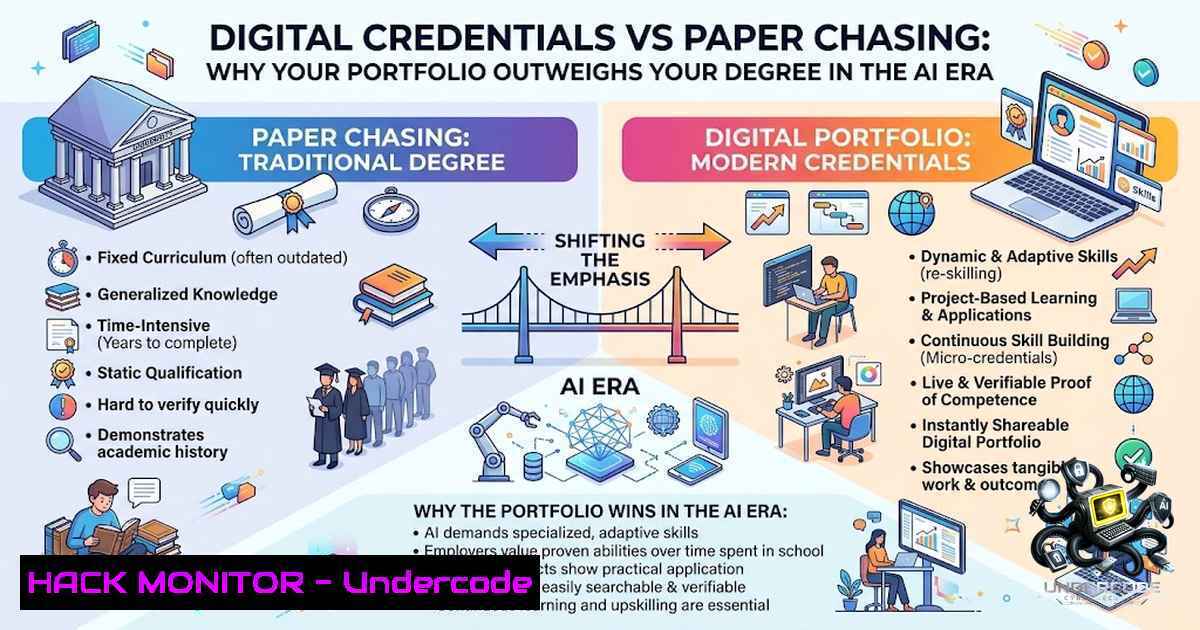
Introduction:
The modern digital economy demands a shift from static academic transcripts to dynamic, verifiable proof of competence. As highlighted in the recent discourse by Tarirai Nunurai, the corporate world—particularly in emerging markets—grapples with a “paper-chasing” obsession that often overlooks actual execution skills in AI, cloud computing, and cybersecurity. This article explores the technical infrastructure behind digital portfolio verification, automated credentialing, and the shift toward performance-based hiring, providing actionable insights for IT professionals and hiring managers alike.
Learning Objectives & Secrets:
- Objective 1: Understand the architecture of digital credentialing and how blockchain-verified badges outperform traditional paper certificates.
- Objective 2 (Secret Tip): Learn to leverage GitHub Actions and CI/CD pipelines to automate the display of live project metrics, transforming your repository into a living resume.
- Objective 3 (Secret Tip): Master the art of “data storytelling” using API integrations (e.g., Google Analytics, LinkedIn API) to extract and visualize real-time performance data, proving competence through quantifiable outcomes.
You Should Know:
1. The Technical Anatomy of a Digital Portfolio
A digital portfolio in 2026 is no longer a simple PDF. It is a decentralized web application or a set of live endpoints that showcase your work. For IT professionals, this means exposing APIs that demonstrate skill, such as a personal SIEM dashboard showing threat logs or an AI inference endpoint that processes natural language.
Step‑by‑step guide to building a verifiable portfolio endpoint:
- Step 1: Set up a secure cloud instance (AWS EC2 or Azure VM) running a lightweight web server (e.g., Nginx).
- Step 2: Deploy a simple Flask or FastAPI application that returns JSON data of your projects. Use environment variables for security keys.
- Step 3: Implement OAuth2 authentication to allow recruiters to view your work without exposing sensitive internal data.
- Step 4: Configure Prometheus and Grafana to monitor the uptime and performance of your portfolio, showcasing your SRE/DevOps skills.
2. Automating Credential Verification with Blockchain
To combat document forgery and slow verification processes, organizations are turning to distributed ledger technology. By hashing certificate details (issuer, date, student ID) onto a public blockchain, employers can instantly verify authenticity without the need for manual calls to universities.
Step‑by‑step guide to implementing a certificate verification system:
- Step 1 (Preparation): Install OpenSSL on your Linux or Windows machine to generate SHA-256 hashes of the PDF documents.
- Linux Command: `sha256sum certificate.pdf > hash.txt`
– Windows (PowerShell): `Get-FileHash -Algorithm SHA256 certificate.pdf`
– Step 2 (Smart Contract Deployment): Use Solidity to deploy a simple verification contract on a testnet like Sepolia. The contract stores a mapping of `student_id` tocertificate_hash. - Step 3 (API Integration): Build a Node.js/Express middleware that queries the blockchain via Web3.js and returns a `verified: true/false` status.
- Step 4 (Frontend): Create a simple HTML/JavaScript interface where employers paste the student ID to receive the verification status.
3. Leveraging GitHub for Performance Metrics (Automation)
Your GitHub profile is a goldmine of performance data. However, recruiters rarely dig through commit histories. By using GitHub Actions, you can automatically update a “README.md” file with your latest activity, such as successful build counts, code coverage percentages, and issue resolution times.
Step‑by‑step guide to creating a dynamic action-based stats board:
– Step 1: Create a `.github/workflows/update-stats.yml` file in your repository.
– Step 2: Use a pre-built action like `lowlighter/metrics` to generate an SVG image of your stats.
– Step 3: Configure the action to run on a schedule (e.g., cron: '0 12 ') or on push events.
– Step 4: Hardcode the generated SVG into your profile README, ensuring that the link updates automatically. This demonstrates cron-job proficiency and automation.
- API Security and Data Governance for Hiring Portfolios
When sharing case studies, candidates often expose API keys or vulnerable endpoints. It is critical to implement API security best practices to avoid leaking sensitive information while still demonstrating technical prowess.
Step‑by‑step guide to securing your public API:
- Step 1: Use API Gateways (like AWS API Gateway or Kong) to throttle requests and prevent DDoS.
- Step 2: Implement JWT (JSON Web Tokens) for stateless authentication. Ensure tokens have a short expiry (15 minutes).
- Linux Command to generate a JWT secret: `openssl rand -base64 32`
– Step 3: Apply “Principle of Least Privilege.” Even if an endpoint is public, ensure it returns minimal, sanitized data (e.g., aggregate counts rather than raw PII). - Step 4: Set up a WAF (Web Application Firewall) rule to block SQL injection or XSS attempts, showing recruiters you understand OWASP Top 10 mitigations.
5. Cloud Operations: Hardening the “Modern Resume”
A modern digital marketer or AI professional should demonstrate proficiency in cloud operations. This involves configuring auto-scaling groups, load balancers, and disaster recovery plans for their portfolio sites, making them resilient and “production-grade.”
Step‑by‑step guide to cloud hardening:
- Step 1 (Setup): Use Terraform (Infrastructure as Code) to define your environment. This proves you understand IaC.
- Terraform Basic: `resource “aws_instance” “web_server” { ami = “ami-0c55b159cbfafe1f0”; instance_type = “t2.micro” }`
– Step 2 (Security Groups): Restrict inbound traffic only to specific IP ranges or Cloudflare proxy IPs. - Step 3 (Backup): Configure automated snapshots of EBS volumes using AWS Backup rules.
- Step 4 (Monitoring): Set up CloudWatch alarms that trigger SNS notifications when the CPU exceeds 80%.
- Integrating AI into the Hiring Process (The Technical Aspect)
While the article highlights human bias, it’s important to note that AI is now being used to scan resumes. To beat the ATS (Applicant Tracking Systems) that parse text, IT professionals must structure their resumes and portfolios with “structured data” (JSON-LD or Schema.org markup) so that AI scrapers can accurately index their skill sets.
Step‑by‑step guide to structured data for resumes:
- Step 1: On your portfolio website, add a `