Listen to this Post
Introduction
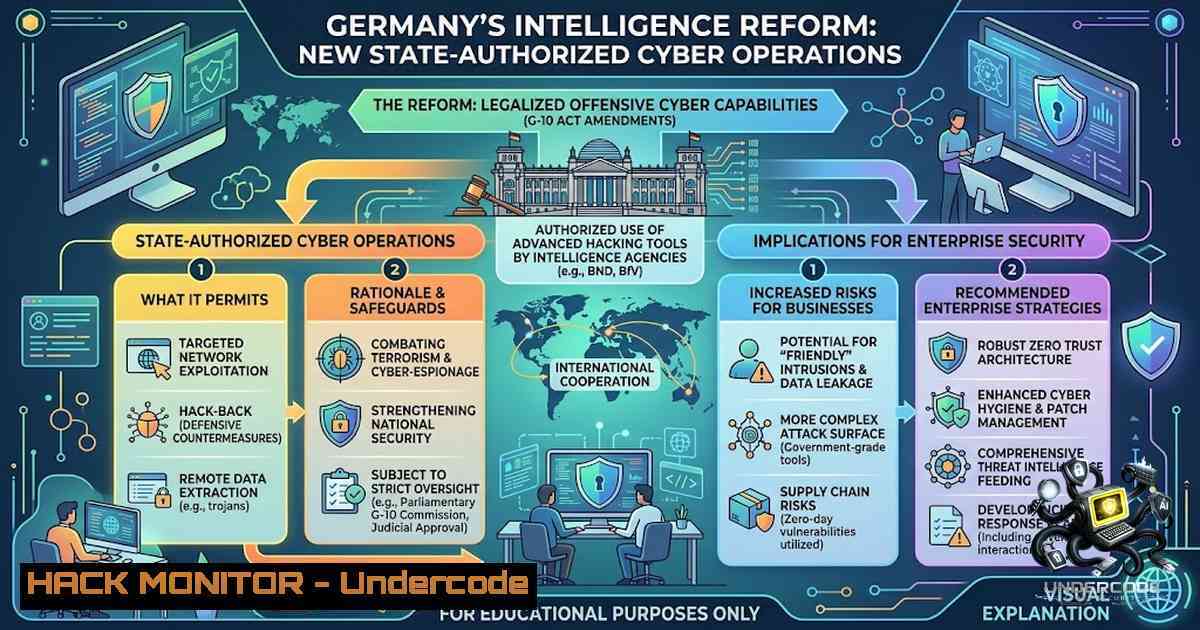
Germany’s cabinet has approved a sweeping 732-page intelligence reform bill that would fundamentally transform the Bundesnachrichtendienst (BND) and Bundesamt für Verfassungsschutz (BfV) from passive intelligence-gathering agencies into active cyber-operations entities with hacking, sabotage, and disruption capabilities. The legislation, which still requires parliamentary approval, grants these agencies unprecedented powers to hack foreign systems, disrupt hostile cyber infrastructure, sabotage adversary supply chains, and—in certain domestic cases—alter data or feed false information to extremists. For CISOs and security professionals, this marks a critical inflection point: state-sponsored cyber activity is no longer confined to espionage but now explicitly includes active disruption and sabotage, demanding a fundamental reassessment of threat models, resilience planning, and supply chain security.
Learning Objectives
- Understand the scope and implications of Germany’s intelligence reform bill, including new BND and BfV operational powers and AI governance restrictions.
- Learn how to incorporate state-authorized cyber disruption and supply-chain interference into enterprise threat models.
- Master practical techniques for data integrity monitoring, supply chain hardening, and resilience planning against state-sponsored sabotage scenarios.
- Develop actionable incident response procedures for compromised suppliers, manipulated data, and disrupted infrastructure.
You Should Know
- Understanding the New Powers: From Intelligence Gathering to Active Disruption
The reform bill represents the most significant overhaul of Germany’s spy laws since the postwar era. Under the proposed framework, the BND (foreign intelligence) can conduct operations that go “beyond information gathering” to actively disrupt threats to Germany and its allies. Specific authorized activities include:
- Hacking foreign systems – penetrating computer systems of hostile state actors
- Supply chain sabotage – substituting faulty components into deliveries, accessing IT systems of drone factories or chemical weapons laboratories
- Disinformation operations – feeding false information to extremists inside Germany
- Infrastructure manipulation – disabling servers run by hostile hackers and disinformation operators
- Data traffic interference – blocking, rerouting, or altering data transmissions in transit
The BfV (domestic intelligence) receives a shorter but equally significant list of powers, including the ability to corrupt data stored for use in a plot, disable equipment about to be used in an attack, and feed false information to individuals involved in extremist activities. These measures represent a departure from existing German law, which has primarily empowered the agency to gather intelligence rather than intervene operationally.
Crucially, the bill stops short of a “license to kill.” It bars measures intended to endanger a person’s life or physical safety, distinguishing Germany’s approach from the paramilitary capabilities of France’s DGSE or the CIA’s Special Activities Center. However, the bill does permit the use of firearms in self-defense.
Operational safeguards are built into the framework: BND disruption operations require the agency’s president to formally declare that a named foreign power is persistently and systematically threatening German interests. This declaration expires after 12 months and must be reviewed every six months. Operations must be directed at the responsible state rather than individuals and conducted outside Germany wherever equally effective.
AI governance is also addressed: the bill establishes controls for intelligence agencies’ use of AI, including restrictions on discriminatory algorithms and safeguards around machine-generated behavioral profiles and predictions. Agencies would be permitted to use AI for data analysis and AI-powered biometric recognition systems.
- Threat Model Evolution: Preparing for State-Authorized Cyber Operations
The shift from passive intelligence to active disruption fundamentally changes the threat landscape. CISOs must expand threat modeling beyond conventional cybercrime and espionage to include scenarios where state actors may actively sabotage infrastructure, manipulate supply chains, or disrupt operations.
Key threat scenarios to model:
- Supply chain compromise – adversaries substituting faulty components or introducing backdoors through legitimate supply chains
- Data integrity attacks – alteration of data stored for critical operations or in transit
- Infrastructure disruption – disabling servers, network equipment, or operational technology
- Disinformation campaigns – false information fed to employees, partners, or customers
Practical steps for threat model updates:
- Inventory all critical dependencies – map suppliers, vendors, and service providers across your entire value chain. Identify single points of failure where a state actor could introduce sabotage.
-
Assess geopolitical risk exposure – organizations operating in sensitive sectors (defense, energy, telecommunications, finance) or with cross-border supply chains face elevated risk. CISOs without a framework for monitoring geopolitical developments are operating with a significant blind spot.
-
Implement supply chain security controls – require Software Bill of Materials (SBOM) from all software vendors. Correlate software components with real-time vulnerability databases and maintain continuous monitoring posture.
-
Adopt zero-trust architecture – assume breach and verify every access request. Implement least-privilege access controls on build systems and code repositories.
-
Establish data integrity monitoring – implement file integrity monitoring (FIM) across critical systems to detect unauthorized modifications.
-
Data Integrity and File Integrity Monitoring: Practical Implementation
Given the bill’s authorization to alter or corrupt data, data integrity monitoring becomes paramount. Here are practical implementations across Linux and Windows environments:
Linux – File Integrity Verification:
 Generate SHA-256 checksum for a file
sha256sum /etc/passwd

Verify file integrity against known hash
sha256sum -c file.sha256

Check all files in a directory recursively
find /critical/directory -type f -exec sha256sum {} \; > baseline.sha256

Verify against baseline
sha256sum -c baseline.sha256

For RPM-based systems (CentOS/RHEL/Rocky) - verify all installed packages
sudo rpm -Va

For Debian/Ubuntu systems - check all installed packages
sudo debsums --all --changed
Linux – Using AIDE (Advanced Intrusion Detection Environment):
 Install AIDE
sudo apt-get install aide  Debian/Ubuntu
sudo yum install aide  RHEL/CentOS

Initialize database
sudo aideinit

Check for changes
sudo aide --check

Update database after authorized changes
sudo aide --update
Linux – Open Source FIM Tool (Achiefs):
 Start FIM service
systemctl start fim

View events
cat /var/lib/fim/events.json
Windows – File Integrity Verification:
 Generate SHA-256 checksum
Get-FileHash -Path "C:\critical\file.exe" -Algorithm SHA256

Verify against known hash
$hash = (Get-FileHash -Path "C:\critical\file.exe" -Algorithm SHA256).Hash
if ($hash -eq "known_hash_value") { Write-Host "Integrity verified" }

System File Checker - scan and repair system files
sfc /scannow

DISM - check system health
DISM /Online /Cleanup-Image /CheckHealth
Windows – Using PowerShell for Directory Monitoring:
 Create baseline for directory
Get-ChildItem -Path "C:\critical" -Recurse | ForEach-Object {
$hash = (Get-FileHash -Path $<em>.FullName -Algorithm SHA256).Hash
[bash]@{Path=$</em>.FullName; Hash=$hash}
} | Export-Csv -Path "C:\baseline.csv" -1oTypeInformation

Verify against baseline
$baseline = Import-Csv "C:\baseline.csv"
Get-ChildItem -Path "C:\critical" -Recurse | ForEach-Object {
$currentHash = (Get-FileHash -Path $<em>.FullName -Algorithm SHA256).Hash
$expected = $baseline | Where-Object { $</em>.Path -eq $<em>.FullName }
if ($expected.Hash -1e $currentHash) {
Write-Warning "Integrity violation: $($</em>.FullName)"
}
}
Cross-platform tool – BitCheck:
 Initialize database for current directory
bitcheck --add --recursive

Check for changes
bitcheck --check
Best practices for data integrity monitoring:
- Maintain cryptographic hashes (SHA-256 or higher) for all critical binaries, configuration files, and data stores
- Store baseline hashes offline or in a separate, secured location
- Implement real-time alerting for integrity violations
- Regularly review and update baselines after authorized changes
- Combine file integrity monitoring with SIEM for correlation and alerting
4. Supply Chain Resilience: Protecting Against State-Sponsored Interference
The bill explicitly authorizes supply chain sabotage—substituting faulty components, accessing critical manufacturing systems, and interfering with deliveries. CISOs must harden supply chain security accordingly.
Immediate actions:
- Require SBOMs from all software vendors – operationalize SBOMs beyond documentation into downstream decision-making for vulnerability tracking and incident response
-
Implement vendor risk management – validate security claims through third-party assessments, penetration testing, and continuous monitoring
-
Build layered defense models – air-gapped backups, file integrity monitoring, and immutable infrastructure
-
Enforce secure development practices – sign artifacts during builds, enforce branch protection on code repositories, and implement least-privilege access controls on build systems
-
Monitor runtime activity – implement continuous monitoring of containerized workloads and AI models
Supply chain incident response considerations:
- When a supply chain compromise is discovered, SBOMs allow teams to determine within minutes which systems are affected
- Maintain playbooks for supplier compromise scenarios, including data integrity breaches and component substitution
- Establish communication protocols with legal, PR, and regulatory teams for supply chain incidents
5. Telecommunications and Digital Service Provider Obligations
The bill requires telecommunications carriers and digital service providers to assist intelligence agencies, enforced by powers that could result in fines or service suspension. This has direct implications for organizations relying on German telecommunications infrastructure.
What this means for CISOs:
- Compelled assistance – providers may be legally obligated to facilitate intelligence operations, potentially including data interception, traffic rerouting, or infrastructure access
- Compliance burden – organizations operating in Germany should track the legislation’s progress and assess compliance obligations
- Data sovereignty concerns – data stored with German providers may be subject to intelligence access under the new framework
Practical steps:
- Review data storage and processing arrangements with German telecommunications and digital service providers
2. Assess contractual provisions regarding compelled government assistance
- Consider data localization and encryption strategies to mitigate unauthorized access risks
- Monitor regulatory developments and update incident response plans accordingly
6. AI Governance and Algorithmic Discrimination Controls
The bill establishes controls for AI use, including restrictions on discriminatory algorithms and safeguards around machine-generated behavioral profiles. While these provisions are designed to constrain intelligence agencies, they signal broader regulatory trends that CISOs should anticipate.
Implications for enterprise AI governance:
- Algorithmic bias – organizations using AI for decision-making should implement testing for discriminatory outcomes
- Transparency requirements – expect increased scrutiny of AI systems used in security, hiring, and customer-facing applications
- Data protection – AI systems processing personal data face elevated compliance requirements
Recommended actions:
- Conduct AI bias audits for algorithms used in security operations, HR, and customer interactions
2. Document AI training data sources and methodology
3. Implement human review for high-stakes AI decisions
- Monitor emerging AI regulations and adapt governance frameworks accordingly
What Undercode Say
Key Takeaway 1: Germany’s intelligence reform bill represents a paradigm shift—intelligence agencies are no longer just watching; they are actively disrupting, sabotaging, and manipulating. This fundamentally changes the threat landscape for enterprises operating in or connected to Germany and Europe. CISOs must update threat models to account for state-authorized cyber operations that go beyond espionage into active sabotage.
Key Takeaway 2: The bill’s authorization of supply chain sabotage and data manipulation demands immediate action on data integrity monitoring, vendor risk management, and resilience planning. Organizations should implement SBOM requirements, file integrity monitoring (AIDE, Achiefs, BitCheck), and zero-trust architectures now—before the legislation takes effect and threat actors begin exploiting these new operational paradigms.
Analysis: This reform is Germany’s response to a rapidly deteriorating threat environment, including Russian hybrid warfare, drone incidents, and terrorist threats. The government has pointed to these threats to justify legislation that would have been unthinkable a decade ago. However, the bill also introduces unprecedented state surveillance and disruption capabilities that raise significant civil liberties concerns. For CISOs, the practical challenge is clear: prepare for a world where state actors have explicit legal authority to hack, sabotage, and manipulate—and where your organization’s supply chain, data, and infrastructure are potential targets. The time to implement integrity monitoring, supply chain hardening, and geopolitical threat modeling is now. As one security leader noted, “The role of the CISO is not to litigate politics but to ensure the organization understands its dependencies and failure modes”.
Prediction
- +1 The reform will accelerate investment in cybersecurity resilience, particularly in data integrity monitoring, supply chain security, and zero-trust architectures, driving innovation in these sectors.
-
-1 The normalization of state-authorized hacking and sabotage will lower the threshold for cyber conflict, increasing the risk of escalation and unintended consequences as more nations adopt similar offensive cyber capabilities.
-
-1 Enterprises may face increased compliance burdens and operational disruptions as telecommunications and digital service providers are compelled to assist intelligence operations, potentially affecting data sovereignty and service reliability.
-
+1 The AI governance provisions in the bill, including restrictions on discriminatory algorithms, may serve as a template for broader AI regulation, encouraging more responsible AI deployment across industries.
-
-1 The expansion of intelligence agency powers could erode trust in German digital infrastructure and services, particularly among international enterprises concerned about data privacy and state access.
-
+1 Organizations that proactively implement supply chain security measures, data integrity monitoring, and geopolitical threat modeling will gain a competitive advantage in resilience and trustworthiness.
▶️ Related Video (78% Match):
https://www.youtube.com/watch?v=1xcsMQMrpd8
🎯Let’s Practice For Free:
🎓 Live Courses & Certifications:
Join Undercode Academy for Verified Certifications
🚀 Request a Custom Project:
Secure, high-velocity infrastructure and disruptive technological engineering. Contact our engineering team for high-tier development and proprietary systems:
[email protected]
💎 Smart Architecture | 🛡️ Secure by Design | ⭐ Trusted by Thousands
IT/Security Reporter URL:
Reported By: https://lnkd.in/p/eneCGnkz – Hackers Feeds
Extra Hub: Undercode MoN
Basic Verification: Pass ✅


