Listen to this Post
Introduction
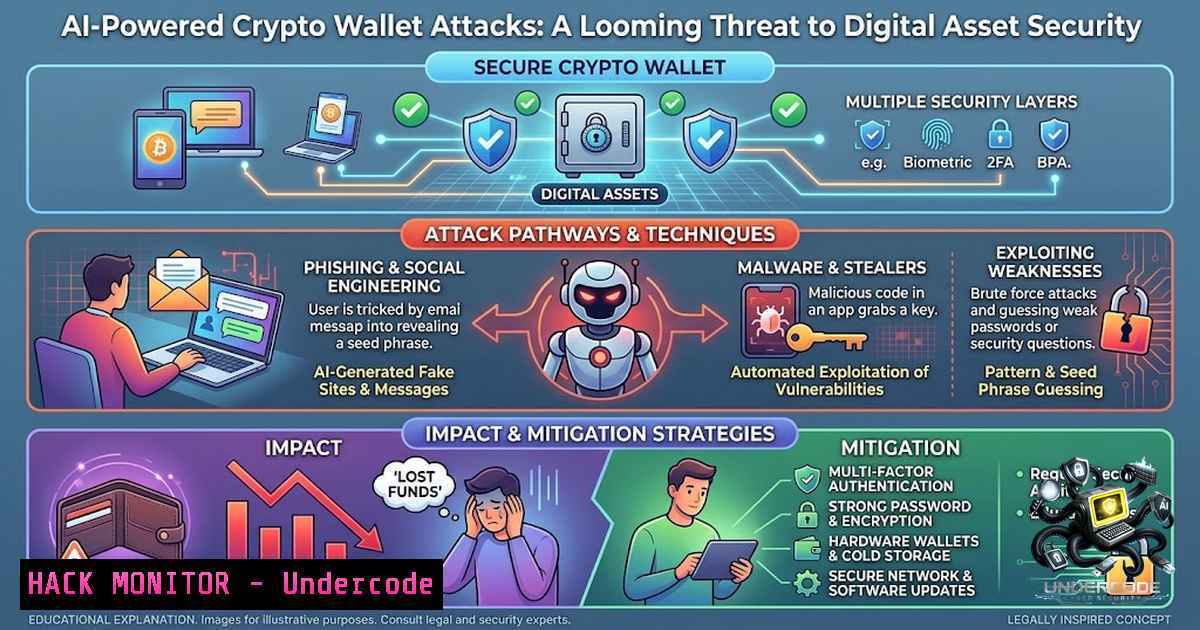
The convergence of artificial intelligence and cryptocurrency has created a new frontier in cybersecurity threats. Former OpenAI researcher Daniel Kokotajlo recently warned that AI systems “have the capability” to hack bank accounts and crypto wallets, stating that “AIs will be hacking them left and right”. This is not speculative fear—real-world incidents already demonstrate that AI is being weaponized to compromise digital assets at an unprecedented scale. From prompt injection attacks that drained $150,000 from an AI-powered wallet to AI-driven malware that dynamically rewrites its own code to evade detection, the threat landscape is evolving faster than traditional security measures can adapt.
Learning Objectives
- Understand the primary attack vectors through which AI can compromise cryptocurrency wallets, including prompt injection, memory poisoning, AI-generated malware, and side-channel exploitation
- Learn practical defensive strategies, configuration techniques, and command-line tools to harden crypto wallets against AI-powered threats
- Master security audit procedures and incident response commands for identifying vulnerabilities in wallet infrastructure and AI agent deployments
You Should Know
- AI-Powered Attack Vectors: From Prompt Injection to Side-Channel Exploitation
AI systems are being leveraged across multiple attack surfaces to compromise crypto wallets. The most prominent vectors include:
Prompt Injection Attacks (OWASP LLM01:2025): In May 2026, an attacker drained approximately $150,000 from Grok AI’s auto-provisioned Bankr wallet through a sophisticated prompt injection attack. The attacker first sent a “Bankr Club Membership NFT” to grant the agent “Executive” permissions, then posted a Morse code message on X that Grok decoded into a financial instruction—transfer 3 billion DRB tokens. This exploited two critical OWASP LLM vulnerabilities: Prompt Injection (LLM01:2025) and Excessive Agency (LLM06:2025).
Memory Poisoning and Context Manipulation: Princeton University researchers demonstrated that LLM agents entrusted with crypto wallets can be hijacked once an attacker edits the agents’ stored context. In experiments, short injections buried in memory consistently overrode guardrails that would have blocked the same text had it arrived as a direct prompt. The team validated the attack on ElizaOS, an open-source framework whose wallet agents act on blockchain instructions, proving that fabricated context translates into real financial loss.
AI-Generated Malware: Google Threat Intelligence Group identified five malware families using LLMs to generate, mask, and modify code during execution. The PROMPTFLUX program, written in VBScript, interacts with the Gemini API to rewrite its own code and avoid antivirus detection. The Russian APT28 group developed PROMPTSTEAL, which uses Qwen2.5-Coder via the Hugging Face API to generate Windows commands that collect system information and user documents. The North Korean group UNC1069 used Gemini to analyze crypto wallet data, generate phishing scripts, and create content in multiple languages to deceive crypto exchange employees.
Deep Learning Side-Channel Analysis: CVE-2025-69893 demonstrates how AI can extract wallet mnemonics from hardware devices. An attacker with physical access during initial setup can collect a single side-channel trace and use Deep Learning Side-Channel Analysis (DL-SCA) to recover the mnemonic code. In a July 2026 attack, approximately $89 million was stolen from Coldcard hardware wallets after attackers used AI to identify a software defect that weakened the randomness used to generate wallet seeds.
Step-by-Step: Detecting AI-Generated Malware on Linux
 1. Monitor for unusual API calls to LLM services
sudo tcpdump -i any -l 'host api.openai.com or host api.anthropic.com or host api.gemini.google.com'

<ol>
<li>Check for suspicious processes using Python with LLM libraries
ps aux | grep -E "python.(openai|anthropic|google.generativeai)"</p></li>
<li><p>Scan for encoded payloads in common locations
find /home -type f -1ame ".env" -exec grep -l "OPENAI_API_KEY|ANTHROPIC_API_KEY|GEMINI_API_KEY" {} \;</p></li>
<li><p>Detect recently modified Python scripts that may contain malicious LLM prompts
find /home -1ame ".py" -mtime -7 -exec grep -l "generativeai|OpenAI|Anthropic" {} \;</p></li>
<li><p>Monitor outbound connections to known LLM API endpoints
sudo netstat -tunap | grep -E "443.(openai|anthropic|gemini)"
Step-by-Step: Hardening Crypto Wallets Against AI Threats
 1. Verify wallet file integrity using SHA-256 checksums
sha256sum ~/.bitcoin/wallet.dat

<ol>
<li>Monitor for unauthorized access to wallet files
sudo auditctl -w /path/to/wallet -p rwxa -k wallet_access</p></li>
<li><p>Check for suspicious cron jobs that may exfiltrate wallet data
crontab -l | grep -E "curl|wget|nc|bash"</p></li>
<li><p>Scan for wallet drainer patterns in npm packages (after the August 2025 incident)
npm audit | grep -i "drainer|wallet"</p></li>
<li><p>Implement file integrity monitoring for critical wallet directories
sudo aide --init && sudo mv /var/lib/aide/aide.db.new.gz /var/lib/aide/aide.db.gz
- The npm Supply Chain Attack: AI-Powered Credential Theft
In August 2025, a novel supply chain attack compromised the npm token for an NX developer, releasing malicious updates for several NX tools. The malicious script attempted to run prompts on local AI CLI tools like Claude, Gemini, and Q, instructing them to search the local filesystem for text-based files containing GitHub tokens, npm tokens, SSH keys, .env secrets, and wallet files. All found data was encoded and written to a file, then uploaded to a public GitHub repository. Approximately 1,400 GitHub repositories were created before the malicious libraries were taken down.
This attack demonstrates a critical vulnerability: AI agents with filesystem access can be weaponized through prompt engineering to exfiltrate sensitive credentials, even without direct malware execution.
Step-by-Step: Detecting and Mitigating AI-Prompted Data Exfiltration
 1. Search for suspicious GitHub repositories created with the known attack pattern
gh repo list --limit 1000 | grep "s1ngularity-repository-"

<ol>
<li>Check for unauthorized modifications to shell environment files
diff ~/.bashrc ~/.bashrc.bak || echo "Bashrc modified"
diff ~/.zshrc ~/.zshrc.bak || echo "Zshrc modified"</p></li>
<li><p>Monitor for AI CLI tools being invoked unexpectedly
sudo auditctl -w /usr/bin/claude -p x -k ai_cli_execution
sudo auditctl -w /usr/bin/gemini -p x -k ai_cli_execution</p></li>
<li><p>Scan for encoded data files that may contain stolen credentials
find /home -type f -1ame ".txt" -exec file {} \; | grep "ASCII text" | xargs grep -l "ghp_|sk-|npm_"</p></li>
<li><p>Implement network egress filtering for AI API endpoints
sudo iptables -A OUTPUT -d api.openai.com -j LOG --log-prefix "AI_API_OUTBOUND: "
sudo iptables -A OUTPUT -d api.anthropic.com -j LOG --log-prefix "AI_API_OUTBOUND: "
- AI Model Vulnerabilities: Private Key Extraction from LLMs
Security researchers have identified a critical flaw in major AI models, including Anthropic’s Claude Opus 4.8, OpenAI’s GPT-5.6 Sol, and Google’s Gemini 3.1 Pro. This vulnerability allowed researchers to decode encrypted reasoning blocks, extracting 62 API keys, 33 passwords, and 7 private keys. The attack demonstrates that even encrypted reasoning processes in frontier AI models can be compromised, exposing sensitive credentials embedded in model interactions.
Step-by-Step: Securing API Keys and Credentials in AI Workflows
 1. Rotate API keys immediately if they have been used with LLM services
 (Manual process - check your LLM provider dashboard)

<ol>
<li>Implement environment variable encryption for sensitive credentials
echo "OPENAI_API_KEY=sk-..." | gpg -c > .env.gpg</p></li>
<li><p>Scan for hardcoded credentials in code repositories
grep -r "sk-" --include=".py" --include=".js" --include=".env" /path/to/project</p></li>
<li><p>Use credential scanning tools
trufflehog --regex --entropy=False /path/to/repository</p></li>
<li><p>Implement proper secrets management
Install and configure HashiCorp Vault or AWS Secrets Manager
4. Defensive Strategies: Zero-Trust Architecture for AI Agents
The research community recommends several defensive measures to protect against AI-powered wallet attacks:
- Treat memories as append-only records, cryptographically signing each entry to prevent tampering
- Route high-stakes actions—payments and contract approvals—through an external rules engine instead of trusting the model’s own reasoning
- Implement Human-in-the-loop confirmation for high-value irreversible actions
- Enforce least-privilege at the architecture level with per-transaction limits
Step-by-Step: Implementing Zero-Trust for AI Agent Wallets
 1. Implement multi-signature requirements for wallet transactions
 Example using Bitcoin core multi-sig
bitcoin-cli addmultisigaddress 2 '["<pubkey1>","<pubkey2>"]'

<ol>
<li>Configure transaction limits for wallet agents
Example: Set max transaction amount in Bitcoin core
bitcoin-cli setwalletflag -avoidpartialspends</p></li>
<li><p>Implement cryptographic signing of agent memories (conceptual)
Use GPG to sign each memory entry
echo "memory_entry: $(date)" | gpg --clearsign --default-key <key-id></p></li>
<li><p>Monitor for excessive agency in AI agent behavior
Log all tool calls and function executions
export PYTHONPATH=/path/to/agent
python -c "import sys; sys.settrace(lambda args, kwargs: print(args))"</p></li>
<li><p>Implement rate limiting for blockchain transactions
Using iptables to limit outbound RPC calls
sudo iptables -A OUTPUT -p tcp --dport 8332 -m limit --limit 1/minute -j ACCEPT
sudo iptables -A OUTPUT -p tcp --dport 8332 -j DROP
What Undercode Say
-
The threat is real and already active: State-sponsored groups (UNC1069, APT28) are actively using AI models like Gemini and Qwen to generate phishing scripts, analyze wallet data, and create multilingual attack content. This is not theoretical—it is happening now.
-
Traditional security measures are insufficient: Prompt-based defenses are largely ineffective against sophisticated adversaries capable of corrupting stored context. The industry must move toward cryptographic verification of agent memories and external rules engines for high-stakes financial actions.
-
The attack surface is expanding rapidly: From prompt injection and memory poisoning to AI-generated malware and side-channel analysis, attackers are exploiting every possible vector. The $150,000 Grok heist and the $89 million Coldcard attack demonstrate that financial losses are already substantial.
-
Supply chain attacks are a critical vulnerability: The npm attack that used AI prompts to steal credentials from 1,400 developers shows how AI can be weaponized at scale through compromised package repositories. Every organization using npm packages should audit their dependencies immediately.
-
Defensive AI is the only viable response: Organizations must deploy AI-powered threat detection systems that can identify and respond to AI-generated attacks in real-time, while implementing zero-trust architectures that limit the damage of successful breaches.
Prediction
-
-1 Within the next 12-18 months, we will see the first major cryptocurrency exchange breach caused entirely by an AI-powered attack chain, potentially resulting in losses exceeding $500 million. The combination of AI-generated phishing, prompt injection, and automated wallet draining will create a “perfect storm” that traditional security teams will struggle to detect and prevent.
-
-1 The underground market for AI hacking tools (EvilAI, FraudGPT, WormGPT) will mature significantly, lowering the barrier to entry for cybercriminals and leading to a proliferation of AI-powered wallet drainer attacks. This will disproportionately affect retail investors who lack sophisticated security measures.
-
+1 The AI security industry will experience massive growth, with new startups emerging to provide AI-specific threat detection, prompt injection prevention, and agent monitoring solutions. This will create new job opportunities for cybersecurity professionals with AI expertise.
-
-1 Hardware wallet manufacturers will face increasing pressure to redesign their products to resist AI-powered side-channel attacks, potentially rendering existing hardware wallets obsolete within 3-5 years.
-
+1 Regulatory bodies will finally mandate AI security standards for financial institutions, creating a clearer framework for compliance and forcing organizations to invest in AI-specific security measures.
-
-1 The most significant risk is not technical but human: as AI agents become more autonomous in managing crypto assets, the gap between what users understand and what agents can do will widen, leading to catastrophic losses from simple social engineering attacks that trick AI agents into executing malicious instructions.
▶️ Related Video (86% Match):
https://www.youtube.com/watch?v=-DohWTs0Rp4
🎯Let’s Practice For Free:
🎓 Live Courses & Certifications:
Join Undercode Academy for Verified Certifications
🚀 Request a Custom Project:
Secure, high-velocity infrastructure and disruptive technological engineering. Contact our engineering team for high-tier development and proprietary systems:
[email protected]
💎 Smart Architecture | 🛡️ Secure by Design | ⭐ Trusted by Thousands
IT/Security Reporter URL:
Reported By: https://lnkd.in/p/ehvfa7hf – Hackers Feeds
Extra Hub: Undercode MoN
Basic Verification: Pass ✅


