
Listen to this Post
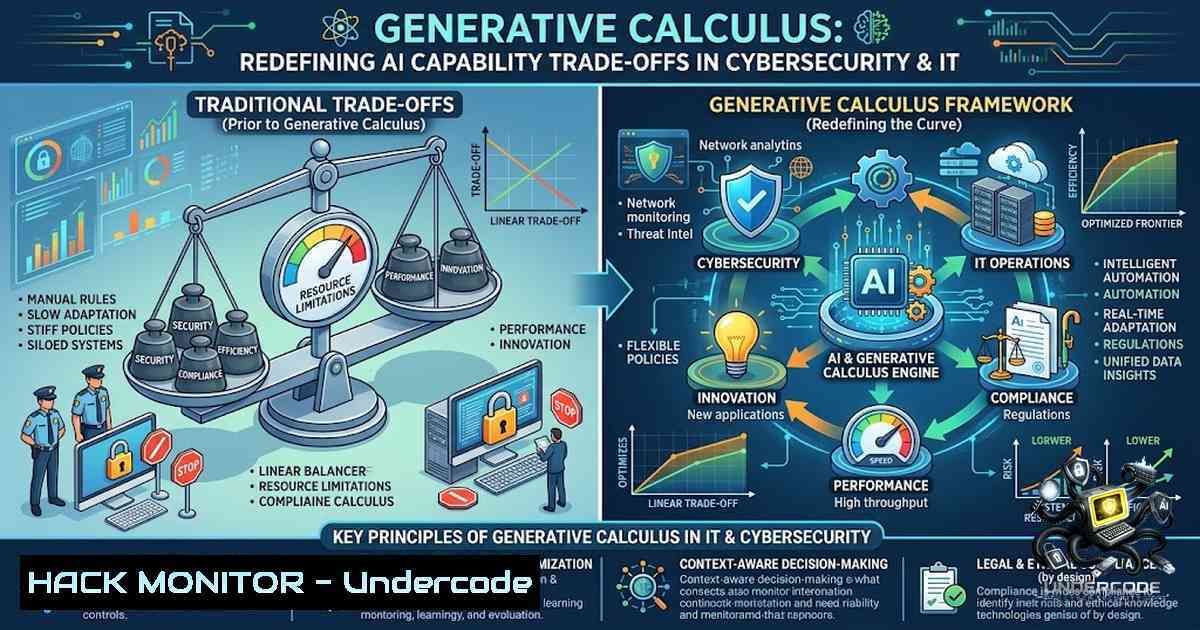
Introduction:
The cybersecurity and IT sectors are increasingly reliant on artificial intelligence for threat detection, automated response, and resource optimization. However, traditional performance metrics like accuracy and energy consumption often present an incomplete picture, hiding critical trade-offs that become exploitable vulnerabilities. “Generative Calculus” (GC) emerges as a mathematical framework that shifts focus from isolated best values to the complete operational envelope, revealing what a system can actually accomplish under various constraints of scale, accuracy, and cost. This concept is vital for evaluating AI models, designing robust network infrastructures, and ensuring that reported capabilities align with real-world deployable security and performance.
Learning Objectives & Secrets:
- Objective 1: Evaluate AI Trade-Offs in Cybersecurity – Understand how Generative Calculus exposes hidden weaknesses in security AI, such as models that achieve high detection accuracy only at high energy costs, making them impractical for continuous real-time monitoring.
- Objective 2 Secret Tip: Optimize Resource Allocation – Use the principles of GC to configure IDS/IPS systems to balance latency, throughput, and accuracy based on current threat levels and network load, moving beyond static benchmarks.
- Objective 3 Secret Tip: Decompose Complex Systems – Apply GC’s composition theory to assess the reliability of multi-layered security architectures, understanding how the capability envelopes of individual components (e.g., firewalls, SIEMs, AI detectors) merge to form a combined operational scope.
You Should Know:
1. The Hidden Trade-Offs in AI Security Appliances
In your Security Operations Center (SOC), you might be comparing two threat intelligence AI models that both boast a 99.9% detection rate and low resource usage. Generative Calculus demonstrates that these headline numbers can be deceptive. The first model might achieve that detection rate only with maximum CPU/GPU usage, but when set to low-power mode to save on cloud costs, its accuracy plummets. The second model might maintain high accuracy even under resource constraints.
Step‑by‑step guide to benchmark your AI security tools using GC principles:
– Step 1: Define the Performance Axes – Identify the key trade-offs for your specific task. For a network intrusion detection system (NIDS), this might be False Positive Rate (FPR) vs. Throughput (packets/sec). For a malware classifier, it’s Accuracy vs. Inference Time.
– Step 2: Develop a Benchmarking Script – Instead of running a single test, script a series of tests that vary a specific constraint, such as CPU affinity or memory limits.
 Linux: Stress-test an AI model by limiting CPU and measuring performance
 Install stress-1g and watch Nvidia-smi for GPU usage

Limit a process to 50% of a single CPU core and time its inference
taskset -c 0 cpulimit -l 50 -- python3 run_model.py --test-data sample.pcap

For Windows (PowerShell), set affinity and priority
Start-Process python -ArgumentList "run_model.py --test-data sample.pcap" -Affinity 0x1  Bind to CPU 0
- Step 3: Iterate and Map the Envelope – Repeat Step 2, varying the resource constraint (e.g., 25%, 50%, 75%, 100%). Record the accuracy, FPR, and throughput for each run.
- Step 4: Plot Your Results – Create a graph with your performance metric (accuracy) on one axis and the resource constraint (CPU) on the other. The curve you generate is your system’s operational envelope.
- Applying Calculus to Network Trade-Offs: Latency vs. Reliability
Consider a network routing protocol. You can choose a route with low latency but high packet loss (unreliable) or a high-latency, reliable route. A “best” route doesn’t exist; the optimal choice depends on the application (e.g., VoIP needs low latency, while file transfer needs reliability). Generative Calculus provides the language to define this trade-off mathematically, allowing for adaptive networking.
Step‑by‑step guide to analyze network trade-offs using Python and standard tools:
– Step 1: Simulate Network Paths – Use a script to ping multiple endpoints with varying packet sizes to map latency and packet loss.
 Python script to measure latency and loss for a list of hosts
import subprocess
import re

def ping_host(host, count=10):
cmd = f"ping -c {count} {host}"
output = subprocess.run(cmd, shell=True, capture_output=True, text=True)
 Parse output to extract avg latency and packet loss
 ... parsing logic ...
return avg_latency, loss_percent

hosts = ["8.8.8.8", "1.1.1.1", "your.internal.server"]
for h in hosts:
lat, loss = ping_host(h)
print(f"Host {h}: Latency={lat}ms, Loss={loss}%")
- Step 2: Implement Adaptive Routing Logic – Use the data to create a simple cost function. For example,
cost = latency + (loss 10). The system can then dynamically choose a route that minimizes cost based on the current data. - Step 3: Consider Transition Costs – In a real network, switching routes costs time and resources (e.g., re-establishing sessions). The script should factor in a “switch penalty.” The cost of a new route is
new_cost + switch_penalty. You then evaluate if switching is worth the temporary disruption.
3. Implementing Generative Calculus in Cloud Security
Organizations often need to scale security resources (e.g., cloud-based web application firewalls) in response to traffic. GC helps you understand the “scale-ability” of your security. It answers: “How does detection accuracy degrade as we add more WAF instances to handle a spike in traffic?”
Step‑by‑step guide for cloud hardening with a focus on resource envelopes:
– Step 1: Baseline Test – Run your WAF or security VMs under normal load. Record CPU, memory, network I/O, and false negative rate (FNR).
– Step 2: Horizontal Scaling Test – Use a load testing tool (e.g., Apache JMeter) to incrementally increase traffic, triggering auto-scaling policies.
 Linux command to monitor a service's resource usage over time
 Uses `top` in batch mode to log data to a file
top -b -d 1 -p $(pgrep -d',' waf_process) >> waf_performance.log
- Step 3: Analyze the Envelope – Plot `FNR` vs `Throughput` and
Number of Instances. You might find that while throughput scales linearly, accuracy begins to drop as the instances become more numerous due to coordination overhead or eventual consistency issues in threat intelligence sharing. - Step 4: Mitigation – Based on the results, you might choose a “scaling strategy” that prioritizes accuracy over resource cost, setting a maximum scaling limit that prevents the system from expanding into a region of unacceptable accuracy.
4. API Security and Rate Limiting
APIs are an interface for multiple, often conflicting, stakeholders. Performance, security, and cost are in constant tension. GC can model the envelope of an API gateway, showing how the security posture (e.g., rate limiting, request validation depth) changes as request volume increases.
Step‑by‑step guide to configure API security with GC principles:
– Step 1: Define the Envelope – The axes are Requests Per Second (RPS) and the response code (200 OK vs 429 Too Many Requests). The gateway’s behavior changes based on the configured rate limit.
– Step 2: Simulate Traffic – Use a tool like `wrk` or `ab` to benchmark the API.
 Linux: Use ab (ApacheBench) to test API with different concurrency levels
 This tests how response time and error rates change with load
ab -1 10000 -c 100 -p post_data.json -T application/json "https://your-api-endpoint/login"
- Step 3: Interpret Results – Under high load, the system might start rejecting requests (returning 429). This is a security mechanism to prevent DoS. However, if the cutoff is too aggressive, legitimate users are blocked. The envelope shows the point where performance and security intersect optimally.
- Step 4: Automate Adaptation – Implement a script that monitors RPS and adjusts the rate limit dynamically based on the historical patterns of the system, ensuring the gateway remains within its “safe operating envelope” where both performance and security are adequate.
- Generative Calculus and the Future of AI in IT Training
The concept of GC isn’t just for systems; it’s for humans too. Training and certification in cybersecurity and IT often focus on “best practices” or isolated skills. This is the “best accuracy at highest energy” model of learning. A GC-inspired approach would focus on the “complete capability envelope” of a professional, evaluating what they can accomplish under different pressures and constraints, such as time, budget, and tools.
Step‑by‑step guide to a “Generative Calculus” approach to training:
– Step 1: Skill Mapping – Map a cybersecurity analyst’s skills not as a single proficiency level, but as a multi-dimensional space. Axes include: Time to Detect, Accuracy of Detection, Number of Tools, and Budget.
– Step 2: Resource-Constrained Drills – Design training exercises where one constraint is tightened, forcing the trainee to make trade-offs. For example, “You have 50% less budget, and you must maintain 95% detection accuracy. Which tools do you sacrifice?”
– Step 3: System Composition – Have trainees work in teams. The “capability envelope” of the team is the composition of each member’s individual envelopes. If one member is weak on a particular tool (e.g., Splunk), the team’s overall capabilities on that axis are constrained, regardless of the team’s average skill.
What Undercode Say:
- Key Takeaway 1: Move Beyond Benchmark Obsession – The cybersecurity industry is fixated on metrics like detection rate, speed, and cost. Generative Calculus forces a paradigm shift, demanding we evaluate tools and systems on their operational envelope. A system that looks perfect on paper may fail catastrophically in a real-world resource-constrained or stressful environment. This is a critical warning for security teams making purchase or adoption decisions.
-
Key Takeaway 2: Security as an Optimization Problem – GC elegantly frames security not as a static state but as a dynamic optimization challenge. You are constantly trading security depth (accuracy, coverage) against operational constraints (energy, latency, cost). Understanding these trade-offs allows for intelligent, context-aware policies that adapt to the current threat landscape and resource availability. It empowers IT leaders to make data-driven decisions about where to invest in security budget to maximize the area of their protective envelope.
-
Key Takeaway 3: The Composition Risk – A final, crucial takeaway is the concept of system composition. The “envelope” of a combined system (e.g., your entire SOC stack) is not the sum of the individual envelopes. Synergies and, more often, conflicts exist. The latency issues of a firewall might compound with the processing delays of a SIEM, creating a bottleneck that constrains the entire security infrastructure. Understanding this is foundational to building resilient and cost-effective security architectures.
Prediction:
- -1 The misuse of Generative Calculus could lead to overly complex system specifications, making procurement and IT management more difficult rather than simplifying it. Vendors might game the system, designing AI that excels in specific, non-representative regions of the envelope while failing in others.
- -1 The future of AI in security will be defined by the ability to understand and predict these trade-offs. In the short term, security breaches will continue to occur in the “invisible” space between reported performance and actual, resource-constrained capabilities.
- +1 Generative Calculus will become a foundational framework for next-generation security tools. It will enable the development of “adaptive” security systems that automatically tune their behavior based on the current threat level, network conditions, and cost constraints.
- +1 For IT professionals, GC-driven training will lead to a more holistic and resilient workforce. Analysts will be trained to think in terms of trade-offs and constraints, making them more adaptable and effective in high-pressure incident response scenarios.
- +1 Organizations that adopt a GC-based evaluation methodology for their cloud and on-premise infrastructure will gain a significant competitive advantage. They will be able to achieve higher security postures at a lower Total Cost of Ownership (TCO) by avoiding over-provisioning and identifying the most efficient points on their operational envelopes.
▶️ Related Video (88% Match):
https://www.youtube.com/watch?v=2jU-mLMV8Vw
🎯Let’s Practice For Free:
🎓 Live Courses & Certifications:
Join Undercode Academy for Verified Certifications
🚀 Request a Custom Project:
Secure, high-velocity infrastructure and disruptive technological engineering. Contact our engineering team for high-tier development and proprietary systems:
[email protected]
💎 Smart Architecture | 🛡️ Secure by Design | ⭐ Trusted by Thousands
IT/Security Reporter URL:
Reported By: https://lnkd.in/p/eexBtwGU – Hackers Feeds
Extra Hub: Undercode MoN
Basic Verification: Pass ✅


