
Listen to this Post
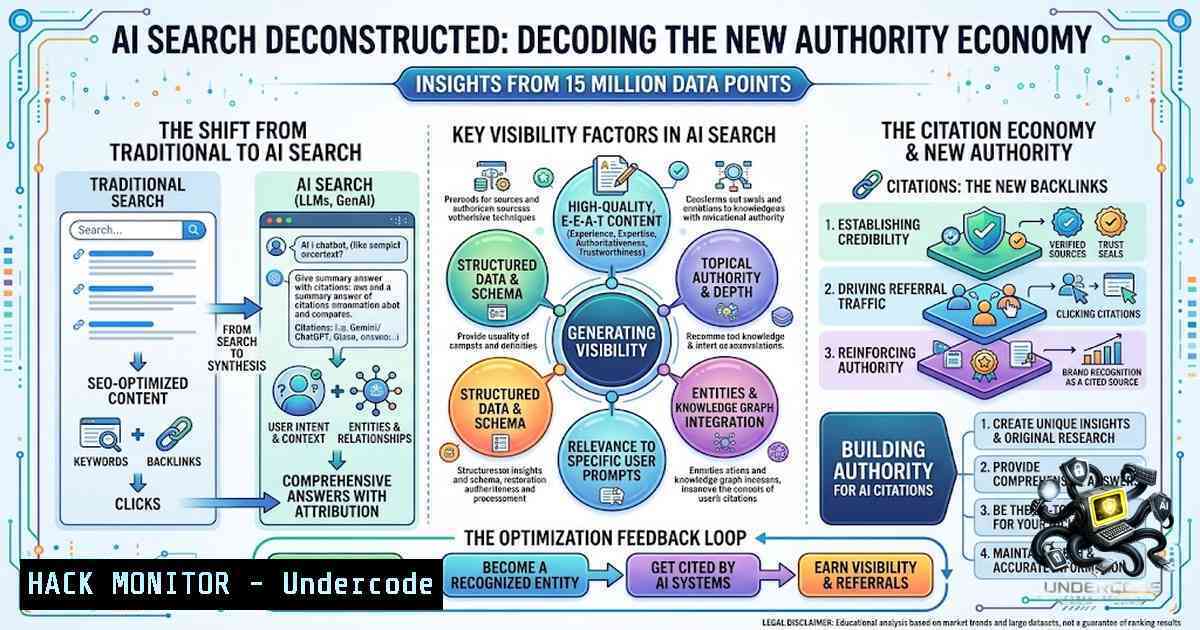
Introduction:
As AI-powered search engines like ChatGPT, Google AI Overviews, Gemini, and Perplexity reshape how users discover information, a flood of unverified tactics has swept through the marketing and SEO industry. A comprehensive research roundup by Ahrefs, spanning approximately 15 million data points across 1.4 million ChatGPT prompts, 4 million citations, 863,000 SERPs, 137,000 sites, and 75,000 brands, has empirically tested nine widely held assumptions about AI search visibility. The findings challenge nearly everything marketers thought they knew, exposing that many popular “shortcuts” are guesswork dressed up as strategy, while the true drivers of AI citations are far more fundamental.
Learning Objectives & Secrets:
- Objective 1: Understand why “best X” listicles, llms.txt files, and schema markup fail as AI visibility shortcuts, and how to avoid wasting resources on low-impact tactics.
- Objective 2 Secret Tip: Shift focus from chasing backlinks to building brand authority through branded web mentions and YouTube presence, which show correlations with AI citations more than double that of traditional Domain Rating (DR).
- Objective 3 Secret Tip: Recognize that while traditional Google rankings still matter—with roughly 88% of ChatGPT citations coming from pages that also rank in search—page-one placement no longer guarantees AI citations, as the overlap has fallen to around 38%.
You Should Know:
- The Shortcut Myths: llms.txt, Schema, and Self-Promotional Lists
The most consequential finding from the Ahrefs research is that three widely promoted “quick-win” tactics failed under empirical measurement.
llms.txt: A File for an Audience That Doesn’t Exist
Following Google’s May 2026 guidance suggesting marketers audit their llms.txt files, Ahrefs analyzed server logs and bot traffic across 137,000 sites. They found that 28% of these domains had published an llms.txt file. However, a staggering 97% of those files received zero fetches in May 2026. Among the tiny fraction that were accessed, 77% of the visitors were not AI bots at all—they were SEO audit tools and platforms built specifically to study llms.txt adoption. As of mid-2026, no major AI company parses it, and Google has explicitly stated it is not required for Search.
Step‑by‑step guide for auditing your llms.txt investment:
- Check your server logs: Use your web server’s access logs or a tool like Ahrefs Bot Analytics to see if any AI user agents (e.g., GPTBot, ClaudeBot, Google-Extended) are actually requesting `/llms.txt` from your domain.
- Analyze the user agents: If you see requests, filter them to determine if they are from genuine AI tools or from SEO crawlers and researchers studying the file.
- Reallocate resources: If you find zero or negligible AI bot traffic to your llms.txt file (which is the case for 97% of sites), cease investing time in maintaining or optimizing it. Focus that effort on improving content quality and brand visibility instead.
- For developers only: If your site serves as developer documentation, llms.txt might still offer a marginal benefit for AI coding tools to save tokens. For the vast majority of content publishers, it offers no measurable ROI.
Schema Markup: Correlation, Not Causation
Schema markup is far more common on pages cited by AI—cited pages are almost three times more likely to have JSON-LD than non-cited pages. However, a controlled Ahrefs experiment tracking 1,885 pages that added JSON-LD schema found that adding it did not result in a clear increase in citations. Across Google AI Overviews, AI Mode, and ChatGPT, the effects were statistically indistinguishable from zero, with AI Overviews even showing a small 4.6% decline.
Step‑by‑step guide for schema markup strategy:
- Do not expect a citation boost: Understand that adding schema markup to pages already visible to AI will not meaningfully increase their citation rates.
- Maintain schema for other purposes: Continue using schema for its traditional benefits—helping search engines understand entities, enabling rich snippets in traditional search, and improving general crawlability.
- Focus on visible HTML: Research indicates that during direct retrieval, AI systems read visible HTML and often ignore JSON-LD, hidden Microdata, and hidden RDFa. Ensure your key content is prominently displayed in the HTML body.
- Audit for cold-start pages: For pages not yet visible to AI, schema might still aid in crawling and parsing, but the data cannot confirm this. Prioritize making content easily extractable through clear HTML structure.
“Best X” Listicles: Feeding the Beast, Not Your Brand
In a controlled experiment, Ahrefs researcher Mateusz Makosiewicz published 34 self-promotional “best of” lists across five domains and tracked 9,886 AI answers. The result was sobering: AI platforms used the articles as source material but did not recommend the brand behind the list. In one striking example, a list promoting Ahrefs’ own conference resulted in 43% of AI-generated answers recommending a competitor’s event instead. While “best X” list pages make up 43.8% of all cited page types, there is a critical gap between being cited as a source and being recommended.
- The Shifting Relationship Between Search Rankings and AI Citations
Traditional search rankings remain an important gateway, but they no longer guarantee AI visibility.
The 88% Rule and the 38% Overlap
Roughly 88% of ChatGPT citations come from pages that also rank in traditional search. However, the overlap between Google’s top 10 rankings and AI citations has fallen to around 38%. More strikingly, only about 12% of links cited by ChatGPT, Gemini, and Copilot appear in Google’s top 10 results for the same prompt. This means that 88% of AI citations go to URLs that are not in Google’s top 10 for that specific prompt. Furthermore, 28% of pages cited in ChatGPT have zero organic visibility in Google—they don’t rank at all.
Step‑by‑step guide for measuring your AI presence:
- Track your AI citations: Use tools like Ahrefs’ Brand Radar, which indexes 353 million prompts across ChatGPT, AI Mode, AI Overviews, Copilot, Gemini, and Grok.
- Measure across multiple instances: Brand appearances in AI answers shift 46% of the time due to personalization. A single check proves nothing; repeated measurement is essential.
- Monitor your traditional rankings: Continue tracking your Google rankings, but do not assume that a top-10 position guarantees AI citations.
- Identify the gap: Compare your top-ranking pages with those being cited by AI. If your high-ranking pages are not being cited, investigate whether your content is structured for extraction (clear headings, concise answers, bullet points).
The Query Fan-Out Effect
AI engines do not search the user’s original prompt directly. Instead, they decompose it into multiple sub-queries—a process called “query fan-out”. This explains why 95% of the “fan-out” queries that ChatGPT uses to find its citations have zero monthly search volume on traditional tools. AI systems retrieve snippets, not entire pages, and they look for semantic similarity with these decomposed queries.
Step‑by‑step guide for optimizing for query fan-out:
- Structure content for extraction: Use clear headings (H2, H3), bullet points for lists, numbered steps for processes, and tables for comparisons.
- Write answer-first: Lead sections with a clear, concise answer to the question being addressed.
- Optimize for density, not just length: The average word count of pages cited in AI Overviews is 1,282 words, and the middle band (350–2,000 words) accounts for ~67% of citations, while pages over 2,000 words account for only 16%. Density and clarity matter more than sheer length.
- Keep content fresh: The average age of AI-cited URLs is 1,064 days, compared to 1,432 days in organic SERPs—about 25.7% fresher.
3. The New Battleground: Brand Mentions Over Backlinks
The Ahrefs research reveals a fundamental shift in what drives AI citations.
Mentions Beat Backlinks
Across a study of ~75,000 brands, the strongest correlation with AI Overview brand mentions was branded web mentions (0.664) —more than double the correlation for Domain Rating (0.326) or backlinks (0.218). YouTube mentions correlate even more strongly, at 0.74. This suggests that AI systems are looking for signals of brand authority and recognition across the web, not just link-based authority.
Step‑by‑step guide for building brand authority for AI visibility:
- Audit your brand mentions: Use tools like Ahrefs’ Brand Radar or Mention to track where your brand is being discussed across the web.
- Increase your web presence: Publish high-quality content on authoritative platforms, participate in industry discussions, and earn editorial mentions.
- Leverage YouTube: Given the strong correlation between YouTube mentions and AI citations, consider building a presence on YouTube with branded content, tutorials, and thought leadership videos.
- Monitor competitor mentions: Track which brands are being cited by AI in your industry and analyze what they are doing differently.
The Click Behavior Shift
AI Overviews are fundamentally changing user behavior. Position-one organic results saw clicks decline by 58% in the study. On pages with AI Overviews, only around 8% of users click a link, compared to 15% on traditional results pages. Despite this, Google remains the dominant traffic source, sending roughly 190x more traffic than ChatGPT.
Step‑by‑step guide for adapting to click behavior changes:
- Diversify your traffic sources: Do not rely solely on organic search clicks. Build direct traffic, email lists, and social media followings.
- Optimize for visibility, not just clicks: Being cited by AI may not drive direct traffic, but it builds brand awareness and authority that can lead to indirect benefits.
- Track both visibility and engagement: Use Google Search Console to monitor impressions and CTR, but also track branded search volume and direct traffic as indicators of growing brand recognition.
What Undercode Say:
- Key Takeaway 1: The AI search gold rush is producing a flood of unverified tactics, but empirical data shows that shortcuts like llms.txt, schema markup, and self-promotional lists do not move the needle. The industry is witnessing a “tail-eating snake effect” where SEOs produce files that only get read by the tools designed to track them.
-
Key Takeaway 2: The fundamental challenge of AI search remains familiar: build authority, demonstrate relevance, and earn visibility where your audience and the systems influencing them are looking. However, the definition of “authority” is shifting from backlinks to brand mentions, and the path to visibility now requires a multi-channel approach that includes traditional search, web mentions, and platforms like YouTube.
Prediction:
-
+1 Brands that pivot from chasing technical SEO hacks to building genuine brand authority through earned media, YouTube presence, and high-quality, extractable content will see their AI citations grow organically over the next 12–24 months.
-
-1 Companies that continue to invest heavily in llms.txt files, schema markup as an AI citation lever, and self-promotional listicles will waste significant resources with little to no return, falling behind competitors who understand the new dynamics.
-
+1 The gap between Google rankings and AI citations will continue to widen, making AI-specific visibility tracking a standard part of the marketing toolkit. Tools like Ahrefs’ Brand Radar, which index hundreds of millions of prompts, will become as essential as traditional rank trackers.
-
-1 The decline in organic click-through rates caused by AI Overviews (up to 58% for position-one results) will force many publishers to rethink their business models, moving away from ad-driven traffic and toward direct monetization strategies like subscriptions, lead generation, and product sales.
-
+1 The strong correlation between YouTube mentions and AI citations will drive a new wave of investment in video content, as brands recognize that appearing on YouTube is not just about reaching viewers directly but also about signaling authority to AI systems.
-
-1 The 28% of ChatGPT-cited pages that have zero Google visibility represent a “shadow” discovery channel that is completely independent of traditional search. Brands that ignore this channel will miss out on a growing source of AI-driven visibility.
-
+1 As AI search becomes more personalized and the brands appearing in answers shift 46% of the time, the need for continuous, repeated measurement will create a new category of AI visibility analytics tools, driving innovation in the marketing technology space.
-
-1 The complexity of the new AI search landscape will widen the gap between sophisticated marketing organizations that can afford advanced analytics and measurement tools, and smaller players that will struggle to keep up, potentially consolidating AI visibility among established brands.
-
+1 The empirical debunking of AI search myths by studies like Ahrefs’ will lead to a more mature, data-driven approach to AI visibility, reducing the noise of unverified tactics and allowing serious marketers to focus on what actually works.
-
-1 However, the persistence of misinformation and the rapid pace of change in the AI space mean that new myths will continue to emerge, requiring constant vigilance and a commitment to testing and measurement over blind faith in the latest “hack.”
▶️ Related Video (74% Match):
https://www.youtube.com/watch?v=1SmbgMBpx6k
🎯Let’s Practice For Free:
🎓 Live Courses & Certifications:
Join Undercode Academy for Verified Certifications
🚀 Request a Custom Project:
Secure, high-velocity infrastructure and disruptive technological engineering. Contact our engineering team for high-tier development and proprietary systems:
[email protected]
💎 Smart Architecture | 🛡️ Secure by Design | ⭐ Trusted by Thousands
IT/Security Reporter URL:
Reported By: https://lnkd.in/p/eeZieT9K – Hackers Feeds
Extra Hub: Undercode MoN
Basic Verification: Pass ✅


