
Listen to this Post
Introduction:
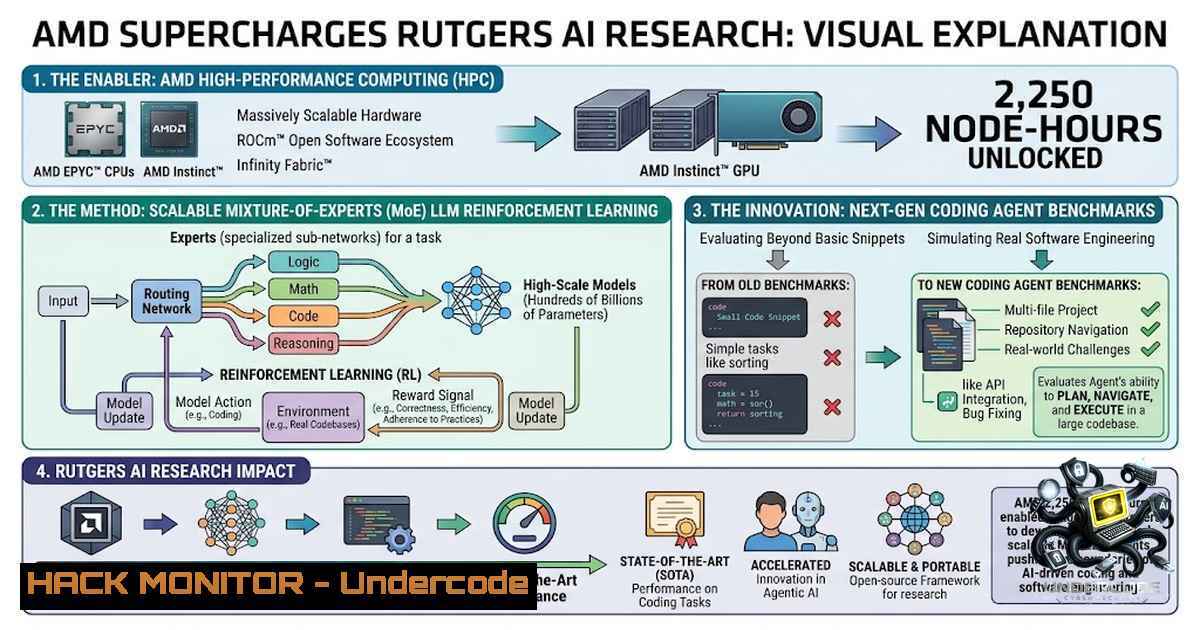
The exponential growth of Large Language Models (LLMs) and Mixture-of-Experts (MoE) architectures has created an insatiable demand for computational resources, transforming high-performance computing (HPC) into the primary bottleneck for AI innovation. Rutgers University’s Department of Computer Science, under Professor Hongyi Wang, has secured a significant boost of 1,500 AMD node-hours, totaling 2,250 node-hours, to tackle the systemic challenges of training and validating these colossal models. This allocation directly fuels cutting-edge systems research in reinforcement learning (RL) and AI agent evaluation, highlighting the critical intersection of hardware enablement, algorithmic efficiency, and cybersecurity in the AI supply chain.
Learning Objectives & Secrets:
- Objective 1: Master MoE Reinforcement Learning Systems – Understand the “PR²: Predictive Routing Replay” framework, a novel approach to optimize RL training for MoE models by predicting and replaying expert routing decisions to improve convergence and stability.
- Objective 2 Secret Tip: Leverage HPC Profiling for Bottleneck Detection – Use profiling tools like `rocprof` and `sysctl` to identify communication overhead in multi-1ode training, a critical secret to maximizing node-hour efficiency and reducing wall-clock time.
- Objective 3 Secret Tip: Validate AI Agents with Dynamic Benchmarking – Design adaptive benchmark suites that expose coding agent vulnerabilities (e.g., logic flaws, infinite loops) rather than relying solely on static test cases, a key insight from the forthcoming Rutgers benchmark.
You Should Know:
1. High-Performance Computing Architecture for MoE Training
The 2,250 node-hours, powered by AMD EPYC CPUs and Instinct accelerators, are pivotal for simulating distributed training environments. This setup is essential for testing the scalability of systems like PR², which rely on efficient inter-1ode communication for expert routing. To validate your own HPC environment, you can use the following command to check the InfiniBand (or Ethernet) fabric performance, which is a common bottleneck in MoE training:
 Linux: Check network latency and bandwidth between nodes
ib_write_bw -a -d mlx5_0 -F  For InfiniBand
iperf3 -c <server_ip> -p 5201 -P 8 -t 60  For general TCP/IP performance

Windows: Use PowerShell for network diagnostics
Test-1etConnection -ComputerName <ServerName> -Port 5201
For multi-GPU synchronization, analyze `rocm-smi` outputs to monitor GPU utilization and memory bandwidth:
 Linux: Monitor AMD GPU performance
watch -1 1 rocm-smi --showallinfo
- Optimizing Reinforcement Learning with Predictive Routing Replay (PR²)
The PR² project addresses a key inefficiency in MoE-based RL: the heavy computational cost of routing inputs to multiple experts. The “Replay” mechanism stores and reuses routing decisions, reducing the overhead of inference during RL policy updates. To implement a similar caching strategy in your PyTorch code, you can use a FIFO cache for routing indices:import torch from collections import deque</li> </ol> class RoutingCache: def <strong>init</strong>(self, max_size=1024): self.cache = deque(maxlen=max_size) def get_routing(self, input_hash, default_routing_fn): if input_hash in self.cache: return self.cache[bash] else: routing = default_routing_fn() self.cache[bash] = routing return routing
This reduces redundant forward passes, effectively optimizing the use of allocated node-hours. The secret tip is to tune the cache size dynamically based on the model’s hidden state variance, which can be measured using
torch.std().- Deploying and Hardening the Frontier AI Coding Agent Benchmark
The upcoming benchmark from Rutgers aims to assess AI coding agents on novel, real-world problems, shifting from static unit tests to dynamic, adversarial evaluations. This is crucial for cybersecurity, as coding agents that pass standard tests might still generate vulnerable code (e.g., SQL injection, buffer overflows). To set up a local test harness for your own agents, consider using Docker to create isolated environments:Linux: Build a secure container for agent testing docker build -t agent_test_env -f Dockerfile.test . docker run --rm -v ./agent_scripts:/app agent_test_env python test_agent.py --security_level high Windows (PowerShell): Similar commands with Docker Desktop docker run --rm -v ${PWD}/agent_scripts:/app agent_test_env python test_agent.py --security_level highThe benchmark should include metrics for execution time, memory usage, and a security score derived from static analysis tools like `bandit` for Python or `eslint` for JavaScript. Integrate `bandit` to automatically flag dangerous code patterns:
bandit -r ./agent_generated_code -f json -o security_report.json
-
Cloud Hardening and API Security for LLM Deployment
Given that LLM training often leverages cloud infrastructure, securing the APIs and storage is paramount. The AMD-Rutgers collaboration highlights the need for robust data pipelines. Use `awscli` or `az` to enforce bucket policies that restrict access to training datasets. To harden your cloud environment, implement strict Identity and Access Management (IAM) roles and enable VPC flow logs for monitoring:Linux: List and audit IAM roles (AWS) aws iam list-roles --query 'Roles[?contains(RoleName, <code>AI_Access</code>)]' Windows: Azure CLI to check Key Vault network policies az keyvault show --1ame <YourKeyVault> --query "properties.networkAcls"
Additionally, ensure that all API endpoints for model inference have rate limiting and authentication in place, using tools like `nginx` or cloud-1ative WAFs to prevent DDoS and unauthorized access.
5. Vulnerability Exploitation and Mitigation in AI Pipelines
A major concern in scalable AI systems is the exposure of model weights via shared storage or CI/CD pipelines. Attackers could inject malicious code into training scripts or poison the cache. To mitigate this, implement checksum verification and code signing. Use `sha256sum` to validate model checkpoints before loading:
 Linux: Verify model integrity
sha256sum -c model_checksum.sha256

Windows: Use CertUtil
CertUtil -hashfile model.bin SHA256
Furthermore, apply the principle of least privilege to the processes running your training jobs. Utilize Linux `setcap` to restrict capabilities:
sudo setcap 'cap_net_bind_service=ep' /usr/bin/python3
This prevents a compromised Python process from opening privileged ports. For Kubernetes deployments, use PodSecurityContext to enforce read-only root filesystems and non-root execution.
What Undercode Say:
- Key Takeaway 1: The AMD-Rutgers partnership is a prime example of how vendor collaboration accelerates systems-level AI research, moving beyond mere compute provision to integrated internships and co-development.
- Key Takeaway 2: The dual focus on MoE RL and coding agent benchmarks indicates a future where AI models are not only larger but also more robust and verifiable, directly addressing the reproducibility and security crises in AI.
Analysis: This announcement signals a strategic move by AMD to deepen its academic footprint by enabling research that could become the backbone of their next-gen hardware architectures. The PR² project addresses a fundamental scaling law: while compute grows, communication overhead slows down training. By optimizing routing, they effectively increase the “marginal utility” of each node-hour, a concept vital for cost-effective AI. The coding benchmark represents a paradigm shift from pure accuracy to safety and reliability, which will likely influence future industry standards for AI agent release. However, this also creates a “computational moat” that could widen the gap between well-funded institutions and others. The internship component ensures knowledge transfer, making the research commercially viable and more secure as it transitions from academia to industry.
Expected Output:
Prediction:
- +1: The PR² technique will likely be adopted by major cloud providers, reducing LLM training costs by an estimated 15-20% through efficient routing and caching.
- +1: The open-sourcing of the coding agent benchmark will standardize AI security evaluations, leading to more trustworthy autonomous systems in DevOps and automated code review.
- -1: The increased demand for specialized AMD HPC resources may create vendor lock-in, forcing researchers to fine-tune their code for specific hardware, reducing portability.
- -1: As training becomes more efficient, it lowers the barrier for malicious actors to fine-tune harmful AI models, necessitating stricter access controls and monitoring on systems like the Rutgers cluster.
- +1: The extended collaboration (up to 2,250 node-hours) implies AMD sees a long-term strategic value in high-margin AI workloads, which could catalyze further innovation in AI-specific chips, benefiting the broader cybersecurity ecosystem by enabling more powerful defense-oriented AI.
▶️ Related Video (72% Match):
🎯Let’s Practice For Free:
🎓 Live Courses & Certifications:
Join Undercode Academy for Verified Certifications
🚀 Request a Custom Project:
Secure, high-velocity infrastructure and disruptive technological engineering. Contact our engineering team for high-tier development and proprietary systems:
[email protected]
💎 Smart Architecture | 🛡️ Secure by Design | ⭐ Trusted by ThousandsIT/Security Reporter URL:
Reported By: https://lnkd.in/p/enhktmF5 – Hackers Feeds
Extra Hub: Undercode MoN
Basic Verification: Pass ✅🔐JOIN OUR CYBER WORLD [ CVE News • HackMonitor • UndercodeNews ]
📢 Follow UndercodeTesting & Stay Tuned:
- Deploying and Hardening the Frontier AI Coding Agent Benchmark


