
Listen to this Post
Introduction:
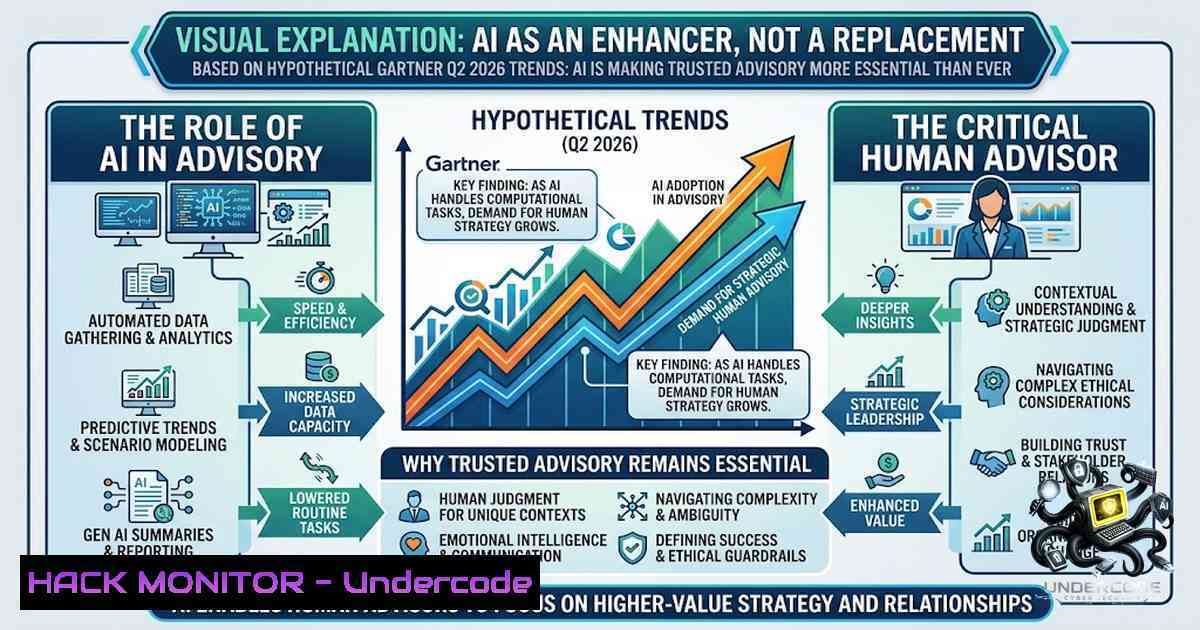
The narrative that artificial intelligence would commoditize strategic advisory and render traditional research firms obsolete has been a persistent theme across the tech landscape. Yet Gartner’s second-quarter 2026 financial results tell a decidedly different story—one where AI has become the single largest catalyst for advisory services rather than a disruptor. With adjusted EPS reaching $4.37 (up 24% year-over-year), total contract value hitting $5.3 billion with accelerating growth, and free cash flow of $378 million, the numbers confirm that enterprise decision-makers are increasingly turning to verified, human-led insights precisely when AI complexity peaks. This article examines why the disruption narrative has failed, explores the technical and economic realities of enterprise AI adoption, and provides actionable frameworks for CIOs and security leaders navigating this complex landscape.
Learning Objectives & Secrets:
- Objective 1: Understand why AI has amplified rather than diminished the need for trusted advisory services—and how to distinguish between scraped web data and verified, benchmarked intelligence.
-
Objective 2 Secret Tip: Master the AI Total Cost of Ownership (TCO) framework—hidden costs such as compliance reviews, model retraining, internal overheads, and specialized infrastructure often exceed initial expectations by significant margins. Track these systematically using cost allocation tags and real-time monitoring.
-
Objective 3 Secret Tip: Navigate vendor pricing complexity with real-time benchmarks—as cloud providers introduce consumption tiers, compute minimums, and usage-based add-ons, LLMs cannot reliably evaluate whether vendor proposals are fair. Maintain a dynamic pricing benchmark database and negotiate from data-backed positions.
You Should Know:
- The AI Advisory Paradox: Why More Data Creates More Demand for Verification
The proliferation of AI-generated content has paradoxically increased the value of verified, human-curated intelligence. CIOs today don’t need scraped web data or Reddit threads—they need validated benchmarks, frameworks, and real-world vendor insights that only come from rigorous research processes. Gartner’s contract value acceleration—growing 1.7% year-over-year and accelerating sequentially—demonstrates that enterprises are voting with their budgets for trusted guidance.
Gartner recommends a four-phase AI integration model: setting ambitions, assessing current capabilities, taking action, and tracking achievements. This structured approach helps organizations avoid the common pitfall of deploying AI without clear strategic alignment.
Step-by-Step Guide: Implementing an AI Advisory Verification Framework
- Establish a vendor intelligence database—maintain real-time pricing benchmarks for all AI and cloud vendors your organization uses or evaluates.
-
Implement a “trust scoring” system—rate all AI-generated insights against verified sources (Gartner, Forrester, internal benchmarks) before operational use.
-
Create an AI advisory review board—comprising security, finance, and operations leaders to validate AI recommendations before implementation.
-
Document decision provenance—track which insights came from AI versus human analysts, and measure outcome differences quarterly.
-
Audit AI-generated vendor comparisons—use contract experts to validate LLM-generated vendor proposals against actual market pricing.
-
The AI TCO Trap: Calculating What LLMs Can’t Tell You
Generative AI initiatives often exceed budget expectations due to hidden costs that LLMs themselves cannot adequately forecast. Gartner’s framework for calculating business value and cost identifies that TCO varies dramatically by use case—“Defend” use cases like coding assistants range from $1.15 million to $8 million in initial costs, while “Upend” use cases such as fine-tuned LLMs for drug discovery can exceed $160,000 in build costs with ongoing user costs up to $11,000 annually.
Step-by-Step Guide: Building an AI TCO Tracker
- Categorize all AI initiatives—classify each project as “Defend” (productivity), “Grow” (revenue), or “Upend” (transformational) to set appropriate cost expectations.
-
Implement cloud cost tagging—assign unique tags to all AI-related resources across AWS, Azure, and GCP:
 AWS: Tag all AI resources
aws ec2 create-tags --resources $RESOURCE_ID --tags Key=Project,Value=AI-Model-Training Key=CostCenter,Value=AI-Innovation

Azure: Tag AI resources
az resource tag --tags Project=AI-Inference Environment=Production --ids $RESOURCE_ID

GCP: Label AI resources
gcloud compute instances add-labels $INSTANCE_NAME --labels=project=ai-training,cost-center=ai-innovation
- Track real-time running costs—use cloud-1ative cost management tools to monitor infrastructure, inference, and storage costs daily:
 AWS Cost Explorer CLI
aws ce get-cost-and-usage --time-period Start=2026-08-01,End=2026-08-31 --granularity=DAILY --filter '{"Tags":{"Key":"Project","Values":["AI-Model-Training"]}}'

Azure Cost Management
az consumption usage list --billing-period-1ame 202608 --query "[?tags.Project=='AI-Inference']"
- Include non-cloud costs—track compliance reviews, model retraining cycles, data preparation, change management, and specialized talent acquisition.
-
Trigger automated cost alerts—configure budgets and alerts when consumption exceeds thresholds:
 AWS Budget alert
aws budgets create-budget --account-id $ACCOUNT_ID --budget file://ai-budget.json --1otifications-with-subscribers file://notifications.json
- Conduct monthly TCO reviews—compare actual costs against initial projections and recalibrate forecasts.
3. Vendor Pricing Complexity: When LLMs Can’t Negotiate
As cloud and AI vendors introduce increasingly complex pricing models—token consumption tiers, compute minimums, commitment discounts, and usage-based add-ons—LLMs struggle to reliably determine whether vendor proposals are fair. Gartner maintains thousands of real-time pricing benchmarks that enable contract experts to evaluate proposals with precision.
Step-by-Step Guide: Vendor Pricing Benchmarking
- Build a vendor pricing matrix—track base rates, volume discounts, commitment terms, and overage charges for all active vendors:
 Example: Track AWS pricing tiers
aws pricing get-products --service-code AmazonEC2 --filters "Type=TERM_MATCH,Field=instanceType,Value=t3.medium" --format-version aws_v1

Azure pricing API
curl -X GET "https://prices.azure.com/api/retail/prices?api-version=2023-01-01-preview&serviceName=Virtual%20Machines&priceType=Consumption"
- Monitor GCP pricing—GCP remains 5-10% cheaper than AWS and Azure on equivalent compute for AI workloads:
 GCP pricing API
curl -X GET "https://cloudbilling.googleapis.com/v1/services/6F81-5844-456A/skus?key=$API_KEY"
- Create a vendor scorecard—weight pricing against performance, reliability, and support.
-
Schedule quarterly vendor benchmark reviews—compare actual spend against market rates and renegotiate where gaps exist.
-
Document negotiation leverage points—use benchmark data to identify when vendors are charging above-market rates.
-
Enterprise AI Security and Governance: Managing the Unquantified Spend
With 83% of CEOs increasing AI investment yet 59% of AI initiatives never reaching production, the governance and security implications are profound. Unquantified AI spending creates shadow IT risks, data exposure vulnerabilities, and compliance gaps that security teams must address.
Step-by-Step Guide: AI Governance and Security Implementation
- Inventory all AI tools and models—discover shadow AI usage across your organization:
 Linux: Scan for AI-related processes
ps aux | grep -E 'python|tensorflow|pytorch|transformers|llama|openai' | grep -v grep

Windows PowerShell: Find AI processes
Get-Process | Where-Object { $_.ProcessName -match 'python|tensorflow|pytorch' }
- Implement API security monitoring—track all AI API calls to detect unauthorized usage or data exfiltration:
 Linux: Monitor outbound API traffic
sudo tcpdump -i any -1 'host api.openai.com or host api.anthropic.com or host api.cohere.com'

Use mitmproxy for API inspection
mitmproxy --mode transparent --showhost
- Establish data classification for AI inputs—ensure sensitive data is never sent to public LLM endpoints:
 Python: Redact sensitive data before API calls
import re
def redact_sensitive(text):
 Redact emails, phone numbers, SSNs
text = re.sub(r'\b[A-Za-z0-9._%+-]+@[A-Za-z0-9.-]+.[A-Z|a-z]{2,}\b', '[bash]', text)
text = re.sub(r'\b\d{3}-\d{2}-\d{4}\b', '[bash]', text)
return text
- Deploy AI usage dashboards—visualize spend, usage patterns, and security incidents across all AI initiatives.
-
Conduct regular AI security audits—review model access controls, data retention policies, and compliance with regulations like GDPR and CCPA.
5. Turning Productivity Gains into Realized Cash ROI
The gap between productivity improvements and realized financial returns remains one of the biggest challenges in enterprise AI. Gartner’s framework for converting productivity gains into financial outcomes requires systematic measurement and attribution.
Step-by-Step Guide: AI ROI Measurement Framework
- Define baseline productivity metrics—measure current task completion times, error rates, and throughput before AI deployment.
2. Implement time-tracking for AI-assisted tasks:
 Linux: Track time spent on tasks
time python run_analysis.py  Measure execution time

Use system monitoring tools
top -b -1 1 | grep -E 'python|node'  Monitor resource usage
- Calculate time savings—compare pre-AI and post-AI task completion times and convert to financial value using loaded labor costs.
-
Track quality improvements—measure error reduction, accuracy gains, and customer satisfaction improvements.
-
Report AI ROI in financial terms—present findings to CFOs using Gartner’s recommended five-business-outcome framework rather than activity metrics.
-
Review and recalibrate quarterly—adjust forecasts based on actual performance data.
What Undercode Say:
-
Key Takeaway 1: AI has become the single largest catalyst for advisory services, not a replacement. The complexity introduced by enterprise AI has made verified, benchmarked intelligence more valuable than ever. CIOs don’t want scraped web data—they need frameworks, benchmarks, and real-world vendor insights that only trusted advisors can provide. Organizations that rely solely on unverified AI insights will find themselves at a competitive disadvantage as technology stacks become harder to navigate.
-
Key Takeaway 2: The AI TCO trap is real and widening. Hidden costs—compliance reviews, model retraining, internal overheads, specialized infrastructure, and talent acquisition—consistently exceed initial projections. Enterprises must implement rigorous TCO tracking frameworks, cloud cost tagging, and automated alerts to prevent AI initiatives from becoming budget black holes. Organizations that fail to quantify true AI costs will struggle to demonstrate ROI and secure continued funding.
Prediction:
-
+1 Trusted advisory firms like Gartner will continue to thrive as AI complexity accelerates, with contract value growth remaining strong through 2027 as enterprises seek verified benchmarks over LLM-generated approximations.
-
+1 AI TCO frameworks will become standard operating procedure for enterprise IT finance teams, with cloud cost tagging and real-time monitoring becoming mandatory for all AI initiatives.
-
-1 Up to 40% of advertised AI “cost savings” will evaporate due to poor optimization and unaccounted hidden costs, creating a wave of AI project cancellations and budget reallocations.
-
-1 Organizations that fail to implement proper AI governance and security controls will face significant data breaches and regulatory penalties as shadow AI usage continues to expand unchecked.
-
+1 The gap between enterprises operating with data-backed precision and those relying on unverified AI insights will widen significantly, creating a competitive moat for organizations that invest in trusted advisory and rigorous TCO management.
▶️ Related Video (76% Match):
https://www.youtube.com/watch?v=50fDAHC2x_w
🎯Let’s Practice For Free:
🎓 Live Courses & Certifications:
Join Undercode Academy for Verified Certifications
🚀 Request a Custom Project:
Secure, high-velocity infrastructure and disruptive technological engineering. Contact our engineering team for high-tier development and proprietary systems:
[email protected]
💎 Smart Architecture | 🛡️ Secure by Design | ⭐ Trusted by Thousands
IT/Security Reporter URL:
Reported By: https://lnkd.in/p/eVBgGr_4 – Hackers Feeds
Extra Hub: Undercode MoN
Basic Verification: Pass ✅


