
Listen to this Post
Introduction:
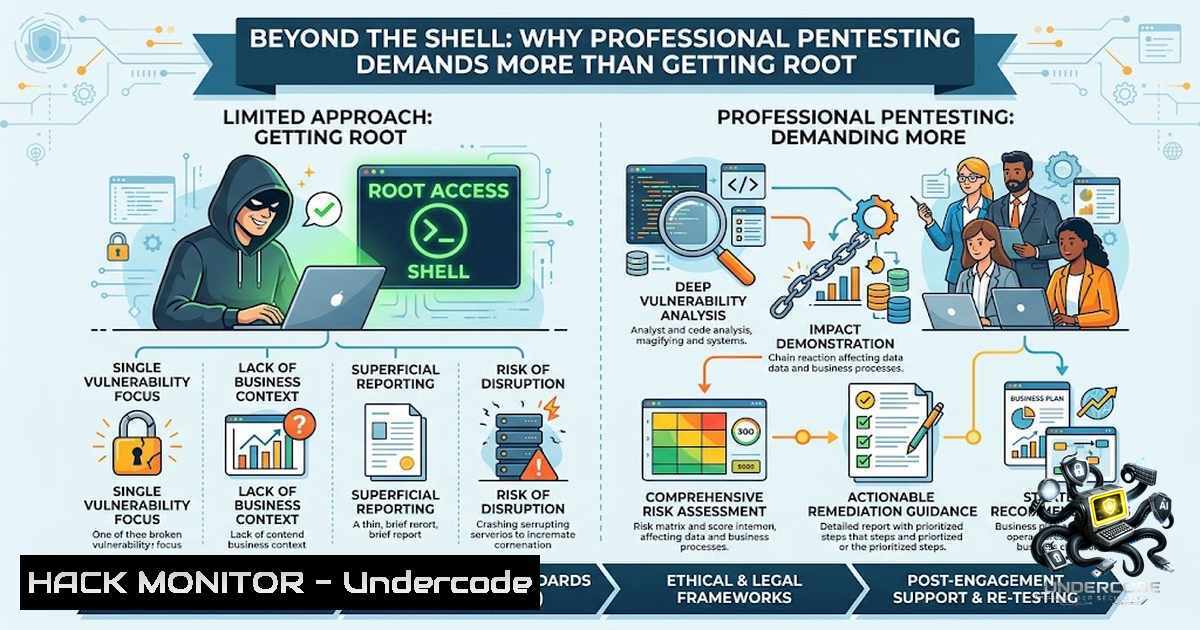
The cybersecurity industry has cultivated a dangerous misconception: that breaking into machines and capturing flags equates to professional penetration testing. While exploit proficiency and CTF success demonstrate technical aptitude, they represent only a fraction of what organizations actually require. Professional pentesting is not about proving you can “hack something”—it is about answering uncomfortable business questions: What vulnerability truly exists? Can it be exploited or is it a false positive? What would the business impact be? What evidence demonstrates the problem? How can the technical team reproduce it? How should it be fixed? The gap between hobbyist hacking and professional auditing is vast, and the report you deliver may be just as important as the access you gain.
Learning Objectives & Secrets:
- Objective 1: Master the Full Pentesting Lifecycle – Move beyond exploitation to encompass scoping, reconnaissance, enumeration, controlled validation, impact assessment, evidence documentation, and professional reporting. The objective is not simply obtaining a shell but delivering actionable intelligence that enables remediation.
-
Objective 2 Secret Tip: Validate Manually, Never Trust Scanners – Vulnerability scanners produce candidates, but the professional pentester must manually validate every finding to eliminate false positives. The golden rule: demonstrate real risk with the minimum technical impact necessary on the audited system. In production, breaking something can mean financial loss, downtime, exposed sensitive data, and legal consequences.
-
Objective 3 Secret Tip: Report for Two Audiences – Every finding must satisfy both technical teams and executive stakeholders. Structure each finding with: clear title and severity, affected asset, technical description of the root cause, step-by-step reproduction steps, evidence (screenshots and payloads with sensitive data masked), and concrete remediation guidance.
You Should Know:
1. Foundational OS and Network Mastery
Professional pentesting demands deep understanding of how systems communicate and operate. When you see 10.10.10.20:443, you must interpret which interface responds, which transport protocol operates (TCP), how the domain resolves via DNS, and why one machine reaches a segment but not another. Without networking, concepts like pivoting or lateral movement lack meaning.
Linux proficiency is not about installing Kali Linux—it means opening a terminal and diagnosing an unknown system. Essential commands include:
 Identify current user and privileges
whoami
id

Examine running processes
ps aux
ps aux | grep -E "http|mysql|nginx"

Identify listening ports and services
ss -tulpn
netstat -tulpn

Check SUID binaries and capabilities
find / -perm -4000 -type f 2>/dev/null
getcap -r / 2>/dev/null

Review scheduled tasks
crontab -l
cat /etc/crontab
ls -la /etc/cron.d/
Windows environments are equally critical—enterprises run endpoints and key servers on Windows. Master user management, NTFS privileges, Windows services, the registry, and PowerShell for auditing insecure configurations:
 Enumerate users and groups
Get-LocalUser
Get-LocalGroup
Get-ADUser -Filter  -Properties   Requires ActiveDirectory module

Examine services and their permissions
Get-Service
sc.exe query
sc.exe qc <service_name>

Check registry for misconfigurations
Get-ItemProperty -Path "HKLM:\SOFTWARE\Microsoft\Windows\CurrentVersion\Run"
Get-ChildItem -Path "HKLM:\SOFTWARE\Microsoft\Windows NT\CurrentVersion\"

Audit NTFS permissions
icacls C:\SensitiveFolder
Get-Acl -Path "C:\SensitiveFolder" | Format-List
2. Scripting for Automation and API Security
You do not need to be a software developer, but you must master enough scripting to automate HTTP requests, parse tool outputs, and modify public exploits. Python with the `requests` library is essential for API testing and automation:
import requests
import json

Basic API authentication and request
headers = {"Authorization": "Bearer <JWT_TOKEN>", "Content-Type": "application/json"}
response = requests.get("https://api.target.com/v1/users", headers=headers)

Test for IDOR (Insecure Direct Object Reference)
for user_id in range(1, 100):
response = requests.get(f"https://api.target.com/v1/users/{user_id}", headers=headers)
if response.status_code == 200:
print(f"Potential IDOR: User {user_id} data accessible")
print(response.json())

SQL injection test via parameter fuzzing
payloads = ["' OR '1'='1", "' UNION SELECT NULL--", "'; DROP TABLE users--"]
for payload in payloads:
response = requests.get(f"https://api.target.com/search?q={payload}")
if "error" not in response.text.lower():
print(f"Potential SQLi with payload: {payload}")
Bash scripting enables chaining tools via pipes (grep, awk, sed), while PowerShell provides native Windows and Active Directory interaction:
 Automate Nmap scanning and service enumeration
nmap -sV -p- -T4 192.168.1.0/24 | grep -E "open|filtered" | tee nmap_results.txt

Extract HTTP headers and server banners
curl -I https://target.com | grep -E "Server|X-Powered-By"
On the web side, understand the full HTTP request lifecycle—methods, headers, session cookies, JWT tokens, status codes—before touching tools like Burp Suite. API security testing requires particular attention to authentication, authorization (IDOR/BOLA), session management, and input validation.
3. Professional Reconnaissance and Enumeration Methodology
The scope is a strict legal boundary—never test a subdomain or IP not expressly authorized in the Rules of Engagement document. Manual enumeration distinguishes beginners from professionals. Instead of blindly launching Nmap with automated flags, ask analytical questions: What service exactly runs on this port? What version does it expose? Does it offer default authentication methods?
 Targeted Nmap scanning with service and version detection
nmap -sV -sC -p 22,80,443,445,3306,3389,8080 <target>

Aggressive but controlled service enumeration
nmap -sV --version-intensity 5 -p- <target>

UDP service scanning (often overlooked)
nmap -sU -p 53,67,68,69,123,135,137,138,139,161,162,445,514,520,631,1434,1900,4500,49152 <target>

Banner grabbing with netcat
nc -1v <target> <port>
echo "HEAD / HTTP/1.0\n\n" | nc <target> 80
Web application auditing follows the OWASP Web Security Testing Guide (WSTG)—not merely the OWASP Top 10, which is an awareness document rather than a testing methodology. Use Burp Suite to intercept traffic, map all endpoints, identify user roles, and enumerate parameters before seeking vulnerabilities.
4. Controlled Exploitation and Privilege Escalation
After gaining initial limited access, evaluate whether privilege escalation is possible. On Linux, look for:
 Sudo misconfigurations
sudo -l

SUID binaries (potential for privilege escalation)
find / -perm -4000 -type f 2>/dev/null

World-writable files and directories
find / -writable -type f 2>/dev/null | grep -v /proc/
find / -perm -222 -type d 2>/dev/null

PATH hijacking vulnerabilities
echo $PATH
find / -writable -type d 2>/dev/null | grep -E "bin|sbin"

Cron jobs with writable scripts
cat /etc/crontab
ls -la /etc/cron.d/
On Windows, examine token privileges (SeImpersonatePrivilege), unquoted service paths, DLL hijacking, and credentials in configuration files:
 Check current user privileges
whoami /priv

Enumerate unquoted service paths
wmic service get name,displayname,pathname,startmode | findstr /i "auto" | findstr /i /v "c:\windows\" | findstr /i /v """

Audit service permissions
sc.exe sdshow <service_name>
accesschk.exe -ucqv <service_name>

Check for stored credentials
cmdkey /list
vaultcmd /listcreds:
Active Directory testing requires enumerating trust relationships, domain groups, Kerberoasting, AS-REP Roasting, and abuse of access control lists (ACLs):
 Enumerate domain users and SPNs (Kerberoasting)
Get-ADUser -Filter {ServicePrincipalName -1e "$null"} -Properties ServicePrincipalName

AS-REP Roasting (users without pre-authentication)
Get-ADUser -Filter {DoesNotRequirePreAuth -eq $true} -Properties DoesNotRequirePreAuth

Enumerate domain admins and high-privilege groups
Get-ADGroupMember -Identity "Domain Admins"
5. Professional Reporting and Remediation
The pentest report must satisfy two distinct audiences: technical teams and executives. Each finding requires:
- and Severity: Clear, direct, and based on real risk (not CVSS score alone, which measures technical severity while business risk depends on context)
- Affected Asset: Exact URL, endpoint, or IP
- Description: Technical explanation of the root cause
- Reproduction Steps: Step-by-step guide for developers to replicate
- Evidence: Screenshots and payloads with sensitive data masked
- Remediation Guidance: Specific code or configuration recommendations
Example remediation for an SQL injection finding:
 Vulnerable code
query = f"SELECT  FROM users WHERE username = '{user_input}'"

Remediated code (parameterized query)
cursor.execute("SELECT  FROM users WHERE username = %s", (user_input,))
For an IDOR vulnerability:
 Vulnerable: direct object reference
user_data = get_user_by_id(request.GET.get('user_id'))

Remediated: enforce authorization
current_user = get_current_user(request.session)
if current_user.role == 'admin' or current_user.id == int(request.GET.get('user_id')):
user_data = get_user_by_id(request.GET.get('user_id'))
else:
return HttpResponseForbidden()
What Undercode Say:
- Key Takeaway 1: Getting Root Does Not Make You a Professional Pentester – The industry has conflated CTF success with professional auditing. Executing Nmap is not pentesting. Launching a vulnerability scanner is not pentesting. Copying an exploit from GitHub is not pentesting. Following a walkthrough to solve a machine does not demonstrate you can conduct a professional audit. Professional pentesting requires networks, Linux, Windows, HTTP and web applications, scripting, reconnaissance and enumeration, controlled exploitation, privilege escalation, Active Directory, risk assessment, and reporting.
-
Key Takeaway 2: Know When NOT to Exploit – In a lab, breaking something may mean restarting the machine. In production, it can mean financial loss, downtime, exposed sensitive data, and legal consequences. The professional rule is: demonstrate risk with the minimum necessary impact. A pentester who identifies fewer vulnerabilities but validates each manually, demonstrates real impact, documents evidence, explains the root cause, and proposes concrete remediation is more valuable than one who simply collects shells.
The debate between Candidate A (300 HTB machines, excellent exploitation, no professional reports) and Candidate B (50 labs, manual enumeration and validation, justifies risk, has complete audit reports) is not even a debate. Organizations hire pentesters to answer uncomfortable questions, not to demonstrate hacking prowess. The cybersecurity community is teaching too much about “getting the shell” and too little about being a professional pentester.
Prediction:
- +1 The demand for professional pentesters who can bridge technical exploitation and business communication will outpace demand for pure “hackers.” Organizations increasingly recognize that actionable reports drive security improvements, not root shells.
-
+1 Certification bodies will evolve practical exams (like OSCP, PNPT, eJPT) to place greater weight on reporting quality, remediation guidance, and business impact articulation.
-
-1 The proliferation of automated pentesting platforms and AI-powered scanners will flood the market with false positives, making manual validation skills more valuable but also more scarce.
-
-1 Junior pentesters who focus exclusively on CTF platforms without developing reporting, scoping, and business communication skills will struggle to secure professional roles and may cause production incidents through reckless exploitation.
-
+1 Organizations will increasingly adopt Purple Team exercises that integrate offensive testing with defensive detection and response, requiring pentesters who understand both attack and defense.
-
+1 Cloud security (AWS, Azure, GCP) and API security will become the dominant specializations, creating opportunities for pentesters who combine foundational skills with cloud IAM, storage misconfiguration, and control plane exploitation expertise.
▶️ Related Video (86% Match):
https://www.youtube.com/watch?v=hGW2ioadeMU
🎯Let’s Practice For Free:
🎓 Live Courses & Certifications:
Join Undercode Academy for Verified Certifications
🚀 Request a Custom Project:
Secure, high-velocity infrastructure and disruptive technological engineering. Contact our engineering team for high-tier development and proprietary systems:
[email protected]
💎 Smart Architecture | 🛡️ Secure by Design | ⭐ Trusted by Thousands
IT/Security Reporter URL:
Reported By: https://lnkd.in/p/efxvxxfy – Hackers Feeds
Extra Hub: Undercode MoN
Basic Verification: Pass ✅


