
Listen to this Post
Introduction:
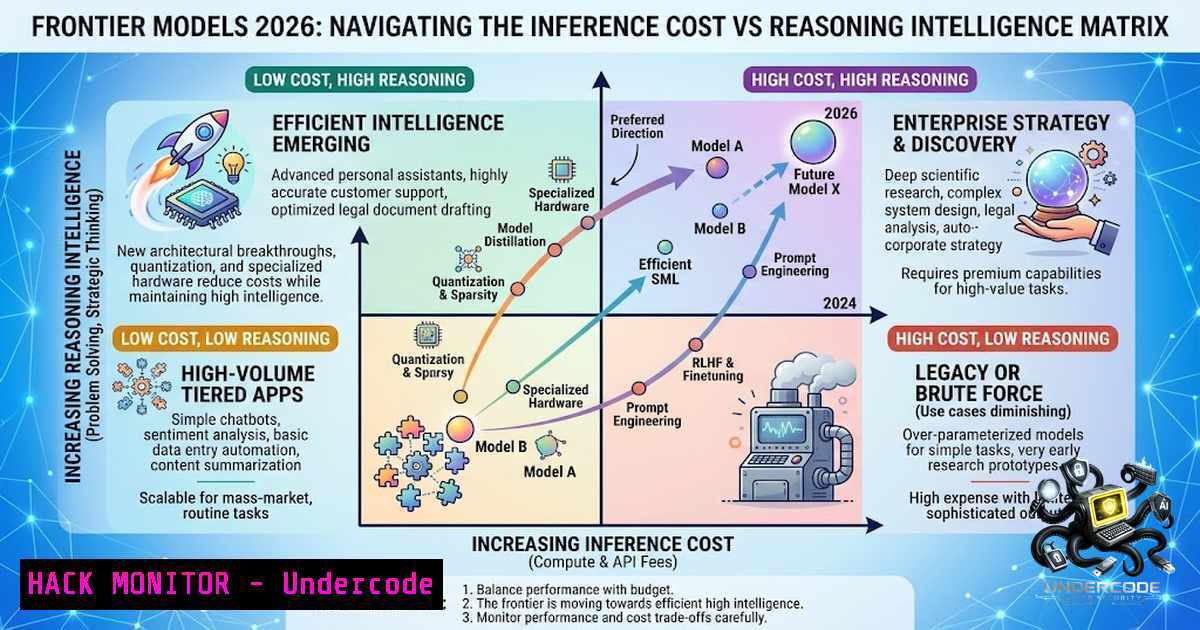
The economics of artificial intelligence have undergone a seismic shift, with token processing costs plummeting by 94% over the past 24 months. This dramatic deflation has transformed model selection from a purely technical decision into a strict portfolio economics exercise. Enterprises now face a strategic imperative: match each workload to the optimally priced model capable of delivering the required reasoning intelligence, or risk hemorrhaging capital on over-provisioned compute. The emergence of intelligent Model Routers—gateways that dynamically dispatch requests to the most cost-effective model for each task—has become the defining architectural pattern for AI-1ative enterprises in 2026.
Learning Objectives & Secrets:
- Objective 1: Master the 2026 Frontier Model Cost Matrix. Understand the precise pricing tiers and use-case fit for elite reasoning models (Claude 3.7 Sonnet, o3), mass automation models (DeepSeek-V3, Gemini 2.0 Flash), open-source sovereignty models (Llama 3.3, Mistral), and real-time voice models (GPT-4o Mini, Claude Haiku). Map these to specific business functions.
-
Objective 2 Secret Tip: Implement Prompt Compression and Context Pruning. Up to two-thirds of agent spend is consumed by re-reading context that the agent itself retrieved. Before routing, aggressively compress prompts and prune unnecessary context. Techniques like dynamic context pruning have demonstrated up to 85% reduction in token consumption and a 62.5% improvement in end-to-end latency.
-
Objective 3 Secret Tip: Architect for Model-Agnostic Agility. Never sign exclusivity contracts with a single foundation provider. The commoditization of model weights is rapid, and your bargaining power resides in the agentic layer. Build your application against an abstraction layer (like an AI Gateway) that allows hot-swapping of model backends without code changes.
You Should Know:
- The 2026 Frontier Model Cost Matrix: A Portfolio Approach
The post identifies four distinct tiers of models, each with a specific cost structure and use case:
- Elite Reasoning (Claude 3.7 Sonnet / o3): Priced at $3.00–$4.50 per 1M input tokens. Use for legal auditing, mission-critical code generation, and M&A planning. Output costs are significantly higher, typically $15.00 per 1M tokens for Claude 3.7 Sonnet.
-
Mass Automation (DeepSeek-V3 / Gemini 2.0 Flash): Priced at $0.10–$0.55 per 1M tokens. Gemini 2.0 Flash inputs cost $0.10/1M tokens and outputs $0.40/1M tokens. DeepSeek-V3 inputs are $0.27/1M tokens and outputs $1.10/1M tokens. Use for 80% of corporate traffic and customer service agents.
-
Open Source Sovereignty (Llama 3.3 / Mistral): On-premise hosting with zero data exposure risk. Deploy using Ollama: `ollama pull llama3.3:70b` or
ollama pull mistral-small. Requires GPU with ≥16 GB VRAM (RTX 4080/4090 or A4000). -
Real-Time & Voice (GPT-4o Mini / Claude Haiku): Sub-150ms inference for voice agents and instant decisions. GPT-4o Mini offers 150ms latency, while Claude Haiku delivers 90–150ms.
Step-by-Step Guide: Implementing a Cost-Aware Routing Strategy
- Audit Your Workload: Classify all AI inference requests by complexity, latency requirements, and data sensitivity.
- Map to Model Tiers: Assign each workload category to the cheapest model tier that can successfully execute it.
- Implement an AI Gateway: Deploy a model router like LiteLLM, Portkey, or Vercel AI Gateway.
- Configure Routing Rules: Define rule-based or semantic routing policies. For example, route all customer support queries to Gemini 2.0 Flash, but route legal contract analysis to Claude 3.7 Sonnet.
- Enable Fallback and Failover: Configure automatic retries and fallback to secondary models if the primary is unavailable or times out.
- Monitor and Optimize: Track cost per request and attribute spend to users or departments. Continuously evaluate model performance against real traffic.
2. Building Your Own AI Model Router
For organizations seeking maximum control and customization, building a self-hosted model router is a viable option. Open-source projects like `ai-router` (single file, zero dependencies) and `llm-router-api` provide OpenAI-compatible gateways that aggregate multiple LLM providers behind a single endpoint.
Step-by-Step Guide: Deploying a Self-Hosted AI Router
- Choose Your Router: Select an open-source router like `longongzi/ai-router` or
kreolsky/llm-router-api. - Configure Providers: Add your API keys for each provider (OpenAI, Anthropic, Google, DeepSeek, etc.) in the configuration file.
- Set Routing Policies: Define rules based on the `model` field in the request. For example, map `model: “fast”` to `gemini-2.0-flash` and `model: “expert”` to
claude-3.7-sonnet. - Deploy the Gateway: Run the router as a service. For
ai-router, this is a single binary deployment. - Point Your Clients: Update your application’s `base_url` to point to the router’s endpoint (e.g., `http://127.0.0.1:15730/v1`).
- Implement Monitoring: Log all routing decisions and track costs per model.
3. Cloud-1ative Model Routing with API Gateways
Major cloud providers now offer native model routing capabilities. Google Cloud API Gateway allows you to map virtual model names to specific backend targets directly in your OpenAPI 3.x specification. Azure AI Foundry offers a Model Router with cost-optimized routing and latency-aware retries. Databricks AI Gateway provides traffic splitting capabilities, allowing you to send a percentage of traffic to different model backends.
Step-by-Step Guide: Configuring Model Routing on Google Cloud
- Define Your OpenAPI Specification: Create an OpenAPI 3.x file.
- Add Routing Rules: Use the `x-google-api-management` extension block to map virtual model names to backend targets.
- Deploy the Gateway: Deploy your updated API configuration to activate the gateway.
- Test the Routing: Send requests with different `model` parameters and verify they are routed to the correct backend.
-
API Security and Key Management in a Multi-Model Environment
With multiple providers and API keys, security becomes paramount. Implement the following best practices:
- Bring Your Own Key (BYOK): Allow each tenant or user to route requests on their own provider credentials.
- Zero Data Retention: Enforce policies that prevent providers from storing prompts and outputs.
- Input Guardrails: Implement semantic routing with input guardrails to prevent adversarial prompts from bypassing security controls.
- Budget Controls: Cap spend with per-user or per-department budgets.
5. The Business Impact: P&L Transformation
Enterprises adopting intelligent Model Routers are reducing their compute bills by up to 70% by sending each request to the model with the lowest marginal cost required. NVIDIA’s NeMo Switchyard routing strategy has demonstrated up to 74% cost reduction compared to relying solely on Claude Opus 4.8, with only a ~6 percentage point accuracy trade-off. Startups like Cursor have reported 30-50% cost savings through their model router. In some cases, Palantir has reported inference cost reductions of up to 97% through routing tools.
What Undercode Say:
- Key Takeaway 1: The 94% drop in token costs has made model selection a pure economics decision. Enterprises must adopt a portfolio approach, matching workloads to the cheapest capable model.
-
Key Takeaway 2: Model Routers are the killer app for AI cost optimization. Companies that implement intelligent routing can reduce inference costs by 60-80% on mixed-complexity workloads.
Analysis: The commoditization of AI inference is accelerating. The barrier to entry for AI-powered applications has never been lower, but the risk of overspending on premium models has never been higher. The winners in this new paradigm will be those who build agnostic architectures that can dynamically adapt to the rapidly evolving model landscape. The agentic layer—not the model itself—is where sustainable competitive advantage will be built. Organizations that lock themselves into exclusive contracts with a single provider will find themselves at a severe cost disadvantage as model prices continue to fall and new entrants emerge. The future belongs to the routers.
Prediction:
- +1 Model routing will become a standard feature of every major cloud AI platform within 18 months, democratizing cost optimization for all enterprises.
-
+1 The rise of model routers will accelerate the adoption of open-source models, as enterprises gain the ability to seamlessly integrate on-premise models with cloud-based ones.
-
-1 The AI model provider landscape will undergo a consolidation, as smaller providers struggle to compete in a market where price is the primary differentiator.
-
-1 Security and compliance risks will escalate as organizations juggle multiple providers with varying data residency and retention policies. Zero-data-retention and input guardrails will become non-1egotiable requirements.
-
+1 The agentic layer will emerge as the new battleground for AI differentiation, with companies building proprietary reasoning and orchestration frameworks on top of commoditized models.
▶️ Related Video (86% Match):
https://www.youtube.com/watch?v=-rQuS8phhKo
🎯Let’s Practice For Free:
🎓 Live Courses & Certifications:
Join Undercode Academy for Verified Certifications
🚀 Request a Custom Project:
Secure, high-velocity infrastructure and disruptive technological engineering. Contact our engineering team for high-tier development and proprietary systems:
[email protected]
💎 Smart Architecture | 🛡️ Secure by Design | ⭐ Trusted by Thousands
IT/Security Reporter URL:
Reported By: https://lnkd.in/p/di5Zsrsd – Hackers Feeds
Extra Hub: Undercode MoN
Basic Verification: Pass ✅


