Listen to this Post
Introduction:
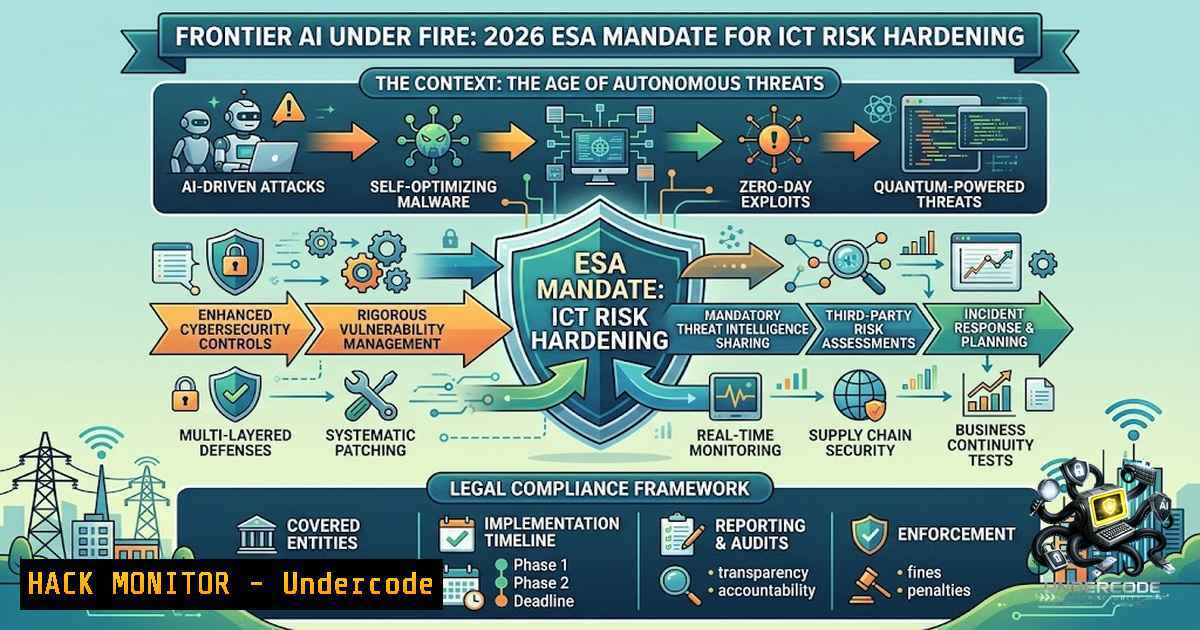
The European Supervisory Authorities (ESAs) have officially sounded the alarm on frontier AI, declaring that the advanced capabilities of recent models are no longer just a business opportunity but a systemic accelerant for cyber risk. In a joint statement published in 2026, the ESAs call for a consistent, risk-based approach to ICT risk management, shifting the paradigm from reactive patching to proactive, AI-aware resilience【0†L1-L6】. This directive compels organizations to treat AI models as critical infrastructure components, demanding stringent technical controls, continuous monitoring, and rapid incident response frameworks that account for the unique velocity and sophistication of AI-driven attacks.
Learning Objectives:
- Understand the ESAs’ 2026 risk-based framework for frontier AI and its implications for ICT security governance.
- Implement technical mitigation strategies, including API hardening, model access control, and adversarial input filtering.
- Develop rapid incident response playbooks tailored to AI-specific threats such as model poisoning, prompt injection, and data exfiltration.
You Should Know:
1. API Security Hardening for AI Model Interfaces
The ESAs’ statement emphasizes that frontier AI models, often exposed via APIs, represent a critical attack surface. Attackers can exploit these interfaces for prompt injection, denial-of-service, or unauthorized data extraction. To comply with the risk-based approach, organizations must implement robust API security controls.
Step‑by‑step guide:
- Inventory and Classify: Document all AI model endpoints, their data sensitivity, and access patterns. Classify models based on the potential impact of compromise (e.g., customer-facing vs. internal decision-making).
- Implement Rate Limiting and Throttling: Prevent brute-force and DoS attacks by restricting the number of requests per user/IP.
- Enforce Strong Authentication and Authorization: Use OAuth 2.0 or API keys with least-privilege permissions. Rotate keys regularly.
- Validate and Sanitize Inputs: Implement strict input validation to block prompt injection and adversarial payloads. Use allowlists for expected input formats.
- Enable Comprehensive Logging and Monitoring: Log all API requests, including headers, payloads, and responses. Integrate with SIEM for real-time anomaly detection.
Linux Commands for API Monitoring:
 Monitor API traffic on port 443 (HTTPS) in real-time
sudo tcpdump -i any port 443 -A -s 0

Analyze API logs for suspicious patterns (e.g., excessive failed requests)
grep "401" /var/log/nginx/access.log | awk '{print $1}' | sort | uniq -c | sort -1r

Set up rate limiting with iptables (limit to 100 connections per minute per IP)
sudo iptables -A INPUT -p tcp --dport 443 -m connlimit --connlimit-above 100 --connlimit-mask 32 -j DROP
Windows Commands for API Monitoring:
 Monitor active network connections to AI endpoints
netstat -an | findstr :443

Parse IIS logs for API errors
Select-String -Path "C:\inetpub\logs\LogFiles\W3SVC1.log" -Pattern "POST /api/model" -Context 0,5
2. Adversarial Input Detection and Filtering
Frontier AI models are vulnerable to adversarial inputs—specially crafted prompts that cause models to produce incorrect, harmful, or confidential outputs. The ESAs highlight this as a key ICT risk requiring mitigation.
Step‑by‑step guide:
- Deploy Input Preprocessing: Use libraries like `adversarial-robustness-toolbox` (ART) to detect and neutralize adversarial perturbations.
- Implement Ensemble Defenses: Combine multiple models or detectors to reduce the success rate of transferable attacks.
- Use Perplexity Filtering: Reject inputs with unusually high or low perplexity, which often indicate adversarial or out-of-distribution prompts.
- Conduct Continuous Red-Teaming: Regularly test models with adversarial prompts to identify weaknesses.
- Establish a Feedback Loop: Log all detected adversarial inputs and use them to retrain or fine-tune the model for improved robustness.
Python Code Snippet for Perplexity Filtering:
from transformers import AutoTokenizer, AutoModelForCausalLM
import torch

model_name = "gpt2"
tokenizer = AutoTokenizer.from_pretrained(model_name)
model = AutoModelForCausalLM.from_pretrained(model_name)

def calculate_perplexity(text):
inputs = tokenizer(text, return_tensors="pt")
with torch.no_grad():
outputs = model(inputs, labels=inputs["input_ids"])
loss = outputs.loss
return torch.exp(loss).item()

user_input = "Your prompt here"
perp = calculate_perplexity(user_input)
if perp > 1000 or perp < 10:
print("Potential adversarial input detected. Blocking.")
else:
print("Input accepted.")
3. Model Poisoning Prevention in Training Pipelines
The ESAs note that frontier AI models are trained on massive, often externally sourced datasets, making them susceptible to data poisoning. Attackers can inject malicious data to corrupt model behavior, leading to biased or vulnerable outputs.
Step‑by‑step guide:
- Implement Data Provenance Tracking: Maintain a clear chain of custody for all training data. Use cryptographic hashing to verify data integrity.
- Apply Data Sanitization: Remove duplicates, outliers, and potential backdoor triggers using statistical methods and anomaly detection.
- Use Differential Privacy: Add noise to training data to reduce the impact of any single poisoned sample.
- Conduct Model Validation: Regularly validate model performance on a clean, trusted test set. Monitor for performance drift.
- Establish a Data Retention Policy: Retain raw training data for forensic analysis in case of suspected poisoning.
Linux Command for Data Integrity Verification:
 Generate SHA-256 hash of a dataset file
sha256sum training_data.csv

Verify file integrity against a known hash
sha256sum -c known_hashes.txt
4. Rapid Incident Response for AI-Specific Threats
The ESAs emphasize the need for rapid incident response capabilities tailored to AI incidents. Traditional incident response plans often fail to address the unique aspects of AI attacks, such as model theft, prompt injection, or data extraction via model inversion.
Step‑by‑step guide:
- Develop an AI Incident Response Playbook: Define specific procedures for containment, eradication, and recovery for AI-related incidents.
- Establish a Cross-Functional Team: Include data scientists, security engineers, legal, and communications.
- Implement Automated Model Rollback: Maintain versioned models and be able to quickly revert to a known-good state.
- Conduct Tabletop Exercises: Simulate AI-specific attack scenarios (e.g., prompt injection leading to data leak) to test the playbook.
- Integrate with SIEM and SOAR: Ensure AI logs are fed into security orchestration tools for automated alerting and response.
Linux Commands for Incident Response:
 Quickly isolate a compromised AI server by blocking all traffic except from management IP
sudo iptables -A INPUT -s ! 192.168.1.100 -j DROP

Capture a memory dump of the AI model process for forensic analysis
sudo gcore -o model_dump $(pgrep -f "python.model")

Analyze recent system logs for unusual activity
journalctl --since "1 hour ago" | grep -i "error|fail|attack"
5. Cloud Hardening for AI Workloads
Given that frontier AI models are often deployed in cloud environments, the ESAs’ risk-based approach necessitates cloud-specific hardening measures. This includes securing storage, networking, and compute resources.
Step‑by‑step guide:
- Implement Zero-Trust Architecture: Apply micro-segmentation and least-privilege access to all cloud resources.
- Encrypt Data at Rest and in Transit: Use customer-managed keys (CMK) for storage buckets and enforce TLS 1.3 for all communications.
- Regularly Scan for Misconfigurations: Use tools like `ScoutSuite` or `Prowler` to identify insecure cloud settings.
- Enable Cloud Trail and Logging: Ensure all API calls to cloud resources are logged and monitored.
- Apply Security Groups and Network ACLs: Restrict inbound/outbound traffic to only necessary ports and IP ranges.
Linux Command for Cloud Misconfiguration Scanning (using Prowler):
 Install Prowler
git clone https://github.com/prowler-cloud/prowler
cd prowler

Run a scan against an AWS account
./prowler -c check_aws_cloudtrail_enabled,check_aws_s3_bucket_public_access
What Undercode Say:
- Key Takeaway 1: The ESAs’ 2026 statement is not just regulatory guidance; it is a technical mandate that forces organizations to embed AI-specific security controls into their ICT risk management frameworks. The emphasis on “rapid incident response” signals that regulators expect organizations to have AI-specific playbooks, not just generic cybersecurity plans.
- Key Takeaway 2: The frontier AI threat landscape is evolving faster than traditional security measures can adapt. The statement implicitly calls for a shift from static defenses to dynamic, AI-driven security solutions—using AI to defend against AI. Organizations that fail to adopt this dual-use approach will be left vulnerable to increasingly sophisticated attacks.
Analysis: The ESAs’ move reflects a growing consensus among global regulators that frontier AI models pose systemic risks akin to critical infrastructure. The statement’s annex of risk mitigation strategies provides a concrete roadmap, but its success hinges on organizations’ ability to translate high-level principles into technical implementations. This requires not only investment in security tools but also a cultural shift toward continuous monitoring, red-teaming, and cross-functional collaboration. The 2026 deadline implies that organizations have a narrow window to achieve compliance, making this a pressing priority for CISOs and AI governance boards.
Prediction:
- +1 The ESAs’ statement will catalyze the development of a new class of AI security startups focused on adversarial defense, model monitoring, and automated incident response, creating a multi-billion-dollar market by 2028.
- +1 Organizations that proactively adopt the ESAs’ risk-based framework will gain a competitive advantage, as they will be better positioned to win contracts requiring AI resilience and regulatory compliance.
- -1 Many organizations will struggle to implement the required technical controls due to a shortage of skilled AI security professionals, leading to a wave of compliance failures and potential regulatory fines.
- -1 The rapid pace of AI model evolution may outstrip the ability of regulators to update guidelines, resulting in a lag between emerging threats and recommended mitigations, leaving early adopters exposed to novel attack vectors.
▶️ Related Video (72% Match):
🎯Let’s Practice For Free:
🎓 Live Courses & Certifications:
Join Undercode Academy for Verified Certifications
🚀 Request a Custom Project:
Secure, high-velocity infrastructure and disruptive technological engineering. Contact our engineering team for high-tier development and proprietary systems:
[email protected]
💎 Smart Architecture | 🛡️ Secure by Design | ⭐ Trusted by Thousands
IT/Security Reporter URL:
Reported By: Juris Uzul%C4%81ns – Hackers Feeds
Extra Hub: Undercode MoN
Basic Verification: Pass ✅


