Listen to this Post
Introduction:
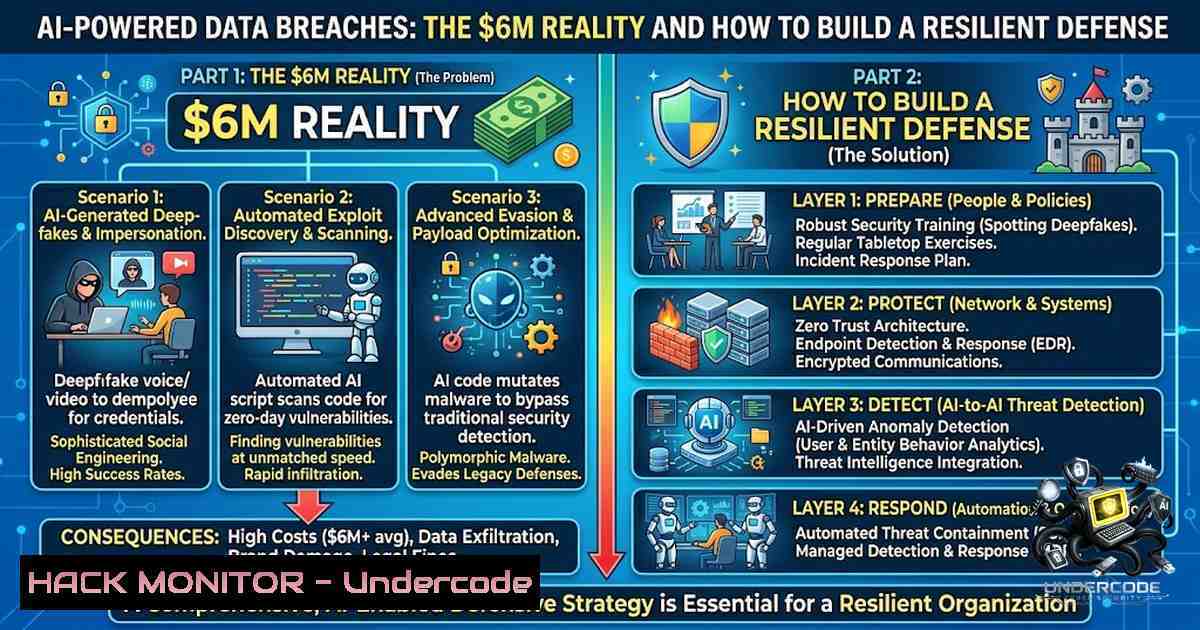
The financial toll of data breaches has reached unprecedented levels, with IBM’s latest Cost of a Data Breach report revealing that the average breach now costs organizations $6 million—a staggering 35% increase from $4.44 million just one year prior. What’s more alarming is that one in four malicious breaches are now AI-enabled, with deepfake impersonation and AI-generated malware leading the charge. As attackers leverage artificial intelligence to automate and scale their operations, organizations face a critical question: how can security teams fight fire with fire while managing the escalating costs that now include an average of 100 days of operational disruption, premium hikes of up to 200%, and an additional $180,000 per breach due to staffing shortages?
Learning Objectives:
- Understand the key drivers behind rising data breach costs, including AI-enabled attacks, ransomware, and the cybersecurity skills gap
- Learn how to implement AI-powered defense strategies that can reduce breach costs by nearly $2 million on average
- Master practical techniques for securing AI models, APIs, and cloud environments against emerging threats
- Develop incident response and recovery strategies to minimize downtime and reputational damage
You Should Know:
- The AI Attack Surface: Securing Models, APIs, and Cloud Workloads
One in five organizations reported a breach targeting AI models or applications. The most common entry points were compromised APIs, applications, or plug-ins (27%) and cloud misconfigurations affecting AI workloads (27%). Alarmingly, the vast majority of organizations suffering AI-related breaches lacked proper access controls, with only 40% deploying access controls on their AI models and data.
Step-by-Step Guide: Securing Your AI Infrastructure
Step 1: Implement Identity and Access Management (IAM) for AI Models
Treat your AI models and their APIs like crown jewels. Apply the principle of least privilege:
 Linux: Audit current IAM policies for AI services (AWS example)
aws iam list-policies --scope Local | grep -i "ai|model|sagemaker"

Check for overly permissive roles
aws iam list-roles --query 'Roles[?contains(AssumeRolePolicyDocument, "Principal\":\"")]'

Windows: Use Azure CLI to check AI service access
az role assignment list --include-inherited --query "[?contains(scope, 'openai')]"
Step 2: Harden API Endpoints
APIs are the primary attack vector for AI systems. Implement API gateway security with rate limiting, authentication, and input validation:
 Linux: Use ModSecurity with Nginx for API protection
sudo apt-get install libmodsecurity3 nginx-module-security
 Configure rate limiting in nginx.conf
limit_req_zone $binary_remote_addr zone=api_limit:10m rate=10r/s;
For Windows/IIS:
 PowerShell: Configure request filtering and throttling
Install-WindowsFeature -1ame Web-Server -IncludeManagementTools
New-WebServiceProxy -Uri "https://your-api-endpoint" -1amespace "Security" -Class "SecureProxy"
Step 3: Monitor and Detect Behavioral Anomalies
Defense requires behavioral detection across everything the AI touches:
 Linux: Set up auditd for AI model access monitoring
sudo auditctl -w /opt/ai-models/ -p rwxa -k ai_model_access
sudo ausearch -k ai_model_access --format text

Deploy Falco for runtime security
curl -s https://raw.githubusercontent.com/falcosecurity/falco/master/scripts/install.sh | sudo bash
sudo falco -r /etc/falco/falco_rules.yaml -A
Step 4: Implement Continuous AI Model Testing
Organizations need to continuously test AI models against realistic adversarial attacks:
 Install Adversarial Robustness Toolbox (ART)
pip install adversarial-robustness-toolbox

Python: Run adversarial testing
from art.attacks.evasion import FastGradientMethod
from art.estimators.classification import TensorFlowV2Classifier
 ... configure and run tests against your model
2. Shadow AI: The Silent Cost Multiplier
Security incidents involving shadow or unsanctioned use of AI tools more than doubled to 43% this year, compared to 20% in 2025. Shadow AI now rivals supply chain breaches as a leading factor in exacerbating breach costs.
Step-by-Step Guide: Detecting and Managing Shadow AI
Step 1: Discover Unsanctioned AI Usage
 Linux: Scan network traffic for AI tool signatures
sudo tcpdump -i eth0 -1 -s 0 -w ai_traffic.pcap
 Analyze with Zeek (formerly Bro)
zeek -C -r ai_traffic.pcap

Use Nmap to detect AI services
nmap -p 5000,8000,8080,8501,8888,9000 --open -sV 192.168.1.0/24 | grep -i "openai|tensorflow|pytorch|jupyter"
For Windows (PowerShell):
 Detect unauthorized AI tools via process and network monitoring
Get-Process | Where-Object { $<em>.ProcessName -match "python|node|jupyter|tensorflow" }
Get-1etTCPConnection | Where-Object { $</em>.RemotePort -in (5000,8000,8080,8501,8888,9000) }
Step 2: Enforce AI Usage Policies
Deploy Data Loss Prevention (DLP) and web filtering:
 Linux: Block known AI endpoints via iptables
sudo iptables -A OUTPUT -d 0.0.0.0/0 -m string --string "openai.com" --algo bm -j DROP
sudo iptables -A OUTPUT -d 0.0.0.0/0 -m string --string "api.anthropic.com" --algo bm -j DROP

Use Squid proxy for granular filtering
echo "acl ai_sites dstdomain .openai.com .anthropic.com .cohere.ai" >> /etc/squid/squid.conf
echo "http_access deny ai_sites" >> /etc/squid/squid.conf
Step 3: Establish an AI Governance Framework
Create a formal approval process for AI tool usage. Implement CASB (Cloud Access Security Broker) solutions to monitor and control shadow AI:
 Linux: Deploy Open Policy Agent (OPA) for policy enforcement
curl -L -o opa https://openpolicyagent.org/downloads/latest/opa_linux_amd64
chmod 755 ./opa
 Define policy to restrict AI model deployments
echo 'package ai_governance
deny[bash] { input.service == "sagemaker"; input.iam_role != "approved-role"; msg = "Unauthorized AI deployment" }' > policy.rego
3. Ransomware and AI: The Double Extortion Playbook
Ransomware incidents rose to 39% this year from 34% previously, as attackers abuse AI to automate and scale their attacks. Beyond encryption, attackers are shifting to double extortion—threatening to leak stolen data if ransoms aren’t paid.
Step-by-Step Guide: Ransomware Defense and Recovery
Step 1: Implement Immutable Backups
 Linux: Configure immutable backups with rsync and chattr
sudo chattr +i /backup/immutable/
 Use rclone with versioning
rclone sync /data/ remote:backup/ --immutable

Windows: Enable Volume Shadow Copy with PowerShell
vssadmin create shadow /for=C:
 Configure Windows Backup with immutable storage
wbadmin enable backup -addtarget:D: -schedule:00:00 -systemstate -allvolumes
Step 2: Deploy Ransomware Detection and Honeypots
 Linux: Deploy RansomWatch for early detection
git clone https://github.com/cloudsploit/ransomwatch
cd ransomwatch && python3 ransomwatch.py --monitor /data

Set up canary files
touch /data/canary_$(date +%s).docx
sudo inotifywait -m /data -e access,modify,delete --format '%w%f %e' | while read file event; do
if [[ $event == "MODIFY" ]]; then
echo "ALERT: Potential ransomware activity on $file" | mail -s "Ransomware Alert" [email protected]
fi
done
Step 3: Network Segmentation to Limit Blast Radius
 Linux: Implement VLAN isolation with iptables
sudo iptables -I FORWARD -i eth0 -o eth1 -d 10.0.0.0/8 -j DROP
sudo iptables -I FORWARD -i eth1 -o eth0 -s 10.0.0.0/8 -j ACCEPT

Configure fail2ban for RDP/SSH protection
sudo fail2ban-client set sshd banip 192.168.1.100
4. Closing the Cybersecurity Skills Gap
The security skills shortage adds an average of $180,000 to breach costs. Organizations must adopt DevSecOps approaches—the No. 1 factor that reduced breach costs—followed by robust IAM and key lifecycle management.
Step-by-Step Guide: Building a Skills-Resilient Security Program
Step 1: Implement DevSecOps Pipeline Security
 Linux: Integrate SAST/DAST into CI/CD (GitLab CI example)
 .gitlab-ci.yml
stages:
- security
sast:
stage: security
script:
- docker run --rm -v $(pwd):/src sonarsource/sonar-scanner-cli
- bandit -r . -f json -o bandit-report.json
artifacts:
paths: [bandit-report.json]
 GitHub Actions example
name: Security Scan
on: [bash]
jobs:
security:
runs-on: ubuntu-latest
steps:
- uses: actions/checkout@v3
- name: Run Trivy
run: trivy fs --format sarif --output trivy.sarif ./
- name: Upload SARIF
uses: github/codeql-action/upload-sarif@v2
with:
sarif_file: trivy.sarif
Step 2: Automate Key and Secret Management
 Linux: Use HashiCorp Vault for secret management
vault secrets enable -path=ai-secrets kv-v2
vault kv put ai-secrets/openai API_KEY=sk-...

Rotate secrets automatically
vault secrets tune -default-lease-ttl=24h ai-secrets/

Windows: Use Azure Key Vault
az keyvault secret set --vault-1ame "security-vault" --1ame "ai-api-key" --value "sk-..."
az keyvault secret rotate --vault-1ame "security-vault" --1ame "ai-api-key"
Step 3: Continuous Security Training and Upskilling
 Linux: Deploy a CTF platform for security training
git clone https://github.com/CTFd/CTFd
cd CTFd && docker-compose up -d

Schedule automated phishing simulations
gophish --config config.json
 Configure campaign for AI-themed phishing awareness
5. Incident Response: The 100-Day Recovery Challenge
Organizations take an average of 100 days to recover from a security incident. The mean time to identify and contain a breach rose to 247 days. Faster incident response remains the clearest driver for lowering breach costs.
Step-by-Step Guide: Building an AI-Powered Incident Response Plan
Step 1: Deploy AI-Powered SIEM and SOAR
 Linux: Deploy Wazuh SIEM with ML-based anomaly detection
curl -s https://packages.wazuh.com/key/GPG-KEY-WAZUH | sudo apt-key add -
echo "deb https://packages.wazuh.com/4.x/apt/ stable main" | sudo tee /etc/apt/sources.list.d/wazuh.list
sudo apt update && sudo apt install wazuh-manager

Configure ML-based detection
echo "<active-response>
<command>python3 /var/ossec/ml_detection.py</command>
<location>local</location>
<rules_id>100001</rules_id>
</active-response>" >> /var/ossec/etc/ossec.conf
Step 2: Establish a Playbook-Driven Response
 Incident Response Playbook (YAML example)
playbook:
name: "AI Breach Response"
phases:
- detection:
- "Isolate affected AI models"
- "Capture API logs and network telemetry"
- containment:
- "Revoke compromised API keys: aws iam delete-access-key"
- "Rotate secrets: vault kv delete ai-secrets/openai"
- eradication:
- "Remove malicious prompts: python3 clean_prompts.py"
- "Patch vulnerabilities: sudo apt update && sudo apt upgrade"
- recovery:
- "Restore from immutable backup: rclone copy remote:backup/ /data/"
- "Notify stakeholders and regulatory bodies"
Step 3: Post-Breach Investment in AI Security
More than half of organizations surveyed plan to invest in AI security and governance tools post-breach—an 88% increase from last year:
 Linux: Deploy AI security monitoring with Microsoft's PyRIT
git clone https://github.com/Azure/PyRIT
cd PyRIT && pip install -e .
python3 pyrit.py --target "https://your-ai-endpoint" --test-cases prompt_injection.json

Deploy continuous red teaming for AI
docker run -d --1ame ai-redteam -p 8080:8080 mindgard/continuous-testing
What Undercode Say:
- Key Takeaway 1: The data breach cost equation has fundamentally changed. With AI-enabled attacks now representing one in four breaches, organizations can no longer rely on traditional security measures alone. The $2 million savings achieved by organizations using AI and automation in security operations proves that fighting fire with fire isn’t just effective—it’s essential. However, the majority of organizations still lack proper access controls on AI models, leaving a critical gap that attackers are actively exploiting.
-
Key Takeaway 2: The 100-day average recovery time and 247-day mean time to identify and contain breaches represent a systemic failure in modern cybersecurity. This extended dwell time directly correlates with higher costs, yet organizations continue to struggle with staffing shortages that add $180,000 to breach costs and skills gaps that delay detection. The solution lies in AI-powered automation, continuous monitoring, and a post-breach mindset that assumes compromise is inevitable. As the experts noted, “Faster incident response continues to be a clear driver for lowering the cost of a breach”. Shadow AI’s explosive growth from 20% to 43% in just one year underscores the urgency of implementing governance frameworks before unauthorized AI usage becomes another unmanageable risk vector.
Prediction:
-
-1 The cybersecurity insurance market will continue to harden as insurers implement more coverage limitations and premium hikes of up to 200% post-breach. Organizations that fail to adopt AI-powered defenses will face increasingly unaffordable premiums or outright denial of coverage, creating a two-tier system where only well-prepared companies can afford adequate protection.
-
-1 The cybersecurity skills shortage will worsen as demand for AI security expertise outpaces supply. With the average additional cost of a breach due to skills shortage already at $180,000, organizations that don’t invest in upskilling and DevSecOps automation will see their breach costs escalate faster than industry averages, potentially creating a survival-of-the-fittest dynamic in highly regulated sectors like healthcare and finance.
-
+1 The adoption of AI security and governance tools will accelerate dramatically, with the 88% increase in planned post-breach investments signaling a market shift. This will drive innovation in AI security testing, continuous red teaming, and automated incident response, potentially creating a new cybersecurity sub-industry focused exclusively on AI model protection and governance.
-
+1 Regulatory bodies will likely mandate AI security controls and breach reporting requirements for AI systems, following the pattern established by GDPR and CCPA. Organizations that proactively implement access controls, continuous testing, and transparent governance will be better positioned to comply with emerging regulations and avoid the steep penalties that currently plague healthcare and financial firms.
-
+1 The 100-day average recovery window will shrink as AI-powered SOAR platforms and automated containment tools mature. Organizations that integrate AI into their security operations now will gain a competitive advantage, reducing downtime from months to days and preserving customer trust through faster, more transparent breach responses.
🎯Let’s Practice For Free:
🎓 Live Courses & Certifications:
Join Undercode Academy for Verified Certifications
🚀 Request a Custom Project:
Secure, high-velocity infrastructure and disruptive technological engineering. Contact our engineering team for high-tier development and proprietary systems:
[email protected]
💎 Smart Architecture | 🛡️ Secure by Design | ⭐ Trusted by Thousands
IT/Security Reporter URL:
Reported By: What Does – Hackers Feeds
Extra Hub: Undercode MoN
Basic Verification: Pass ✅


