Listen to this Post
Introduction:
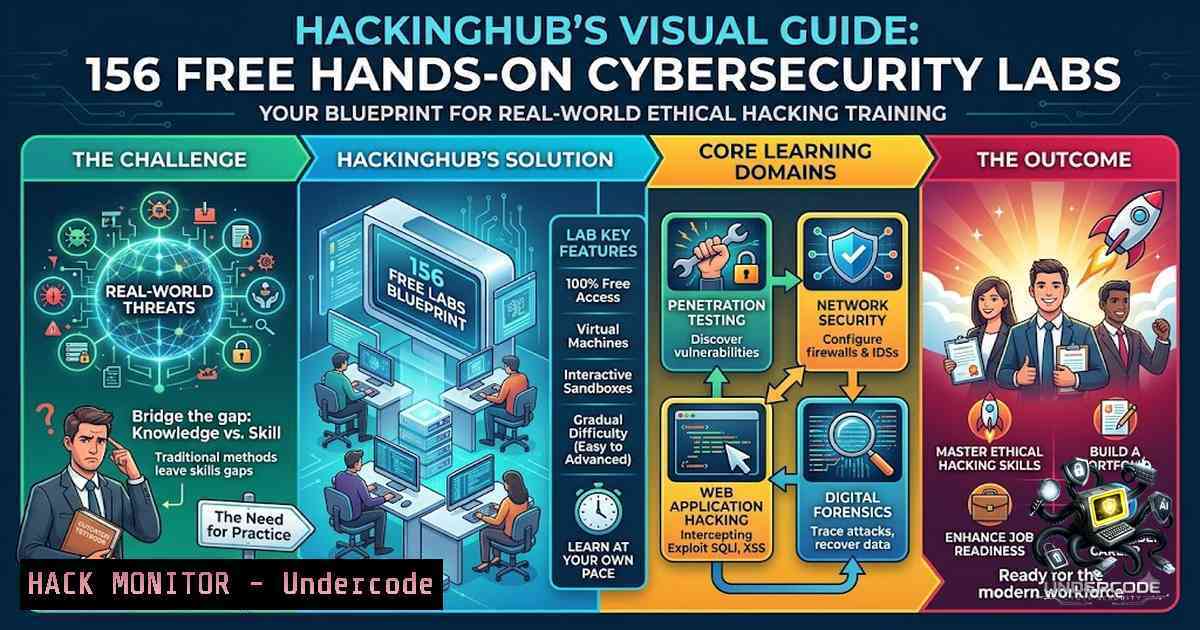
The cybersecurity industry faces a persistent skills gap—not from a lack of theoretical knowledge, but from a scarcity of practical, hands-on experience. HackingHub, co-founded by Adam Langley (CTO) and Ben Sadeghipour, addresses this directly by offering 156 completely free resources covering offensive web security, AI, reconnaissance, OSINT, mobile security, and more. Each lab spins up a dedicated, isolated environment with no complicated setup—just click “launch” and start hacking. This article explores the technical architecture behind HackingHub, provides actionable commands and methodologies used in its labs, and outlines a step-by-step approach to mastering real-world vulnerabilities through its platform.
Learning Objectives:
- Master Real-World Vulnerability Exploitation: Develop practical skills by attacking environments built from actual bug bounty reports, penetration tests, and disclosed CVEs.
- Navigate Modern Attack Surfaces: Gain hands-on experience with offensive web, API security, cloud hardening, AI application hacking, OSINT, and mobile security.
- Apply Professional-Grade Tools and Methodologies: Learn to use industry-standard tools like
nmap,ffuf,Burp Suite, and binary analysis tools within controlled, time-boxed lab environments.
You Should Know:
- The HackingHub Architecture: LEMP Stack, Docker, and Dynamic Instance Generation
HackingHub’s backend is built on a custom LEMP stack (Linux, Nginx, MySQL, PHP) with a proprietary PHP framework that handles everything from user registration to Docker container deployments. When a user clicks “Launch Hub,” the platform dynamically generates a unique, isolated environment for that specific user. This approach ensures that each lab instance is fresh, preventing interference between users and accurately mimicking real-world scenarios where targets are unique.
Step-by-Step Guide: Understanding the Lab Launch Process
- User Request: The user selects a lab (e.g., a CVE-2025-29927 Next.js authorization bypass lab).
- Backend Orchestration: The PHP framework receives the request and communicates with the Docker daemon.
- Container Spawn: Docker pulls the relevant image (e.g., a vulnerable Next.js application) and spins up a container with a predefined network configuration.
- Scope Assignment: The platform provides the user with a specific target IP or domain (e.g.,
http://<unique-subdomain>.hackinghub.io) and a time limit (often 1 hour). - Environment Teardown: After the time expires or the user closes the session, the container is destroyed, ensuring a clean state for the next user.
2. Essential Reconnaissance and Enumeration Techniques
Reconnaissance is the cornerstone of any successful penetration test. HackingHub labs emphasize thorough enumeration, often providing custom wordlists to streamline the process.
Step-by-Step Guide: Directory and Subdomain Busting with ffuf
In labs like “VulnLtd,” initial enumeration involves identifying hidden directories and subdomains.
- Directory Busting: Use `ffuf` with a content discovery wordlist to find hidden paths.
ffuf -w ~/Desktop/hacking_hub/wordlists/content.txt -u http://<target-domain>/FUZZ -fs 0
`-w`: Specifies the wordlist.
-u: The target URL with `FUZZ` as the placeholder.
-fs 0: Filters out responses with a size of 0 bytes to reduce noise.
Expected Output: Discovers paths like /contact, /css, /images, /js, and /robots.txt.
- Subdomain Fuzzing: Identify additional attack surfaces by fuzzing for subdomains.
ffuf -w ~/Desktop/hacking_hub/wordlists/subdomains.txt -u http://<domain> -H "Host: FUZZ.<domain>" -fs 0
-H "Host: FUZZ.<domain>": Sets the `Host` header to the fuzzed subdomain.
Expected Output: Discovers subdomains like `support` andwww.
3. Analyze Discovered Resources:
Check `/robots.txt` for disallowed paths (e.g., `/secr3t_l0g1n/`).
Visit discovered subdomains and directories to identify new functionalities or login panels.
- Web Application Exploitation: From SQL Injection to Authorization Bypass
HackingHub labs are built on real-world vulnerabilities, including SQL injection, XSS, and critical authorization bypasses. For instance, a free module on SQL injection from Ben Sadeghipour’s bug bounty course is available on the platform.
Step-by-Step Guide: Exploiting an Authorization Bypass (CVE-2025-29927)
CVE-2025-29927 is a vulnerability in Next.js that allows for a complete authorization bypass.
- Lab Launch: Navigate to `app.hackinghub.io/hubs/cve-2025-29927` and launch the instance.
- Identify the Vulnerability: The lab environment runs a vulnerable version of Next.js. The bypass often involves manipulating request headers or specific middleware.
- Craft the Exploit: Using a tool like `Burp Suite` or
curl, intercept a request to a protected endpoint. - Modify the Request: Add or modify a specific header (e.g.,
x-middleware-subrequest) to bypass the authorization check. - Verify Access: If successful, the request will return the protected resource, confirming the bypass.
4. API Security and Cloud Hardening
Beyond traditional web apps, HackingHub covers API security and cloud hardening. Labs are dynamically generated to reflect vulnerabilities in modern cloud-1ative applications.
Step-by-Step Guide: Testing for API Insecure Direct Object References (IDOR)
- Intercept API Traffic: Use `Burp Suite` or `Caido` to capture API requests between your browser and the lab application.
- Identify Object Identifiers: Look for parameters in API endpoints that reference objects, such as `user_id=123` or
order_id=456. - Modify the Identifier: Change the identifier to another value (e.g.,
user_id=124) and resend the request. - Analyze the Response: If the API returns data for the modified identifier, the application is vulnerable to IDOR.
5. Binary Exploitation and Reverse Engineering
Some advanced HackingHub labs, like “Mother Printers,” focus on binary exploitation, inspired by real CVEs found in Brother Printers.
Step-by-Step Guide: Initial Binary Analysis with `file` and `checksec`
1. Download the Binary: In the “Mother Printers” lab, an open directory listing exposes a `printer` binary file.
2. Run file: Determine the binary type and architecture.
file printer
Expected Output: ELF 64-bit LSB executable, x86-64, version 1 (SYSV), dynamically linked, interpreter /lib64/ld-linux-x86-64.so.2, ... stripped.
3. Run checksec: Identify the security mitigations in place.
checksec --file printer
Expected Output: Arch: amd64-64-little RELRO: Partial RELRO Stack: No canary found NX: NX enabled PIE: No PIE (0x400000).
Analysis: “No canary found” and “No PIE” indicate the binary is potentially vulnerable to buffer overflow exploits, as stack canaries and ASLR are not fully enabled.
6. OSINT and Reconnaissance Workflows
OSINT (Open Source Intelligence) is a critical skill for ethical hackers. HackingHub labs incorporate OSINT to simulate gathering intelligence on targets before launching an attack.
Step-by-Step Guide: Basic OSINT Data Gathering
- Passive Reconnaissance: Use tools like `theHarvester` and `recon-1g` to gather email addresses, subdomains, and employee names associated with a target domain.
- Active Reconnaissance: Use `nmap` to scan for open ports and services.
nmap -sV -sC -oA initial_scan <target-ip>
`-sV`: Version detection.
`-sC`: Default scripts.
-oA: Output in all formats (.nmap, .gnmap, .xml).
3. Social Media Analysis: Search for the target company on LinkedIn, Twitter, and other platforms to identify key personnel and potential social engineering vectors.
7. Mobile Security Testing
HackingHub also offers labs focused on mobile application security, covering both Android and iOS platforms.
Step-by-Step Guide: Setting Up a Mobile Testing Environment
- Proxy Configuration: Configure your mobile device or emulator to route traffic through `Burp Suite` or `Caido` to intercept and analyze API calls.
- Certificate Installation: Install the proxy’s CA certificate on the device to intercept encrypted (HTTPS) traffic.
- Dynamic Analysis: Interact with the mobile app while monitoring the proxy logs for sensitive data exposure, insecure data storage, and API vulnerabilities.
What Undercode Say:
- Key Takeaway 1: The most effective cybersecurity training mirrors real-world attacks. HackingHub’s use of actual bug bounty data and disclosed CVEs ensures that learners are not just memorizing exploits but understanding the context and impact of vulnerabilities.
- Key Takeaway 2: Accessibility is a force multiplier. By offering 156 free, instantly-launchable labs, HackingHub lowers the barrier to entry for aspiring ethical hackers, democratizing access to high-quality, practical education.
Analysis:
Adam Langley’s post highlights a critical shift in cybersecurity education: the move from theoretical learning to practical, hands-on application. The platform’s architecture, built on a custom LEMP stack and Docker, ensures scalability and realism, while its partnership with industry experts like Ben Sadeghipour and John Hammond adds credibility. The inclusion of AI, mobile, and cloud security labs reflects the evolving threat landscape, preparing learners for the challenges of tomorrow. However, the time-limited nature of labs (1 hour) can be a double-edged sword; while it encourages efficiency, it may also add unnecessary pressure for beginners. Overall, HackingHub represents a significant step forward in bridging the cybersecurity skills gap by providing free, accessible, and realistic training environments.
Prediction:
- +1 The demand for hands-on, realistic cybersecurity training will continue to surge, with platforms like HackingHub leading the charge. As more professionals seek practical skills over certifications, the value of such free, high-quality resources will only increase.
- +1 The integration of AI-specific labs will become a standard feature in cybersecurity training, as attackers increasingly leverage AI for sophisticated attacks. HackingHub’s early adoption of this trend positions it as a forward-thinking educational resource.
- -1 The reliance on cloud-based, ephemeral lab environments may pose challenges for users in regions with limited internet connectivity. To truly democratize access, offline or locally-hosted versions of the labs could be a necessary future development.
▶️ Related Video (84% Match):
🎯Let’s Practice For Free:
🎓 Live Courses & Certifications:
Join Undercode Academy for Verified Certifications
🚀 Request a Custom Project:
Secure, high-velocity infrastructure and disruptive technological engineering. Contact our engineering team for high-tier development and proprietary systems:
[email protected]
💎 Smart Architecture | 🛡️ Secure by Design | ⭐ Trusted by Thousands
IT/Security Reporter URL:
Reported By: https://lnkd.in/p/eWZxu783 – Hackers Feeds
Extra Hub: Undercode MoN
Basic Verification: Pass ✅


