
Listen to this Post
Introduction:
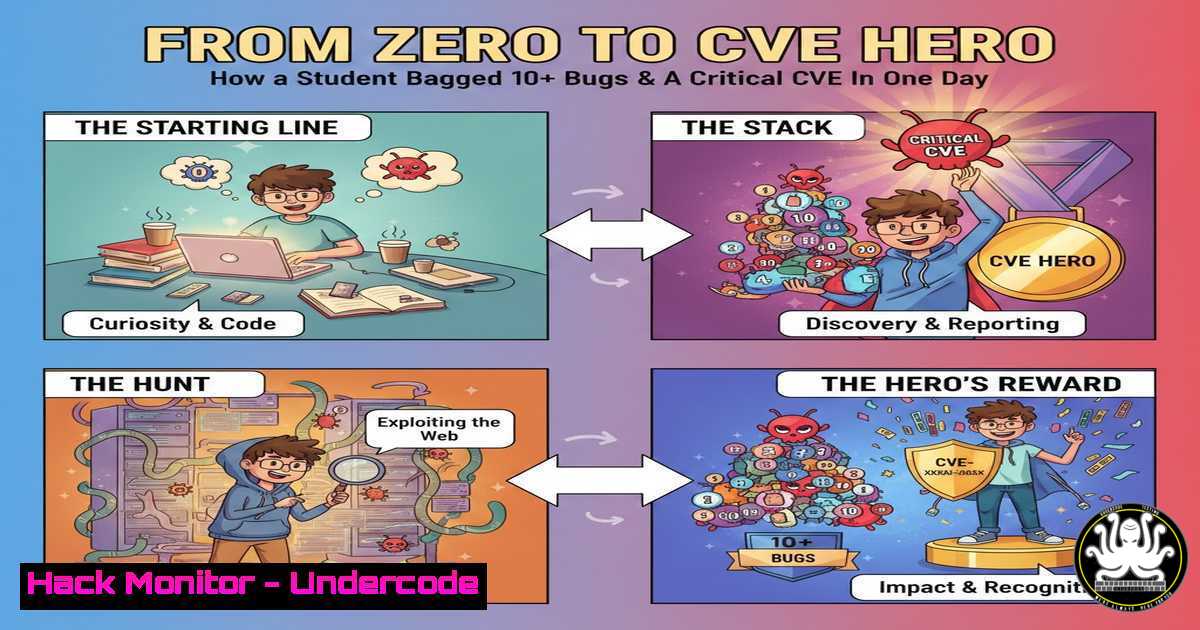
In the high-stakes world of cybersecurity, the journey from aspiring student to published vulnerability researcher is often long and arduous. However, the recent success story of a B.Tech student, who discovered a new CVE (CVE-2025-14847) and submitted over ten valid bug bounty reports in a single day, shatters that timeline. This feat highlights a potent blend of methodological rigor, relentless practice, and the democratizing power of public bug bounty platforms. This article deconstructs the underlying processes, tools, and mindset required to replicate such success, transforming enthusiasm into tangible, high-impact security contributions.
Learning Objectives:
- Understand the end-to-end workflow of a modern bug bounty hunter, from reconnaissance to proof-of-concept (PoC) development and report writing.
- Learn practical, command-level techniques for efficient vulnerability discovery and validation across web and API targets.
- Develop the consistent practice and research habits necessary to transition from learning to earning in the cybersecurity landscape.
You Should Know:
1. The Bug Hunter’s Toolkit: Reconnaissance and Enumeration
Before a single vulnerability can be found, you must map the attack surface. This involves systematic reconnaissance to discover domains, subdomains, APIs, and exposed services that belong to the target scope.
Step‑by‑step guide explaining what this does and how to use it.
Subdomain Enumeration: Use tools like subfinder, amass, and `assetfinder` to discover subdomains.
 Install tools (requires Go)
go install -v github.com/projectdiscovery/subfinder/v2/cmd/subfinder@latest
go install -v github.com/owasp-amass/amass/v3/...@latest
go install -v github.com/tomnomnom/assetfinder@latest

Basic enumeration
subfinder -d target.com -silent | tee subdomains.txt
amass enum -passive -d target.com -o amass_subs.txt
cat subdomains.txt amass_subs.txt | sort -u > all_subs.txt
Service Discovery: Probe discovered hosts for open ports and running services using `nmap` or masscan.
 Quick top ports scan
nmap -sV --top-ports 100 -iL all_subs.txt -oA initial_scan
 For wide scope, use masscan for speed, then nmap for detail
masscan -p1-65535 --rate 10000 -iL all_subs.txt -oL ports.txt
Web Path Discovery: For discovered web servers, find hidden directories and files.
 Using ffuf, a fast web fuzzer
ffuf -w /path/to/wordlist.txt -u https://target.com/FUZZ -mc 200,403 -c
 For API endpoints
ffuf -w /path/to/api-wordlist.txt -u https://api.target.com/v1/FUZZ -mc all -fr "error"
This phase creates your target list for in-depth vulnerability testing.
2. Crafting the Killer Proof of Concept (PoC)
As highlighted in the LinkedIn comments, a valid report is worthless without a clear, reproducible PoC. A PoC demonstrates the vulnerability’s impact, typically through a crafted HTTP request or a small script.
Step‑by‑step guide explaining what this does and how to use it.
Document the Original Request: Always start by capturing the benign request using a proxy like Burp Suite or OWASP ZAP.
Craft the Exploit Payload: Modify the request to inject your payload. For a common vulnerability like SQL Injection (SQLi), this might look like:
GET /user/profile?id=1' AND 1=1-- HTTP/1.1
Host: vulnerable.target.com
Script for Validation (Python Example): Automate the testing and proof process.
import requests
import sys

target_url = sys.argv[bash]
 Test for boolean-based SQLi
payloads = ["1' AND '1'='1", "1' AND '1'='2"]
for payload in payloads:
r = requests.get(f"{target_url}?id={payload}")
if payload == "1' AND '1'='1" and "welcome" in r.text:
print(f"[+] Vulnerable to SQLi! Payload: {payload}")
elif payload == "1' AND '1'='2" and "welcome" not in r.text:
print(f"[+] Confirmed Boolean-based SQLi.")
The PoC must clearly show the difference between a normal and a malicious response.
3. Mastering API Security Testing
Modern applications are API-driven, making them a prime target. Common flaws include Broken Object Level Authorization (BOLA), excessive data exposure, and injection.
Step‑by‑step guide explaining what this does and how to use it.
Discover API Endpoints: Use `gau` (GetAllURLs) or `waybackurls` to historical data, then filter for JSON/API paths.
echo "target.com" | gau | grep -E ".json|api/v|/graphql" | tee api_endpoints.txt
Test for BOLA: If an endpoint like `GET /api/v1/users/123/orders` returns a user’s data, test by changing the user ID to `124` while using the same authentication token.
 Using curl with a stolen/auth token
curl -H "Authorization: Bearer <token>" https://api.target.com/v1/users/124/orders
If you access another user’s data, you’ve found a critical IDOR/BOLA vulnerability.
Test for Mass Assignment: Send POST/PUT requests with additional parameters not intended to be user-controlled, like "isAdmin": true.
- The Art of the Perfect Bug Bounty Report
A well-structured report gets you from submission to triage to bounty faster. It’s a technical document that must be clear, concise, and complete.
Step‑by‑step guide explaining what this does and how to use it.
1. Clear and specific. “Blind SQL Injection in `/user/profile` parameter `id` leading to database disclosure.”
2. Summary: One-paragraph overview of the vulnerability and impact.
3. Steps to Reproduce: A numbered, foolproof list. Include every click, input, and observed output. Use exact URLs and payloads.
4. Proof of Concept: Embedded code snippets, curl commands, or screenshots.
curl -X GET "https://target.com/user/profile?id=1' WAITFOR DELAY '0:0:5'--"
5. Impact: Clearly state the business risk (data theft, account takeover, system compromise).
6. Remediation: Suggest a fix (e.g., “Use parameterized queries.”).
5. Building Consistency: The “Learning by Doing” Engine
The post’s hashtag `LearningByDoing` is the core philosophy. Consistency beats sporadic deep dives.
Step‑by‑step guide explaining what this does and how to use it.
Daily Practice: Dedicate 1-2 hours daily. Use platforms like Hack The Box, TryHackMe, or PortSwigger’s Web Security Academy for guided labs.
Write-Ups: Maintain a private blog or note-taking system (e.g., Obsidian, Notion) for every technique learned, tool used, and bug found (even on practice platforms).
Automate Your Workflow: Script repetitive tasks. A simple bash script to automate the initial recon phase can save hours.
!/bin/bash
echo "Starting recon for $1"
subfinder -d $1 -o subfinder_$1.txt
amass enum -passive -d $1 -o amass_$1.txt
cat subfinder_$1.txt amass_$1.txt | sort -u > all_subs_$1.txt
echo "Recon complete. Total subdomains: $(wc -l all_subs_$1.txt)"
Schedule this practice relentlessly.
What Undercode Say:
- Methodology Over Magic: The “10+ reports in a day” achievement isn’t luck; it’s the result of a scalable, repeatable testing process applied across a wide attack surface. Efficient hunters are process automation engineers.
- The Proof is in the PoC: The community’s immediate question—”did you provide a PoC?”—underscores its non-negotiable status. A vulnerability without a demonstrable, exploitable impact is often just a theoretical finding. Your credibility is tied to the quality of your proof.
Analysis:
This case study demonstrates the maturation of bug bounty ecosystems. They now effectively function as crowdsourced, continuous security audits, where motivated individuals can contribute meaningfully regardless of formal background. The student’s success validates a new, meritocratic pathway into the industry. However, it also raises the bar for entry; newcomers must now possess not just theoretical knowledge but also practical, tool-driven execution skills. The emphasis on `Consistency` reveals that vulnerability discovery is becoming a quantifiable discipline, more akin to skilled craftsmanship than artistic inspiration. This shift promises more secure software but demands higher baseline competencies from aspiring security professionals.
Prediction:
The success of individual researchers like this will accelerate the integration of bug bounty platforms into the standard Software Development Life Cycle (SDLC) for enterprises, moving from a reactive “pay-for-bugs” model to a proactive “security-as-a-subscription” partnership. We will see more AI-assisted vulnerability discovery tools emerge, but they will augment rather than replace the critical thinking of human hunters, especially for complex logic flaws. Furthermore, academic institutions will rapidly formalize partnerships with platforms like Bugcrowd and HackerOne, making “bug hunting semesters” a common component of cybersecurity curricula, thereby bridging the talent gap with a pipeline of rigorously tested, practice-ready graduates.
▶️ Related Video (72% Match):
🎯Let’s Practice For Free:
IT/Security Reporter URL:
Reported By: Abhinav Bhatt – Hackers Feeds
Extra Hub: Undercode MoN
Basic Verification: Pass ✅


