
Listen to this Post
Introduction:
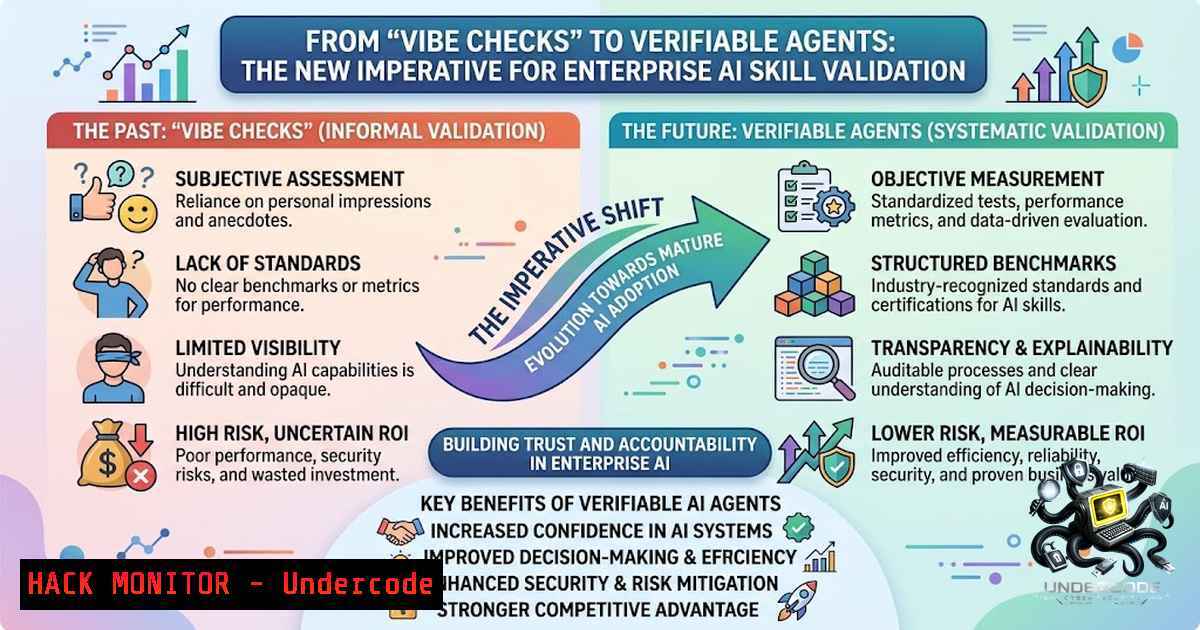
The rapid proliferation of AI agents and Large Language Model (LLM)-powered skills on platforms like GitHub has created a critical blind spot in enterprise AI development. Over 50% of skill failures originate from ambiguous descriptions, yet many teams still rely on subjective “vibe checks” before deploying these skills into production. As Philipp Schmid (Google DeepMind) and Rustem Feyzkhanov (Snorkel AI) detailed at AI Engineer, the industry is now pivoting from ad-hoc testing to deterministic, multi-layered evaluation frameworks that combine unit-level assertions with full-lifecycle agent simulations to ensure reliability, security, and performance.
Learning Objectives & Secrets:
- Objective 1: Master the Skill Trigger Dilemma – Learn to craft precise skill descriptions that reduce failure rates and prevent context window pollution through rigorous trigger testing.
- Objective 2 Secret Tips – Differentiate between capability skills and preference skills, implementing automated retirement tests for temporary patches and strict regression protection for durable policies.
- Objective 3 Secret Tips – Implement negative test cases with multi-trial runs in isolated workspaces to measure true statistical reliability against agent non-determinism, using deterministic verification like regex matching before resorting to LLM-as-a-judge.
You Should Know:
- The Skill Trigger Dilemma & Prompt Engineering for Precision
The core issue lies in how models interpret skill descriptions. Shallow or ambiguous language causes models to either fail to invoke a skill or over-trigger, flooding context windows with irrelevant data. To mitigate this, you must adopt a structured prompt engineering approach.
Step‑by‑step guide:
- Step 1: Audit all existing skill descriptions and identify those lacking explicit trigger conditions, required parameters, or output formats.
- Step 2: Refactor prompts to include “When to use” and “When NOT to use” sections. Use clear, conditional logic (e.g., “Only trigger if the user query contains a date and a monetary value”).
- Step 3: Implement lightweight script asserts in Python to test trigger accuracy.
import re
def test_trigger(text):
pattern = r'\$\d+|\d+ dollars'  Example: looks for monetary references
if re.search(pattern, text):
return True
return False
Test cases
assert test_trigger("I need $500 for the project") == True
assert test_trigger("Tell me a joke") == False
2. Capabilities vs. Preferences: The Lifecycle Management
Capability skills are workarounds for current model limitations and must be continuously evaluated for retirement as base models evolve. Preference skills, however, enforce domain-specific rules and require strict regression protection. Failing to distinguish these leads to bloated, inefficient agent systems.
Step‑by‑step guide:
- Step 1: Tag each skill in your repository as either `capability` or
preference. - Step 2: For `capability` skills, set up a weekly CI job that tests the skill against a baseline model (e.g., GPT-4) and a newer model (e.g., GPT-4.5). If the newer model resolves the issue without the skill, flag it for deprecation.
- Step 3: For `preference` skills, create a regression test suite that runs on every code commit.
Linux/Windows: Running regression tests with pytest
pytest tests/preference_tests/ --maxfail=1 --disable-warnings
- Step 4: Implement a scoring system to track the relevance of capability skills over time, retiring those with a score below a defined threshold.
3. Negative Test Cases & Statistical Reliability
Evaluating when a skill should not fire is critical for preventing over-triggering and pollution. Due to agent non-determinism, tests must be repeated over multiple trials.
Step‑by‑step guide:
- Step 1: Create a dataset of negative examples (queries that should NOT invoke the skill).
- Step 2: Configure a testing harness that runs the skill in an isolated workspace. Use Docker to containerize the environment.
Linux/Windows: Run a Docker container for isolated testing
docker run -it --rm --1ame skill_test_env -v $(pwd):/workspace my_skill_image python test_runner.py
- Step 3: Execute the test suite across 3-6 trials and log the invocation rate.
- Step 4: Establish a pass/fail threshold (e.g., the skill must not fire on more than 10% of negative examples across all trials). Use statistical methods to calculate the standard deviation and confidence intervals.
4. Deterministic Verification First: Cheap and Fast Checks
Before deploying expensive LLM-as-a-judge models, implement a layer of deterministic verifications. These include scripted asserts, regex pattern matching against tool execution outputs, and state checks within isolated workspaces.
Step‑by‑step guide:
- Step 1: For every tool execution, log the stdout, stderr, and return codes.
- Step 2: Write unit tests that assert expected output patterns.
def test_tool_output(): result = subprocess.run(['python', 'my_tool.py', '--param', 'test'], capture_output=True) assert result.returncode == 0 assert b"Success" in result.stdout Verify non-deterministic elements are consistent assert re.search(rb"ID: \d{5}", result.stdout) is not None - Step 3: Integrate these tests into a pre-commit hook (using Linux or Windows Git hooks) to catch regressions instantly before they reach the CI/CD pipeline.
5. Trace-to-Benchmark Harvesting (Loop 1)
Moving beyond synthetic tests, the most effective way to build a robust evaluation suite is to harvest real edge cases from production observability tools like Arize. This ensures your tests reflect actual user behavior.
Step‑by‑step guide:
- Step 1: Connect to your production observability data lake and extract trace IDs for all failed agent interactions.
- Step 2: Develop a script that converts these traces into isolated, reproducible simulation tasks.
- Step 3: Store these tasks in a benchmark repository, versioned alongside your code.
- Step 4: Implement a mechanism to anonymize and cleanse the data to avoid privacy violations.
Linux: Using jq to parse production logs
cat prod_logs.jsonl | jq 'select(.status == "failure") | {input: .input, response: .output}' > benchmark_tasks.jsonl
6. Containerized Sandbox Environments
Standardize your evaluation harnesses using containerization (Docker/Harbor). These sandboxes should include mock APIs, sidecar services, simulated user personas, and Oracle solutions to prove multi-turn solvability in deterministic environments.
Step‑by‑step guide:
- Step 1: Write a Dockerfile that defines the evaluation environment, including all required libraries, mock services, and the agent code.
FROM python:3.11-slim
RUN pip install pytest requests
COPY . /app
WORKDIR /app
CMD ["pytest", "tests/"]
- Step 2: Implement mock APIs using tools like WireMock. Create a sidecar container that simulates external dependencies.
- Step 3: Use a “harness” script to orchestrate the entire test run, spinning up the agent, the mocks, and the verifier simultaneously.
Linux/Windows: Use docker-compose to orchestrate
docker-compose -f eval-harness.yml up --abort-on-container-exit
- Hybrid Multi-Tier Verifiers & CI/CD Simulation Gates (Loop 2)
Move beyond simple string matching. Evaluate state transitions and trajectories using a combination of deterministic checks, rubric-based LLM judges, and SME-in-the-loop validation.
Step‑by‑step guide:
- Step 1: Define a data contract for the agent’s state (e.g., JSON schema for the context window, memory, and variables).
- Step 2: Implement deterministic checks that validate state transitions match the expected schema or values after each step.
- Step 3: For complex outputs, use a “rubric-based” LLM judge (e.g., GPT-4 with a specific rubric prompt) to score the agent’s trajectory against criteria like coherence, relevance, and policy adherence.
- Step 4: Integrate the entire benchmark suite as a required CI/CD gate. Run it on every prompt diff, skill update, harness tweak, or foundation model upgrade.
GitHub Actions (Linux/Windows)
name: Agent Simulation Gate
on: [bash]
jobs:
simulate:
runs-on: ubuntu-latest
steps:</li>
<li>uses: actions/checkout@v3</li>
<li>name: Run full simulation suite
run: |
python run_benchmarks.py --env prod-like --gates all</li>
<li>name: Gate Check
if: failure()
run: exit 1
What Undercode Say:
- Key Takeaway 1: The shift from “vibe checks” to deterministic, automated evaluations is non-1egotiable for enterprise-grade AI. Teams must invest in unit-level skill testing as a foundational step.
- Key Takeaway 2: End-to-end agent simulations using trace-to-benchmark harvesting and containerized sandboxes are the only way to ship with confidence. This approach transforms reactive debugging into proactive quality assurance.
- Analysis: The industry is witnessing a maturation of the AI engineering discipline. The methodologies proposed—emphasizing isolation, deterministic verification, and production telemetry—mirror the evolution of traditional software engineering (e.g., unit testing, CI/CD). However, the added complexity of agent non-determinism and the potential for cascading failures means that these practices are not just beneficial but critical for mitigating security risks and operational costs. The integration of observability data directly into the testing lifecycle creates a powerful feedback loop that ensures tests remain relevant as user behavior and foundation models change. Organizations that fail to adopt these practices risk deploying agents that are brittle, insecure, and ultimately more costly to maintain.
Prediction:
- -1: In the next 18 months, companies that do not implement rigorous agent simulation testing will experience at least one major production incident involving data leakage or financial loss due to unvetted skills.
- +1: The adoption of “CI/CD Simulation Gates” will become an industry standard, leading to the emergence of new open-source frameworks and commercial products specifically designed for agent lifecycle management.
- +1: The role of the “AI Reliability Engineer” will emerge, combining DevOps, data engineering, and ML knowledge to manage these complex evaluation pipelines.
- -1: The reliance on LLM-as-a-judge for complex trajectory evaluation will introduce new biases and security vulnerabilities (such as prompt injection on the evaluator itself), necessitating hybrid human-in-the-loop systems for critical decisions.
- +1: Trace-to-benchmark harvesting will become a primary source of competitive advantage, allowing organizations to build evaluation suites that closely mimic real-world scenarios, thereby reducing time-to-market for new agent features.
- +1: Standardization around sandbox environments (e.g., OCI container formats) will improve, enabling seamless sharing of test harnesses across teams and organizations.
- -1: The complexity of managing multi-turn, multi-trial simulations will increase infrastructure costs significantly, pushing companies to optimize for efficiency and prioritize which skills undergo full simulation.
- +1: The gap between open-source agent development and enterprise-grade agent deployment will widen, as enterprise teams invest heavily in these validation frameworks, while open-source communities may lag behind.
▶️ Related Video (80% Match):
🎯Let’s Practice For Free:
🎓 Live Courses & Certifications:
Join Undercode Academy for Verified Certifications
🚀 Request a Custom Project:
Secure, high-velocity infrastructure and disruptive technological engineering. Contact our engineering team for high-tier development and proprietary systems:
[email protected]
💎 Smart Architecture | 🛡️ Secure by Design | ⭐ Trusted by Thousands
IT/Security Reporter URL:
Reported By: https://lnkd.in/p/eSY5BtgX – Hackers Feeds
Extra Hub: Undercode MoN
Basic Verification: Pass ✅


