
Listen to this Post
Introduction:
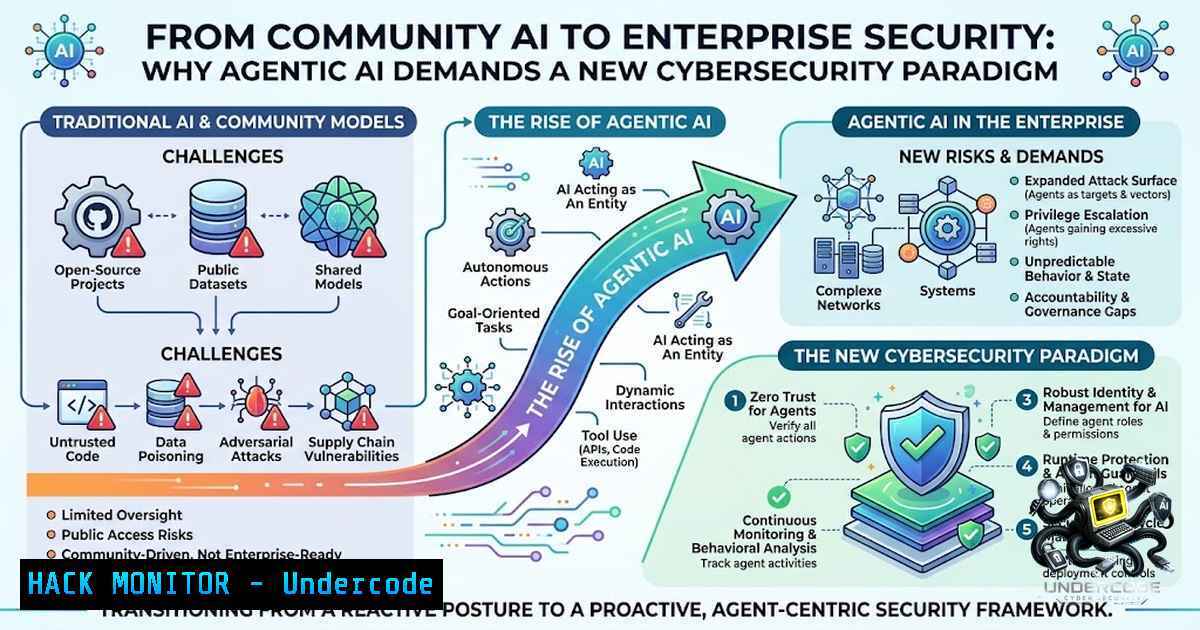
On August 29, 2026, Ignite Room’s Launchpad Mumbai brought together developers, builders, and AI enthusiasts to explore one deceptively simple question: How deeply can AI already be present in the things we casually ignore? From hands-on sessions with Google AI Studio to discussions on Agentic AI, the event underscored a critical reality—AI is no longer a passive tool. It is becoming an autonomous agent capable of making decisions, executing tasks, and interacting with systems. And with that autonomy comes a cybersecurity paradigm shift that the industry can no longer afford to ignore.
Learning Objectives & Secrets:
- Objective 1: Understand the Attack Surface of Agentic AI Systems – Learn to identify vulnerabilities unique to autonomous agents, including prompt injection, memory poisoning, and excessive agency. The secret? Most organizations focus on securing the model itself while neglecting the orchestration layer—the very layer where agents plan, reason, and execute tool calls.
- Objective 2: Master API Security for AI Services – Google AI Studio and Gemini API integrations are powerful but introduce significant risk if API keys are mishandled. The secret tip: never expose API keys in client-side code; always route requests through a server-side proxy with rate limiting and key restrictions.
- Objective 3: Implement Zero Trust for AI Agents – Traditional perimeter security fails when agents operate across multiple environments. The secret: adopt a Zero Trust architecture that treats every agent action as a transaction requiring explicit verification, least-privilege access, and continuous monitoring.
You Should Know:
- The Agentic AI Threat Landscape: Beyond the Prompt
The cybersecurity community has documented over 30 CVEs and multiple distinct attack classes targeting AI agents in 2025–2026 alone. These aren’t theoretical—they’re production incidents. The AutoJack vulnerability (disclosed June 18, 2026) demonstrated that a single malicious webpage could achieve remote code execution on hosts running affected versions of AutoGen Studio’s browsing agent. Similarly, the Chronos Vulnerability revealed how memory-based attacks—including Memory Injection Attacks (MINJA)—can compromise an agent’s internal belief system, effectively decoupling it from its intended purpose.
Step‑by‑step guide to assessing your agentic AI attack surface:
- Inventory all agents and their capabilities – Document every autonomous agent in your environment, including what tools they can access and what actions they can perform.
- Map data flows – Identify where agents receive input (user prompts, system instructions, external data sources) and where they send output or execute actions.
- Test for indirect prompt injection – Use red-teaming frameworks like Microsoft’s PyRIT or open-source tools like Agentic Security to stress-test your agents with randomized inputs.
- Audit long-term memory stores – RAG architectures are vulnerable to memory poisoning. Verify that retrieval mechanisms filter and validate content before it reaches the agent’s context.
-
Securing Google AI Studio and Gemini API Integrations
Google AI Studio’s “transparent” proxy approach—using a Node.js proxy server combined with Service Workers—hides API keys while allowing frontend code to call the API directly. However, security researchers have noted that the proxy itself can become an exposure point.
Step‑by‑step guide to Gemini API security hardening:
- Never embed API keys in client-side code – All requests to the Gemini API must be routed through a server where the key remains confidential.
- Add key restrictions – In Google AI Studio or Google Cloud Console, restrict your API key to specific IP addresses, referrers, or application types.
- Enable rate limiting – The generated proxy server includes rate limiting—ensure it is properly configured to prevent abuse and cost exhaustion.
- Audit enabled APIs – Check every GCP project for the Generative Language API under APIs & Services. If it’s not enabled, enable it with restricted credentials.
- Rotate exposed keys immediately – If any unrestricted API key or key that allows the Generative Language API is found, rotate it immediately.
- Redact sensitive prompts – If prompts contain user data, store hashes or filtered versions. For auditing, retain metadata and a short sample—not full payloads—unless explicit consent is obtained.
3. Automated Penetration Testing with AI Agents
Ironically, the same autonomous capabilities that create security risks can also be used to defend against them. AgentPentestAI, a multi-agent framework using large language models, has demonstrated that 68 percent of penetration testing subtasks can be completed autonomously on HackTheBox and VulnHub targets. Tools like AutoPentester can automate information gathering, vulnerability assessment, attack execution, and report generation with minimal human intervention.
Linux command sequence for setting up an AI-powered security assessment pipeline:
 Clone an agentic security scanner
git clone https://github.com/empowered-humanity/agent-security.git
cd agent-security

Run static analysis on your agent codebase
agent-security scan --path ./your-agent-project --format json --output scan_results.json

Deploy the AI security gateway (Deepint-Shield example)
docker run -d -p 8080:8080 deepint-shield/ai-security:latest

Test API endpoints with fuzzing (Agentic Security example)
agentic-security fuzz --target http://localhost:8080/api/v1/agent \
--payloads ./payloads/ --workers 10 --output fuzz_report.html
Windows PowerShell equivalent:
 Clone and run agent-security scanner
git clone https://github.com/empowered-humanity/agent-security.git
cd agent-security
python -m agent_security.scan --path .\your-agent-project --format json

Run Agentic Security fuzzing
python -m agentic_security.fuzz --target http://localhost:8080/api/v1/agent `
--payloads .\payloads\ --workers 10
4. API Authentication and Authorization for AI Agents
The Model Context Protocol (MCP) Authorization Specification has emerged as the standard for securing LLM-powered autonomous agents, using OAuth 2.1 with Proof Key for Code Exchange (PKCE). However, implementing this correctly requires attention to several critical details.
Step‑by‑step guide to OAuth 2.1 + PKCE for AI agents:
- Use OAuth 2.1 with PKCE – Never use implicit flow; always require PKCE for token exchanges.
- Scope aggressively – Resource indicators should be mandatory and scoped aggressively; keep tokens short-lived and server-specific.
- Never let credentials leak into LLM context – Ensure that tokens, secrets, and credentials are never exposed to the model’s prompt or memory.
- Adopt gateway-based authorization – Centralize policy enforcement, token transformation, and audit boundaries through an API gateway.
- Implement conditional access – Use ephemeral tokens and conditional access policies to reduce risk.
- Treat sensitive actions as reviewable – Include human-in-the-loop checks for sensitive agent actions.
5. Defending Against Prompt Injection and Jailbreaking
Prompt injection remains the dominant attack vector for agentic AI systems. The OWASP Top 10 for LLM Applications (2025) ranks LLM01: Prompt Injection as the most critical risk. Defenses must be layered.
Step‑by‑step guide to prompt injection mitigation:
- Separate trusted instructions from untrusted content – Use delimiters and structural markers to distinguish system prompts from user input.
- Constrain what the model is allowed to do – Never let model output trigger a sensitive action without explicit verification.
- Minimize sensitive data in prompts – Scrub outputs and avoid including sensitive data unless absolutely necessary.
- Deploy a proxy defense layer – Solutions like Proxy Barrier (ProB) interpose a proxy LLM between the user and the target model, achieving up to 98.8% defense effectiveness.
- Implement test-time verification – Tools like Task Shield systematically verify whether each instruction and tool call contributes to user-specified goals.
What Undercode Say:
- Key Takeaway 1: Agentic AI is not a future concern—it is a present reality. The vulnerabilities documented in 2025–2026 (AutoJack, Chronos, second-order prompt injection in ServiceNow’s Now Assist platform) demonstrate that attackers are already targeting autonomous agents in production environments.
- Key Takeaway 2: Security for AI agents requires a fundamental shift from perimeter-based to Zero Trust thinking. Every agent action, every API call, every tool invocation must be treated as potentially malicious and verified at every step.
- Analysis: The Ignite Room Mumbai event captured a crucial moment in the evolution of AI adoption. As developers move from “I know AI” to building autonomous agents, the security community must move in parallel—from theoretical risk assessments to practical, implementable defenses. The tools exist (agent-security scanners, MCP authorization frameworks, red-teaming kits). What’s missing is widespread adoption and integration into the development lifecycle. The community-driven approach exemplified by Ignite Room—where learning is hands-on and mentorship-driven—is precisely the model needed to bridge this gap.
Prediction:
- +1 Organizations that adopt Zero Trust architectures for AI agents by early 2027 will see 60–70% fewer security incidents related to autonomous systems compared to those that treat agent security as an afterthought.
- -1 The next 12–18 months will see a wave of high-profile agentic AI breaches, as most organizations are currently unprepared for the attack surface expansion that autonomous agents introduce.
- -1 Supply chain attacks targeting AI agent frameworks and dependencies (as seen with the LiteLLM compromise that achieved nearly 47,000 downloads in three hours) will become the primary vector for widespread compromise.
- +1 The emergence of open-source security tools specifically designed for AI agents (Agentic Security, agent-security scanner, Deepint-Shield) will democratize access to agent security, enabling smaller teams to implement enterprise-grade protections.
- -1 Without standardized, enforceable security requirements for AI agents, regulatory bodies will step in—and the resulting compliance burden may slow innovation in the very communities, like Ignite Room’s Mumbai tech ecosystem, that are driving AI adoption forward.
▶️ Related Video (80% Match):
🎯Let’s Practice For Free:
🎓 Live Courses & Certifications:
Join Undercode Academy for Verified Certifications
🚀 Request a Custom Project:
Secure, high-velocity infrastructure and disruptive technological engineering. Contact our engineering team for high-tier development and proprietary systems:
[email protected]
💎 Smart Architecture | 🛡️ Secure by Design | ⭐ Trusted by Thousands
IT/Security Reporter URL:
Reported By: https://lnkd.in/p/e7rhk52k – Hackers Feeds
Extra Hub: Undercode MoN
Basic Verification: Pass ✅


