
Listen to this Post
Introduction:
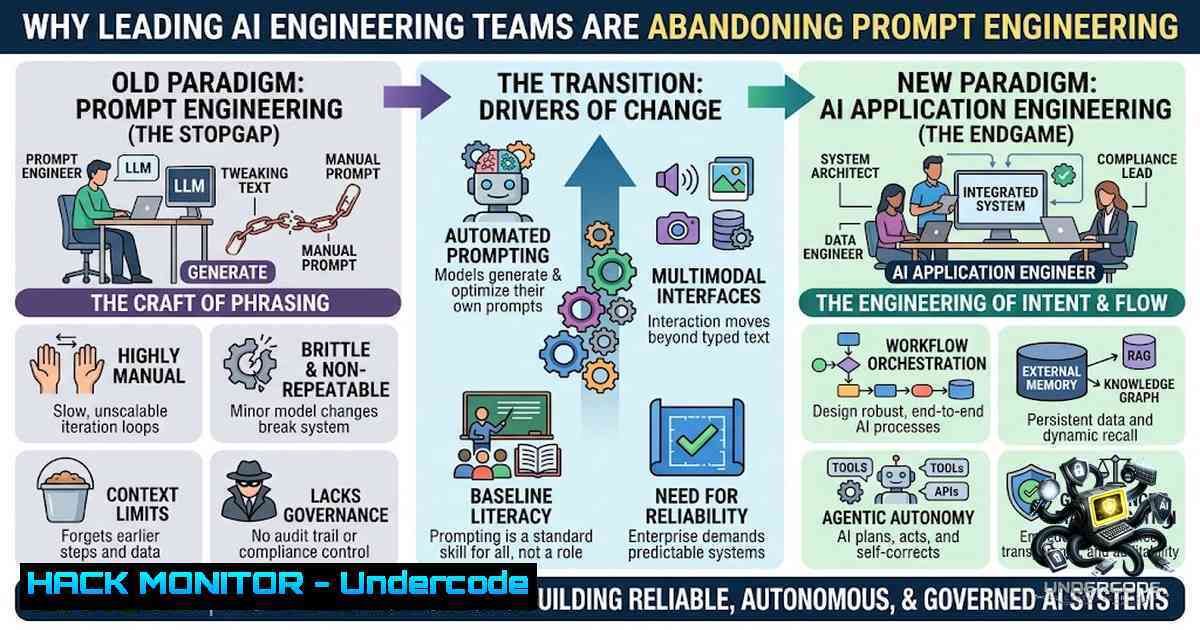
The artificial intelligence engineering landscape is undergoing a silent but radical transformation as top-tier teams pivot from the art of prompt crafting to the science of deterministic software architecture. For years, the industry norm was to treat Large Language Model (LLM) behavior as a prompt optimization problem, where engineers spent countless hours fine-tuning instructions to coax better reasoning from black-box models. However, as these systems move from prototypes to mission-critical production environments, the inherent unpredictability of LLMs—such as hallucination and schema drift—has forced elite engineering units to abandon reliance on clever prompting in favor of building rigid, verifiable guardrails around the model.
Learning Objectives & Secrets:
- Objective 1: Master Deterministic Wrapping for LLM Agents. Learn to encapsulate an LLM within a finite state machine, restricting the model’s operational context to prevent uncontrolled execution loops and self-correction failures.
- Objective 2 (Secret Tip): Leverage Pydantic for Rigorous Schema Validation. Implement validation at the entry and exit points of the model to ensure that the input payloads and output structures strictly adhere to predefined formats, dramatically reducing error rates.
- Objective 3 (Secret Tip): Implement Flow-Control at the System Level, Not the Prompt Level. Instead of instructing the model on how to think, design the orchestration layer to govern the model’s decisions, allowing the system to manage retries, fallbacks, and final outputs without relying on the model’s internal reasoning for process management.
You Should Know:
1. The Shift from Prompt Tuning to Guardrailing
The core philosophy of the new wave of AI engineering is that an LLM is an unreliable reasoning engine that must be treated as a component within a larger, predictable system. The prompt is no longer the central control plane; instead, it is reduced to a data-transformation script. The real intelligence lies in the architecture that surrounds the model. By implementing state machines, developers can pre-define the possible states and transitions an agent can make, eliminating the model’s ability to wander into undefined behavior—such as fixing an API schema drift by attempting to re-query the endpoint infinitely. This shift reduces the cognitive load on the prompt itself, allowing engineers to focus on system resilience rather than linguistic nuance.
2. Implementing Pydantic Schema Validation for Production LLMs
To achieve the benchmark results seen by leading teams, implementing strict data validation is non-1egotiable. Pydantic, a Python library, allows for the creation of data models that enforce type and structure checks. When an LLM output fails these checks, the system can trigger a fallback or a retry without allowing the corrupted data to propagate.
Step‑by‑step guide:
- Define the Output Model: Create a Pydantic `BaseModel` class that strictly defines the expected output structure (e.g.,
class AgentResponse(BaseModel): action: str; parameters: dict). - Integrate with the LLM Call: Use function-calling or structured-output features to guide the LLM to produce a JSON object that matches the Pydantic schema.
- Validate the Response: After receiving the LLM’s output, parse it through the Pydantic model. If validation raises an error, log the failure and route the execution to a corrective state.
- Implement State Transitions: Wrap the call in a state machine. If validation passes, move to the “Execute” state; if it fails, move to a “Retry” state with a predefined limit.
- Monitor Failures: Use logging to track how often validation fails, providing insight into model drift or prompt degradation over time.
3. Building Deterministic Finite State Machines (FSM)
The architecture flips the control flow: the state machine decides the next action based on the output of the previous state, not the model itself. This prevents the “infinite retry loop” scenario described in the post.
Step‑by‑step guide:
- Identify States: Define explicit states such as
IDLE,PROCESSING,VALIDATING,EXECUTING,RETRYING, andFAILED. - Define Transitions: Map out the conditions that trigger a state change (e.g., `PROCESSING` -> `VALIDATING` if response is received).
- Code the Orchestrator: Use a library like `transitions` in Python to manage these states programmatically. Ensure that the LLM call is nested inside the `PROCESSING` state.
- Set Retry Limits: Hardcode a maximum retry count within the `RETRYING` state. Exceeding this limit moves the agent to the `FAILED` state, preventing resource drain.
- Test Edge Cases: Simulate upstream API failures to ensure the FSM correctly handles exceptions without relying on the LLM to self-correct.
4. Mitigating Hallucination via Constrained Decoding
While state machines provide systemic control, constraining the LLM’s token generation through grammar or JSON schemas reduces the risk of hallucination at the output level.
Step‑by‑step guide:
- Enable JSON Mode: Configure the OpenAI or Anthropic API to enforce a JSON output format.
- Implement Grammar Constraints: Use libraries like `Outlines` or `Guidance` to restrict the generation to specific token sequences based on a regex or a context-free grammar.
- Perform Semantic Checks: Beyond syntactic validation, write Python functions that check if the output makes logical sense within the business context (e.g., checking if requested database fields actually exist).
- Fallback to Deterministic Logic: If the output fails semantic checks, the state machine should bypass the model and rely on predefined heuristic logic, ensuring the system still provides a valid, safe result.
5. Cost Optimization and Latency Reduction
By abandoning the “trial and error” approach of prompt engineering, teams reduce the number of tokens sent and received, which is a primary driver of cloud compute costs. The use of deterministic routing means shorter, more focused prompts, cutting down on inference time.
Step‑by‑step guide:
- Compress Prompts: Remove redundant system instructions that were previously used to guide the model’s internal process. Only include context necessary for the immediate task.
- Reduce Output Token Count: Validate that the model is only required to output essential keys, not verbose reasoning. This reduces token usage and speeds up response times.
- Implement Caching: If the same input payload enters the state machine, serve a cached deterministic output without calling the LLM, reducing latency and cost.
- Monitor Usage: Use cloud monitoring tools (e.g., AWS CloudWatch) to track cost-per-inference before and after implementation to quantify the 3.2x reduction in expenditure.
6. Securing the API Gateway and Infrastructure
As the LLM agent interacts with upstream APIs, it introduces new attack vectors. Ensuring that the state machine sanitizes inputs and validates API responses is crucial for security.
Step‑by‑step guide:
- Validate All Incoming Requests: Use Pydantic to validate the initial payload hitting the API gateway, rejecting malformed requests before they reach the LLM.
- Sanitize Outputs: Ensure that the LLM’s output does not contain malicious scripts or escape characters that could lead to injection attacks.
- Implement Rate Limiting: Use the state machine to enforce rate limits on API calls, preventing the agent from overwhelming downstream services.
- Use API Keys with Minimal Privileges: Ensure the credentials stored in environment variables have the least privilege necessary to perform the defined deterministic actions.
What Undercode Say:
The post highlights a critical evolution in system design: the realization that AI reliability is a software engineering problem, not a language modeling problem. The key takeaway is the clear metric-driven evidence—a drop from a 14% failure rate to 0.1%—which underscores that the probabilistic nature of LLMs requires deterministic containment. It effectively argues that the industry is maturing past the “hype cycle” of asking AI to manage itself. The analysis shows that shifting architecture is not just about performance but about survivability; systems that rely on the model’s ability to reason about its own process are brittle. In contrast, a system that views the AI as an “actuator” rather than an “orchestrator” will inherently scale better. Finally, the post serves as a powerful warning to technical leaders: clinging to prompt engineering as a primary skill set is a strategic risk that will soon be obsolete.
Prediction:
- +1 Engineering roles will bifurcate, with a growing specialization in “LLM Systems Engineering” that requires deep knowledge of state machines and validation, rather than just prompt composition.
- -1 The proliferation of “clever prompts” as a marketable asset will depreciate in value as more deterministic frameworks and GUI-based orchestration tools abstract away prompt tuning.
- +1 We will see an increase in open-source libraries that combine Pydantic validation, JSON schema enforcement, and state machines, standardizing the “wrapping” approach across the industry.
- -1 Teams that fail to adopt these deterministic practices will experience higher failure rates in production, leading to frequent API outages and a loss of stakeholder trust in AI initiatives.
- +1 The cost savings and reduced latency will make LLM-powered applications more accessible to startups, leveling the playing field with larger enterprises that previously burned cash on inefficient prompts.
▶️ Related Video (84% Match):
🎯Let’s Practice For Free:
🎓 Live Courses & Certifications:
Join Undercode Academy for Verified Certifications
🚀 Request a Custom Project:
Secure, high-velocity infrastructure and disruptive technological engineering. Contact our engineering team for high-tier development and proprietary systems:
[email protected]
💎 Smart Architecture | 🛡️ Secure by Design | ⭐ Trusted by Thousands
IT/Security Reporter URL:
Reported By: https://lnkd.in/p/e3WmQRZ9 – Hackers Feeds
Extra Hub: Undercode MoN
Basic Verification: Pass ✅


