Listen to this Post
Introduction:
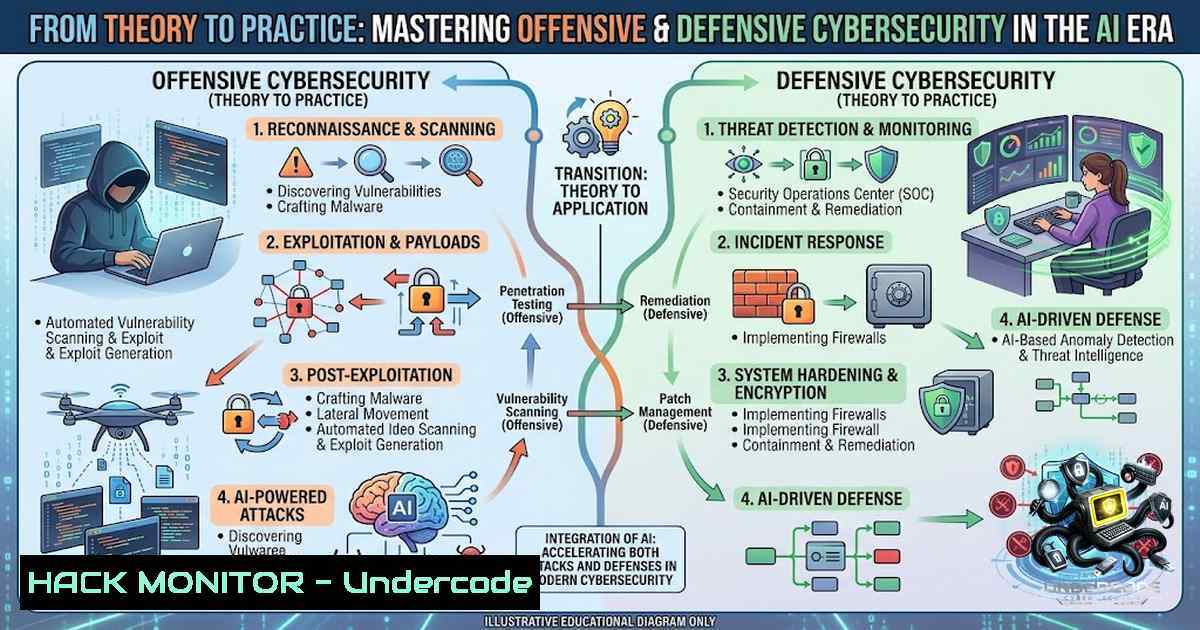
The cybersecurity landscape in 2026 demands professionals who can bridge the gap between offensive and defensive strategies. A recent training program at King Saud University, conducted in collaboration with Google, exemplifies this integrated approach—equipping participants with hands-on experience in ethical hacking, penetration testing, incident response, and cloud security. As organizations face increasingly sophisticated threats, understanding both how attackers operate and how to defend against them is no longer optional; it is essential. This article distills the core technical components from that program into actionable insights, commands, and configurations for cybersecurity practitioners.
Learning Objectives & Secrets:
- Objective 1: Master the Penetration Testing Lifecycle – From reconnaissance using Kali Linux, Nmap, theHarvester, and Maltego to vulnerability exploitation and report writing. Secret tip: Always combine automated scanning with manual validation—tools find patterns, but human reasoning finds business logic flaws.
-
Objective 2: Exploit and Defend Web Applications – Understand OWASP Top 10:2025 vulnerabilities including SQL Injection, XSS, CSRF, IDOR, and Broken Access Control. Secret tip: Use Burp Suite’s Repeater and Intruder not just to find flaws but to understand how input sanitization fails at different layers—and always test authenticated endpoints with multiple privilege levels.
-
Objective 3: Operationalize Incident Response and Cloud Hardening – Apply the PICERL framework (Preparation, Identification, Containment, Eradication, Recovery, Lessons Learned) with SIEM and AI-driven detection. Secret tip: Memory forensics with Volatility often reveals what logs miss—always capture memory before powering down a compromised system.
You Should Know:
- Reconnaissance and Vulnerability Scanning with Kali Linux & Nmap
Reconnaissance is the foundation of any penetration test. Kali Linux 2026.2, the industry-standard distribution, now includes nine new tools including `penelope` (a powerful shell handler), `shell-gpt` (AI-assisted command generation), and `uro` (URL decluttering for web testing). Nmap remains the undisputed king of network discovery.
Step‑by‑Step Guide:
- Discover live hosts on a subnet: `nmap -sn 192.168.1.0/24` – Performs a ping sweep to identify responsive hosts without scanning ports.
- Perform a stealth SYN scan on a target: `nmap -sS -p- target_ip` – Scans all 65,535 ports using half-open connections, reducing logging at the target.
- Run a comprehensive service and vulnerability scan: `nmap -sC -sV -A –script=vuln target_ip` – Executes default scripts, version detection, OS fingerprinting, and vulnerability checks in one pass.
- Scan from a list of targets: `nmap -iL targets.txt` – Useful for large-scale assessments.
- For web application discovery: Combine Nmap with `theHarvester` for email and domain reconnaissance, and `Maltego` for visualizing relationships between discovered assets.
- Web Application Security Testing with Burp Suite and OWASP Top 10:2025
OWASP Top 10:2025 continues to rank Broken Access Control as the number one risk, with Security Misconfiguration jumping to second place and Software Supply Chain Failures debuting at third. Burp Suite Professional 2026.4 provides the toolkit needed to identify these vulnerabilities.
Step‑by‑Step Guide:
- Configure Burp Suite as an intercepting proxy: Set your browser to use Burp’s listener (default 127.0.0.1:8080) and install the CA certificate to intercept HTTPS traffic.
- Map the application: Use the Target tab to spider the site and build a sitemap of all endpoints and parameters.
- Test for SQL Injection: Send a request to Repeater, inject a single quote (
') into a parameter, and observe the response for database errors. Use Intruder with a payload list of SQL injection strings to automate testing. - Detect IDOR (Insecure Direct Object References): Intercept requests containing user identifiers (e.g.,
user_id=123). Change the value to another user’s ID and check if you can access unauthorized data—this is the most common manifestation of Broken Access Control. - Leverage AI-assisted scanning: Use Burp Scanner’s built-in Chromium browser to crawl and audit the application automatically, combining dynamic analysis with AI-driven vulnerability correlation.
- Advanced Web Vulnerability Exploitation: SQL Injection, XSS, and CSRF
Beyond scanning, manual exploitation validates findings and demonstrates business impact.
Step‑by‑Step Guide:
- SQL Injection (Error‑based): Inject `’ OR ‘1’=’1` into a login form. If successful, you may bypass authentication. For data extraction, use `UNION SELECT` statements to retrieve database contents.
- Cross‑Site Scripting (XSS): Inject `` into input fields. If the script executes, the application is vulnerable. For persistent XSS, store the payload in a comment or profile field.
- CSRF (Cross‑Site Request Forgery): Craft an HTML form that submits a state‑changing request (e.g., password change) without the user’s consent. If the application relies only on session cookies without anti‑CSRF tokens, it is vulnerable.
- Use DVWA (Damn Vulnerable Web Application) as a practice environment to safely test these techniques before attempting them on live systems.
- Incident Response and Memory Forensics with the PICERL Framework
The SANS PICERL framework provides a structured approach to incident handling. When an incident is detected, rapid containment and evidence preservation are critical.
Step‑by‑Step Guide:
- Preparation: Establish logging and monitoring (SIEM with AI‑driven analytics). Ensure you have forensic tools ready, including Volatility 3 for memory analysis.
- Identification: Use SIEM alerts and endpoint detection to confirm an active breach.
- Containment: Isolate affected systems from the network to prevent lateral movement.
- Eradication: Remove the attacker’s foothold—delete malicious files, terminate processes, and patch vulnerabilities.
- Recovery: Restore systems from clean backups and validate integrity.
- Lessons Learned: Document the incident, update playbooks, and improve defenses.
Memory Forensics with Volatility 3:
- List running processes: `vol -f memory.dmp windows.pslist` – Shows active processes, useful for identifying suspicious executables.
- Dump process memory for analysis: `vol -f memory.raw windows.memmap –pid
–dump` – Extracts the memory space of a specific process for deeper inspection. - Extract network connections: `vol -f memory.raw windows.netscan` – Reveals active and recent network connections from the compromised system.
- Dump password hashes: `vol -f memory.raw windows.hashdump` – Extracts NTLM hashes from memory, which can be used for pass‑the‑hash attacks or to identify compromised credentials.
- Automated full scan: `python3 autovol3.py -f MEMFILE -o OUT_DIR -s full` – Runs all Volatility plugins in one pass for comprehensive analysis.
- Cloud Security Hardening: IAM, S3, CloudTrail, and Zero Trust
Cloud environments require a shift from perimeter‑based to identity‑centric security. Zero Trust principles—never trust, always verify—are now industry standard.
Step‑by‑Step Guide:
- Implement least‑privilege IAM: Use AWS IAM to assign roles with only the permissions necessary for each function. Regularly audit permissions and remove unused roles.
- Secure S3 buckets: Enable default encryption (SSE‑S3 or SSE‑KMS), block public access by default, and enable versioning to protect against accidental deletion or ransomware.
- Enable CloudTrail for all regions: Log all API activity. Stream logs to CloudWatch and set up alerts for suspicious events such as
DeleteTrail,CreateAccessKey, orModifyInstanceAttribute. - Adopt Zero Trust Network Access (ZTNA): Implement micro‑segmentation and enforce continuous verification of user identity and device health before granting access to resources.
- Leverage AI for anomaly detection: Use services like AWS GuardDuty to analyze CloudTrail, VPC Flow Logs, and DNS logs for unusual behavior patterns.
6. Integrating AI into Offensive and Defensive Operations
Artificial intelligence is transforming both attack and defense. Attackers use AI to automate reconnaissance, craft convincing phishing emails, and evade detection. Defenders use AI to correlate alerts, predict attack paths, and accelerate incident response.
Step‑by‑Step Guide:
- Offensive AI: Use tools like `shell-gpt` (included in Kali Linux 2026.2) to generate complex command sequences based on natural language prompts. For example, ask “scan for open SMB ports on the subnet and check for EternalBlue” to receive a ready‑to‑run Nmap command.
- Defensive AI: Configure your SIEM to use machine learning models that baseline normal user behavior and flag deviations. Train models on historical data to reduce false positives.
- AI in vulnerability management: Use AI‑powered scanners to prioritize vulnerabilities based on exploitability and business context, not just CVSS scores.
What Undercode Say:
- Key Takeaway 1: The integration of offensive (ethical hacking) and defensive (incident response, cloud security) skills is no longer a luxury—it is a necessity. Cybersecurity professionals must think like attackers to defend effectively.
- Key Takeaway 2: Hands‑on practice with real tools (Kali, Nmap, Burp Suite, Volatility) and frameworks (OWASP Top 10, PICERL, Zero Trust) is the only way to build true competency. Theory alone is insufficient in a field where attackers are constantly evolving.
Analysis: The training program at King Saud University, delivered by experts Dr. Qatrunnada Alsmail and Dr. Ohoud Alharbi, represents a modern, balanced cybersecurity curriculum. By covering both the CS05 (Ethical Hacking) and CS06 (Advanced Defence) tracks, participants gained a 360‑degree view of the security landscape. The inclusion of AI topics in both tracks reflects the industry’s recognition that AI is a double‑edged sword—accelerating both attacks and defenses. The emphasis on practical application, including working with community organizations, ensures that learning translates into real‑world impact. This model should be replicated across academic and professional training programs to close the cybersecurity skills gap.
Prediction:
- +1 The demand for cybersecurity professionals with both offensive and defensive skills will continue to outpace supply, driving higher salaries and more investment in training programs like this one.
- +1 AI‑powered security tools will become standard in both red and blue teams, reducing manual effort and enabling faster threat detection and response.
- -1 Attackers will increasingly leverage AI to automate vulnerability discovery and exploit development, making traditional signature‑based defenses obsolete.
- -1 The complexity of cloud environments and the shift to Zero Trust will create new attack surfaces, requiring continuous learning and adaptation from security teams.
- +1 Hands‑on, lab‑based training (like the KSU program) will become the gold standard for cybersecurity education, as employers prioritize practical skills over certifications alone.
▶️ Related Video (82% Match):
🎯Let’s Practice For Free:
🎓 Live Courses & Certifications:
Join Undercode Academy for Verified Certifications
🚀 Request a Custom Project:
Secure, high-velocity infrastructure and disruptive technological engineering. Contact our engineering team for high-tier development and proprietary systems:
[email protected]
💎 Smart Architecture | 🛡️ Secure by Design | ⭐ Trusted by Thousands
IT/Security Reporter URL:
Reported By: https://lnkd.in/p/eMC3DQMv – Hackers Feeds
Extra Hub: Undercode MoN
Basic Verification: Pass ✅


