Listen to this Post
Introduction:
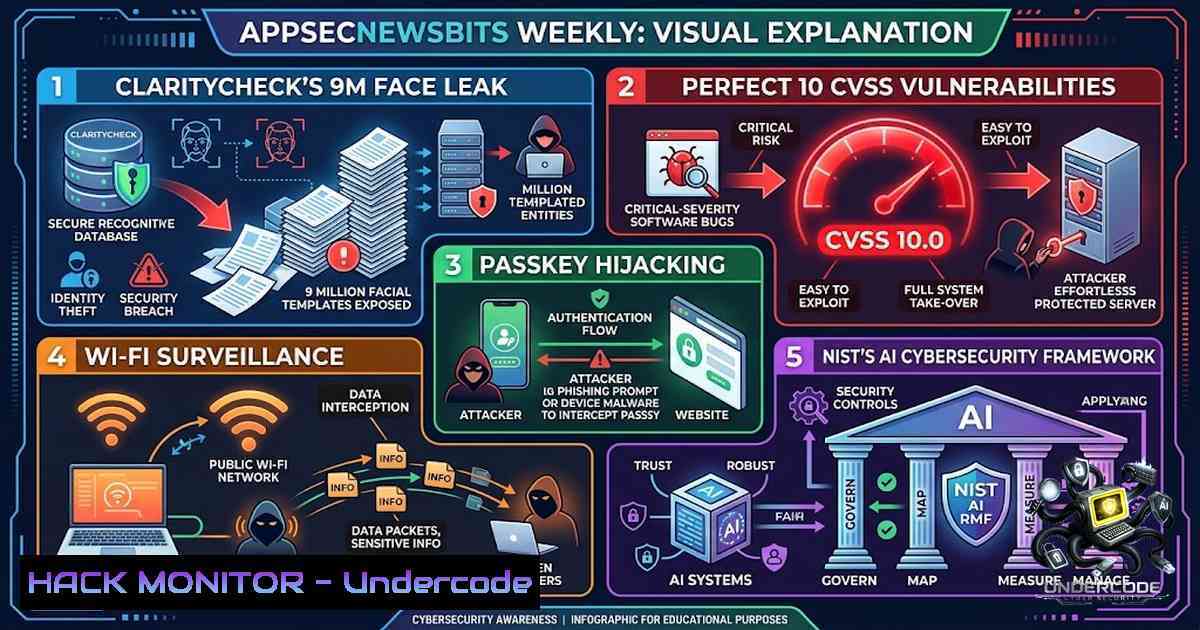
The cybersecurity landscape this week is defined by a convergence of identity, infrastructure, and artificial intelligence threats. From the exposure of over 9 million biometric facial images by the people-search tool ClarityCheck to critical “perfect 10” vulnerabilities in Microsoft Entra ID and Cisco Secure Workload, the attack surface continues to expand. Simultaneously, novel “Pass-ta-key” attacks are undermining the security of passwordless authentication, while researchers have demonstrated that unencrypted Wi-Fi signals can be used to track individuals with near-perfect accuracy. Adding a layer of complexity, NIST has released SP 1353, a draft guide for integrating artificial intelligence into Cybersecurity Framework (CSF) 2.0 analysis and reporting, signaling a pivotal shift toward AI-augmented security operations.
Learning Objectives & Secrets:
- Objective 1: Master Cloud Storage and API Security – Understand the misconfigurations that led to the ClarityCheck data exposure and learn how to audit S3 buckets and APIs to prevent similar leaks.
- Objective 2 Secret Tips: Exploit and Mitigate “Perfect 10” Vulnerabilities – Gain insight into the critical deserialization flaw in Microsoft Entra ID (CVE-2026-69836) and the authentication bypasses in Cisco Secure Workload (CVE-2026-20315, CVE-2026-20317). Learn the specific patches and configuration changes required.
- Objective 3 Secret Tips: Defend Against Passkey and Authentication Bypasses – Discover how the Pass-ta-key, Silver Pass-ta-key, and Golden Pass-ta-key attacks work and implement detection and mitigation strategies to protect synced passkeys.
You Should Know:
1. ClarityCheck Data Exposure: The 450GB Biometric Breach
Security researcher Jeremiah Fowler discovered an unsecured Amazon S3 bucket belonging to ClarityCheck, a people-search service that markets itself as “private and secure”. The bucket contained over 9 million image files totaling approximately 450 GB, including photographs of faces, profile images, and screenshots of adults, teenagers, and children. The files were organized in folders named “faces” and “profiles” and were accessible via a URL embedded in the company’s public website code. A second misconfiguration exposed email addresses and phone numbers through the company’s APIs. While ClarityCheck secured the database after media inquiry, the data was exposed for months, and the company controversially disputed that the data was “publicly exposed,” arguing that the unindexed URL was not discoverable through ordinary use.
Step-by-Step Guide: Auditing Cloud Storage and API Exposure
This guide explains how to prevent similar data exposures by auditing cloud storage and APIs.
- Inventory Cloud Storage Buckets: Use cloud provider CLIs to list all storage buckets. For AWS, run:
aws s3 ls
For Azure, use:
az storage account list
- Check Bucket Permissions: Verify that buckets are not publicly accessible. For AWS, check the bucket ACL and policy:
aws s3api get-bucket-acl --bucket YOUR_BUCKET_NAME
aws s3api get-bucket-policy --bucket YOUR_BUCKET_NAME
Ensure that `”Effect”: “Allow”` with `”Principal”: “”` is not present unless absolutely necessary.
-
Enable Block Public Access: For AWS, enable Block Public Access settings at the account or bucket level:
aws s3api put-public-access-block --bucket YOUR_BUCKET_NAME --public-access-block-configuration "BlockPublicAcls=true,IgnorePublicAcls=true,BlockPublicPolicy=true,RestrictPublicBuckets=true"
-
Audit API Endpoints: Use an API security testing tool like OWASP ZAP or Postman to enumerate and test API endpoints for unauthorized data exposure. Look for endpoints that return PII without proper authentication.
-
Implement Data Retention Policies: Ensure that uploaded data is automatically deleted after a specified period. For AWS S3, configure a lifecycle policy:
aws s3api put-bucket-lifecycle-configuration --bucket YOUR_BUCKET_NAME --lifecycle-configuration file://lifecycle.json
Example `lifecycle.json`:
{
"Rules": [
{
"Status": "Enabled",
"Prefix": "",
"Expiration": {
"Days": 14
}
}
]
}
- The “Perfect 10” Vulnerabilities: Microsoft Entra ID and Cisco Secure Workload
This week saw the disclosure of multiple critical vulnerabilities with a CVSS score of 10.0. Microsoft patched CVE-2026-69836, a deserialization vulnerability in Entra ID (formerly Azure Active Directory) that could allow an unauthenticated attacker to remotely execute code over a network with low complexity and no user interaction. Meanwhile, Cisco addressed five flaws in its Secure Workload platform, including two perfect 10.0-rated bugs (CVE-2026-20315 and CVE-2026-20317) involving authorization failures and authentication bypasses. Cisco discovered these vulnerabilities during an internal security review using frontier AI models.
Step-by-Step Guide: Patching and Mitigating Critical Vulnerabilities
- Identify Affected Systems: For Microsoft, check Entra ID tenants; the fix was applied service-side, and no additional customer action is required. For Cisco, identify on-premises Secure Workload deployments running version 3.10 or earlier, or 4.0 and newer.
-
Apply Patches: For Cisco on-premises, upgrade to version 3.10.9.1 or 4.0.4.16, depending on your current version. For SaaS customers, update the Agent and Connector components.
-
Verify Patch Status: After patching, verify the installation. For Cisco, check the version via the web interface or CLI:
show version
-
Implement Network Segmentation: Restrict network access to the affected systems to only necessary IP ranges and services. Use firewalls to limit exposure.
-
Monitor for Exploitation: Review logs for unusual authentication attempts or unexpected system behavior. For Entra ID, monitor sign-in logs for anomalies.
3. Pass-ta-key Attacks: Hijacking Synced Passkeys
Palo Alto Networks’ Unit 42 disclosed three novel attacks targeting Google Password Manager’s synced passkeys on Windows devices with TPM chips. The Pass-ta-key attack allows unprivileged malware to impersonate a trusted device and obtain a valid authentication assertion. Silver Pass-ta-key enables attackers to register their own verification key, bypassing user verification checks. The most severe, Golden Pass-ta-key, extracts the master encryption key (security domain secret) from Chrome’s memory, allowing decryption of all synced passkeys.
Step-by-Step Guide: Detecting and Mitigating Passkey Attacks
- Endpoint Detection and Response (EDR): Deploy EDR solutions to detect and block malware attempting to access Chrome’s process memory or FIDO logs.
- Monitor for Unusual Re-registration: Track Chrome’s passkey re-registration events. An unexpected re-registration may indicate a Silver Pass-ta-key attack.
- Enforce User Verification: For services using passkeys, ensure they properly validate the `User Verified` flag. GitHub correctly does this, while eBay initially did not.
- Windows Security Configuration: Ensure Windows Defender Credential Guard is enabled to protect TPM-backed keys.
- Regular Security Audits: Conduct regular audits of authentication logs for suspicious patterns.
-
Wi-Fi as a Surveillance Tool: BFId and 802.11bf
Researchers from the Karlsruhe Institute of Technology have demonstrated that unencrypted beamforming feedback information (BFI) signals, routinely exchanged between Wi-Fi devices and routers, can be used to create radio-based images of individuals and identify them with 99.5% accuracy. The method, called BFId (Beamforming Feedback Information Identification), works even when a person is not carrying any connected device. The technique exploits standard Wi-Fi telemetry, turning everyday routers into potential surveillance tools. The researchers are calling for privacy safeguards to be built into new Wi-Fi systems, particularly the upcoming IEEE 802.11bf standard.
Step-by-Step Guide: Mitigating Wi-Fi-Based Tracking
- Avoid Public Wi-Fi: Limit the use of public Wi-Fi networks, as they can be used to track your presence.
- Disable Wi-Fi When Not in Use: Turn off Wi-Fi on your devices when not actively using it to prevent the exchange of management frames.
- Use VPNs and Encryption: While this does not prevent the signal exchange, using a VPN adds a layer of privacy for your data traffic.
- Advocate for Privacy Standards: Support and advocate for the inclusion of privacy protections in the IEEE 802.11bf standard.
-
Physical Awareness: Be aware that your physical presence can be detected even without a device.
-
NIST SP 1353: AI for CSF 2.0 Analysis and Reporting
On August 19, 2026, NIST released the initial public draft of Special Publication 1353, a quick-start guide for using Artificial Intelligence (AI) for Cybersecurity Framework (CSF) 2.0 analysis and reporting. The guide provides structured AI prompts and notional use cases to help practitioners create CSF-related artifacts, such as implementation plans and progress reports. It emphasizes practical applications of AI for analyzing an organization’s progress toward CSF 2.0 outcomes. The public comment period is open through October 15, 2026.
Step-by-Step Guide: Implementing AI for CSF 2.0
- Access the Draft: Download NIST SP 1353 ipd from the CSRC website.
- Review the Use Cases: Study the three notional use cases provided in the guide to understand how AI can be applied.
- Experiment with Prompts: Use the example prompts to generate CSF 2.0 outputs from a generative AI model, such as creating a current-state profile or a target-state profile.
- Simulate with Provided Files: Use the simulated organizational files for the fictitious company to practice AI-driven analysis.
- Submit Comments: Provide feedback to NIST by October 15, 2026, to help shape the final publication.
What Undercode Say:
- Key Takeaway 1: The ClarityCheck breach underscores the critical failure of assuming that an unindexed URL equates to security. Biometric data is immutable, and its exposure carries lifelong privacy risks. Organizations must treat cloud storage as public by default and enforce strict access controls, encryption, and automated retention policies.
- Key Takeaway 2: The disclosure of “perfect 10” vulnerabilities in both Microsoft and Cisco products highlights the persistent threat of remote code execution and authentication bypass. While both companies patched the flaws before widespread exploitation, the use of AI in discovering these vulnerabilities marks a significant shift in defensive capabilities. Organizations must prioritize rapid patch management and continuous monitoring.
Prediction:
- +1 The release of NIST SP 1353 will accelerate the adoption of AI in cybersecurity operations, enabling more efficient and accurate CSF 2.0 compliance and reporting. This will empower organizations to better understand and improve their security posture.
- -1 The Pass-ta-key attacks represent a significant challenge to the passwordless future. As passkey adoption grows, so will the sophistication of attacks targeting them. This will necessitate a reevaluation of trust models and endpoint security, potentially slowing the transition away from passwords.
- -1 The ability to track individuals via Wi-Fi signals, without their knowledge or consent, poses a grave threat to privacy. As the IEEE 802.11bf standard is finalized, there is an urgent need for built-in privacy protections to prevent the creation of a global, invisible surveillance network.
- +1 The increasing use of AI to discover vulnerabilities, as demonstrated by Cisco and Microsoft, will lead to more secure software and faster identification of zero-day flaws.
- -1 The ClarityCheck exposure is a stark reminder that data, once leaked, cannot be recalled. This incident will likely fuel regulatory scrutiny and legal actions against companies that fail to protect biometric data.
▶️ Related Video (70% Match):
https://www.youtube.com/watch?v=pMyUTRyEk54
🎯Let’s Practice For Free:
🎓 Live Courses & Certifications:
Join Undercode Academy for Verified Certifications
🚀 Request a Custom Project:
Secure, high-velocity infrastructure and disruptive technological engineering. Contact our engineering team for high-tier development and proprietary systems:
[email protected]
💎 Smart Architecture | 🛡️ Secure by Design | ⭐ Trusted by Thousands
IT/Security Reporter URL:
Reported By: https://lnkd.in/p/ebHFXYgK – Hackers Feeds
Extra Hub: Undercode MoN
Basic Verification: Pass ✅


