
Listen to this Post
Introduction:
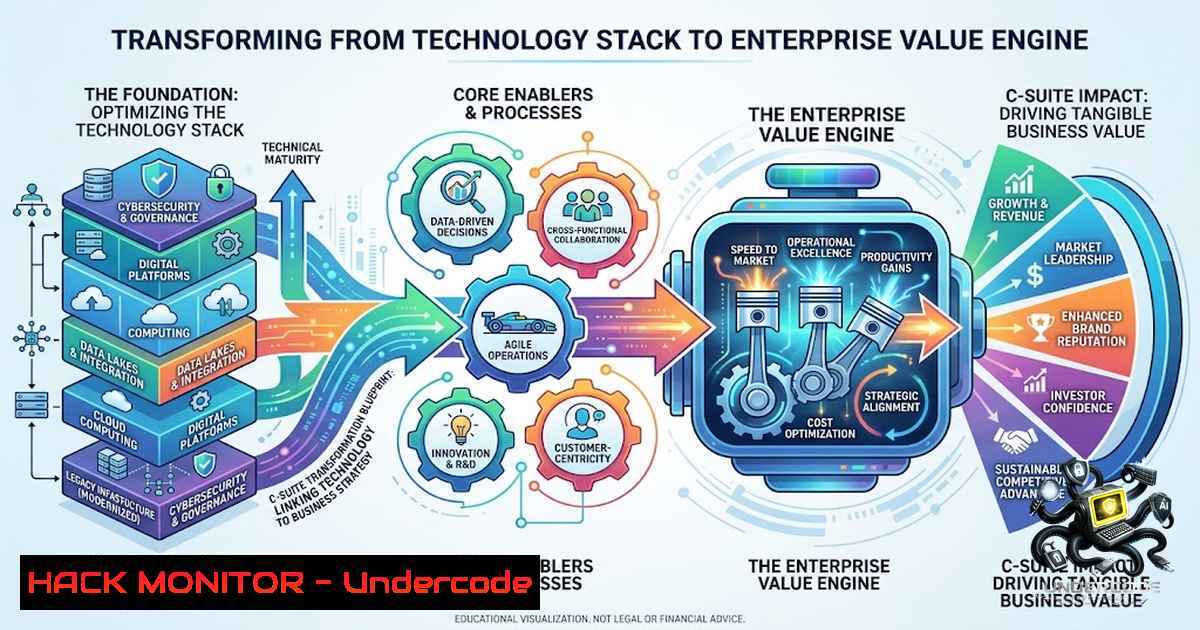
In today’s hyper-connected digital landscape, the mere accumulation of cloud platforms, AI models, and cybersecurity tools does not guarantee business success. The critical challenge facing C-level executives is not the lack of technology, but the inability to trace complex technology investments directly to tangible business outcomes like revenue growth, margin improvement, and risk reduction. This article deconstructs the modern enterprise transformation lifecycle, providing a technical roadmap to bridge the gap between architectural intent and financial impact, ensuring that every layer of the stack—from infrastructure to intelligence—is aligned with a singular value traceability chain.
Learning Objectives & Secrets:
- Objective 1: Master the Value Traceability Chain. Learn how to map investments directly to KPIs and financial impacts, moving beyond vanity metrics to prove ROI in cloud, AI, and security initiatives.
- Objective 2 Secret Tip: Operationalizing the “Value Stream.” Instead of focusing solely on tech stacks, identify and optimize the flow of data and processes from strategy to operations to uncover hidden cost savings and revenue opportunities.
- Objective 3 Secret Tip: Architecting for Cyber Resilience. Discover how to embed Zero Trust and AI-driven observability into the infrastructure layer to protect revenue and ensure compliance without slowing down innovation velocity.
- Strategizing the Technical Foundation: Moving from Intent to Architecture
The journey begins with converting high-level business intent into a robust technical architecture. This phase requires a shift from discussing platforms to defining capabilities. For a CTO or CIO, this means conducting a “technology rationalization” exercise to eliminate redundant SaaS applications and legacy systems.
Step‑by‑step guide:
- Step 1: Conduct a full asset inventory using cloud provider tools (AWS Config, Azure Resource Graph) or open-source tools like Osquery to map all running instances and services.
- Step 2: Classify workloads based on business criticality and data sensitivity. This involves tagging resources for cost allocation and security grouping.
- Step 3: Utilize Infrastructure as Code (IaC) to define the desired state. For example, using Terraform to provision a secure, multi-cloud environment that enforces compliance from the start.
Relevant Commands (Linux/Cloud CLI):
 AWS: List all EC2 instances with tags and status
aws ec2 describe-instances --query 'Reservations[].Instances[].[InstanceId,State.Name,Tags]'

Azure: Query for underutilized VMs
az vm list --show-details --query "[?powerState=='VM stopped']"

GCP: Audit project IAM policies
gcloud projects get-iam-policy [bash] --format=json
2. Designing the Data & Intelligence Fabric
Data is the new currency, but raw data is useless without a strategy for intelligence. This section focuses on building a modern data stack that feeds AI models (GenAI, LLMs, RAG) while maintaining strict governance. The challenge is to connect disparate sources like Snowflake, Databricks, and Kafka into a single source of truth.
Step‑by‑step guide for implementing a Data Mesh:
- Step 1: Decouple data storage from compute. Use object storage (S3, ADLS) as your data lake foundation.
- Step 2: Implement a streaming platform like Apache Kafka or AWS Kinesis to handle real-time data ingestion.
- Step 3: Deploy a data transformation layer using Apache Spark or dbt. Ensure that all transformations are version-controlled.
- Step 4: Secure data at rest and in transit using encryption (AES-256) and implement Column-Level Security (CLS) in your warehouse.
AI Security Tip:
When deploying LLMs, ensure you sanitize inputs to prevent prompt injection attacks. Use tools like Rebuff or implement strict regex filters on user inputs before they reach the model.
3. Building the Integration and API Security Layer
Modern enterprises are composed of microservices and APIs. The integration layer (Kubernetes, APIs) is often the most vulnerable point of failure. To achieve resilience and security, we must adopt a “Zero Trust” approach at the network edge.
Step‑by‑step guide for API Security Hardening:
- Step 1: Shift-left security by using Static Application Security Testing (SAST) during the CI/CD pipeline. Tools like SonarQube or Snyk can catch vulnerabilities early.
- Step 2: For runtime protection, deploy a Web Application Firewall (WAF) and API Gateway (e.g., Kong, AWS API Gateway) to enforce rate limiting and validate JWTs.
- Step 3: Implement Mutual TLS (mTLS) for service-to-service communication within Kubernetes clusters via a service mesh like Istio.
- Step 4: Audit logs continuously. Integrate your API logs with a SIEM (e.g., Splunk, Sentinel) to detect anomalies.
Windows/Linux Commands for Network Troubleshooting:
 Windows: Test connectivity and port status
Test-1etConnection -ComputerName api.example.com -Port 443
 Linux: Trace route and check TLS certificate expiry
openssl s_client -connect api.example.com:443 -servername api.example.com
4. Operating the Platform: Observability, SRE, and AIOps
Platforms are not the finish line; operations are. The shift from traditional monitoring to Observability (Metrics, Traces, Logs) is crucial for resilience. This involves implementing SRE practices to ensure uptime and AIOps to automate incident response.
Step‑by‑step guide for setting up an Observability Pipeline:
- Step 1: Deploy a monitoring agent (e.g., Prometheus exporters, OpenTelemetry collectors) on all nodes to gather telemetry data.
- Step 2: Configure centralized logging. Use the ELK Stack (Elasticsearch, Logstash, Kibana) or cloud-1ative solutions (AWS CloudWatch, Azure Log Analytics).
- Step 3: Define Service Level Objectives (SLOs) based on latency and error rates. Use Grafana to create dashboards that visualize these SLOs.
- Step 4: Automate remediation using AIOps. For instance, configure an auto-scaling policy based on CPU/memory thresholds, but also trigger a lambda function to restart unhealthy pods in Kubernetes automatically.
Kubernetes Commands for Health Checks:
 Check the status of all pods in a namespace
kubectl get pods -1 production

Describe a specific pod for error logs
kubectl describe pod [bash] -1 production

Scale a deployment based on load
kubectl scale deployment [bash] --replicas=5 -1 production
5. Security, Governance, and Cyber Resilience (CISO Focus)
The CISO’s mandate is to protect revenue. This requires moving beyond compliance checkboxes to active threat hunting and vulnerability management. The “Zero Trust” architecture must be enforced across IAM, SIEM, and XDR tools.
Step‑by‑step guide for implementing a Zero Trust model:
- Step 1: Implement IAM with Multi-Factor Authentication (MFA) and Privileged Access Management (PAM). Use tools like CyberArk or Azure AD PIM.
- Step 2: Deploy Endpoint Detection and Response (EDR) / XDR across all devices. Ensure logs are forwarded to the SIEM.
- Step 3: Conduct regular vulnerability scans using Nessus or OpenVAS. Prioritize patching based on CVSS scores and exploitability.
- Step 4: Establish a “Purple Team” exercise where red (offensive) and blue (defensive) teams work together to simulate a ransomware attack to test incident response times.
Linux Command for Security Auditing:
 Audit user login attempts and sudo access
sudo grep "Failed password" /var/log/auth.log

Check for open ports listening on the network
sudo netstat -tulpn | grep LISTEN
Windows Command for Security Auditing:
 Get-PS - Get security event logs for failed logins
Get-WinEvent -LogName Security | Where-Object { $_.Id -eq 4625 }

Check local firewall rules
Get-1etFirewallRule -Direction Inbound -Action Allow
6. FinOps and Cloud Optimization
Cost optimization is a primary concern for the CFO. The “FinOps” discipline involves managing cloud spend through tagging, right-sizing, and savings plans. This requires collaboration between engineering and finance to create a culture of cost accountability.
Step‑by‑step guide for Cloud Cost Management:
- Step 1: Enable detailed billing reports (AWS Cost Explorer, Azure Cost Management).
- Step 2: Tag all resources with Business Unit, Environment, and Cost Center. Enforce tagging policies using infrastructure as code (OPA policies).
- Step 3: Analyze usage patterns to identify idle resources. Automate the shutdown of non-production environments during off-hours using Cloud Custodian or AWS Instance Scheduler.
- Step 4: Purchase Reserved Instances or Savings Plans for predictable workloads to save up to 70% on compute costs.
Kubernetes Cost Command:
 Using kubectl to check resource requests/limits (ensuring you aren't overprovisioning)
kubectl describe nodes | grep -A 5 "Allocated resources"
What Undercode Say:
- Key Takeaway 1: Alignment is Key. The biggest takeaway is that technology alone cannot drive growth. The secret to successful transformation lies in mapping every technical decision—whether it’s choosing a cloud provider or deploying a new API—directly to a business metric. This requires a common language between the CTO and the CFO.
- Key Takeaway 2: “Value Engineering” is the New Strategy. It is no longer about building the “best” technical stack; it is about building a stack that is easily traceable to ROI, resilience, and customer experience. The focus on the “value traceability chain” helps organizations cut through the noise of hype cycles and focus on execution.
Analysis:
The core of this post highlights a systemic problem: the disconnect between operational IT and business strategy. By emphasizing the sequence from “Strategy to Business Impact,” the author advocates for a holistic architecture that treats cyber resilience and AI industrialization as business enablers rather than cost centers. The mention of specific C-level roles (CEO to CISO) indicates a maturity model that requires top-down sponsorship. For this to work, organizations must invest in training their teams to understand FinOps and DevSecOps principles, ensuring that security is embedded in code from the start. The recommended approach forces a shift in the market—vendors who only sell point solutions will lose relevance to those who offer integrated, value-driven platforms.
Prediction:
- P: By 2027, enterprises that successfully implement this “Value-Driven Architecture” will see a 30% faster time-to-market for new digital products due to streamlined governance and automated compliance.
- P: The rise of Agentic AI will automate the “Value Traceability” mapping, allowing CFOs to receive real-time cost predictions for every new feature deployment.
- N: Companies that fail to adopt this lifecycle approach will suffer from “Technical Debt Inflation,” where legacy systems consume over 80% of the IT budget, stifling innovation and leaving them vulnerable to cyberattacks that exploit unpatched, untracked assets.
▶️ Related Video (84% Match):
🎯Let’s Practice For Free:
🎓 Live Courses & Certifications:
Join Undercode Academy for Verified Certifications
🚀 Request a Custom Project:
Secure, high-velocity infrastructure and disruptive technological engineering. Contact our engineering team for high-tier development and proprietary systems:
[email protected]
💎 Smart Architecture | 🛡️ Secure by Design | ⭐ Trusted by Thousands
IT/Security Reporter URL:
Reported By: https://lnkd.in/p/ejd-4Hzm – Hackers Feeds
Extra Hub: Undercode MoN
Basic Verification: Pass ✅


