
Listen to this Post
Introduction:
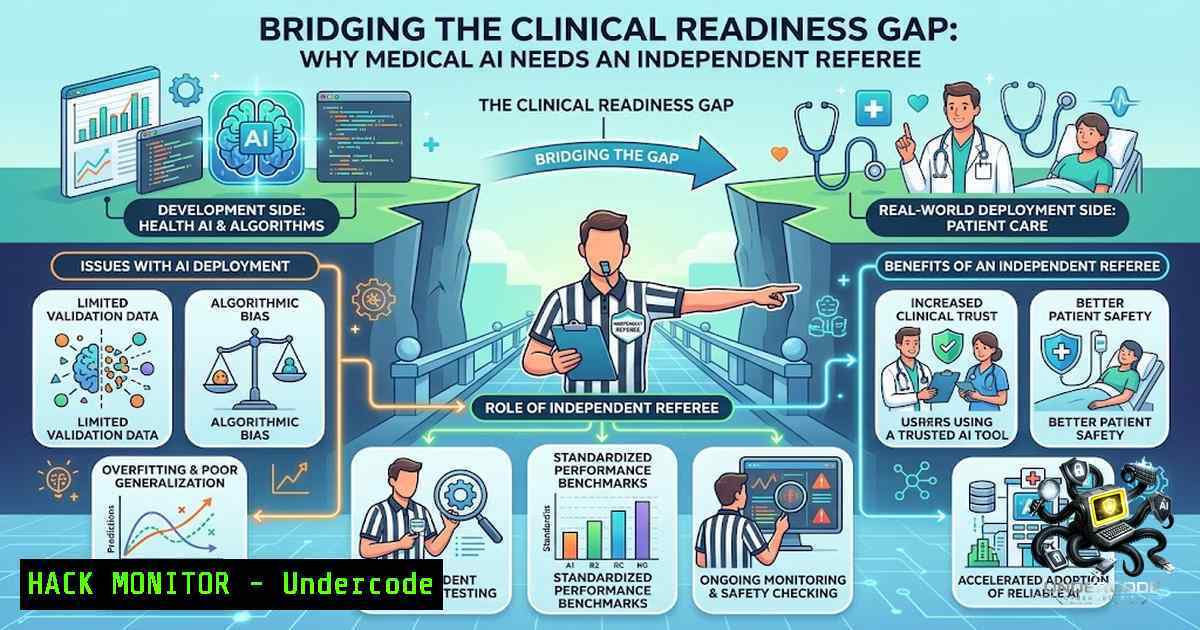
The gap between how healthcare AI performs on standardized tests and how it performs in real clinical workflows has emerged as one of the most critical challenges in medical technology today. Leading academic institutions and health systems alike face the same question: How do we best measure AI for healthcare applications when AI is already being used by doctors and patients alike? As Protege Co-Founder and Chief Scientific Officer Engy Ziedan explains, the industry needs independent evaluations that go beyond static exams to measure how models actually perform in real-world clinical workflows.
Learning Objectives & Secrets:
- Objective 1: Understand the Clinical Readiness Gap — Recognize why models that score 90%+ on medical licensing exams can fail at basic real-world clinical tasks, and why benchmark performance is a misleading proxy for clinical readiness.
-
Objective 2 Secret Tip: Master Benchmark Contamination Detection — Learn to identify when training data has leaked into evaluation datasets. The Protege Data Lab found that under 5% of publicly available healthcare benchmarks meet transparency and high-fidelity criteria. Always verify that evaluation data is uncontaminated before trusting benchmark results.
-
Objective 3 Secret Tip: Implement Multi-Turn Clinical Evaluation — Move beyond single-turn QA to multi-turn scenarios that simulate actual clinical conversations. Recent benchmarks like MedMT-Bench show even frontier models underperform (overall accuracy below 60%) on multi-turn clinical reasoning tasks.
You Should Know:
1. The Four Pillars of Healthcare AI Evaluation
Protege’s DataLab identified four key criteria for benchmark-specific healthcare datasets:
- Internally Valid: The assessment itself does not contain biased data — particularly bias not linked to the evaluation result
- Externally Valid: The data reflects the actual sequence, complexity, and entropy seen in real-world tasks
- Uncontaminated: The data is independent of training data
- Sufficient Sample Size: The data volume is large enough for statistical significance
To test for contamination in your own evaluation pipeline, you can use the following Python snippet to check for n-gram overlap between training and evaluation datasets:
from sklearn.feature_extraction.text import CountVectorizer
import numpy as np

def check_contamination(train_texts, eval_texts, ngram_range=(3,5)):
vectorizer = CountVectorizer(ngram_range=ngram_range)
train_ngrams = set(vectorizer.fit_transform(train_texts).toarray().sum(axis=0))
eval_ngrams = set(vectorizer.transform(eval_texts).toarray().sum(axis=0))
overlap = len(train_ngrams.intersection(eval_ngrams))
total = len(eval_ngrams)
return overlap / total if total > 0 else 0
On Windows, you can use PowerShell to hash and compare dataset samples:
Get-FileHash -Path .\train_data.csv -Algorithm SHA256
Get-FileHash -Path .\eval_data.csv -Algorithm SHA256
2. Data Readiness and the Contamination Crisis
Over 800 publicly available healthcare benchmarks exist on Hugging Face and other sources. However, the Protege Data Lab found that under five percent meet transparency and high-fidelity criteria. A staggering 92% of benchmarks fail to address data contamination risks. This creates a false perception of model capability — models appear to perform well because they’ve already seen the test questions during training.
To build uncontaminated evaluation datasets:
- Maintain strict data provenance: Document every data source used in training
- Create holdout datasets before training begins: Set aside evaluation data that the model will never see
- Use n-gram overlap detection: Regularly check for overlap between training and evaluation corpora
- Consider dynamic benchmarks: Use continuously updated evaluation sets that models cannot memorize
-
The Oracle Problem and the Need for Continuous Monitoring
As AI becomes more personalized and evolves faster than traditional healthcare quality systems can keep up, the industry faces what Protege CEO Bobby Samuels calls “The Oracle Problem” — the challenge of objectively measuring AI performance over time when usage itself changes the evaluation landscape. The future of medical AI may require continuous monitoring rather than occasional testing.
For continuous monitoring of deployed clinical AI models, consider implementing:
Linux-based monitoring setup:
 Monitor model performance drift over time
!/bin/bash
 Collect daily performance metrics
for metric in accuracy f1 precision recall; do
curl -s "http://localhost:8000/metrics/$metric" \
-H "Authorization: Bearer $API_KEY" \
| jq ".$metric" >> ${metric}_history.log
done

Calculate rolling average to detect drift
tail -1 30 accuracy_history.log | awk '{sum+=$1} END {print sum/30}'
Windows PowerShell for API performance monitoring:
 Monitor clinical AI API response times and error rates
$endpoint = "https://your-clinical-api.healthcare/v1/predict"
$results = @()
1..100 | ForEach-Object {
$response = Invoke-RestMethod -Uri $endpoint -Method Post -Body $requestBody -ContentType "application/json"
$results += [bash]@{
Latency = $response.latency
Status = $response.status
Timestamp = Get-Date
}
Start-Sleep -Milliseconds 100
}
$results | Export-Csv -Path "api_performance.csv" -1oTypeInformation
4. Multi-Modal and Longitudinal Data Requirements
Healthcare data is inherently multi-modal. A doctor may consult notes, imaging studies in multiple formats, patient portal messages, and other structured health data to evaluate a single cancer patient. The Protege Data Lab found that less than 10% of all publicly available healthcare benchmarks adequately reflect this multi-modal reality.
Protege addresses this by securely obtaining and stitching data into longitudinal, multimodal, anonymized patient-level datasets, enabling AI builders to better detect disease, predict successful treatments.
For working with multi-modal healthcare data, consider these approaches:
Python – Combining structured and unstructured EHR data:
import pandas as pd
import json
from datetime import datetime

Load structured EHR data
ehr_data = pd.read_csv('ehr_structured.csv')

Load unstructured clinical notes
with open('clinical_notes.json', 'r') as f:
notes = json.load(f)

Create longitudinal patient timeline
def build_patient_timeline(patient_id):
structured = ehr_data[ehr_data['patient_id'] == patient_id]
unstructured = [n for n in notes if n['patient_id'] == patient_id]

timeline = []
for _, row in structured.iterrows():
timeline.append({
'timestamp': row['date'],
'type': 'structured',
'data': row.to_dict()
})
for note in unstructured:
timeline.append({
'timestamp': note['date'],
'type': 'unstructured',
'data': note['content']
})
return sorted(timeline, key=lambda x: x['timestamp'])
5. Benchmark Design and Test Validity
Protege Co-Founder Engy Ziedan outlines four critical perspectives on healthcare AI evaluation:
- Test Design: Does the test measure the “right” answer?
- Data: Does the data represent real-world scenarios?
- The Referee: Who decides which model is best?
- Gamification: What happens when passing the test becomes the goal?
Recent studies confirm the severity of this gap. A systematic review found that technical validation alone characterised 92% of studies, while only 8% reported implementation outcomes. This highlights a critical gap between technical performance validation and real-world clinical utility assessment.
- Practical Implementation: Building a Clinical AI Evaluation Pipeline
To implement a robust clinical AI evaluation framework:
Step 1: Define clinical tasks, not just benchmark tasks
– Identify specific clinical workflows the AI will support
– Define success metrics in clinical terms (reduced errors, time saved, outcome improvement)
Step 2: Curate uncontaminated, multi-modal evaluation data
- Partner with data providers like Protege that offer evaluation-ready datasets
- Ensure data covers the full patient journey across modalities
Step 3: Implement multi-turn evaluation scenarios
- Use frameworks like MedMT-Bench for simulating entire diagnosis and treatment processes
- Test models on sequential clinical reasoning, not just single QA pairs
Step 4: Establish continuous monitoring
- Deploy drift detection systems
- Monitor for degradation in real-world model performance over time
Step 5: Engage independent evaluators
- Consider third-party evaluation to avoid conflicts of interest
- Protege positions itself as an independent evaluator for healthcare AI
What Undercode Say:
- Key Takeaway 1: The clinical readiness gap is real and measurable — models that ace medical exams routinely fail at actual clinical tasks. The industry must move beyond static benchmarks toward realistic, multi-turn scenarios built on real-world healthcare data.
-
Key Takeaway 2: Data contamination is a systemic problem affecting over 90% of healthcare AI benchmarks. Without uncontaminated evaluation data, we cannot trust performance claims. The solution requires rigorous data provenance, holdout datasets, and potentially continuous monitoring rather than occasional testing.
-
Analysis: The healthcare AI industry is at an inflection point. With models now being deployed at the point of care and nearly a third of all SOAP notes now written by AI, the need for credible evaluation has never been more urgent. Protege’s approach — connecting privacy-protected, multimodal, longitudinal healthcare data to specific real-world tasks — represents a promising path forward. However, the challenge extends beyond any single company. The entire ecosystem needs to embrace evaluation-forward operating systems that can transform clinical AI adoption from a leap of faith into a stepwise, trust-building process. The ultimate barrier to true AI adoption in hospitals is trust in what you’re getting, and that trust can only be built through rigorous, independent, and continuous evaluation.
Prediction:
- +1 The push for independent healthcare AI evaluation will create a new market category of “AI referees” and evaluation platforms, driving innovation in benchmark design and continuous monitoring systems.
- +1 Regulatory bodies like the FDA will increasingly require real-world clinical validation — not just benchmark performance — for AI-based medical devices, accelerating the adoption of rigorous evaluation frameworks.
- -1 Without standardized evaluation frameworks, healthcare systems will continue to deploy AI models that perform well on tests but fail in practice, potentially leading to patient harm and eroding trust in medical AI.
- -1 The data contamination problem will worsen as more public healthcare data is used for training, making it increasingly difficult to find truly uncontaminated evaluation datasets.
- +1 Multi-turn, longitudinal evaluation benchmarks will become the new standard, better reflecting how clinicians actually work and providing more meaningful assessments of AI capabilities.
- -1 The gap between academic AI research and clinical deployment may widen as researchers continue optimizing for benchmark performance rather than real-world clinical utility.
- +1 Healthcare organizations that invest early in robust AI evaluation infrastructure will gain a competitive advantage in deploying safe, effective AI tools.
- -1 Smaller health systems and startups may struggle to afford the data and expertise needed for proper AI evaluation, potentially concentrating AI capabilities in well-resourced institutions.
▶️ Related Video (84% Match):
https://www.youtube.com/watch?v=1IhFWOo4G-Q
🎯Let’s Practice For Free:
🎓 Live Courses & Certifications:
Join Undercode Academy for Verified Certifications
🚀 Request a Custom Project:
Secure, high-velocity infrastructure and disruptive technological engineering. Contact our engineering team for high-tier development and proprietary systems:
[email protected]
💎 Smart Architecture | 🛡️ Secure by Design | ⭐ Trusted by Thousands
IT/Security Reporter URL:
Reported By: https://lnkd.in/p/eEG7pXnm – Hackers Feeds
Extra Hub: Undercode MoN
Basic Verification: Pass ✅


