
Listen to this Post
Introduction:
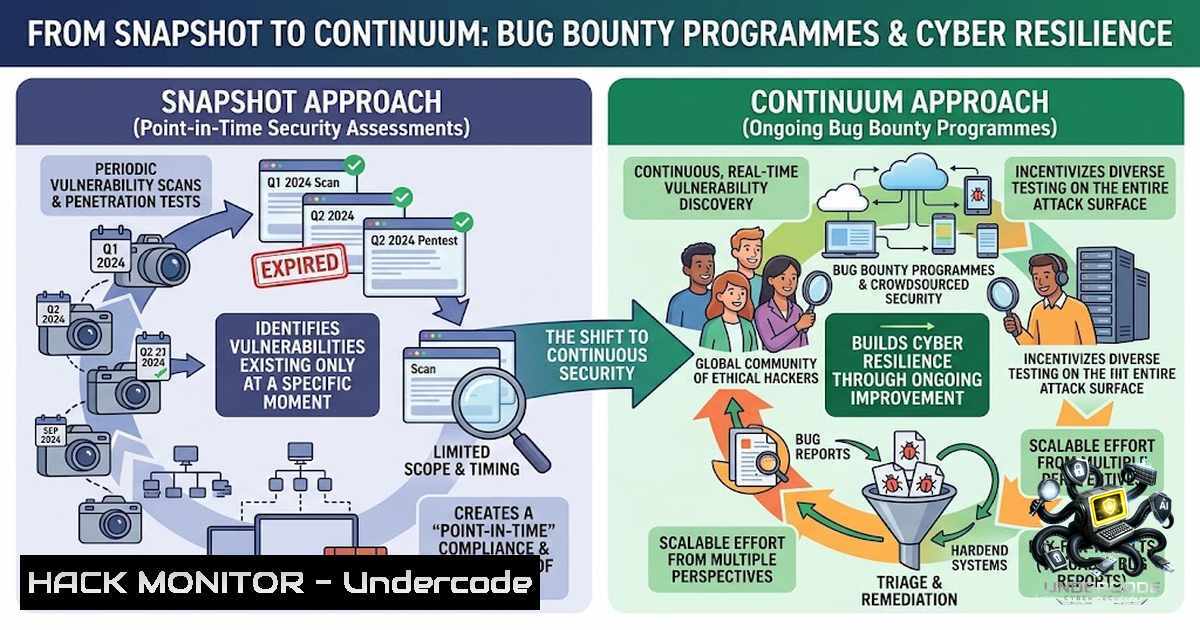
The traditional cybersecurity paradigm—anchored in annual penetration tests and periodic compliance audits—is rapidly becoming obsolete. As Gartner analysts and security leaders highlight, cyber threats do not operate on a schedule, yet most security testing programs remain calendar-driven, offering only a snapshot of risk in an environment that evolves daily. With the proliferation of AI tools lowering the barrier for attackers to discover complex vulnerabilities and chain them into sophisticated attack paths, organizations must shift to a continuous, proactive security operations model. Bug bounty programmes have emerged as a critical component of this new model, enabling continuous discovery by tapping into a global community of skilled researchers to find exploitable flaws before attackers do.
Learning Objectives & Secrets:
- Objective 1: Implement Continuous Validation Over Point-in-Time Testing. Learn to move beyond annual assessments by integrating continuous offensive security testing (COST) and bug bounty programmes into your security strategy to validate risk as it emerges, not when the calendar dictates.
-
Objective 2 Secret Tip: Measure Researcher Effort, Not Just Findings. A healthy bug bounty program isn’t just about the number of vulnerabilities found. Track metrics like “researcher-hours spent” against specific features. If multiple researchers spend significant time trying to break a new feature and fail, that is a powerful indicator of genuine security confidence.
-
Objective 3 Secret Tip: Embed Testing into the SDLC. Make adversarial testing a mandatory, non-1egotiable final step in your software development lifecycle (SDLC) before any significant feature goes live. This transforms security from a gatekeeper to an integral part of the engineering process, fostering a culture where development teams actively request security campaigns.
You Should Know:
- The Shift from Annual Pentests to Continuous Offensive Security Testing (COST)
The core argument for bug bounty programmes is rooted in the failure of periodic testing. Modern cloud environments change continuously—new workloads are deployed, IAM permissions are modified, and APIs evolve—creating exposure windows that an annual test simply cannot cover. Gartner’s March 2026 research report, “The Future of Pen Testing Is Continuous Offensive Security Testing,” defines COST as a trigger-driven, intelligence-led model that activates validation when material risk changes, not when the calendar dictates. This model unifies penetration testing, red teaming, bug bounty, and control validation into a single, continuously operating capability, blending automation, AI, and human adversarial reasoning.
Step-by-Step Guide to Implementing a COST-Inspired Model:
- Step 1: Define Risk Triggers. Identify events that should automatically initiate a security validation. These can include new application deployments, significant changes to identity and access management (IAM) configurations, exposure of new APIs, or spikes in relevant threat intelligence.
- Step 2: Adopt a Risk-Tier Model. Classify triggers into high, medium, and low priority to determine the urgency and depth of testing required. A critical new customer-facing feature would trigger a high-priority, full-scope bug bounty campaign.
- Step 3: Select the Right Method. Map each trigger to the most appropriate validation method. For a new feature, a targeted bug bounty campaign is ideal. For a major infrastructure change, a combination of automated scanning and red teaming might be more suitable.
- Step 4: Integrate with Operations. Embed these validation triggers directly into your CI/CD pipelines, ITSM, and SecOps workflows. This ensures that security testing is an automated part of the deployment process, not a separate, manual activity.
- Step 5: Measure Outcomes, Not Activity. Track key performance indicators like exposure-window reduction, trigger-to-start time, and SLA completion rates to demonstrate the effectiveness of your continuous program.
- The Synergy Between Bug Bounty Programmes and CTEM
Gartner’s Continuous Threat Exposure Management (CTEM) framework provides a structured, five-stage cycle for exposure reduction: scoping, discovery, prioritization, validation, and mobilization. Bug bounty programmes are a perfect fit for the “validation” stage. While automated scanners and periodic tests are good for discovery, they often generate a high volume of false positives. A bug bounty programme, with its crowd of skilled human researchers, excels at validating whether a discovered exposure is actually exploitable in a real-world context. This synergy is crucial because research shows that testing for exploitability can reduce false urgency by 84%, allowing teams to focus remediation efforts on the critical 2% of exposures that pose a genuine threat.
Step-by-Step Guide to Integrating Bug Bounty with CTEM:
- Step 1: Align Scope. Ensure the scope of your bug bounty programme directly maps to the assets and attack surfaces identified in the CTEM “scoping” phase.
- Step 2: Feed Findings into Prioritization. Use the validated findings from your bug bounty programme as high-confidence input for the CTEM “prioritization” stage, ensuring that resources are allocated to fixing the most critical, exploitable vulnerabilities first.
- Step 3: Automate Remediation Workflows. Integrate your bug bounty platform with your issue-tracking system (e.g., Jira) to automatically create tickets for validated findings, streamlining the “mobilization” phase and reducing mean time to remediation (MTTR).
- Step 4: Continuous Feedback Loop. Use the lessons learned from bug bounty findings to improve secure coding practices and update the scope for future discovery cycles, creating a continuous improvement loop.
- Practical Commands and Tools for Continuous Security Validation
To operationalize a continuous security model, security teams can leverage a variety of open-source and commercial tools. The following commands and examples illustrate how to integrate automated scanning and validation into your workflow.
Linux Command Examples for Vulnerability Scanning:
- Nmap for Network Discovery and Service Detection: Use Nmap to discover live hosts and identify services running on your network. This is a foundational step for understanding your attack surface.
Discover live hosts in a subnet (Always get proper authorization before scanning)
nmap -sn 192.168.1.0/24

Perform an aggressive service scan on the top 1000 ports of a target
nmap -sV --top-ports 1000 <target-ip>
-
Nuclei for Template-Based Vulnerability Scanning: Nuclei is a fast, customizable vulnerability scanner powered by a vast community of templates. It’s excellent for continuous scanning in CI/CD pipelines.
Run a scan against a target using all templates
nuclei -u https://example.com

Run a scan with specific templates for critical vulnerabilities
nuclei -u https://example.com -t cves/ -severity critical
- Masscan for High-Speed Port Scanning: For large-scale, rapid discovery of open ports, Masscan is significantly faster than Nmap.
Scan the entire internet for port 443 (use with extreme caution and authorization)
masscan 0.0.0.0/0 -p443 --rate=10000
Windows Command Example (PowerShell) for Basic Reconnaissance:
- Test-1etConnection for Port Scanning: PowerShell provides built-in cmdlets for basic network reconnaissance.
Test if a specific port is open on a remote host
Test-1etConnection -ComputerName example.com -Port 443
Integrating Scans into CI/CD (Example with a hypothetical `security-scan` tool):
 Example GitLab CI job for continuous security scanning
security-scan:
stage: test
script:
- echo "Starting security scan..."
- nuclei -u $CI_ENVIRONMENT_URL -t cves/ -severity critical,high -o scan_report.json
- python security_parser.py scan_report.json  Custom script to parse and fail the build if critical findings exist
only:
- main
- merge_requests
artifacts:
reports:
security: scan_report.json
- Building and Managing an Effective Bug Bounty Programme
Launching a bug bounty programme requires more than just setting up a webpage. It demands careful planning, clear rules of engagement, and a commitment to researcher relations.
Step-by-Step Guide to Launching a Bug Bounty Programme:
- Step 1: Define Your Scope and Rules. Clearly define which systems, applications, and APIs are in scope for testing. Specify what is out of bounds (e.g., physical security, social engineering) to avoid any legal or operational issues.
- Step 2: Set a Budget and Reward Structure. Establish a fixed budget and define a reward structure based on the severity of the vulnerability (e.g., using the CVSS score). This ensures cost predictability while incentivizing high-quality research.
- Step 3: Choose a Platform. Select a bug bounty platform (e.g., HackerOne, Bugcrowd, YesWeHack) that manages the crowd, triages reports, and handles payouts, reducing your administrative burden.
- Step 4: Launch and Promote. Announce your programme to the security researcher community. Provide clear, detailed documentation and be responsive to researcher questions.
- Step 5: Triage and Remediate. Establish a robust internal process for triaging incoming reports, validating findings, and routing them to the appropriate development teams for remediation. Use managed triage services to filter noise and duplicates before they reach your engineering team.
- Step 6: Communicate and Iterate. Maintain open communication with researchers. Acknowledge their findings promptly, provide updates on remediation status, and pay bounties quickly to encourage repeat engagement.
- The Human Element: Why AI and Automation Aren’t Enough
While AI and automation are transforming application security, true resilience is achieved when advanced technology is paired with skilled human testers. AI tools are excellent at finding known vulnerability patterns at scale, but they often lack the creativity and contextual understanding to identify complex, logic-based flaws or chain seemingly minor issues into a critical attack path. Human researchers ask the crucial question: “What if we tried this?” This “adversarial reasoning” is what uncovers the most dangerous, non-obvious vulnerabilities that automated scanners miss. The combination of AI-powered scanning for speed and scale, with human-led bug bounty programmes for depth and creativity, represents the most effective defense against modern adversaries.
What Undercode Say:
- Key Takeaway 1: Resilience Requires Continuous, Not Periodic, Action. The fundamental shift is moving from a schedule-driven security model to a risk-driven one. Cyber threats are constant, so your defenses must be too.
- Key Takeaway 2: Bug Bounties Are a Force Multiplier. By harnessing a global community of ethical hackers, organizations gain access to a diverse range of skills and perspectives, uncovering vulnerabilities that internal teams and automated tools are likely to miss.
- Key Takeaway 3: Culture and Metrics Matter. A successful bug bounty programme is about more than just finding bugs. It’s about building a culture of security where engineering teams actively seek adversarial testing, and where success is measured by the effort researchers expend trying to break your systems, not just the number of CVEs found.
Prediction:
- +1 The adoption of continuous offensive security testing (COST) and bug bounty programmes will accelerate, moving from a niche practice to an enterprise standard. By 2028, Gartner predicts that over 60% of enterprise pen test programs will operate as continuous validation within DevSecOps pipelines, replacing annual assessments as the primary proof of resilience.
- +1 AI will become a powerful ally in bug bounty programmes, not a replacement for human researchers. AI-powered tools will automate reconnaissance and initial vulnerability discovery, allowing human researchers to focus on complex, logic-based flaws and exploit chaining, thereby increasing the efficiency and depth of the programmes.
- -1 Organizations that fail to adopt a continuous, proactive security model will face a growing and significant risk gap. As AI lowers the barrier for attackers, companies relying on periodic audits will become increasingly vulnerable to automated and sophisticated attacks, leading to more frequent and costly breaches.
▶️ Related Video (78% Match):
🎯Let’s Practice For Free:
🎓 Live Courses & Certifications:
Join Undercode Academy for Verified Certifications
🚀 Request a Custom Project:
Secure, high-velocity infrastructure and disruptive technological engineering. Contact our engineering team for high-tier development and proprietary systems:
[email protected]
💎 Smart Architecture | 🛡️ Secure by Design | ⭐ Trusted by Thousands
IT/Security Reporter URL:
Reported By: https://lnkd.in/p/eKjrPBK3 – Hackers Feeds
Extra Hub: Undercode MoN
Basic Verification: Pass ✅


