
Listen to this Post
Introduction:
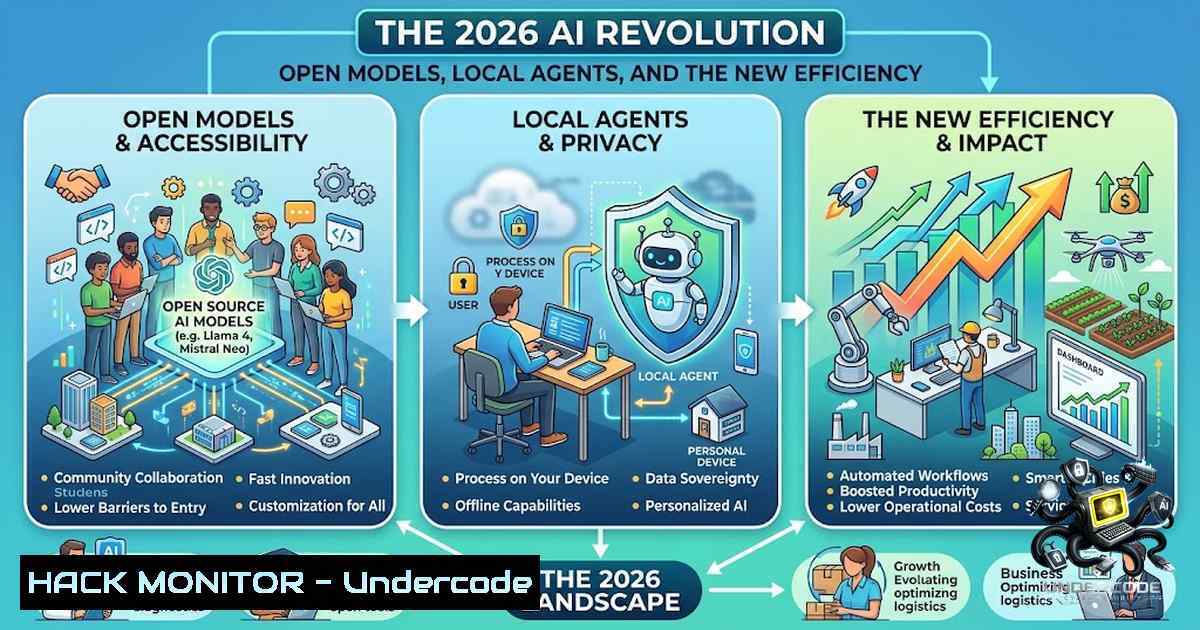
The artificial intelligence landscape of 2026 is no longer defined solely by the escalating parameter counts of monolithic models, but by the triad of democratization, efficiency, and stringent governance. As open-weight models achieve parity with proprietary systems on complex reasoning benchmarks, organizations are pivoting from mere adoption to strategic, cost-effective integration. This paradigm shift compels security and IT professionals to recalibrate their infrastructure, data pipelines, and compliance frameworks to harness the power of local agents and massive context windows while mitigating new vectors of risk.
Learning Objectives & Secrets:
- Objective 1: Deploy and Benchmark Open “Frontier” Models – Learn to operationalize models like Qwen3.8-Max and Nemotron 3.5 Lightning in a production environment, comparing performance against proprietary counterparts using industry-standard benchmarks such as MMLU and HumanEval.
- Objective 2 (Secret Tip): Optimize Local Agentic Workflows – Discover how to fine-tune the inference parameters and memory management for 27B–30B parameter models to run efficiently on a single 24 GB VRAM GPU, ensuring low-latency responses for autonomous coding agents.
- Objective 3 (Secret Tip): Implement Governed Context Processing – Master the art of handling million-plus token contexts without sacrificing speed, while embedding provenance tracking and compliance checks to meet the EU AI Act’s transparency mandates.
You Should Know:
- Deploying and Securing Open-Weight Models on Private Infrastructure
The accessibility of frontier-level open models is a double-edged sword; while it empowers innovation, it also expands the attack surface. Deploying a model like Qwen3.8-Max internally requires a hardened environment. This involves containerization, strict API key rotation, and monitoring for prompt injection attempts.
Step‑by‑Step Guide:
- Environment Setup: Install NVIDIA drivers (version 550+) and the latest CUDA toolkit.
- Containerization: Pull a secure inference server, e.g.,
docker pull nvcr.io/nvidia/pytorch:24.10-py3. - Model Loading: Use Hugging Face Transformers to load the model with `device_map=”auto”` to optimize memory allocation.
- API Security: Deploy the model behind an NGINX reverse proxy with rate-limiting and SSL termination.
- Testing Connectivity: Verify API availability with
curl -X POST http://localhost:5000/v1/chat/completions -H "Authorization: Bearer $YOUR_KEY" -d @input.json.
Linux Commands for Monitoring:
- Monitor GPU usage in real-time: `watch -1 1 nvidia-smi`
– Check for unauthorized model file access: `auditctl -w /path/to/model/weights -p rwa -k model_access`
2. Building Local Autonomous Agents with Extended Memory
Executing advanced code agents locally with 1M+ token context windows enables unprecedented analysis of massive codebases. However, this requires orchestrating a “memory” layer that can retrieve and prioritize relevant information without overloading the context window, effectively using a vector database for retrieval-augmented generation.
Step‑by‑Step Guide:
- Data Ingestion: Clone your target repository: `git clone https://github.com/your-project/repo.git`
- Embedding Creation: Use a local embedding model (e.g.,
all-MiniLM-L6-v2) to convert code files into vectors. - Vector Database: Store these vectors in a Chroma or FAISS instance.
- Agent Orchestration: Implement a LangChain agent that queries the vector DB for context, then formulates a prompt for the local LLM (e.g., Qwen3.8-27B).
- Execution & Loop: Allow the agent to generate code, execute it in a sandboxed environment (using
docker run --rm -v "$PWD":/app python:3.11 /app/script.py), and iterate on the output.
Windows PowerShell Commands (If applicable):
- Set environment variable for local model path: `$env:MODEL_PATH = “C:\models\Qwen3.8-27B”`
– Check Windows CUDA availability: `nvidia-smi` (via command prompt in admin mode).
3. Massive Cost Reduction via Agile Inference
The “inference cost per million tokens” has become a critical metric for production viability. Models like Gemini 3.7 Flash demonstrate that speed and accuracy are no longer mutually exclusive. Optimizing inference involves quantization (e.g., FP8 or INT4) and leveraging optimized serving frameworks like TensorRT-LLM or vLLM to maximize throughput on existing hardware.
Step‑by‑Step Guide:
- Quantization: Convert the model to a 4-bit format using the `bitsandbytes` library.
- Serving Framework: Set up vLLM, which uses PagedAttention to manage memory more efficiently:
python -m vllm.entrypoints.api_server --model your-model --tensor-parallel-size 1 --quantization awq. - Benchmarking: Use `locust` to simulate concurrent API calls and measure latency and throughput.
- Auto-scaling: Configure Kubernetes Horizontal Pod Autoscaler (HPA) based on custom metrics from the inference server.
- Cost Analysis: Log input/output tokens per request to calculate cost-per-request using the pricing formula from your cloud provider, then compare against your internal on-premise costs for a concrete ROI analysis.
4. Governance and Compliance Implementation (EU AI Act)
The “right to be forgotten” and “explainability” are now technical requirements. Implementing compliance for deployed models means creating a tamper-proof log of data provenance, model decisions, and synthetic content generation.
Step‑by‑Step Guide:
- Provenance Tracking: Instrument your data pipeline to generate hashes (SHA-256) for source data before it is consumed by the LLM, storing these in an immutable SQLite database.
- Tracing Output: Use the `C2PA` standard to attach metadata to generated images/text, indicating they were AI-generated.
- Access Control: Implement fine-grained access control lists (ACLs) using Open Policy Agent (OPA) to restrict which users can interact with specific models.
- Audit Logging: Forward all user prompts and model responses to a centralized logging solution (e.g., ELK stack) for security auditing.
- Vulnerability Testing: Run adversarial testing using tools like `TextAttack` to check for biases or exploitable prompt injections.
5. Prompt Engineering and Secure Sandboxing
As agents become more autonomous, the risk of “indirect prompt injection” increases. A malicious file read by a code assistant could instruct the model to perform harmful actions. Security must be embedded in the orchestration layer.
Step‑by‑Step Guide:
- Input Sanitization: Implement a regex-based filter to remove potential system commands from prompts before they reach the LLM.
- Sandbox Execution: Use `nsjail` on Linux to isolate code execution, limiting system calls and memory allocation.
- System Prompts: Hardcode a system prompt that strictly forbids the agent from executing certain high-risk commands (e.g.,
rm -rf,chmod 777). - Monitoring: Use `prometheus` to monitor the frequency of attempts to execute privileged commands and trigger alerts.
- RAG Safeguards: For retrieval-augmented generation (RAG), implement a re-ranking step that assigns a “toxicity” score to retrieved documents and excludes those that are untrusted or malicious.
 Example of a safety filter in Python
import re
def sanitize_prompt(prompt):
 Remove potential SQL injection patterns
prompt = re.sub(r'(\;|--|SELECT|DROP|INSERT)', '', prompt)
 Remove potential shell command patterns
prompt = re.sub(r'(\&\&||||`|\$(|\;||)', '', prompt)
return prompt
What Undercode Say:
- Key Takeaway 1: The democratization of frontier AI models is a pivotal shift, but it mandates a robust local infrastructure capable of handling the computational load while maintaining strict security and compliance postures.
- Key Takeaway 2: The reduction in inference costs and expansion of context windows are not just incremental improvements; they are enabling a new class of applications—from real-time codebase refactoring to complex document analysis—that were previously cost-prohibitive.
- Analysis: The overarching trend is the maturation of AI from a cloud-dependent service to an integral, native component of enterprise architecture. This convergence of open models, local execution, and stringent regulation creates a complex ecosystem where the ability to navigate cost, performance, and security simultaneously will become the primary differentiator. The “secrets” to success lie in optimized memory management, automated governance, and a shift-left mindset for security, treating AI agents as privileged users that require the same level of scrutiny as human system administrators.
Prediction:
- +1 The “AI-First” Enterprise: The next 18 months will see a surge in software development kits (SDKs) and managed platforms specifically designed for orchestrating local agentic workflows, rapidly accelerating the “AI-First” enterprise model where every application has an embedded intelligence layer.
- +1 Specialized Compute Market Boom: As 24 GB VRAM becomes the baseline for local AI development, we will witness a massive market expansion for high-performance consumer and enterprise GPUs, commoditizing AI compute power further.
- -1 The Complexity Crisis: The push towards localized, multi-model systems will introduce unprecedented operational complexity, leading to a skills gap shortage. Organizations that fail to invest in training and automated observability tools will find themselves vulnerable to cascading failures and security breaches.
- -1 The Regulatory Drag: While governance is necessary, the stringent requirements of legislation like the EU AI Act may create a “compliance tax” that disproportionately affects smaller innovators, potentially slowing down the release cycles of beneficial open-source projects.
▶️ Related Video (84% Match):
🎯Let’s Practice For Free:
🎓 Live Courses & Certifications:
Join Undercode Academy for Verified Certifications
🚀 Request a Custom Project:
Secure, high-velocity infrastructure and disruptive technological engineering. Contact our engineering team for high-tier development and proprietary systems:
[email protected]
💎 Smart Architecture | 🛡️ Secure by Design | ⭐ Trusted by Thousands
IT/Security Reporter URL:
Reported By: https://lnkd.in/p/eUDy8S2d – Hackers Feeds
Extra Hub: Undercode MoN
Basic Verification: Pass ✅


