
Listen to this Post
Introduction:
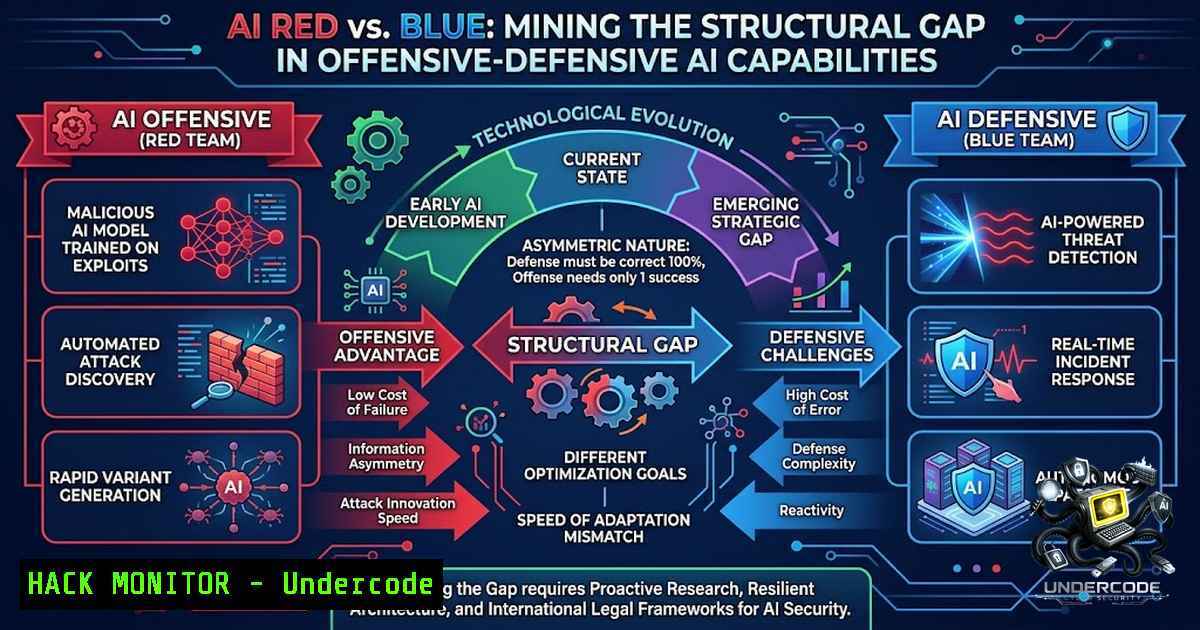
As artificial intelligence increasingly permeates cybersecurity operations, a troubling paradox has emerged: AI systems are proving significantly more effective at offensive hacking than at defensive protection. This capability disparity isn’t accidental—it’s structural, rooted in how training data is gathered and scored. Dreadnode AI Research Scientist Martin Wendiggensen’s upcoming keynote at CrowdStrike’s Day Zero Threat Research Summit (August 31, Virgin Hotel Las Vegas) proposes a novel solution: pitting AI red team and blue team agents against each other on simulated corporate networks to generate training data that can close this gap.
Learning Objectives & Secrets:
- Objective 1: Understand the Structural AI Capability Gap — Learn why current AI training methodologies favor offensive over defensive postures and how this imbalance creates systemic vulnerability in AI-powered security stacks.
- Objective 2 Secret Tip: Synthetic Adversarial Training — Instead of relying solely on static datasets, deploy AI agents in competitive simulations where red and blue teams generate dynamic, realistic training data that captures the full spectrum of attack and defense.
- Objective 3 Secret Tip: Scale Through Simulation — Use simulated corporate network environments to impose realistic constraints on AI agents, forcing them to operate under the same limitations as human analysts—bandwidth, latency, access controls, and detection evasion—producing more robust and deployable models.
You Should Know:
1. Setting Up an AI Red-Team Simulation Environment
To replicate the Dreadnode methodology, you need a controlled environment where AI agents can interact with a realistic network topology. This involves deploying containerized network segments, vulnerable services, and monitoring infrastructure.
Step-by-step guide:
- Step 1: Deploy a virtual network using Docker Compose. Create a `docker-compose.yml` file defining a target network with services (e.g., an Apache server, a PostgreSQL database, and an internal DNS). Use bridge networking to simulate segmentation.
- Step 2: Install and configure a SIEM or logging stack (e.g., Elasticsearch, Logstash, Kibana—ELK) to capture all agent actions. This provides the training data feedback loop.
- Step 3: Set up an OpenAI Gym or similar reinforcement learning environment wrapper around your network. Define observation spaces (logs, packet captures) and action spaces (commands, exploits).
- Step 4: Launch two agent instances—one red (offensive) and one blue (defensive). The red agent’s reward function is based on successful compromise; the blue agent’s reward is based on detection and prevention.
- Step 5: Run iterative simulations, logging all interactions. After each episode, use the logs to update both agents’ policies using algorithms like Proximal Policy Optimization (PPO) or Deep Q-1etworks (DQN).
Linux Commands for Environment Setup:
 Create Docker network
docker network create --driver bridge --subnet=172.20.0.0/16 ai_sim_net

Deploy vulnerable target
docker run -d --1ame vuln_web --1etwork ai_sim_net -p 8080:80 vulnerables/web-dvwa

Deploy ELK stack for logging
docker run -d --1ame elasticsearch --1etwork ai_sim_net elasticsearch:7.17.0
docker run -d --1ame logstash --1etwork ai_sim_net -v ./logstash.conf:/usr/share/logstash/pipeline/logstash.conf logstash:7.17.0
docker run -d --1ame kibana --1etwork ai_sim_net -p 5601:5601 kibana:7.17.0
2. Generating Training Data Through Competitive AI Agents
The core innovation is using competition to generate labeled training data. Each simulation round produces a dataset where red actions are mapped to blue responses, creating a rich, bidirectional corpus.
Step-by-step guide:
- Step 1: Define a scoring rubric. Red scores +10 for each service compromised, -5 for each detection. Blue scores +10 for each threat neutralized, -5 for each missed alert.
- Step 2: Implement a replay buffer that stores state-action-reward tuples for both agents. This becomes your raw training data.
- Step 3: After 1,000 episodes, extract the replay buffer and label each red action with the subsequent blue response (detected/undetected, mitigated/not mitigated).
- Step 4: Use this labeled data to fine-tune a separate “supervisor” AI that can predict blue-team detection rates given a red-team action—effectively mining the capability gap.
Python Snippet for Data Collection:
import numpy as np
from collections import deque

class ReplayBuffer:
def <strong>init</strong>(self, capacity=100000):
self.buffer = deque(maxlen=capacity)

def push(self, red_state, red_action, blue_state, blue_action, reward, done):
self.buffer.append((red_state, red_action, blue_state, blue_action, reward, done))

def sample(self, batch_size):
idx = np.random.choice(len(self.buffer), batch_size, replace=False)
return [self.buffer[bash] for i in idx]

def save_to_csv(self, filename="training_data.csv"):
import csv
with open(filename, 'w', newline='') as f:
writer = csv.writer(f)
writer.writerow(["red_state", "red_action", "blue_state", "blue_action", "reward", "done"])
writer.writerows(self.buffer)
3. Imposing Realistic Constraints on AI Agents
Real-world defenders face constraints—limited compute, network latency, incomplete visibility. Training AI without these constraints produces brittle models that fail in production.
Step-by-step guide:
- Step 1: In your simulation environment, inject artificial latency (e.g., 50–200ms) between agent actions and network responses using `tc` (traffic control) on Linux.
- Step 2: Limit the blue agent’s observation window—simulate SIEM log delays by only providing logs with a 5-second lag.
- Step 3: Restrict compute budgets for both agents (e.g., limit CPU and memory usage via Docker `–cpus` and `–memory` flags).
- Step 4: Introduce “noise” into the observation space—random false positives in logs, packet drops, or incomplete PCAP data.
- Step 5: Retrain agents under these constraints. The resulting models will be more resilient and deployable in real-world environments.
Linux Commands for Constraint Injection:
 Add 100ms latency to Docker bridge network
tc qdisc add dev docker0 root netem delay 100ms

Limit container resources
docker update --cpus=0.5 --memory=512m vuln_web

Simulate log delay (example using iptables to drop and replay packets)
iptables -A INPUT -p tcp --dport 5000 -m statistic --mode random --probability 0.1 -j DROP
4. API Security Hardening for AI Agent Communication
AI agents often communicate via APIs. Securing these channels is critical to prevent tampering with training data or agent policies.
Step-by-step guide:
- Step 1: Implement mutual TLS (mTLS) between all agent endpoints. Generate client and server certificates using OpenSSL.
- Step 2: Use API gateways (e.g., Kong or NGINX) to rate-limit and authenticate all agent requests.
- Step 3: Encrypt all training data at rest and in transit using AES-256-GCM.
- Step 4: Implement strict input validation on all API endpoints to prevent injection attacks that could corrupt the training pipeline.
- Step 5: Regularly rotate API keys and certificates using a secrets management tool like HashiCorp Vault.
OpenSSL Commands for mTLS:
 Generate CA key and certificate
openssl req -1ew -x509 -days 365 -keyout ca.key -out ca.crt

Generate server key and CSR
openssl genrsa -out server.key 2048
openssl req -1ew -key server.key -out server.csr

Sign server certificate with CA
openssl x509 -req -in server.csr -CA ca.crt -CAkey ca.key -CAcreateserial -out server.crt -days 365
5. Cloud Hardening for Scalable AI Training
Scaling AI agent simulations requires cloud infrastructure. Hardening this environment is essential to prevent data exfiltration or model poisoning.
Step-by-step guide:
- Step 1: Deploy agents in isolated VPCs with strict security group rules (only allow necessary ports).
- Step 2: Use AWS IAM or Azure AD with least-privilege policies for all service accounts.
- Step 3: Enable VPC Flow Logs and CloudTrail to monitor all network and API activity.
- Step 4: Implement automated secrets rotation using AWS Secrets Manager or Azure Key Vault.
- Step 5: Use infrastructure-as-code (Terraform) to version and audit all cloud configurations.
Terraform Snippet for AWS VPC Hardening:
resource "aws_security_group" "agent_sg" {
name = "agent_security_group"
description = "Allow limited traffic for AI agents"
vpc_id = aws_vpc.main.id

ingress {
from_port = 443
to_port = 443
protocol = "tcp"
cidr_blocks = ["10.0.1.0/24"]  Only internal subnet
}

egress {
from_port = 0
to_port = 0
protocol = "-1"
cidr_blocks = ["0.0.0.0/0"]
}
}

resource "aws_iam_role" "agent_role" {
name = "agent_iam_role"
assume_role_policy = jsonencode({
Version = "2012-10-17"
Statement = [
{
Action = "sts:AssumeRole"
Effect = "Allow"
Principal = {
Service = "ec2.amazonaws.com"
}
}
]
})
}
- Vulnerability Exploitation and Mitigation in AI Training Pipelines
The AI training pipeline itself is a target. Attackers could poison training data or manipulate reward functions.
Step-by-step guide:
- Step 1: Implement data provenance tracking—each training sample should have a cryptographic hash and metadata recording its source and timestamp.
- Step 2: Use anomaly detection on the training data stream to identify outliers or poisoning attempts (e.g., sudden shifts in action distributions).
- Step 3: Regularly validate model performance against a hold-out “golden” dataset that is air-gapped and never exposed to the training pipeline.
- Step 4: Implement differential privacy mechanisms to prevent reconstruction attacks on training data.
- Step 5: Conduct red-team exercises specifically targeting the training infrastructure—not just the simulated network.
Python Code for Data Provenance:
import hashlib
import json
from datetime import datetime

def create_provenance_record(data, source):
record = {
"data": data,
"source": source,
"timestamp": datetime.utcnow().isoformat(),
"hash": hashlib.sha256(json.dumps(data).encode()).hexdigest()
}
return record

Example usage
sample = {"red_action": "sql_injection", "blue_response": "detected"}
provenance = create_provenance_record(sample, "simulation_episode_42")
print(provenance)
What Undercode Say:
- Key Takeaway 1: The offensive-defensive AI gap is not an inherent flaw but a data problem—synthetic competition between red and blue agents can systematically mine and remediate this structural weakness.
- Key Takeaway 2: Realistic constraints (latency, incomplete visibility, compute limits) are not obstacles but essential training parameters that produce production-ready AI defenders.
The Dreadnode approach represents a paradigm shift from static, manually labeled datasets to dynamic, adversarial-generated training data. By framing the capability gap as a research question rather than a fatal flaw, organizations can systematically improve AI defensive postures at scale. This methodology also exposes a critical vulnerability: if attackers can manipulate the simulation environment or training data, they could potentially “teach” blue-team AI to be less effective. Therefore, securing the training pipeline is as important as securing the production environment. The CrowdStrike Day Zero Summit on August 31 will likely reveal more technical details, but the core insight—that competition generates better data than curation—is already reshaping how we think about AI security. Organizations should begin experimenting with small-scale adversarial simulations immediately, even if only on isolated test networks, to build institutional knowledge before scaling.
Prediction:
- +1 Democratization of AI Red-Teaming: Open-source frameworks for AI-vs-AI simulations will emerge within 12–18 months, lowering the barrier to entry for smaller security teams and fostering community-driven training datasets.
- +1 Shift in AI Procurement: Enterprises will begin requiring vendors to demonstrate adversarial training provenance—proof that models were tested against dynamic red-team agents, not just static benchmarks.
- -1 New Attack Surface: As AI training pipelines become more complex, they will become prime targets for supply-chain attacks. Expect an increase in “training data poisoning” and “reward hacking” incidents targeting these systems.
- -1 Regulatory Scrutiny: The use of autonomous AI agents in cybersecurity will attract regulatory attention, particularly around accountability and explainability. Organizations may face compliance challenges if they cannot audit AI decision-making.
- +1 Accelerated Defensive Capabilities: Within 3–5 years, AI defenders trained via competitive simulation will outperform human analysts in pattern recognition and threat response, enabling a new era of “always-on” autonomous protection.
▶️ Related Video (84% Match):
🎯Let’s Practice For Free:
🎓 Live Courses & Certifications:
Join Undercode Academy for Verified Certifications
🚀 Request a Custom Project:
Secure, high-velocity infrastructure and disruptive technological engineering. Contact our engineering team for high-tier development and proprietary systems:
[email protected]
💎 Smart Architecture | 🛡️ Secure by Design | ⭐ Trusted by Thousands
IT/Security Reporter URL:
Reported By: https://lnkd.in/p/eE6PgGxh – Hackers Feeds
Extra Hub: Undercode MoN
Basic Verification: Pass ✅


