Listen to this Post
Introduction
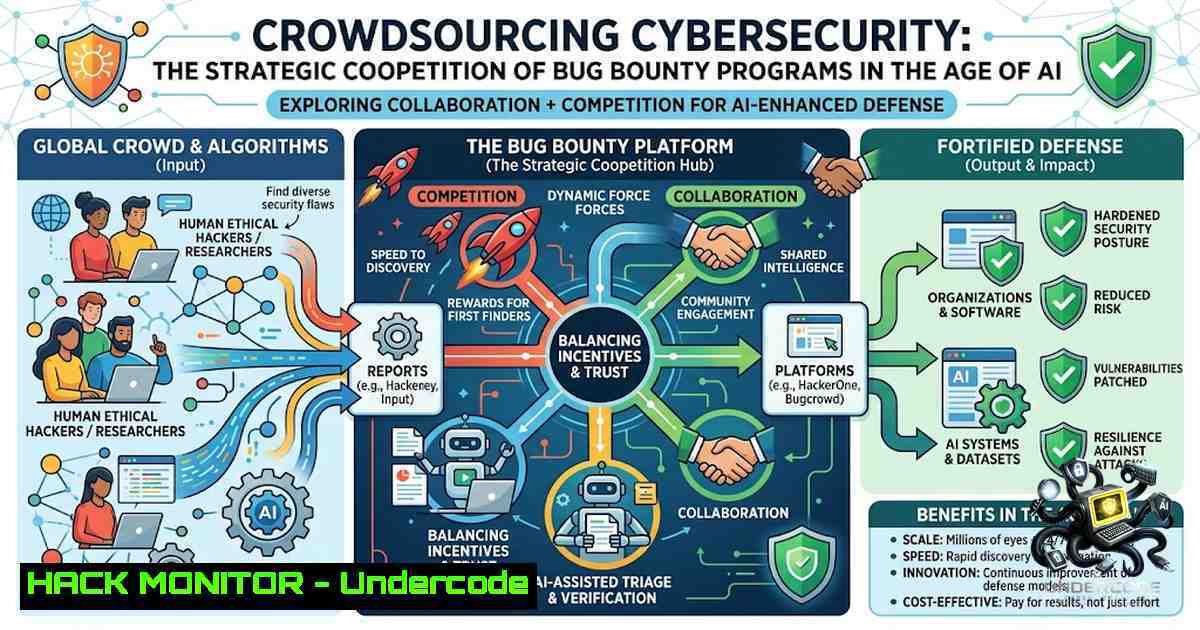
In the perpetual arms race between defenders and attackers, organizations have discovered a counterintuitive strategy: pay your potential enemies to find your weaknesses. Bug bounty programs (BBPs) represent a fundamental shift in cybersecurity governance—transforming adversarial relationships into structured “coopetition” where ethical hackers are incentivized to disclose vulnerabilities rather than exploit them. Yet as AI-powered vulnerability detection tools like Anthropic’s Mythos demonstrate unprecedented capability in identifying software flaws—scanning over 1,000 open-source projects and surfacing 6,202 high-severity bugs—a critical question emerges: Will artificial intelligence render human-powered bug hunting obsolete? The answer, according to new research published in Management Science, is a resounding “no”—but for reasons that challenge conventional wisdom about both AI and human expertise.
Learning Objectives
- Understand the strategic and economic framework of bug bounty programs as a governance mechanism for “coopetitive” relationships with hackers
- Analyze the empirical evidence on how crowd incentives create inter-group spillovers and affect core developer contributions
- Evaluate the complementary role of AI-powered vulnerability detection versus human-driven bug bounty programs
- Master practical reconnaissance, API testing, and report-writing techniques for participating in modern bug bounty programs
- Apply Linux and Windows commands for vulnerability discovery and validation in bounty-eligible targets
- The Strategic Coopetition Framework: Why Paying Hackers Works
At its core, a bug bounty program is not merely a vulnerability discovery mechanism—it is a strategic instrument for attack diversion. The analytical framework developed by Zhou and Hui (2020) reveals that BBPs induce hackers to self-select into cooperative vulnerability discovery, effectively diverting them away from adversarial actions. This “protection delegation” transfers part of the security burden to the very individuals who might otherwise pose the greatest threat.
The model yields several counterintuitive insights. First, BBPs can be economically beneficial even when participating hackers are inefficient at vulnerability identification—yet paradoxically, more participants can make the program less attractive to firms. Second, while BBPs improve overall security posture, they may inadvertently encourage competitive hackers to exert more effort, creating a complex dynamic where rewards must be carefully calibrated. Third, common cybersecurity regulations such as breach penalties and bounty reward subsidies may exacerbate inefficiency rather than resolve it. The research identifies complementarity between bounty subsidies and breach penalties, suggesting that customized, firm-specific approaches to BBP governance outperform one-size-fits-all regulatory frameworks.
Practical Implementation: Setting Up a Bug Bounty Program
For organizations considering a BBP, the following Linux-based reconnaissance commands can help establish baseline security posture before launching:
 Comprehensive subdomain enumeration
subfinder -d target.com -silent | tee subdomains.txt

Active subdomain resolution and HTTP probing
cat subdomains.txt | httpx -silent -status-code -title -tech-detect | tee live_hosts.txt

Port scanning for exposed services
nmap -iL live_hosts.txt -p- --min-rate 10000 -oA full_port_scan

Vulnerability scanning with nuclei
nuclei -l live_hosts.txt -t cves/ -severity critical,high -o critical_vulns.txt
For Windows environments, equivalent PowerShell commands enable initial assessment:
 Test-1etConnection for port scanning
1..1024 | ForEach-Object { Test-1etConnection target.com -Port $_ -WarningAction SilentlyContinue }

Resolve DNS records
Resolve-DnsName target.com -Type A | Select-Object IPAddress

Basic web request enumeration
Invoke-WebRequest -Uri "https://target.com" -Method Head | Select-Object StatusCode, Headers
2. The Unintended Consequence: When Crowd Incentives Backfire
The second paper in the Management Science publication pair examines a troubling empirical finding: incentivizing crowd contributions to digital public goods can produce negative inter-group spillovers. Using the Internet Bug Bounty program targeting Python as a natural experiment, researchers documented that paying crowd contributors for vulnerability reports reduced Python core developers’ bug reports by 48% and enhancement reports by 38%.
The mechanism behind this decline is reduced inter-task learning—the phenomenon where routine problem-solving on one task fosters knowledge that drives broader improvement and innovation across related tasks. When monetary incentives displace intrinsic motivation and the organic learning that comes from hands-on problem-solving, core contributors disengage from both incentivized and non-incentivized work. This finding carries profound implications for organizations considering bounties for open-source security: short-term efficiency gains in vulnerability discovery may erode the human capability and productivity that sustains long-term software quality.
Step-by-Step Guide: Measuring BBP Impact on Internal Contributions
To assess whether a bounty program is affecting internal developer productivity, security teams can implement the following monitoring approach:
- Establish baseline metrics for internal bug reports, enhancement requests, and code commits (minimum 6-month pre-program data)
2. Track contribution velocity using version control analytics:
 Git commit frequency analysis
git log --since="6 months ago" --pretty=format:"%ad" --date=short | sort | uniq -c

Identify high-contribution periods
git shortlog -sn --since="6 months ago"

Bug report trends in issue tracker (GitHub CLI example)
gh issue list --state all --label "bug" --json createdAt,comments
3. Segment contributors by tenure, expertise level, and historical contribution patterns
4. Monitor cross-task spillovers—specifically, whether reductions in bug reporting correlate with declines in enhancement or documentation work
5. Conduct regular contributor surveys to assess motivation, satisfaction, and perceived value of the bounty program
- The AI Disruption: Mythos and the New Vulnerability Landscape
Anthropic’s Mythos represents a quantum leap in AI-powered vulnerability detection. Independent benchmarking by XBOW confirms that Mythos Preview “presents a significant step up over all existing models, regardless of provider,” demonstrating exceptional capability in source code audits, reverse engineering, and native-code analysis. In real-world testing, Mythos scanned over 1,000 open-source projects, identified 6,202 high or critical severity bugs, and passed 28% of findings (1,752 bugs) to independent security research firms for review. The confirmed false positive rate of 9.4%—while not high by industry standards—still represents significant noise that requires human triage.
However, Mythos exhibits critical limitations. XBOW’s testing revealed that while the model excels at finding problems in “live + source” environments, it performs less effectively against source code alone. The model sometimes rejected true positives when evidence did not formally satisfy its criteria, and it requires precise prompts for optimal results. Moreover, Mythos is computationally expensive—projected to cost five times more than Anthropic’s Opus model—raising questions about cost-effectiveness compared to giving cheaper models more processing time.
Practical Commands: Integrating AI-Assisted Vulnerability Discovery
Security researchers can supplement AI findings with manual validation using these techniques:
 Extract and analyze code patterns from AI-discovered candidates
grep -rni "strcpy|gets|printf" --include=".c" --include=".cpp" .

Static analysis with open-source tools
semgrep --config auto ./src

Dynamic analysis with strace for suspicious binaries
strace -f -e trace=network,file ./suspicious_binary 2>&1 | tee strace.log

Memory corruption detection with Valgrind
valgrind --leak-check=full --show-leak-kinds=all ./target_program
4. AI and BBPs: Complementarity, Not Obsolescence
Despite Mythos’s impressive capabilities, Anthropic continues to operate its own bug bounty program—a decision that validates Zhou’s prediction that AI will not render BBPs obsolete. The reason lies in the fundamental distinction between vulnerability discovery and vulnerability governance. AI can identify potential weaknesses at scale, but it cannot perform the critical function of attack diversion—incentivizing hackers to report rather than misuse the vulnerabilities they find.
The rise of AI-generated vulnerability reports has created new challenges for bounty programs. HackerOne reported a 210% increase in valid AI-related vulnerability reports and a 339% jump in total bounties paid for AI vulnerabilities. However, this surge has also triggered a flood of “AI slop”—low-quality, automated, or erroneous submissions that security teams must sift through. Bug bounty platforms are now dealing with a wave of AI-generated submissions characterized by thin evidence, templated language, and minimal meaningful validation.
This dynamic creates a new specialization opportunity: human researchers who can effectively validate, contextualize, and chain AI-discovered vulnerabilities into exploitable proof-of-concepts. Cloudflare demonstrated this by using Mythos to combine low-severity flaws into more serious exploits across 50+ repositories—a capability that requires human reasoning and creative synthesis that AI alone cannot replicate.
Step-by-Step Guide: Validating AI-Discovered Vulnerabilities
1. Reproduce the finding in a controlled environment:
 Docker-based isolated testing
docker run -it --rm vulnerable_image:latest /bin/bash

Capture network traffic during reproduction
tcpdump -i any -w reproduction.pcap
2. Chain vulnerabilities by identifying dependencies and potential privilege escalation paths
3. Develop proof-of-concept code that demonstrates impact:
 Example: Simple PoC template for authenticated API abuse
import requests
session = requests.Session()
session.headers.update({"Authorization": "Bearer <token>"})
response = session.get("https://target.com/api/sensitive-endpoint")
4. Document the full attack chain with screenshots, logs, and step-by-step reproduction instructions
5. Submit detailed report following platform-specific templates (e.g., HackerOne standards)
- Cloud Hardening and API Security in Bounty-Ready Environments
Modern bug bounty programs increasingly target cloud-1ative applications and APIs. Security researchers must master both offensive and defensive cloud security techniques to identify valid vulnerabilities.
Linux Commands for Cloud Infrastructure Assessment:
 Enumerate AWS S3 buckets (publicly accessible)
aws s3 ls --1o-sign-request

Check for open Kubernetes API servers
kubectl cluster-info --insecure-skip-tls-verify

Scan for exposed cloud storage
bucket_finder -d target.com

Test for misconfigured cloud permissions
cloudfox aws --profile target -v
Windows PowerShell for Azure Assessment:
 Enumerate Azure resources
Get-AzResource | Select-Object ResourceType, Name

Check storage account permissions
Get-AzStorageAccount | Get-AzStorageContainer

Test for publicly accessible blobs
Get-AzStorageBlob -Container "public" -Context $ctx | Select-Object Name, AccessTier
API Security Testing Commands:
 Fuzz API endpoints for parameter injection
ffuf -u https://target.com/api/v1/users/FUZZ -w /usr/share/wordlists/dirb/common.txt

Test for IDOR vulnerabilities
for i in {1..1000}; do curl -s "https://target.com/api/user/$i" | grep -i "email|password"; done

Automated API scanning with Postman/Newman
newman run api_collection.json --environment test_env.json --reporters cli
6. The Human Element: Why Skills Erosion Matters
The most profound implication of Zhou’s research concerns the erosion of human capability when AI substitutes for complex knowledge work. Two years ago, a SCMP article connected these findings to AI’s increasing role in replacing cognitive labor: while AI can substitute much complex human knowledge work in the short term, the efficiency gains may erode humans’ learning of necessary skills, potentially affecting capability and productivity in related tasks.
This insight has direct relevance to cybersecurity training. Organizations that rely exclusively on AI-powered scanning tools risk developing security teams that cannot independently reason about vulnerabilities, understand attack chains, or creatively identify novel threat vectors. The Python core developer data provides a cautionary tale: when monetary incentives displace organic learning, both immediate productivity and long-term capability suffer.
Step-by-Step Guide: Building Human Security Capability Alongside AI
- Implement structured training programs that require manual vulnerability discovery before allowing AI assistance
- Create “capture the flag” (CTF) exercises that simulate real-world bounty scenarios
- Encourage cross-training between security, development, and operations teams
- Document lessons learned from both successful and failed bounty submissions
5. Measure learning outcomes through periodic skill assessments
What Undercode Say
- Attack diversion is the killer feature of bug bounty programs. Organizations don’t just pay for vulnerability discovery—they pay to transform potential adversaries into allies. This governance function cannot be automated by AI, as it depends on human incentives, trust, and behavioral economics.
-
Incentives can backfire spectacularly. The 48% reduction in Python core developer bug reports demonstrates that paying for crowd contributions can inadvertently demotivate the very experts whose intrinsic motivation drives open-source innovation. Organizations must carefully calibrate bounty programs to avoid crowding out internal expertise.
Analysis: The research fundamentally reframes how we understand cybersecurity crowdsourcing. Rather than viewing BBPs as simple procurement mechanisms for vulnerability information, we must recognize them as complex socio-technical systems that shape hacker behavior, developer motivation, and organizational security culture. The finding that AI tools like Mythos—despite their impressive capabilities—cannot replace the attack diversion function of BBPs highlights a deeper truth: cybersecurity is ultimately a human challenge, not merely a technical one. The most effective defenses combine AI-powered scanning with human judgment, creative reasoning, and the strategic alignment of incentives. Organizations that treat bug bounties as purely technical exercises miss the governance dimension that makes them truly valuable. Conversely, those who understand the coopetitive dynamics can design programs that simultaneously improve security, reduce adversarial behavior, and maintain healthy internal developer communities.
Prediction
- +1 Bug bounty programs will evolve to explicitly incorporate AI validation layers, where human researchers use AI tools as force multipliers while maintaining ultimate responsibility for vulnerability validation and reporting.
-
-1 The flood of AI-generated “slop” submissions will force some bounty platforms to implement stricter submission requirements, potentially reducing accessibility for legitimate researchers without AI resources.
-
+1 Specialized roles will emerge for “AI vulnerability chainers”—security professionals who can combine multiple low-severity AI-discovered flaws into critical exploits, creating new career paths in offensive security.
-
-1 Organizations that over-rely on AI vulnerability scanning without maintaining human expertise will experience long-term capability erosion, mirroring the Python core developer effect documented in Zhou’s research.
-
+1 Regulatory frameworks will increasingly recognize the governance function of BBPs, potentially offering liability protections for organizations that maintain good-faith bounty programs with transparent disclosure policies.
-
-1 The cost differential between AI-powered scanning and human researcher bounties may drive some organizations to reduce bounty rewards, potentially undermining the attack diversion effect and increasing adversarial behavior.
-
+1 Open-source projects will adopt hybrid models that combine AI-assisted scanning with carefully structured bounty programs designed to preserve core contributor motivation and learning.
▶️ Related Video (80% Match):
https://www.youtube.com/watch?v=3dqDBWCRtHE
🎯Let’s Practice For Free:
🎓 Live Courses & Certifications:
Join Undercode Academy for Verified Certifications
🚀 Request a Custom Project:
Secure, high-velocity infrastructure and disruptive technological engineering. Contact our engineering team for high-tier development and proprietary systems:
[email protected]
💎 Smart Architecture | 🛡️ Secure by Design | ⭐ Trusted by Thousands
IT/Security Reporter URL:
Reported By: Jiali Zhou – Hackers Feeds
Extra Hub: Undercode MoN
Basic Verification: Pass ✅


