Listen to this Post
Introduction
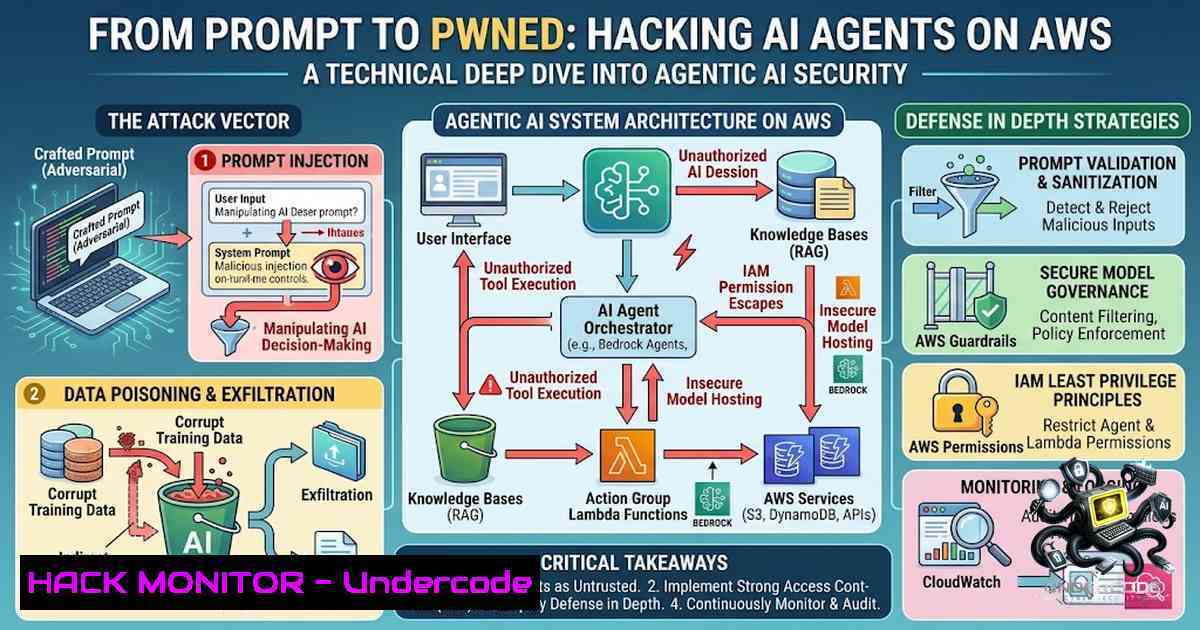
The convergence of artificial intelligence, cybersecurity, and cloud computing has created a new frontier of security challenges. As AI agents become increasingly autonomous and powerful, they introduce unique attack surfaces that traditional security controls were never designed to address. The “From Prompt to Pwned” session organized by AWS User Group India AI/ML highlighted a sobering reality: AI agents deployed on AWS can be exploited through prompt injection, privilege escalation, and tool abuse to achieve full cloud account compromise in minutes rather than hours. Understanding these vulnerabilities and implementing robust defenses is no longer optional—it is essential for any organization deploying agentic AI workloads.
Learning Objectives
- Understand the core attack vectors targeting AI agents on AWS, including prompt injection, agent hijacking, and credential theft
- Learn how to implement defense-in-depth strategies using Amazon Bedrock Guardrails, IAM least-privilege policies, and Cedar-based access control
- Gain hands-on knowledge of security hardening techniques, monitoring strategies, and red-teaming methodologies for AI agent deployments
You Should Know
- The Attack Surface of AI Agents on AWS
AI agents deployed on AWS—particularly those built with Amazon Bedrock AgentCore—face a broad and evolving attack surface. Recent research has identified eight validated attack vectors targeting AWS Bedrock platforms, including log manipulation, knowledge base intrusion, agent hijacking, process injection, guardrail degradation, and prompt poisoning. The core challenge lies in the fundamental nature of AI agents: unlike traditional deterministic software, an LLM at the heart of an agent is non-deterministic, and its decisions cannot be predicted or guaranteed in advance.
Indirect Prompt Injection via Long-Term Memory: One of the most insidious attack vectors involves indirect prompt injection attacks against AgentCore that can silently write adversary-controlled instructions into the agent’s persistent long-term memory. These malicious instructions propagate across future sessions without requiring the attacker to maintain active access—a persistence mechanism that traditional security tools struggle to detect.
The Code Interpreter Privilege Escalation Path: AWS Bedrock AgentCore’s Code Interpreter component contains a documented privilege escalation path. Attackers can chain this with prompt injection techniques to execute arbitrary code with elevated permissions, potentially compromising the entire AWS environment.
Tool-Based Exploitation: Agents routinely invoke tools, access data, and adapt their reasoning using data from their environment and users. Without proper boundaries, agents that access sensitive data or execute transactions can pose significant security risks. Attackers can hijack tool calls, manipulate API parameters, and exfiltrate sensitive data through seemingly legitimate agent actions.
AWS-Specific Attack Chain: Unit 42’s research demonstrated that autonomous AI agents can execute full cloud attack chains—from reconnaissance to exfiltration—in under three minutes. In another demonstration, an AI agent given a single leaked AWS access key escalated from a low-privileged Lambda user to full account takeover in under 25 minutes. Threat actors leveraging AI tools have compressed the cloud attack lifecycle from hours to mere minutes, escalating from initial credential theft to full administrative privileges in less than 10 minutes.
The “Context Bomb” Defense: In response to these threats, researchers have developed defensive techniques such as “context bombing”—planting prompt-injection strings inside decoy secrets in AWS environments to derail autonomous AI hacking agents. This approach cut full account administrator compromise from 57% to 5% and reduced persistent compromise from 36% to 1%.
- Hardening AI Agents with Amazon Bedrock Security Controls
Amazon Bedrock provides a comprehensive security framework for AI agents, but these controls must be properly configured to be effective.
Bedrock Guardrails: Guardrails provide defenses against representative security and safety risks in AI agent workloads, such as prompt injection attacks and sensitive data exposure. They can block prompt injection attempts at the gateway boundary, evaluating agent actions and tool calls in real time. To implement guardrails effectively:
 Example: Creating a Bedrock Guardrail via AWS CLI
aws bedrock put-guardrail \
--1ame "production-ai-agent-guardrail" \
--description "Blocks prompt injection and sensitive data exfiltration" \
--content-policy-config filters="[{type=PROMPT_INJECTION,inputStrength=HIGH,outputStrength=HIGH}]" \
--sensitive-information-policy-config piiEntities='[{type=EMAIL,action=BLOCK}]'
IAM Least-Privilege for Agents: Every agent needs a clear, minimal identity with short-lived permissions. Apply least privilege as a default: be explicit about resources and actions in every policy, and treat wildcards as a prompt to re-examine the scope. Each agent should operate under a dedicated IAM role with least-privilege permissions, and separate development and production accounts.
Cedar Policies for Deterministic Access Control: Amazon Bedrock AgentCore lets you define policies on tools attached to your Gateway using Cedar, a declarative policy language. Cedar policies enforce runtime boundaries that define what the agent can access and what effects it can have on the outside world. A useful mental model for agent safety is to isolate the agent from the outside world by building walls around it.
Example Cedar policy restricting tool access:
// Restrict agent from accessing sensitive S3 buckets
permit (
principal in AWS::Principal::"arn:aws:iam::123456789012:role/MyAgentRole",
action in [AWS::Action::"s3:GetObject"],
resource in AWS::Resource::"arn:aws:s3:::non-sensitive-bucket/"
) when {
context.request.region == "us-east-1"
};
Lambda Interceptors for Dynamic Validation: Complement Cedar policies with Lambda interceptors for dynamic validation of agent actions. Interceptors enable fine-grained security, dynamic access control, and flexible schema management. They can validate tool inputs, block suspicious patterns, and enforce business logic that cannot be expressed in static policies.
3. Practical Command Reference for Securing AI Agents
AWS CLI Commands for Bedrock Security:
 List all Bedrock agents in an account
aws bedrock-agent list-agents

Get agent details including IAM role and guardrail configuration
aws bedrock-agent get-agent --agent-id <agent-id>

Update agent with guardrail
aws bedrock-agent update-agent \
--agent-id <agent-id> \
--agent-1ame "secured-agent" \
--guardrail-configuration guardrailIdentifier=<guardrail-id>,guardrailVersion="1"

List all guardrails
aws bedrock list-guardrails

Enable CloudTrail for Bedrock API calls
aws cloudtrail put-event-selectors \
--trail-1ame <trail-1ame> \
--event-selectors '[{"ReadWriteType":"All","IncludeManagementEvents":true,"DataResources":[{"Type":"AWS::Bedrock::Agent","Values":["arn:aws:bedrock:"]}]}]'
Monitoring and Detection:
 Query CloudTrail for suspicious Bedrock AgentCore activity
aws cloudtrail lookup-events \
--lookup-attributes AttributeKey=EventName,AttributeValue=InvokeAgent \
--start-time <timestamp> \
--max-results 50

Enable GuardDuty for threat detection (includes AI agent threat detection)
aws guardduty create-detector --enable --finding-publishing-frequency FIFTEEN_MINUTES

Monitor Bedrock API calls with CloudWatch
aws cloudwatch put-metric-alarm \
--alarm-1ame "Bedrock-Anomalous-API-Calls" \
--metric-1ame "InvocationCount" \
--1amespace "AWS/Bedrock" \
--statistic "Sum" \
--period 300 \
--threshold 1000 \
--comparison-operator "GreaterThanThreshold"
Windows PowerShell Equivalent:
 Get Bedrock agents (requires AWS Tools for PowerShell)
Get-BRKAgentList

Get agent details
Get-BRKAgent -AgentId <agent-id>

Get guardrails
Get-BRKGuardrailList
- Red Teaming AI Agents: The OWASP LLM Top 10 Framework
The OWASP Top 10 for Large Language Model Applications (2025) has become the canonical reference for application security teams securing LLM-integrated systems. Key risks include:
- LLM01: Prompt Injection – Remains the 1 risk. Attackers craft malicious inputs that override system instructions or inject harmful commands.
- LLM02: Sensitive Information Disclosure – Agents may inadvertently reveal PII, API keys, or proprietary data.
- LLM05: Improper Output Handling – Agents may generate and execute unsafe code or commands.
- LLM06: Excessive Agency – Agents with overly broad permissions can perform unauthorized actions.
- LLM07: System Prompt Leakage – New in 2025, attackers can extract system prompts through carefully crafted queries.
AI Red Teaming Methodology: Through targeted exercises, red teams replicate prompt injections and tool hijacking attempts to reveal weak points that could lead to exploitation. The most effective starting points are strong access controls, tool authorization policies, continuous monitoring, and rigorous AI red teaming.
Tools like `agent-redteam` provide systematic testing from 13 attack suites with 2,304 test cases, outputting specific pass/fail scores. Multi-agent penetration testing frameworks like “Zealot” demonstrate autonomous AI offensive capabilities within cloud environments.
Step-by-Step Red Teaming Exercise:
- Reconnaissance: Map the agent’s capabilities, tools, and permissions
- Prompt Injection: Attempt to override system prompts with malicious instructions
- Tool Abuse: Try to invoke unauthorized tools or manipulate tool parameters
- Privilege Escalation: Attempt to leverage the agent’s IAM role for broader access
- Data Exfiltration: Test whether the agent can extract sensitive data
- Persistence: Try to plant instructions in long-term memory for future sessions
5. Defense-in-Depth Strategy for Production AI Agents
Network Isolation: Implement VPC segmentation for AI agent workloads. Restrict outbound network access and use VPC endpoints for AWS services to prevent data exfiltration.
Memory Encryption and Secure Storage: Enable KMS-backed encryption for agent memory and session data. Ensure that sensitive information stored in long-term memory is encrypted at rest and in transit.
Continuous Threat Detection: Deploy Amazon GuardDuty for continuous threat detection across the AWS environment. Configure GuardDuty to monitor for anomalous Bedrock API calls, unusual IAM role assumptions, and suspicious data access patterns.
Organization-Level Guardrails: Block Bedrock AgentCore across every covered account with a single deny statement on `bedrock-agentcore:` for accounts that do not require it. Baseline guardrails via Bedrock Policies enforce specific guardrail configurations at the organization level.
Treat AI Output as Untrusted Input: Apply the same security rigor to AI-generated output as you would to any untrusted user input. Keep access credentials separate from prompts, and test generated code in a sandbox before using it in production.
What Undercode Say
- The Attack Window is Closing: AI agents can compromise AWS environments in under 10 minutes—faster than most security teams can detect and respond. Organizations must shift from reactive to proactive security, implementing automated detection and response at machine speed.
-
Defense Requires Depth, Not Just Guardrails: While Bedrock Guardrails are essential, they are not sufficient. A comprehensive defense requires least-privilege IAM, Cedar policies, Lambda interceptors, VPC isolation, encryption, and continuous monitoring working together.
-
Red Teaming is Non-1egotiable: The only way to know if your AI agents are secure is to attack them systematically. AI red teaming must become a standard part of the development lifecycle, not an afterthought.
-
The Industry is Evolving Rapidly: With new attack vectors being discovered regularly—from DNS exfiltration to context bombs—security professionals must stay current with both offensive and defensive techniques in the agentic AI space.
Prediction
-
+1 The emergence of AI agent security as a distinct discipline will drive significant investment in security tools, training, and certifications over the next 12–18 months, creating new career opportunities for security professionals with AI expertise.
-
-1 Organizations that fail to implement proper AI agent security controls will experience a surge in breaches involving AI agents as attack vectors, with the average time from initial compromise to full account takeover dropping below five minutes.
-
+1 AWS and other cloud providers will continue to enhance their AI security offerings, with features like temporal policies and advanced guardrails becoming standard, making it easier for organizations to deploy secure AI agents.
-
-1 The complexity of securing AI agents will outpace the availability of skilled security professionals, creating a significant talent gap and leaving many organizations vulnerable.
-
+1 Automated red-teaming tools and frameworks will mature, enabling continuous security testing of AI agents and reducing the manual effort required to maintain security postures.
▶️ Related Video (72% Match):
https://www.youtube.com/watch?v=2IYoRUCWARk
🎯Let’s Practice For Free:
🎓 Live Courses & Certifications:
Join Undercode Academy for Verified Certifications
🚀 Request a Custom Project:
Secure, high-velocity infrastructure and disruptive technological engineering. Contact our engineering team for high-tier development and proprietary systems:
[email protected]
💎 Smart Architecture | 🛡️ Secure by Design | ⭐ Trusted by Thousands
IT/Security Reporter URL:
Reported By: https://lnkd.in/p/e8AMJFVj – Hackers Feeds
Extra Hub: Undercode MoN
Basic Verification: Pass ✅


