Listen to this Post
Introduction:
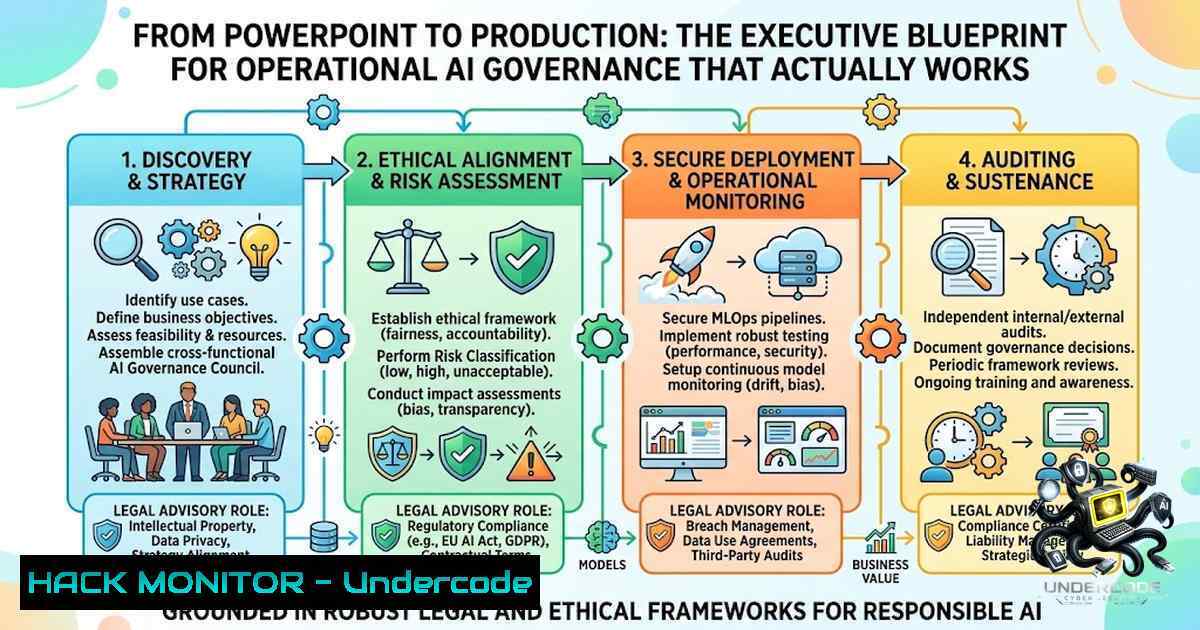
Governance that exists only in slide decks is not governance—it is theater. As organizations rush to deploy artificial intelligence across operations, the gap between strategic AI commitments and operational reality has become the primary source of regulatory, financial, and reputational risk. Recent executive workshops convened by CINTEL – ICT Research and Development Center in Bogotá, bringing together over 40 leaders from Colombian organizations, revealed a clear consensus: executives no longer ask “what is AI governance?” but rather demand a reference model, a practical risk management approach, and an actionable roadmap they can implement immediately. This article translates that demand into a technical, step‑by‑step blueprint for building AI governance that survives contact with production environments.
Learning Objectives:
- Design and implement a multi‑layer AI governance framework aligned with NIST AI RMF and ISO/IEC 42001 standards
- Deploy technical controls—including access restrictions, continuous monitoring, and automated compliance workflows—to secure AI systems throughout their lifecycle
- Build an actionable, risk‑based roadmap that transforms governance from policy documents into operational reality
You Should Know:
- Establishing the Governance Foundation: From Principles to Production Controls
The first mistake organizations make is treating AI governance as a compliance exercise rather than an engineering discipline. Effective governance must begin with clear accountability: appoint a single executive role responsible for AI oversight across security, privacy, legal, and business teams, with both the authority to enforce policy and the mandate to coordinate cross‑functionally. This role becomes the central node for all AI-related decisions.
From there, organizations should adopt a layered governance model that mirrors established IT frameworks. The NIST AI Risk Management Framework (AI RMF) provides a full‑lifecycle structure across four core functions—GOVERN, MAP, MEASURE, and MANAGE—integrating policy, threat modeling, testing, and control deployment. For organizations seeking certifiable standards, ISO/IEC 42001:2023 establishes an AI Management System that defines leadership accountability, lifecycle controls, risk planning, performance monitoring, and continual improvement. These frameworks are not mutually exclusive; together, they enable organizations to implement responsible, compliant, and accountable AI governance that balances innovation with oversight.
Step‑by‑Step Guide:
- Audit existing AI assets: Inventory all AI systems, models, and data pipelines currently in production or development. Document their purpose, data sources, access controls, and decision‑making scope.
- Define governance scope and accountability: Establish a cross‑functional AI governance council with representatives from security, legal, compliance, privacy, and business units. Assign a single accountable executive.
- Select and tailor frameworks: Map NIST AI RMF functions to your organizational structure. For regulated industries, pursue ISO/IEC 42001 certification readiness.
- Develop policy documentation: Create concise, actionable policies covering data stewardship, model development, deployment approval, incident response, and continuous monitoring.
- Establish decision guardrails: Define clear escalation paths for high‑risk AI decisions, including mandatory human review thresholds.
Linux/Windows Command Examples for AI Asset Discovery:
 Linux: Scan for AI/ML model files across systems
find / -type f ( -1ame ".h5" -o -1ame ".pb" -o -1ame ".onnx" -o -1ame ".pth" -o -1ame ".joblib" ) 2>/dev/null | tee ai_asset_inventory.txt

Windows PowerShell: Discover Python ML libraries and model artifacts
Get-ChildItem -Path C:\ -Recurse -ErrorAction SilentlyContinue -Include .h5, .pb, .onnx, .pth, .joblib | Export-Csv -Path ai_asset_inventory.csv

Linux: Identify running AI/ML services
ps aux | grep -E 'tensorflow|torch|keras|transformers|llama|openai' | grep -v grep

Windows: List installed Python packages related to AI
pip list | findstr -i "tensorflow torch keras transformers scikit-learn"
2. Risk Mapping and Organizational Gap Analysis
The workshop participants structured governance models tied to business strategy and mapped organizational gaps. This gap analysis is the critical bridge between principles and practice. Organizations must assess their current AI capabilities against the requirements of their chosen frameworks.
Key gaps typically emerge in four areas: data governance (where data lineage, quality, and privacy controls are insufficient), model transparency (where explainability and documentation are lacking), monitoring (where production AI systems operate without continuous performance and bias tracking), and incident response (where teams lack procedures for AI‑specific failures or security breaches).
Step‑by‑Step Guide:
- Conduct a capability maturity assessment: Evaluate current AI governance practices against NIST AI RMF functions and ISO 42001 requirements. Score each area (e.g., data stewardship, model validation, monitoring, incident response) on a 1–5 maturity scale.
- Identify high‑risk AI use cases: Prioritize systems that make autonomous decisions affecting customers, employees, or regulatory compliance. Map these to specific risk categories (bias, security, privacy, safety).
- Document control gaps: For each risk, document existing controls, missing controls, and the business impact of control failures.
- Develop a remediation plan: Assign owners, timelines, and resources for each identified gap. Prioritize based on risk severity.
- Validate with stakeholders: Present findings to the AI governance council and business leadership for alignment and approval.
Risk Assessment Commands and Tools:
 Linux: Use OWASP ZAP for basic AI API endpoint security scanning
zap-cli quick-scan --self-contained --start-options '-config api.disablekey=true' http://your-ai-api-endpoint

Python: Use the AI Fairness 360 toolkit for bias detection
pip install aif360
 Example: Audit a classifier for disparate impact
python -c "from aif360.datasets import BinaryLabelDataset; from aif360.metrics import ClassificationMetric;  ... load data and compute metrics"

Linux: Monitor AI model drift with Evidently AI
pip install evidently
evidently run --dashboard --workspace drift_monitoring

Windows PowerShell: Check for exposed AI API keys in environment variables
Get-ChildItem Env: | Where-Object { $_.Name -match "API|KEY|SECRET|TOKEN" }
- Technical Controls: Securing AI Systems with a Cybersecurity Mindset
AI systems require the same cybersecurity rigor applied to any critical infrastructure—but with additional layers specific to machine learning. Google DeepMind’s recent “AI Control Roadmap” treats AI agents not merely as software tools but as potential insider threats that could bypass human oversight, exfiltrate data, or quietly sabotage tasks. This paradigm shift demands a multilayered security approach.
Foundational controls include sandboxing (isolating AI execution environments), endpoint security, and prompt injection resistance. More advanced controls involve permission‑based access where AI agents receive permissions based on verified behavior, enabling trust through controlled, incremental access. Organizations should also implement continuous monitoring to detect anomalous AI behavior, and preventive controls that restrict what AI agents can access, which resources they can use, and when human intervention is required before taking sensitive actions.
Step‑by‑Step Guide:
- Implement identity and access management for AI: Apply role‑based access controls (RBAC) to all AI systems and agents. Restrict permissions to the minimum necessary for function.
- Deploy AI‑specific monitoring: Implement logging and alerting for AI model inputs, outputs, performance metrics, and anomalous behavior patterns.
- Establish secure development practices: Integrate security reviews into the AI model development lifecycle, including threat modeling, static analysis, and red‑team testing.
- Create incident response procedures: Develop playbooks specific to AI incidents—model poisoning, data leakage, prompt injection, adversarial attacks, and compliance violations.
- Regularly test controls: Conduct penetration testing of AI APIs, adversarial robustness testing of models, and tabletop exercises for AI incident scenarios.
Technical Control Implementation Commands:
 Linux: Set up AI API rate limiting with NGINX
 Add to nginx.conf:
limit_req_zone $binary_remote_addr zone=ai_api:10m rate=10r/s;
location /ai/ {
limit_req zone=ai_api burst=20 nodelay;
proxy_pass http://ai_backend;
}

Python: Implement input validation and sanitization for LLM prompts
import re
def sanitize_prompt(prompt: str) -> str:
 Remove potential injection patterns
sanitized = re.sub(r'[;|&$`]', '', prompt)
 Add length limits
return sanitized[:1000]

Linux: Set up audit logging for AI system access
sudo auditctl -w /var/log/ai/ -p wa -k ai_access

Windows PowerShell: Configure Windows Defender Application Guard for AI sandboxing
Add-WindowsCapability -Online -1ame "Microsoft.ApplicationGuard.Enterprise~~~~0.0.1.0"
- Building an Actionable Roadmap for Responsible, Scalable Adoption
The workshop’s central output was a roadmap participants could act on immediately. An effective AI governance roadmap must be phased, risk‑based, and tied to measurable outcomes. It should balance quick wins (e.g., establishing an AI inventory and basic policies) with long‑term transformation (e.g., achieving ISO 42001 certification and embedding governance into CI/CD pipelines).
Organizations progressing most effectively treat AI as an integral operating layer, prioritizing workflow design and governance to enable speed and reliability. The roadmap should align stakeholders, secure executive sponsorship, and guide implementation toward both immediate risk reduction and sustained enterprise transformation.
Step‑by‑Step Guide:
- Define the AI vision and strategic objectives: Articulate how AI supports business goals and what responsible AI means for your organization.
- Prioritize initiatives: Identify high‑impact, low‑effort initiatives for phase one (e.g., AI inventory, policy development, high‑risk use case review).
- Establish timelines and milestones: Create a 12‑24 month roadmap with quarterly milestones, clear deliverables, and success metrics.
- Allocate resources: Assign budget, personnel, and technology investments required for each phase.
- Implement governance as code: Embed governance checks into CI/CD pipelines—model validation, security scanning, compliance checks—before deployment.
- Monitor and adjust: Regularly review progress against milestones and adjust the roadmap based on emerging risks, regulatory changes, and organizational learning.
Roadmap Automation Scripts:
 Python: Simple governance checklist automation for CI/CD
import json
def validate_ai_model(model_path: str) -> dict:
checks = {
"version_control": True,
"data_lineage_documented": False,
"bias_test_passed": False,
"security_scan_passed": False,
"approval_granted": False
}
 Implement actual validation logic here
return checks

Linux: Integrate with GitHub Actions for AI governance gates
 .github/workflows/ai_governance.yml
name: AI Governance Check
on: [bash]
jobs:
governance:
runs-on: ubuntu-latest
steps:
- uses: actions/checkout@v3
- name: Run AI governance validation
run: python validate_ai_model.py --path ./models/

Windows: Schedule automated compliance reporting with Task Scheduler
schtasks /create /tn "AI_Compliance_Report" /tr "powershell -File C:\scripts\ai_compliance.ps1" /sc weekly /d MON /st 09:00
5. Aligning with Emerging Regulatory Landscapes
Colombia is actively shaping its AI regulatory framework. The AI Bill introduced in July 2025 seeks to establish a comprehensive, risk‑based framework for ethical, competitive, and innovative AI development and use. The Ministry of Science, Technology and Innovation has been designated as the national authority on AI matters. Additionally, Colombia’s Constitutional Court has begun articulating a normative framework for AI governance through rulings T‑323 of 2024 and T‑067 of 2025, representing a foundational moment in the constitutional governance of AI in the country.
Organizations must prepare for these regulatory developments by building governance structures that are adaptable and forward‑looking. This means not only complying with current requirements but also anticipating stricter oversight, transparency obligations, and accountability standards.
Step‑by‑Step Guide:
- Monitor regulatory developments: Assign a team member to track AI‑related legislation, court rulings, and regulatory guidance in your jurisdiction.
- Conduct regulatory gap assessments: Compare your current governance practices against emerging regulatory requirements.
- Engage with policymakers: Participate in public consultations and industry working groups to shape practical, implementable regulations.
- Build compliance into design: Adopt a “compliance by design” approach where regulatory requirements are embedded into AI development processes from the start.
- Document everything: Maintain comprehensive records of AI system development, risk assessments, decisions, and controls—this documentation will be essential for regulatory audits.
Compliance Documentation Automation:
 Python: Generate AI system documentation template
def generate_ai_documentation(model_name, purpose, data_sources, risk_level):
template = f"""
AI System Documentation
Model: {model_name}
Purpose: {purpose}
Data Sources: {data_sources}
Risk Level: {risk_level}
Date: {datetime.now()}
"""
return template

Linux: Use git for version control and audit trail of AI models
git log --oneline --all -- models/ > model_version_history.txt

Windows PowerShell: Generate compliance reports from audit logs
Get-WinEvent -LogName "AI-Audit" | Export-Csv -Path compliance_report.csv
What Undercode Say:
- Governance that only works in PowerPoint is not governance—it must support real decisions, real responsibilities, and real organizational capabilities. The workshop’s focus on practical outputs over theoretical frameworks reflects this fundamental truth.
- Executives want reference models, risk management approaches, and actionable roadmaps, not abstract definitions. This demand signals a maturation of the AI governance conversation from awareness to implementation.
- Colombian organizations are taking meaningful steps toward AI governance and are ready to move to the next level. The engagement of over 40 leaders from across sectors demonstrates that AI governance is no longer a niche concern but a strategic priority.
- The convergence of international frameworks (NIST AI RMF, ISO 42001) with domestic regulatory developments (Colombia’s AI Bill, Constitutional Court rulings) creates both complexity and opportunity. Organizations that build adaptable governance now will have a competitive advantage.
- Technical controls—from sandboxing and access restrictions to continuous monitoring and incident response—are essential for translating governance policies into operational reality. AI security requires a cybersecurity mindset, treating AI systems as potential insider threats.
- The roadmap approach—phased, risk‑based, and tied to measurable outcomes—provides a practical path forward. Quick wins build momentum, while long‑term investments build resilience.
- Governance must be embedded into development workflows (“governance as code”) to scale effectively. Manual, checklist‑based governance will not keep pace with AI adoption.
- Regulatory landscapes are evolving rapidly. Organizations that proactively build compliance into their AI systems will avoid costly retrofits and reputational damage.
- The success of AI governance ultimately depends on leadership commitment, cross‑functional collaboration, and a culture of accountability—not just policies and tools.
- The Colombian digital ecosystem, with ANDICOM 2026 approaching, is poised to become a regional leader in practical, operational AI governance.
Expected Output:
The article above provides a comprehensive, technically grounded blueprint for operational AI governance, translating executive workshop insights into actionable steps, verified commands, and practical frameworks.
Prediction:
- +1 Colombian organizations that adopt the governance frameworks and technical controls outlined in this article will be better positioned to comply with the emerging AI Bill and Constitutional Court rulings, reducing regulatory risk and building trust with customers and partners.
- +1 The emphasis on practical, actionable governance—rather than theoretical frameworks—will accelerate AI adoption in Latin America, as organizations gain confidence in managing AI risks effectively.
- +1 Integration of AI governance into CI/CD pipelines and development workflows will become standard practice within 12‑18 months, mirroring the evolution of DevSecOps in cybersecurity.
- -1 Organizations that delay implementing robust AI governance face increasing regulatory enforcement actions, reputational damage from AI failures, and potential loss of competitive advantage as peers move ahead.
- -1 The complexity of navigating multiple frameworks (NIST, ISO, EU AI Act, domestic regulations) may overwhelm smaller organizations, potentially widening the AI capability gap between large enterprises and SMBs.
- +1 The cross‑sector collaboration demonstrated in the CINTEL workshop—bringing together public sector, private sector, and academia—provides a replicable model for other countries seeking to build practical AI governance ecosystems.
▶️ Related Video (80% Match):
🎯Let’s Practice For Free:
🎓 Live Courses & Certifications:
Join Undercode Academy for Verified Certifications
🚀 Request a Custom Project:
Secure, high-velocity infrastructure and disruptive technological engineering. Contact our engineering team for high-tier development and proprietary systems:
[email protected]
💎 Smart Architecture | 🛡️ Secure by Design | ⭐ Trusted by Thousands
IT/Security Reporter URL:
Reported By: Tganguly Aigovernance – Hackers Feeds
Extra Hub: Undercode MoN
Basic Verification: Pass ✅


