Listen to this Post
Introduction:
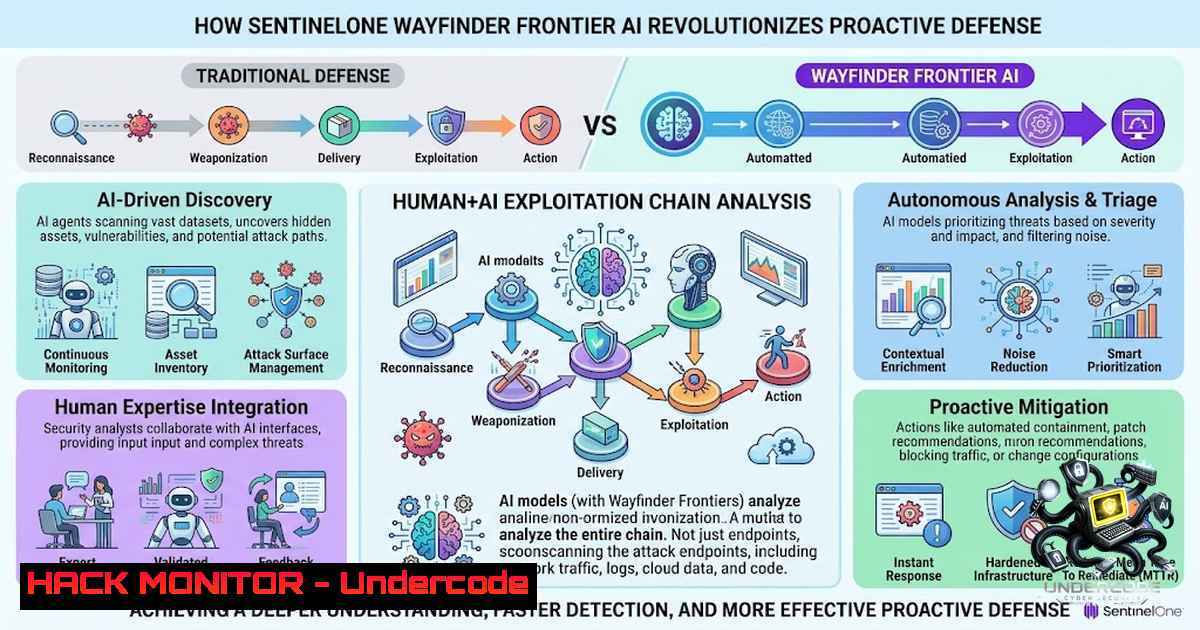
The cybersecurity industry is drowning in vulnerability noise. Traditional scanners produce exhaustive lists of theoretical weaknesses, yet most are not realistically exploitable in a live environment. SentinelOne’s expansion of Wayfinder Frontier AI Services addresses this critical gap by combining frontier AI models from Anthropic with elite human security experts to identify, validate, and prioritize only the threats that adversaries can actually exploit. This high-touch Source Code Compromise Assessment represents a paradigm shift from volume-based scanning to intelligence-led, outcome-driven exposure management.
Learning Objectives:
- Understand how Sentinelone’s Wayfinder Frontier AI Services leverage Anthropic Claude Opus 4.7 to identify validated, exploitable vulnerabilities across source code, dependencies, and post-deployment environments.
- Learn to operationalize AI-driven findings through prioritized remediation guidance, hyperautomation workflows, and managed threat hunting for identity platforms like Okta and Microsoft Entra ID.
- Gain actionable insights into breaking real-world exploitation chains using a multi-model AI approach that reduces mean time to remediation (MTTR) and strengthens software supply chain resilience.
You Should Know:
- Source Code Compromise Assessment: Finding the Signal in the Noise
Wayfinder Frontier AI Services is not a vulnerability scanner—it is an intelligence-led discovery engine. The service combines Anthropic’s Claude Security models, powered by Claude Opus 4.7, with SentinelOne’s most seasoned offensive and defensive experts. Together, they perform a point-in-time Source Code Compromise Assessment that identifies and validates realistically exploitable weaknesses across four critical domains: source code, software dependencies, exposed secrets, and post-deployment tampering.
What sets this apart is the validation layer. Every finding is reviewed by human experts who provide reproduction details and severity assessments based on real environmental context. This eliminates the false positives that plague traditional tools and ensures that security teams focus on what actually matters.
Step‑by‑step guide: How to Conduct an AI-Powered Source Code Assessment
While Wayfinder is a managed service, organizations can adopt similar principles using open-source and commercial tools:
- Dependency Scanning: Use `osv-scanner` to check for known vulnerabilities in your dependencies.
Linux/macOS
osv-scanner -r /path/to/your/repo
For Python projects, combine with `pip-audit`:
pip-audit -r requirements.txt
- Secrets Detection: Scan your repository for accidentally committed secrets using
trufflehog.Linux/macOS/Windows (via WSL or Git Bash) trufflehog filesystem /path/to/your/repo --only-verified
For CI/CD pipelines, integrate `git-secrets` to prevent secrets from being committed:
git secrets --install
git secrets --register-aws
-
Static Application Security Testing (SAST): Use `Semgrep` for fast, rule-based static analysis.
Linux/macOS
semgrep --config=p/owasp-top-ten /path/to/your/repo
-
Software Composition Analysis (SCA): Generate a Software Bill of Materials (SBOM) using `syft` and check it against vulnerability databases.
syft dir:/path/to/your/repo -o json > sbom.json
grype sbom.json
-
Validate and Prioritize: Use threat intelligence feeds (e.g., CISA KEV, Exploit-DB) to cross-reference findings with known exploited vulnerabilities. This mirrors Wayfinder’s approach of validating against real-world attacker activity.
-
Human+AI Collaboration: The Core of Wayfinder Frontier AI
“Frontier AI models are powerful enough to find real exposure paths, but they still need experienced humans to validate what’s real, what’s noise, and what to do next,” said Steve Stone, Chief Customer Officer at SentinelOne. This philosophy underpins the entire Wayfinder Frontier AI Service. The service pairs Claude Opus 4.7 with SentinelOne’s elite cyber experts to deliver continuous, intelligence-led discovery, prioritization, and remediation.
The multi-model approach is equally critical. SentinelOne plans to extend coverage to OpenAI’s GPT-5.5-cyber and GPT-5.6 models, as well as models from other frontier AI labs, to offer a fully multi-model foundation. This ensures that the service evolves with the AI landscape and does not become dependent on a single vendor’s capabilities.
Step‑by‑step guide: Integrating AI into Your Threat Hunting Workflow
- Leverage AI for Threat Hunting Queries: Use tools like SentinelOne’s Purple AI to generate Deep Visibility queries using natural language.
-- Example Deep Visibility Query (similar to SentinelOne's syntax)
SELECT  FROM processes WHERE process_name LIKE '%powershell%' AND command_line LIKE '% -e %'
-
Automate Alert Triage with SOAR: Implement hyperautomation workflows that ingest alerts, enrich them with threat intelligence, and trigger response actions.
Python snippet for alert enrichment (pseudo-code)
import requests
alert = get_alert()
enriched = enrich_with_threat_intel(alert['indicator'])
if enriched['risk_score'] > 80:
create_ticket(enriched)
-
Identity Threat Hunting: For identity environments like Okta and Microsoft Entra ID, monitor for suspicious logins and privilege escalations.
PowerShell: Query Microsoft Entra ID sign-in logs (requires AzureAD module)
Get-AzureADAuditSignInLogs -All $true | Where-Object { $_.Status.ErrorCode -1e 0 }
For Okta, use the Okta API to pull system logs:
curl -X GET "https://your-org.okta.com/api/v1/logs?since=2026-08-01T00:00:00Z" -H "Authorization: SSWS ${OKTA_API_TOKEN}"
3. Wayfinder MDR Workflows: Hyperautomation for Defense
The expansion of Wayfinder Frontier AI Services also introduces Wayfinder MDR Workflows, which add customizable hyperautomation capabilities to the MDR customer experience. These workflows transform manual SOC processes into scalable, reliable automation pipelines that handle alert triage, enrichment, investigation, and response.
Hyperautomation is not about replacing humans—it is about enabling them to focus on high-value tasks. By automating the repetitive, time-consuming aspects of incident response, security teams can respond faster and more accurately to validated threats.
Step‑by‑step guide: Building a Hyperautomation Workflow
- Define Triggers: Identify the events that should initiate automated actions (e.g., high-severity alert, suspicious login from a new location).
-
Enrichment: Automatically pull contextual data from threat intelligence feeds, asset inventories, and identity providers.
Using curl to query VirusTotal API curl -X GET "https://www.virustotal.com/api/v3/files/${FILE_HASH}" -H "x-apikey: ${VT_API_KEY}" -
Decision Logic: Implement conditional logic to determine the appropriate response based on enrichment results.
if enrichment['malicious'] == True and asset['critical'] == True:
response = 'isolate_endpoint'
elif enrichment['malicious'] == True:
response = 'block_indicator'
else:
response = 'log_for_review'
-
Automated Response: Execute the chosen response using APIs or orchestration tools.
Isolate an endpoint via SentinelOne API (example) curl -X POST "https://your-instance.sentinelone.net/web/api/v2.1/agents/actions" \ -H "Authorization: ApiToken ${S1_API_TOKEN}" \ -H "Content-Type: application/json" \ -d '{"filter": {"ids": ["AGENT_ID"]}, "action": "disconnect"}' -
Feedback Loop: Log the outcome and update the workflow based on effectiveness.
4. LevelBlue Partnership: From Discovery to Remediation
Discovery is only half the battle. As AI accelerates vulnerability identification, remediation has emerged as the next major security challenge. SentinelOne has named LevelBlue as its premier remediation partner for Wayfinder Frontier AI Services. LevelBlue provides milestone-based remediation programs that include vulnerability triage, developer-focused guidance, and independent validation.
The partnership offers two service tracks:
- Remediation Sprint: Tactical advisory and remediation assistance, sequenced by severity rather than fixed calendar blocks.
- Application Resilience Program: Strategic resilience consulting and posture trend reporting for long-term improvement.
This approach ensures that validated findings translate into measurable risk reduction, not just another report.
Step‑by‑step guide: Prioritizing Remediation Based on Real-World Exploitability
- Contextualize Findings: Evaluate each vulnerability against your organization’s specific environment, existing controls, and current attacker activity.
-
Prioritize by Exploitability: Use threat intelligence to determine which vulnerabilities are being actively exploited in the wild. The CISA Known Exploited Vulnerabilities (KEV) catalog is a good starting point.
Download CISA KEV catalog
curl -s https://www.cisa.gov/sites/default/files/feeds/known_exploited_vulnerabilities.json | jq '.vulnerabilities[] | .cveID'
-
Assign Ownership: Clearly define which team (development, security, operations) is responsible for each remediation task.
-
Validate Fixes: After remediation, re-scan and validate that the fix effectively closes the attack path.
Re-run SAST/SCA scans and compare results
semgrep --config=p/owasp-top-ten /path/to/your/repo --output=scan_results.json
diff scan_results_before.json scan_results_after.json
-
Continuous Improvement: Use posture trend reporting to track remediation progress and identify systemic weaknesses.
5. Managed Threat Hunting for Identity: Extending Coverage
The expansion also includes Wayfinder Threat Hunting for Identity, now covering Okta and Microsoft Entra ID. This is a critical addition given the rise of identity-based attacks. By combining SentinelOne’s AI-driven alerting with curated threat intelligence, the service provides proactive hunting across identity layers.
Step‑by‑step guide: Hunting for Identity Threats
- Monitor for Anomalous Logins: Use your SIEM or identity provider’s logs to detect logins from unusual locations or at unusual times.
-- Example SQL query for SIEM
SELECT user, source_ip, timestamp FROM authentication_logs
WHERE source_ip NOT IN (SELECT known_ip FROM trusted_ips)
AND timestamp > NOW() - INTERVAL '1 hour'
-
Detect Privilege Escalation: Monitor for changes in user roles or group memberships.
PowerShell: Audit Azure AD role assignments Get-AzureADDirectoryRole | ForEach-Object { Get-AzureADDirectoryRoleMember -ObjectId $_.ObjectId } -
Investigate Suspicious Service Principals: Review service principal activity for signs of compromise.
Azure CLI: List service principals with recent sign-ins
az ad sp list --show-mine --query "[?signInActivity.lastSignInDateTime > '2026-08-01']"
-
Correlate with Endpoint Data: Cross-reference identity anomalies with endpoint detection data to identify potential lateral movement.
What Undercode Say:
- Key Takeaway 1: The future of cybersecurity is not about finding more vulnerabilities—it is about finding the right ones. Wayfinder Frontier AI Services exemplifies this by focusing on validated, exploitable threats rather than theoretical weaknesses.
- Key Takeaway 2: Human expertise remains irreplaceable. Even the most advanced AI models require experienced analysts to validate findings and provide actionable remediation guidance. The human+AI partnership is the winning formula.
Analysis: The expansion of Wayfinder Frontier AI Services signals a maturing of the AI security market. We are moving beyond the “AI-powered scanner” hype to a more nuanced understanding of how AI can augment human decision-making. The emphasis on remediation and hyperautomation acknowledges that discovery alone is insufficient—security teams need help operationalizing findings. The multi-model approach (Anthropic, OpenAI, and others) is a smart hedge against vendor lock-in and ensures the service remains at the cutting edge of AI capabilities. However, organizations must also address the underlying challenge: many lack the skilled personnel to interpret and act on AI-generated findings, which is precisely why managed services like Wayfinder are gaining traction.
Prediction:
- -1 The remediation gap will widen before it narrows. As AI accelerates vulnerability discovery, organizations without mature DevSecOps practices will struggle to keep pace, creating a temporary backlog of validated findings.
- +1 Multi-model AI security will become the industry standard. SentinelOne’s move to integrate Anthropic and OpenAI models will pressure competitors to adopt similar multi-vendor strategies, driving innovation and reducing dependency on single AI providers.
- +1 Hyperautomation will redefine the SOC. Wayfinder MDR Workflows represent a shift toward autonomous incident response, where routine tasks are fully automated and human analysts focus on strategic threat hunting and complex investigations.
- -1 Identity-based attacks will intensify. The expansion of threat hunting to Okta and Entra ID is a direct response to the growing threat landscape, but attackers will continue to evolve their tactics, requiring constant vigilance and adaptive defenses.
▶️ Related Video (82% Match):
🎯Let’s Practice For Free:
🎓 Live Courses & Certifications:
Join Undercode Academy for Verified Certifications
🚀 Request a Custom Project:
Secure, high-velocity infrastructure and disruptive technological engineering. Contact our engineering team for high-tier development and proprietary systems:
[email protected]
💎 Smart Architecture | 🛡️ Secure by Design | ⭐ Trusted by Thousands
IT/Security Reporter URL:
Reported By: Roshan Pradeep – Hackers Feeds
Extra Hub: Undercode MoN
Basic Verification: Pass ✅


