Listen to this Post
Introduction
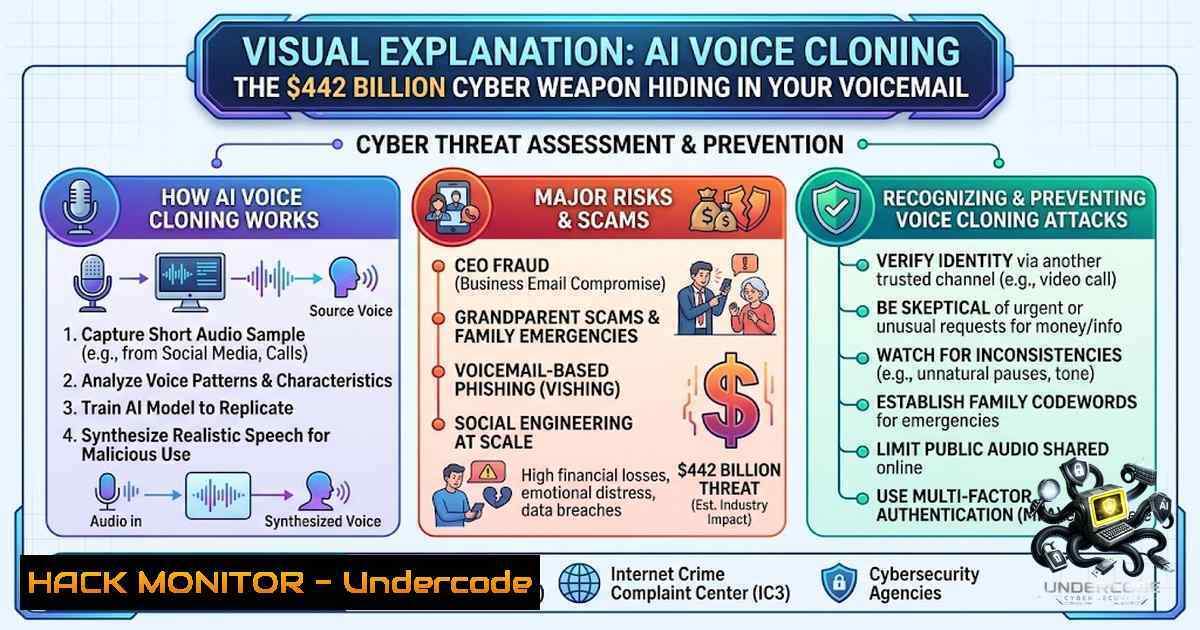
Your voice is no longer private—it is a digital fingerprint that can be cloned from as little as three seconds of audio, weaponized by transnational criminal networks operating fraud-as-a-service platforms with enterprise-grade efficiency. In 2025 alone, automated cyber-enabled fraud networks extracted more than $442 billion globally, with one in three voice scam targets who engage losing an average of $18,000 per victim. As AI-generated voices now deceive human listeners approximately 80% of the time, the boundary between authentic communication and synthetic impersonation has effectively collapsed.
Learning Objectives
- Identify the five primary attack vectors scammers use to harvest voice biometrics from social media, smart devices, and everyday applications
- Understand the technical pipeline—scrape, clone, scam—and how open-source tools like XTTS, VALL-E, and Chatterbox enable real-time voice skinning
- Implement defensive countermeasures including family code words, callback verification protocols, and forensic audio authentication techniques
You Should Know
- The Voice Harvesting Attack Surface: Where Your Voice Is Already Exposed
Scammers do not need to be expert hackers to obtain your voiceprint. Your voice is captured and stored across an expansive digital ecosystem that most individuals never consider. A single 15-second TikTok rant, Instagram Story, or LinkedIn Live broadcast provides sufficient audio for a near-perfect digital twin. Even your voicemail greeting—”Hi, you’ve reached Ana, leave a message…”—is often enough to power a clone.
Beyond social media, voice data is routinely harvested from:
- Podcasts and webinars: Guest appearances and Q&A sessions persist indefinitely in public archives
- Robocalls and IVR systems: Interactive voice responses that prompt “Say yes to continue” capture clear, isolated recordings
- Video conferencing platforms: Zoom, Webex, and Teams meetings—especially recorded sessions—are prime targets
- Voice assistants: Alexa, Siri, and Google devices continuously store and train on speech patterns
- Fitness and language apps: Peloton, Duolingo, and Babbel log voice data for cloud synchronization and AI training
- Vehicle infotainment and smart appliances: Synced phone calls and ambient listening from Samsung Family Hub and LG webOS systems
- Telehealth and job interview platforms: Virtual visits and HireVue recordings store speech indefinitely for transcription and biometric analysis
Step‑by‑step audit to reduce your voice exposure:
- Review privacy settings on all social media platforms—set audio-containing content to “Friends Only” or “Private”
- Delete old recordings, Stories, and archived videos that contain your voice
- Opt out of voice biometrics where possible; use passphrases instead of voice as a password
- Disable “Hey Google” or “Alexa” wake-word recording history in your device privacy dashboards
- When receiving unsolicited calls, never speak the word “yes” or any confirmation phrase—hang up and call back on a verified number
-
The 3‑Second Weaponization Pipeline: From Audio to Impersonation in Seconds
The criminal pipeline operates with assembly-line precision across three distinct phases:
Scrape: Automated Audio Harvesting
Automated bots crawl Instagram, TikTok, and LinkedIn, extracting audio clips as short as three seconds. Alternatively, scammers simply dial your number to record your voicemail greeting. The barrier to entry is effectively zero.
Clone: AI‑Powered Voice Synthesis
The harvested audio is fed into open-source engines—Chatterbox, XTTS, VALL-E—or proprietary platforms like ElevenLabs (Creator Plan: $22/month). These systems simultaneously analyze more than 500 vocal variables: tone, pitch, nasal resonance, regional accent, and rhythmic pacing. A synthetic voiceprint is generated within seconds. For those seeking to experiment defensively, you can visit Eleven Labs or Voiceslab to hear sample AI voices or record your own to observe what a clone sounds like.
Scam: Real‑Time Voice Skinning
Using real-time voice skinning, the audio engine automatically converts the scammer’s voice into the cloned voice as they speak, enabling fluid, dynamic conversations. Sophisticated criminal enterprises now operate “fraud as a service” (FaaS) platforms with customer support tiers, feature updates, and subscription pricing.
Step‑by‑step technical verification for security professionals:
To detect synthetic audio, examine for these four digital artifacts:
| What You Hear | Technical Indicator | Why It Happens |
|||-|
| Tiny unnatural hesitations before names/numbers | Micro-latency gaps | Real-time AI skinning needs milliseconds to process variable inputs |
| Jagged cutoffs on hard consonants (T, K, P) | Acoustic edge clipping | Generative algorithms struggle with synthetic phonetic transitions |
| Studio-quality backgrounds devoid of environmental noise | Sterile isolation | Real distress calls occur amid traffic, wind, or room noise |
| Loud/strained voices without organic breath or pacing changes | Uniform flattening | AI cannot replicate the chaos of genuine human panic |
For forensic-grade verification, tools including DuckDuckGoose, Phonexia, Reality Defender, and Sensity AI can authenticate audio evidence and build court-admissible audit trails.
- The Three Attack Scenarios That Exploit Human Emotion
Scam scripts are meticulously engineered to bypass rational cognition by creating fear and urgency. The three most devastating scenarios include:
Family Panic (The Grandparent Scam)
The cloned voice of a child or spouse begs for emergency cash—arrested, kidnapped, or in a hospital—demanding immediate transfer via cryptocurrency or gift cards. This was the scenario that nearly ensnared the author’s father, though the scam failed because it predated AI voice cloning.
CEO Impersonation (The $35 Million Heist)
In 2021, scammers cloned a company director’s voice to authorize a $35 million wire transfer from a Japanese firm’s Hong Kong branch. The attack succeeded because the voice was indistinguishable from the authentic executive.
Extortion (Self‑Extortion)
Scammers clone your voice to create fabricated audio of you confessing to installing malware, sharing compromising information, or committing a crime. They then demand payment to prevent release to law enforcement, family, or employers—amplifying panic because the evidence sounds undeniably like you.
Step‑by‑step incident response protocol:
- Hang up immediately—do not engage, do not argue, do not provide any additional voice data
- Do not use redial—manually dial the family member’s known number from your contacts
- Deploy the family code word—if the caller cannot produce it, terminate the call
- Verify payment red flags—law enforcement, hospitals, and courts never demand cryptocurrency, gift cards, or wire transfers
- If you have been scammed, contact financial institutions, the FBI, and local law enforcement immediately
4. Infrastructure‑Level Defenses: STIR/SHAKEN, SynthID, and Cryptographic Provenance
Long-term defense against voice cloning is shifting from human assessment toward infrastructure-level authentication. Several critical technologies now in play include:
- STIR/SHAKEN: Digitally signs calls so carriers can verify caller ID—a legal requirement since September 2025
- Google’s RCS‑based fake‑call detection (June 2026 Android update): Verifies the caller’s hardware
- Google’s SynthID and Microsoft’s C2PA protocol: Provide cryptographic provenance for synthetic media
For investigators: securing forensic evidence
Preserve raw, uncompressed audio files immediately. Standard apps compress data, destroying the minute algorithmic anomalies required by forensic authentication tools.
Linux command for audio integrity verification:
 Check audio file metadata and compression
ffprobe -v quiet -print_format json -show_format -show_streams suspicious_audio.wav

Extract spectrogram for visual anomaly detection
sox suspicious_audio.wav -1 spectrogram -o spectrogram.png

Analyze for phase inconsistencies (indicative of synthesis)
ffmpeg -i suspicious_audio.wav -af "aphaser=in_gain=0.9,out_gain=0.9" -f null -
Windows PowerShell command for audio hashing (chain of custody):
 Generate SHA-256 hash for evidentiary integrity
Get-FileHash -Path "C:\Evidence\suspicious_audio.wav" -Algorithm SHA256 | Format-List

Extract detailed audio properties
[System.Reflection.Assembly]::LoadWithPartialName("System.Windows.Forms") | Out-1ull
$player = New-Object System.Media.SoundPlayer
$player.SoundLocation = "C:\Evidence\suspicious_audio.wav"
$player.Load()
$player.Stream.Length
- The Consumer Survival Checklist: Replacing Trust with Verified Protocols
When a crisis strikes, emotion is the enemy of security. Replace reactive trust with practiced, established responses:
- Establish a family code word: A distinct, memorable word or phrase that is never written down, texted, or shared digitally. Change it often. If someone claiming to be a family member cannot produce it, hang up immediately
- Implement the callback rule: If something seems suspicious—especially automated systems asking for voice responses—hang up and call back on a verified number
- Privatize social audio: Set access to friends and known followers only; delete old recordings
- Voice biometrics opt‑out: Avoid using your voice as a password; use passphrases banks cannot predict
What Undercode Say
- Voice cloning has transitioned from a theoretical threat to a commoditized, transnational fraud-as-a-service industry, with open-source tools and $22/month subscriptions placing this capability in the hands of any criminal
- The most effective defense is not technological sophistication but behavioral protocol—family code words and callback verification remain the strongest shields against emotionally manipulative social engineering
- Infrastructure-level authentication (STIR/SHAKEN, SynthID, C2PA) represents the only scalable long-term solution, as human ears now fail to distinguish synthetic from authentic voices approximately 80% of the time
- The $442 billion extracted by cyber-enabled fraud networks in 2025 signals that voice cloning is not an isolated nuisance but a systemic threat integrated with money laundering, human trafficking, and organized crime
- Awareness and education—such as the work performed by Operation Shamrock—remain the most critical tools, as the criminal ecosystem is industrialized, self-improving, and operates with the efficiency of modern enterprise software
Prediction
- -1: Voice cloning scams will surpass traditional phishing as the primary vector for financial fraud within 18–24 months, as the cost of voice synthesis continues to decline and the quality improves beyond human detectability
- -1: The proliferation of FaaS platforms will enable a new class of hyper-targeted attacks—scammers will combine voice clones with stolen personal data (addresses, family relationships, travel schedules) to craft perfectly personalized, context-aware extortion campaigns
- +1: Regulatory frameworks like STIR/SHAKEN and cryptographic provenance protocols (SynthID, C2PA) will become mandatory across all major telecom carriers and social media platforms, establishing a foundational authentication layer that reduces successful impersonation rates by 60–70% within three years
- +1: Enterprise adoption of forensic audio authentication tools (Reality Defender, Phonexia, Sensity AI) will become standard practice for financial institutions and high-value transaction environments, creating a new cybersecurity sub-sector valued at over $15 billion annually
- -1: The average consumer will continue to lose approximately $18,000 per successful voice scam, with total annual losses exceeding $50 billion globally by 2028, as the emotional manipulation inherent in family-panic scenarios consistently bypasses technological defenses
▶️ Related Video (84% Match):
🎯Let’s Practice For Free:
🎓 Live Courses & Certifications:
Join Undercode Academy for Verified Certifications
🚀 Request a Custom Project:
Secure, high-velocity infrastructure and disruptive technological engineering. Contact our engineering team for high-tier development and proprietary systems:
[email protected]
💎 Smart Architecture | 🛡️ Secure by Design | ⭐ Trusted by Thousands
IT/Security Reporter URL:
Reported By: How Scammers – Hackers Feeds
Extra Hub: Undercode MoN
Basic Verification: Pass ✅


