Listen to this Post
Introduction:
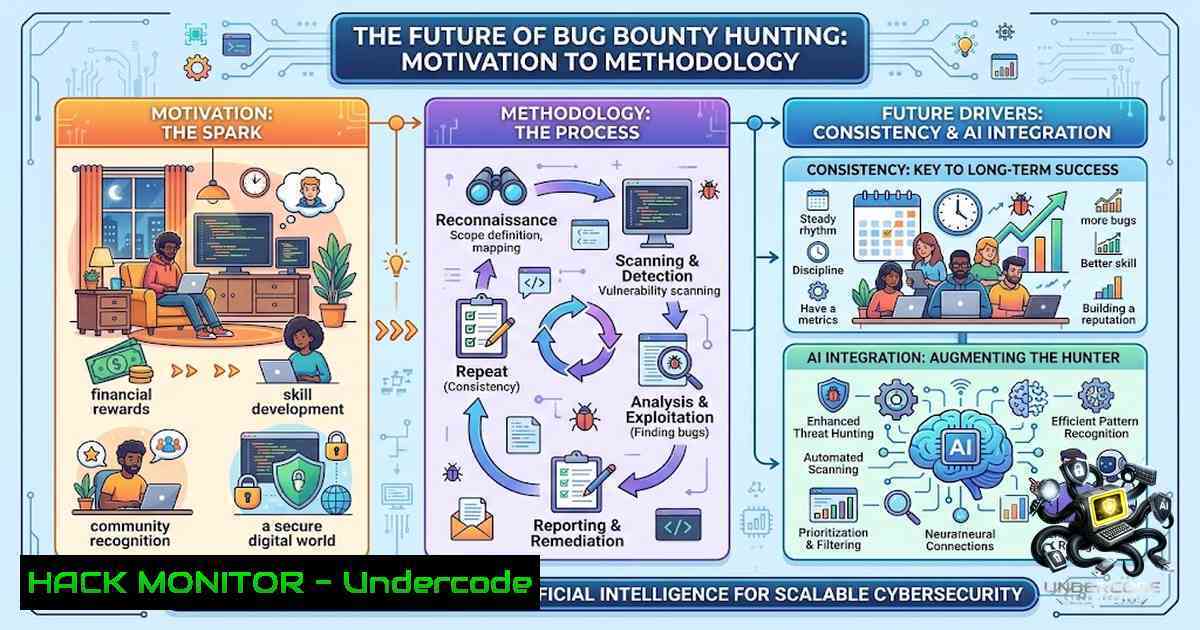
The bug bounty landscape has fundamentally shifted. In 2026, the most successful hunters are not those who chase the largest one-time payouts, but those who have systematized their approach into a repeatable, high-signal methodology. As industry leaders like Lakshay Shandilya of BugsTrace emphasize, consistency, not motivation, is the true engine of success in this field. This article distills the core principles of a modern, AI-augmented bug bounty workflow, providing a technical blueprint for hunters looking to move beyond sporadic wins and build a sustainable, high-impact practice.
Learning Objectives & Secrets:
- Objective 1: Master the Signal-to-1oise Workflow. Learn to structure your hunting from wide, passive reconnaissance to aggressive, targeted exploitation. This method ensures you don’t waste time on low-probability attack vectors.
- Objective 2 Secret Tip: The “Depth Over Speed” Principle. In a crowded field, competing on speed against automated pipelines is a losing battle. The real competitive advantage lies in going deep on a specific skill or target set, uncovering business logic flaws that automated scanners miss.
- Objective 3 Secret Tip: AI as a Force Multiplier, Not a Replacement. Use AI to accelerate your reconnaissance, organize findings, and automate repetitive tasks. However, the final verification and exploitation must always be performed manually to ensure accuracy and craft a compelling report.
You Should Know:
- The Modern Reconnaissance Pipeline: From Passive to Active
A successful hunt begins with a structured reconnaissance phase. The goal is to build a comprehensive map of the target’s attack surface.
- Step 1: Passive Subdomain Enumeration. Gather subdomains without directly interacting with the target’s infrastructure. This is the safest and quietest first step.
- Linux Command: Use `subfinder` for fast, API-based enumeration and `amass` in passive mode for more comprehensive results.
subfinder -d example.com -o subdomains.txt
- Linux Command: Extract subdomains from certificate transparency logs using `curl` and
jq.curl -s "https://crt.sh/?q=%.example.com&output=json" | jq -r '.[].name_value' | sed 's/\.//g' | sort -u
- Step 2: Active Subdomain Enumeration & Bruteforcing. Once you have a list of known subdomains, use active techniques to discover additional assets.
- Linux Command: Use `ffuf` to fuzz for subdomains against a wordlist.
ffuf -u https://FUZZ.example.com -w /path/to/subdomain-wordlist.txt -fc 404
- Step 3: Infrastructure Mapping. Identify the IP ranges, ASNs, and cloud providers associated with your target. This helps uncover shadow IT and forgotten assets.
2. Harnessing AI for Scalable Reconnaissance and Analysis
The integration of AI is no longer optional; it is a core component of a competitive bug bounty workflow. AI tools can dramatically accelerate the initial phases of hunting.
- Linux Command (Setup): Deploy an AI-assisted reconnaissance tool like
dragonflAI. It is a lightweight, local-first platform that automates recon and detects potential vulnerabilities using heuristics.Clone the repository (example) git clone https://github.com/EthicalTomas/dragonflAI.git cd dragonflAI Follow the setup instructions in the README
- Linux Command: For a more comprehensive approach, frameworks like the Pentest Agent Suite integrate with AI coding platforms (Claude Code, OpenAI Codex, etc.) to provide over 50 specialized security agents. This allows you to orchestrate complex, multi-stage attacks with AI assistance.
- Secret Tip: Run these AI tools in a Kali Linux sandbox or a local environment with no cloud dependency to ensure your reconnaissance remains private and compliant with program rules.
3. Deep Dive: API Security Testing
Modern web applications are API-driven. Finding vulnerabilities in REST and GraphQL APIs is a primary source of high-value bounties.
- Step 1: Traffic Inspection. Use a professional tool like the Arcane Scout browser extension. It provides more detailed API traffic inspection than the standard browser’s network tab, making it ideal for penetration testers and bug bounty hunters.
- Step 2: Automated Endpoint Discovery. Use tools like ExecEndpoints to automatically capture every API call, including methods, parameters, and per-host JWTs or cookies, directly from the site’s JavaScript.
- Step 3: Specialized API Hunting. For a more aggressive approach, use an AI-powered tool like API Hunter, which focuses on discovering and exploiting sophisticated attack vectors, business logic flaws, and vulnerability chains in modern APIs.
- Windows Command (PowerShell): While testing on Windows, you can use `curl` to interact with APIs.
Example: Send a GET request with a header
curl.exe -X GET "https://api.example.com/v1/users" -H "Authorization: Bearer <token>"
4. Cloud Hardening and Misconfiguration Exploitation
Misconfigured cloud storage (like AWS S3 buckets) and overly permissive IAM roles are a goldmine for bug bounty hunters.
- Linux Command: Use `awscli` to check S3 bucket permissions.
aws s3 ls s3://target-bucket-1ame/ --1o-sign-request
If this command lists the contents, the bucket is publicly readable.
- Linux Command: Use a tool like `bucket_finder` to brute-force common bucket names and check their permissions.
./bucket_finder.rb /path/to/wordlist --download
- Linux Command: For a comprehensive security audit of an AWS environment, use Prowler. It performs hundreds of CIS benchmark checks and generates an HTML report highlighting risks like public S3 buckets and overly permissive IAM roles.
Install Prowler
git clone https://github.com/prowler-cloud/prowler
cd prowler
Run the assessment
./prowler -M html
5. Windows Privilege Escalation Essentials (Post-Exploitation)
While less common in cloud-1ative bug bounties, understanding Windows privilege escalation is crucial for internal network or thick-client assessments.
- Step 1: System and User Enumeration. Gather basic information about the compromised system.
- Windows Command (cmd): `whoami /priv` (Check current user privileges).
- Windows Command (cmd): `systeminfo` (View system information, patches, and hotfixes).
- Windows Command (cmd): `ipconfig /all` & `netstat -ano` (View network configuration and active connections).
- Step 2: Automated Enumeration. Use tools like WinPEAS to automate the discovery of privilege escalation vectors.
Download and run WinPEAS
.\winPEASx64.exe
- Step 3: Exploitation. If you find a vulnerable service, you might use a tool like PrintSpoofer or JuicyPotatoNG to escalate privileges.
6. Building a Consistent, Repeatable Methodology
Consistency is the cornerstone of long-term success. This means documenting your process and using checklists.
- Step 1: Follow a Standard Operating Procedure (SOP). Utilize community-curated SOPs, such as the one from
intel-codex, which covers reconnaissance strategies, vulnerability hunting techniques, and report writing. - Step 2: Use a Methodology Checklist. A checklist like the “BB-Methodology” consolidates the entire process from recon to critical RCE and cloud exploits. This prevents you from missing key steps.
- Example Checklist Items:
- [ ] Passive Subdomain Enumeration (subfinder, amass)
- [ ] Active Subdomain Enumeration (ffuf, massdns)
- [ ] Port Scanning (nmap)
- [ ] Web/API Testing (Burp Suite, Arcane Scout)
- [ ] Cloud Misconfiguration Check (Prowler, awscli)
- Step 3: Master Report Writing. A finding is only as valuable as its report. Focus on clarity, reproducibility, and demonstrating business impact. A well-written report is key to getting the maximum payout for your findings.
What Undercode Say:
- Key Takeaway 1: Systemization Trumps Talent. The most successful bug bounty hunters are those who have built a personal system—a repeatable, documented methodology. This allows them to work efficiently and consistently, regardless of their “motivation” on any given day.
- Key Takeaway 2: AI is an Essential Tool, Not a Silver Bullet. The future of the field is human-AI collaboration. AI and automation are critical for handling the massive scale of modern reconnaissance, but human intuition, curiosity, and the ability to understand complex business logic are what will continue to separate the top 1% of hunters from the rest.
- Analysis: The bug bounty market in 2026 is more competitive than ever. The barriers to entry are lower, but the barriers to success are higher. To thrive, one must evolve from a “scanner jockey” to a “security researcher.” This means deeply understanding the technology you are targeting, thinking like a developer to find business logic flaws, and using AI not as a crutch, but as a powerful accelerator. As Lakshay Shandilya suggests, the path to consistency lies in adapting to these new tools and focusing on the quality and depth of your findings, rather than the quantity or the hype. The hunters who embrace this methodology-first, AI-augmented approach will be the ones who consistently find and report the most impactful vulnerabilities.
Prediction:
- +1 The democratization of AI-powered pentesting tools will lower the barrier to entry for new hunters, leading to a more diverse and innovative security researcher community.
- +1 Organizations will increasingly adopt continuous, AI-driven offensive security testing (like Snyk Evo COS), making security a continuous process rather than a point-in-time event.
- -1 The reliance on AI for initial reconnaissance may lead to a homogenization of findings, with many hunters reporting the same automated discoveries, thus lowering the value of low-hanging fruit.
- +1 The “depth over speed” philosophy will gain prominence, rewarding hunters who specialize in niche areas (e.g., GraphQL, cloud misconfigurations, complex business logic) and can find unique, high-impact vulnerabilities that AI cannot.
- -1 As AI tools become more powerful, the attack surface for organizations will also expand, introducing new classes of AI-specific vulnerabilities (e.g., prompt injection, model theft) that will require a new generation of security expertise to identify and mitigate.
▶️ Related Video (76% Match):
🎯Let’s Practice For Free:
🎓 Live Courses & Certifications:
Join Undercode Academy for Verified Certifications
🚀 Request a Custom Project:
Secure, high-velocity infrastructure and disruptive technological engineering. Contact our engineering team for high-tier development and proprietary systems:
[email protected]
💎 Smart Architecture | 🛡️ Secure by Design | ⭐ Trusted by Thousands
IT/Security Reporter URL:
Reported By: https://lnkd.in/p/eDDjSZri – Hackers Feeds
Extra Hub: Undercode MoN
Basic Verification: Pass ✅


