Listen to this Post
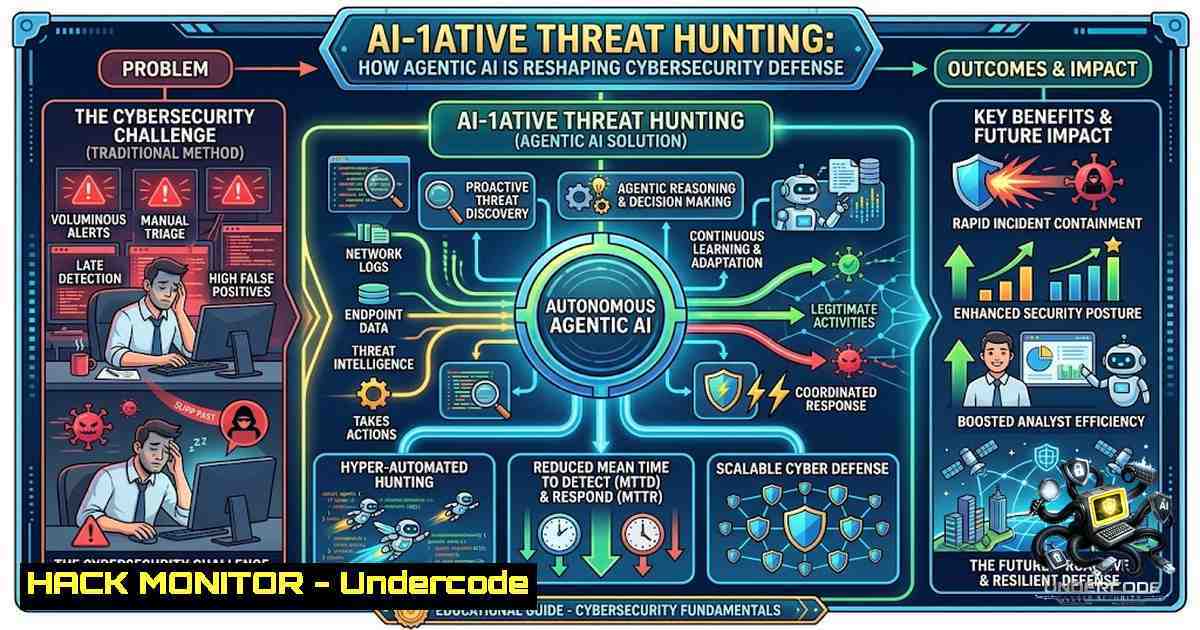
Introduction:
The cybersecurity industry is witnessing a fundamental shift as artificial intelligence transitions from a defensive aid to an offensive weapon capable of automating hacking at scale. Damien Lewke, Founder and CEO of Nebulock, who spent over a decade at CrowdStrike, Palo Alto Networks, and Arctic Wolf before launching his AI-1ative security platform, argues that the paradigm has inverted: protecting a company today is far harder than it was 12 years ago, largely because AI has collapsed the hacker talent gap into what is effectively a subscription service. With Nebulock already running more than 300 million agentic investigations and surfacing over 4,000 high-confidence findings that traditional tools missed, the question is no longer whether AI will automate cyberattacks—but whether defenders can deploy AI agents fast enough to keep pace.
Learning Objectives & Secrets:
- Objective 1: Understand Agentic AI in Cybersecurity – Learn how autonomous AI agents differ from traditional rule-based detection, moving beyond Indicators of Compromise (IOCs) to hunt for behavioral anomalies across endpoint, identity, cloud, network, and SaaS telemetry.
-
Objective 2 Secret Tip: Hunt-First, Not Alert-First – Instead of reacting to alerts, adopt a proactive “hunt-first” posture. Lewke’s approach at Nebulock emphasizes continuously investigating hypotheses and reasoning through telemetry rather than waiting for signatures. The secret is to treat AI agents as 24/7 teammates that learn from your environment.
-
Objective 3 Secret Tip: Correlate Weak Signals into Actionable Hypotheses – Most breaches succeed because security stacks generate siloed data. The real value comes from correlating weak signals across identity, cloud, and endpoint telemetry to convict and attribute threats. Speed of iteration in refining these correlations beats raw execution speed in the AI era.
You Should Know:
1. The AI Offense-Defense Asymmetry
The core challenge Lewke highlights is that AI has democratized offensive capabilities. Bad actors can now use agentic AI to autonomously scan, discover vulnerabilities, and execute multi-step exploits with limited human oversight. Research shows that frontier LLMs like GPT-4-Turbo can successfully exploit 33–83% of vulnerabilities—performance comparable to human penetration testers (75%). Open-source models are rapidly closing the gap. This means attack surface has expanded exponentially while defender headcount remains static.
Step‑by‑Step Guide: Simulating an AI-Powered Attack to Test Defenses
To understand how AI agents operate offensively, security teams can leverage platforms like Nebulock’s test environment to run simulated attacks:
- Access the Simulation Environment: Navigate to the Nebulock platform’s “Attack From Detection Rules” section.
- Select a Rule to Test: Choose a detection rule you want to validate against simulated adversary behavior.
- Launch the Simulated Attack: Click “Simulate Attack.” The platform automatically provisions a virtual machine with the specified operating system.
- Observe Agentic Execution: An attack agent executes virtual “hands-on-keyboard” (HOK) commands to emulate real-world adversary tactics.
- Analyze Detection Efficacy: Review whether your existing rule logic identified the expected activity. If not, refine your detection rules and re-test.
- Iterate Rapidly: As Lewke emphasizes, speed of iteration beats speed of execution—run multiple simulations per day to harden your detection posture.
Linux Command Example – Simulating Persistence Mechanisms:
To test detection for common persistence techniques, use the following on a test system (authorized environment only):
 Simulate a cron job persistence (common adversary technique)
echo "     /path/to/malicious_script.sh" >> /etc/crontab

Simulate systemd service persistence
cat > /etc/systemd/system/malicious.service << EOF
[bash]
Description=Malicious Service
[bash]
ExecStart=/path/to/malicious_binary
[bash]
WantedBy=multi-user.target
EOF
systemctl enable malicious.service

Monitor for detection alerts in your SIEM or EDR
tail -f /var/log/syslog | grep -i "malicious"
2. Contextual Security: Moving Beyond IOCs
Traditional security tools operate on known Indicators of Compromise—hashes, IP addresses, domain names. But AI-generated attacks don’t reuse IOCs; they adapt. Nebulock’s platform is built on the premise that security teams need context-rich, behavior-based protection that shows them what their existing stack cannot see. The platform’s autonomous threat-hunting agent, Vespyr, works continuously across identity, endpoint, and cloud telemetry to hunt for how adversaries actually behave—not just what signatures they leave behind.
Step‑by‑Step Guide: Implementing Contextual Threat Hunting
- Integrate Multi-Source Telemetry: Connect your SIEM or data lake to ingest logs from endpoints (Sysmon, Windows Event Logs), identity providers (Azure AD, Okta), cloud providers (AWS CloudTrail, GCP Audit Logs), and network devices.
- Define Behavioral Baselines: Use AI agents to establish normal behavioral patterns for users, devices, and services over a 30-day period.
- Deploy Autonomous Hunters: Configure agentic AI to continuously compare real-time telemetry against baselines, flagging deviations.
- Correlate Across Domains: When an anomaly is detected in one domain (e.g., an impossible travel event in identity logs), automatically correlate with endpoint activity (e.g., new process creation) and cloud activity (e.g., API calls to sensitive S3 buckets).
- Generate High-Confidence Findings: Rather than flooding analysts with low-fidelity alerts, AI agents should produce contextualized findings with evidence chains.
- Convict and Attribute: Use the correlated evidence to determine whether the activity is malicious and attribute it to specific adversary tactics (MITRE ATT&CK mapping).
Windows PowerShell Example – Correlating Identity and Endpoint Events:
 Query Windows Security Event Log for suspicious logons (Event ID 4624)
Get-WinEvent -FilterHashtable @{LogName='Security'; ID=4624; StartTime=(Get-Date).AddHours(-24)} |
Where-Object {$<em>.Properties[bash].Value -like "DomainAdmin"} |
Select-Object TimeCreated, @{N='User';E={$</em>.Properties[bash].Value}}, @{N='SourceIP';E={$_.Properties[bash].Value}}

Cross-reference with Sysmon Process Creation (Event ID 1) for same timeframe
Get-WinEvent -FilterHashtable @{LogName='Microsoft-Windows-Sysmon/Operational'; ID=1; StartTime=(Get-Date).AddHours(-24)} |
Where-Object {$<em>.Properties[bash].Value -match "powershell|cmd|wmic"} |
Select-Object TimeCreated, @{N='Process';E={$</em>.Properties[bash].Value}}, @{N='CommandLine';E={$_.Properties[bash].Value}}
3. The 90-in-90 Customer Discovery Methodology
Lewke’s approach to building Nebulock offers a blueprint for cybersecurity innovation: before writing a single line of code, he conducted 90 customer conversations in 90 days. This discovery sprint killed his original architecture before he wasted money building it. The lesson for security practitioners: tool selection and security architecture should be driven by understanding the specific threats and workflows of your organization, not by vendor marketing.
Step‑by‑Step Guide: Conducting a Security Customer Discovery Sprint
- Identify 30 Stakeholders: Include security analysts, SOC managers, IT operations, compliance officers, and business unit leaders.
- Ask the Right Questions: What keeps you up at night? What alerts do you ignore and why? What would you automate if you could?
- Document Pain Points: Categorize feedback into detection gaps, workflow inefficiencies, and integration challenges.
- Map to MITRE ATT&CK: Align each pain point with specific adversary techniques that are not currently covered.
- Prioritize Based on Impact: Focus on gaps that would cause the most damage if exploited (e.g., identity-based attacks, cloud misconfigurations).
- Design Defenses Around Real Needs: Build or procure solutions that address the prioritized gaps, not generic “best practices.”
4. AI-1ative Security Architecture: Key Components
Based on Lewke’s experience at CrowdStrike (joining at ~200 employees through IPO), Arctic Wolf, and Palo Alto Networks, an AI-1ative security architecture requires:
- Agentic Threat Hunting: Autonomous AI agents that continuously investigate hypotheses across telemetry.
- Vendor-Agnostic Data Ingestion: The ability to consume data from any source—endpoint, identity, cloud, network, SaaS.
- Behavioral Analytics: AI that learns normal behavior and detects anomalies, not just known signatures.
- Real-Time Correlation: Cross-telemetry correlation that turns weak signals into high-confidence findings.
- Automated Response: Where appropriate, automated containment actions (e.g., isolating endpoints, revoking tokens) based on AI-confirmed threats.
API Security Configuration Example – Hardening Cloud Identity:
 AWS CLI: Enforce MFA for all IAM users
aws iam update-account-password-policy --require-uppercase-characters --require-lowercase-characters --require-symbols --require-1umbers --minimum-password-length 14 --password-reuse-prevention 24 --max-password-age 90

AWS CLI: Enable CloudTrail for all regions
aws cloudtrail create-trail --1ame security-trail --s3-bucket-1ame your-security-bucket --is-multi-region-trail --enable-log-file-validation

AWS CLI: Configure GuardDuty for threat detection
aws guardduty create-detector --enable --finding-publishing-frequency FIFTEEN_MINUTES

Azure CLI: Enable Azure Defender for all subscriptions
az security pricing create -1 VirtualMachines --tier Standard
az security pricing create -1 SqlServers --tier Standard
az security pricing create -1 StorageAccounts --tier Standard
5. Why the Best Tools Still Get Breached
Lewke points to a critical paradox: companies with the best cybersecurity tools still get breached. The reason is not technical inadequacy but operational fragmentation. Security tools generate siloed data—endpoint telemetry here, cloud logs there, identity events elsewhere. Without contextual correlation, even the best tools produce noise, not conviction. AI-1ative platforms address this by acting as a unified layer that correlates across the entire stack, turning fragmented data into actionable intelligence.
Step‑by‑Step Guide: Breaking Down Security Silos
- Audit Your Security Stack: List all security tools (EDR, SIEM, CASB, CWPP, IAM, etc.) and their data outputs.
- Identify Overlap and Gaps: Determine where multiple tools monitor the same activity (waste) and where no tool monitors critical activity (gap).
- Select a Correlation Layer: Implement a platform (like Nebulock or a custom data lake with AI analytics) that ingests from all tools.
- Normalize Data: Standardize field names, timestamps, and log formats across sources.
- Build Cross-Domain Detection Rules: Example: If an identity logs in from a new location AND an endpoint process creates a scheduled task AND a cloud API call accesses sensitive data—escalate.
- Measure Coverage: Track the percentage of MITRE ATT&CK techniques that your correlated stack can detect vs. individual tools alone.
What Undercode Say:
- Key Takeaway 1: The hacker talent gap has been commoditized by AI—defenders must adopt AI agents not as a luxury but as a necessity. Organizations that wait will be outmaneuvered by adversaries running autonomous, adaptive attacks at machine speed.
-
Key Takeaway 2: The future of cybersecurity is not about buying more tools but about connecting the tools you already have through contextual, AI-driven correlation. The companies that win will be those that prioritize iteration speed, customer discovery, and cross-telemetry intelligence over checklist compliance.
The analysis here reveals a fundamental truth: cybersecurity has entered an era where defensive superiority depends less on the sophistication of individual tools and more on the intelligence of the layer that connects them. Lewke’s journey—from professional football in Germany to the frontlines of CrowdStrike, Palo Alto Networks, and Arctic Wolf—embodies the adaptability required. His 90-in-90 customer discovery sprint and emphasis on consistency over intensity (running 1,000 miles a year) reflect a mindset shift: security is no longer about heroic incident response but about systematic, AI-powered, always-on vigilance. As agentic AI continues to evolve, the defenders who embrace autonomous threat hunting and contextual correlation will define the next generation of cybersecurity—while those who cling to legacy, siloed approaches will remain perpetually reactive, always one breach behind.
Prediction:
- +1 AI-1ative threat hunting platforms will become the default security architecture for enterprises by 2028, displacing traditional SIEMs as the primary investigation layer.
-
+1 The cost of sophisticated cyberattacks will drop dramatically as AI-powered penetration testing frameworks become commoditized, forcing defensive AI to evolve at an unprecedented pace.
-
-1 Organizations that fail to adopt AI-driven correlation will experience a 40–60% increase in breach dwell time, as adversaries leveraging agentic AI will operate faster than human-led detection teams.
-
-1 The shortage of human security analysts will worsen before it improves, as AI automation increases the volume of attacks while the talent pool remains static—necessitating AI augmentation just to maintain current detection rates.
-
+1 Open-source AI penetration testing frameworks will democratize security testing, enabling smaller organizations to afford continuous, autonomous red-team exercises that were previously cost-prohibitive.
-
-1 Attribution will become nearly impossible in an AI-driven attack landscape, as adversaries use generative AI to craft attacks that mimic legitimate user behavior and leave no reusable IOCs.
▶️ Related Video (88% Match):
https://www.youtube.com/watch?v=0iNqKbrdtJI
🎯Let’s Practice For Free:
🎓 Live Courses & Certifications:
Join Undercode Academy for Verified Certifications
🚀 Request a Custom Project:
Secure, high-velocity infrastructure and disruptive technological engineering. Contact our engineering team for high-tier development and proprietary systems:
[email protected]
💎 Smart Architecture | 🛡️ Secure by Design | ⭐ Trusted by Thousands
IT/Security Reporter URL:
Reported By: https://lnkd.in/p/eZQNWzUQ – Hackers Feeds
Extra Hub: Undercode MoN
Basic Verification: Pass ✅


