Listen to this Post
Introduction
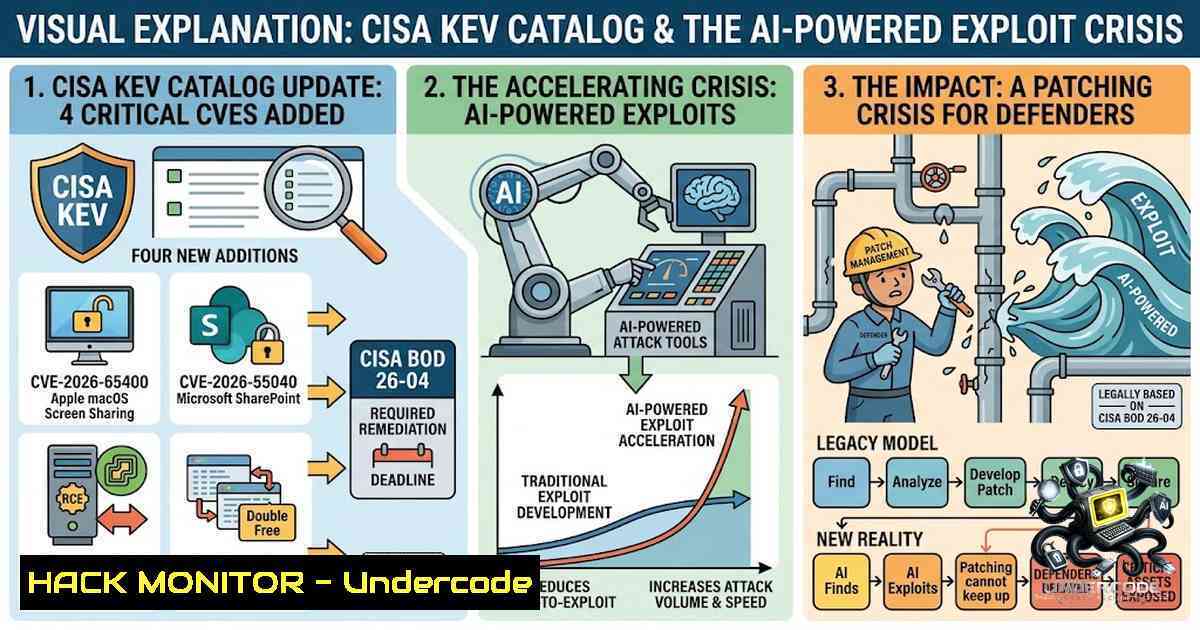
The Cybersecurity and Infrastructure Security Agency (CISA) has added four actively exploited critical vulnerabilities to its Known Exploited Vulnerabilities (KEV) Catalog, spanning Apple macOS, Microsoft SharePoint, Broadcom VMware vCenter, and Microsoft Internet Key Exchange (IKE) Service Extensions. With CVSS scores ranging from 9.1 to 9.8, these flaws are being weaponized in the wild—from Monero cryptocurrency mining on corporate workstations to autonomous AI-driven attack campaigns. Federal agencies face an August 21 patch deadline under Binding Operational Directive (BOD) 26-04, while private organizations must confront the uncomfortable reality that threat actors are now exploiting vulnerabilities faster than many change management boards can approve remediation.
Learning Objectives & Secrets
- Objective 1: Master KEV Catalog Prioritization — Understand how CISA’s KEV Catalog functions as the authoritative source for active threat intelligence, enabling security teams to move beyond CVSS scores and prioritize remediation based on confirmed exploitation.
-
Objective 2 Secret Tips: Accelerate Patching Without Breaking Change Management — Implement emergency change advisory boards (CAB) with pre-approved “critical vulnerability” lanes that bypass standard review cycles for KEV-listed CVEs, reducing mean time to remediate (MTTR) from weeks to hours.
-
Objective 3 Secret Tips: Hunt for Post-Exploitation Indicators — Before applying patches, conduct forensic triage to determine whether systems were already compromised. BOD 26-04 requires agencies to verify pre-patch compromise status, and this forensic discipline should become standard practice for all organizations.
You Should Know
- Apple macOS Screen Sharing Authentication Bypass (CVE-2026-65400, CVSS 9.8)
This vulnerability allows remote attackers to bypass authentication on macOS systems with Screen Sharing enabled, gaining root-level access without requiring valid credentials or a VNC password. The flaw resides in macOS’s Secure Remote Password authentication implementation, where improper frame-length validation causes the service to return an outdated success status, treating unauthenticated connections as legitimate.
The Netherlands’ National Cyber Security Centre (NCSC-1L) confirmed active exploitation across multiple internet-accessible systems, with attackers gaining root access and deploying Monero cryptocurrency miners in every confirmed case. Port 5900 exposure to the internet is the primary attack vector.
Step-by-Step Remediation Guide:
- Identify exposed systems — Scan for TCP port 5900 open to the internet:
nmap -p 5900 --open <target-subnet>/24
Or use Shodan/Censys to identify public-facing Mac systems.
2. Check Screen Sharing status on macOS:
sudo systemsetup -getremotelogin
sudo /usr/libexec/ApplicationFirewall/socketfilterfw --listapps | grep -i "screensharing"
3. Apply Apple patches released August 6:
- macOS Tahoe 26.6.1
- macOS Sequoia 15.7.9
- macOS Sonoma 14.8.9
4. Disable Screen Sharing when not required:
sudo systemsetup -setremotelogin off
- Forensic triage — Check for Monero miners or unauthorized processes:
ps aux | grep -i "xmrig|miner|crypto"
lsof -i :5900
Critical Note: A compromised Mac should be treated as fully breached even after patching. Root-level access means attackers could have established persistence mechanisms.
- Microsoft SharePoint JWT Authentication Bypass (CVE-2026-55040, CVSS 9.1)
This critical authentication bypass vulnerability affects on-premises Microsoft SharePoint Server, including SharePoint Enterprise Server 2016, SharePoint Server 2019, and SharePoint Server Subscription Edition. The flaw chains four distinct weaknesses in the JWT token validation pipeline, allowing unauthenticated remote attackers to forge valid JWTs and impersonate any SharePoint site user or administrator.
Rapid7 released a proof-of-concept (PoC) exploit that demonstrated how attackers can send a JWT with `”alg: none”` in the outer header, bypass signature verification, and use SharePoint’s own STS certificate thumbprint to resolve a signing key with no verification. Active exploitation attempts were recorded across five countries, including Hong Kong, Japan, the Netherlands, Taiwan, and the U.S..
Step-by-Step Remediation Guide:
1. Identify vulnerable SharePoint instances — Check versions:
Get-SPFarm | Select-Object BuildVersion
Affected versions include SharePoint Server 2016, 2019, and Subscription Edition prior to July 2026 patches.
- Apply Microsoft’s July 2026 Patch Tuesday updates immediately.
-
Audit JWT token validation — Review custom authentication configurations:
Get-SPSecurityTokenServiceConfig
-
Monitor for exploitation attempts — Check IIS logs for suspicious JWT patterns:
Select-String -Path "C:\inetpub\logs\LogFiles\W3SVC.log" -Pattern "Bearer.alg:none"
-
Implement additional controls — Consider disabling legacy token handlers if not required:
– Review `SPJsonWebSecurityTokenHandlerV2` and `SPJsonWebSecurityBaseTokenHandlerV2` usage
- VMware vCenter Syslog Path Traversal (CVE-2026-59310, CVSS 9.8)
A directory traversal vulnerability in the VMware vCenter Syslog server allows remote attackers with network access to execute arbitrary code as root. The flaw (CWE-22) has been exploited by suspected China-1exus actors to drop reverse shells and Babuk-derived ransomware across 361 victim IP addresses spanning 47 countries.
The vulnerability was exploited just five days after patches were released, demonstrating the speed at which threat actors now operationalize disclosed vulnerabilities.
Step-by-Step Remediation Guide:
1. Identify vulnerable versions:
- vCenter 8.0: prior to 8.0 Update 3k or 8.0 Update 2f
- vCenter 9.0.x: prior to 9.0.2.0100
- vCenter 9.1.x: prior to 9.1.0.0300
2. Apply patches from VMware Security Advisory VMSA-2026-0006:
 For vCenter Appliance
software-packages stage --iso /path/to/patch.iso
software-packages install --staged
3. Verify patch status:
vpxd -v
- Check for compromise indicators — Review Syslog server logs for directory traversal attempts:
grep -i "../" /var/log/vmware/syslog/.log
-
Restrict network access to vCenter management interfaces — ensure only trusted administrative networks can reach port 514 (Syslog) and management ports.
-
Microsoft IKE Service Extensions Double Free (CVE-2026-33824, CVSS 9.8)
A double-free memory corruption vulnerability in the Windows Internet Key Exchange (IKE) Service Extensions allows unauthenticated network attackers to execute arbitrary code without user interaction. The flaw occurs when the IKE service processes malformed vendor-extension attributes during security association negotiation, triggering a synchronization failure that attempts to free the same memory buffer twice.
Microsoft patched this vulnerability in the April 2026 Patch Tuesday update. However, threat actors are now actively weaponizing it alongside autonomous AI attack workflows powered by DeepSeek, highlighting the convergence of AI-driven exploitation with legacy protocol vulnerabilities.
Step-by-Step Remediation Guide:
- Identify vulnerable systems — Windows 10 Version 1607 and later versions prior to April 2026 patches:
Get-WmiObject -Class Win32_OperatingSystem | Select-Object Version, BuildNumber
2. Apply Microsoft’s April 2026 Patch Tuesday update:
 Check installed updates
Get-HotFix | Where-Object {$_.InstalledOn -gt (Get-Date).AddMonths(-6)}
3. Verify IKE service status:
Get-Service -1ame IKEEXT
- Monitor for exploitation — Check for unusual IKE service crashes or memory corruption events:
Get-EventLog -LogName System -Source "IKE" -1ewest 50
-
Network segmentation — Restrict IKE (UDP 500, UDP 4500) traffic to trusted VPN gateways only.
-
Autonomous AI Attack Campaigns: The New Threat Vector
Perhaps the most alarming development is the integration of autonomous AI agents into attack workflows. Security firm Calif demonstrated that an AI agent could produce working exploits for macOS Screen Sharing flaws in just four hours. The same pattern has emerged across WordPress, Zoom, and now Apple’s ecosystem.
Attackers are deploying “DeepSeek-powered” autonomous campaigns that can:
- Scan for vulnerable targets at machine speed
- Generate and adapt exploits in real-time
- Coordinate multi-vector attacks across different vulnerability classes
Step-by-Step Defense Guide:
- Implement automated patch management — Manual patching cannot keep pace with AI-driven exploitation.
-
Deploy continuous vulnerability scanning with tools like Qualys, Tenable, or Rapid7:
Example: Nessus scan for all four CVEs
nessuscli scan --template "Advanced Scan" --targets <subnet> --policy "CISA KEV"
-
Establish KEV monitoring — Subscribe to CISA’s KEV Catalog updates via RSS or API.
-
Implement emergency patching procedures — Pre-approve critical patches without standard CAB delays.
6. BOD 26-04 Compliance Requirements
Binding Operational Directive 26-04 requires Federal Civilian Executive Branch (FCEB) agencies to prioritize remediation of KEV-listed vulnerabilities on publicly exposed assets that grant total control post-exploitation.
Key Requirements:
- Federal agencies must patch by August 21, 2026
- Document verification that systems were not compromised before patching
- Apply mitigations per vendor instructions, ensuring BOD 26-04 compliance
For Private Organizations:
CISA strongly encourages all organizations to adopt risk-based vulnerability management and prioritize KEV Catalog remediation, even though BOD 26-04 applies only to federal agencies.
7. Commands and Tools Summary
Linux/MacOS Detection Commands:
 Check for open ports
nmap -p 5900,443,514 <target>

Check for crypto miners
ps aux | grep -E "xmrig|miner|crypto|stratum"

Check Screen Sharing status (macOS)
sudo systemsetup -getremotelogin

Check for suspicious network connections
netstat -an | grep -E "5900|443|514"
Windows Detection Commands (PowerShell):
 Check SharePoint version
Get-SPFarm | Select-Object BuildVersion

Check Windows version and patches
Get-WmiObject Win32_OperatingSystem
Get-HotFix | Sort-Object InstalledOn -Descending

Check IKE service
Get-Service IKEEXT

Check for suspicious processes
Get-Process | Where-Object {$_.ProcessName -match "miner|crypto|xmrig"}
What Undercode Say
- Key Takeaway 1: The CISA KEV Catalog is no longer optional reading—it is the definitive priority list for vulnerability management. Organizations that treat KEV additions as “advisories” rather than “emergency patch triggers” will inevitably be breached. Federal agencies have a hard August 21 deadline; the private sector should adopt the same urgency.
-
Key Takeaway 2: AI is fundamentally reshaping the attack surface. When an AI agent can produce working exploits in four hours, the traditional patching cycle of “identify, assess, test, deploy” becomes obsolete. Security teams must adopt automated patch management, real-time vulnerability scanning, and emergency CAB procedures that can deploy critical patches within hours, not weeks.
Prediction
-
-1 The convergence of AI-powered exploitation and legacy vulnerabilities will accelerate dramatically. Organizations still relying on manual vulnerability management processes will face catastrophic breaches within the next 12 months as autonomous attack agents scale exploitation beyond human capacity to respond.
-
-1 Ransomware gangs will increasingly adopt the “patch gap” window—the period between vendor patch release and organizational deployment—as their primary attack vector. With AI agents reducing exploit development time from weeks to hours, this window will shrink to near-zero for KEV-listed vulnerabilities.
-
+1 Organizations that invest in automated patch management, continuous vulnerability scanning, and KEV-aligned prioritization will gain a significant competitive advantage. Regulatory frameworks like SOC 2 and ISO 27001 are increasingly aligning with KEV Catalog requirements, creating a defensible, audit-ready standard for vulnerability management.
-
-1 The fragmentation of patch management across hybrid cloud environments will create dangerous blind spots. Production servers inadvertently exposed to the public internet during cloud migrations will become primary targets, as attackers leverage Shodan and Censys to identify vulnerable assets at scale.
-
+1 Security teams that adopt “patch-first, ask-questions-later” policies for KEV-listed vulnerabilities will dramatically reduce their incident response costs. The cost of emergency patching is always lower than the cost of ransomware remediation.
▶️ Related Video (80% Match):
https://www.youtube.com/watch?v=-K3xPnpg_0Q
🎯Let’s Practice For Free:
🎓 Live Courses & Certifications:
Join Undercode Academy for Verified Certifications
🚀 Request a Custom Project:
Secure, high-velocity infrastructure and disruptive technological engineering. Contact our engineering team for high-tier development and proprietary systems:
[email protected]
💎 Smart Architecture | 🛡️ Secure by Design | ⭐ Trusted by Thousands
IT/Security Reporter URL:
Reported By: https://lnkd.in/p/eV8tqzuB – Hackers Feeds
Extra Hub: Undercode MoN
Basic Verification: Pass ✅


